IPhO 1982, Теория и експеримент — Задача 5. Motion of a rolling cylinder
Problems of the 13th International Physics Olympiad (Malente, 1982) · 12 т.
Abstract
The 13th International Physics Olympiad took place in 1982 in the Federal Republic of Germany. This article contains the competition problems, their solutions and a grading scheme.
Увод
In 1982 the Federal Republic of Germany was the first host of the Physics Olympiad outside the so-called Eastern bloc. The 13th International Physics Olympiad took place in Malente, Schleswig-Holstein. The competition was funded by the German Federal Ministry of Science and Education. The organisational guidelines were laid down by the work group “Olympiads for pupils” of the conference of ministers of education of the German federal states. The Institute for Science Education (IPN) at the University of Kiel was responsible for the realisation of the event. A commission of professors, whose chairman was appointed by the German Physical Society, were concerned with the formulation of the competition problems. All other members of the commission came from physics department of the university of Kiel or from the college of education at Kiel.
The problems as usual covered different fields of classical physics. In 1982 the pupils had to deal with three theoretical and two experimental problems, whereas at the previous Olympiads only one experimental task was given. However, it seemed to be reasonable to put more stress on experimental work. The degree of difficulty was well balanced. One of the theoretical problems could be considered as quite simple (problem 3: “hot-air balloon”). Another theoretical problem (problem 1: “fluorescent lamp”) had a mean degree of difficulty and the distribution of the points was a normal distribution with only a few excellent and only a few unsatisfying solutions. The third problem (problem 2: “oscillation coat hanger”) turned out to be the most difficult problem. This problem was generally considered as quite interesting because different ways of solving were possible. About one third of the pupils did not find an adequate start to the problem, but nearly one third of the pupils was able to solve the substantial part of the problem. That means, this problem polarized between the pupils. The two experimental tasks were quite different in respect of the input for the experimental setup and the time required for dealing with the problems, whereas they were quite similar in the degree of difficulty. Both required demandingly theoretical considerations and experimental skills. Both experimental problems turned out to be rather difficult. The tasks were composed in a way that on the one hand almost every pupil had the possibility to come to certain partial results and that there were some difficulties on the other hand which could only be solved by very few pupils. The difficulty in the second experimental problem (problem5: “motion of a rolling cylinder”) was the explanation of the experimental results, which were initially quite surprising. The difficulty in the other task (problem 4: “lens experiment") was the revealing of an observation method with a high accuracy (parallax). The five hours provided for solving the two experimental problems were slightly too short. According to that, in both experiments only a few pupils came up with excellent solutions. In problem 5 nobody got the full points.
The problems presented here are based on the original German and English versions of the competition problems. The solutions are complete but in some parts condensed to the essentials. Almost all of the original hand-made figures are published here.
Contact: Leibniz-Institute for Science Education (IPN) at the University of Kiel, Olshausenstrasse 62, 24098 Kiel, Germany, ipho@ipn.uni-kiel.de
Условие
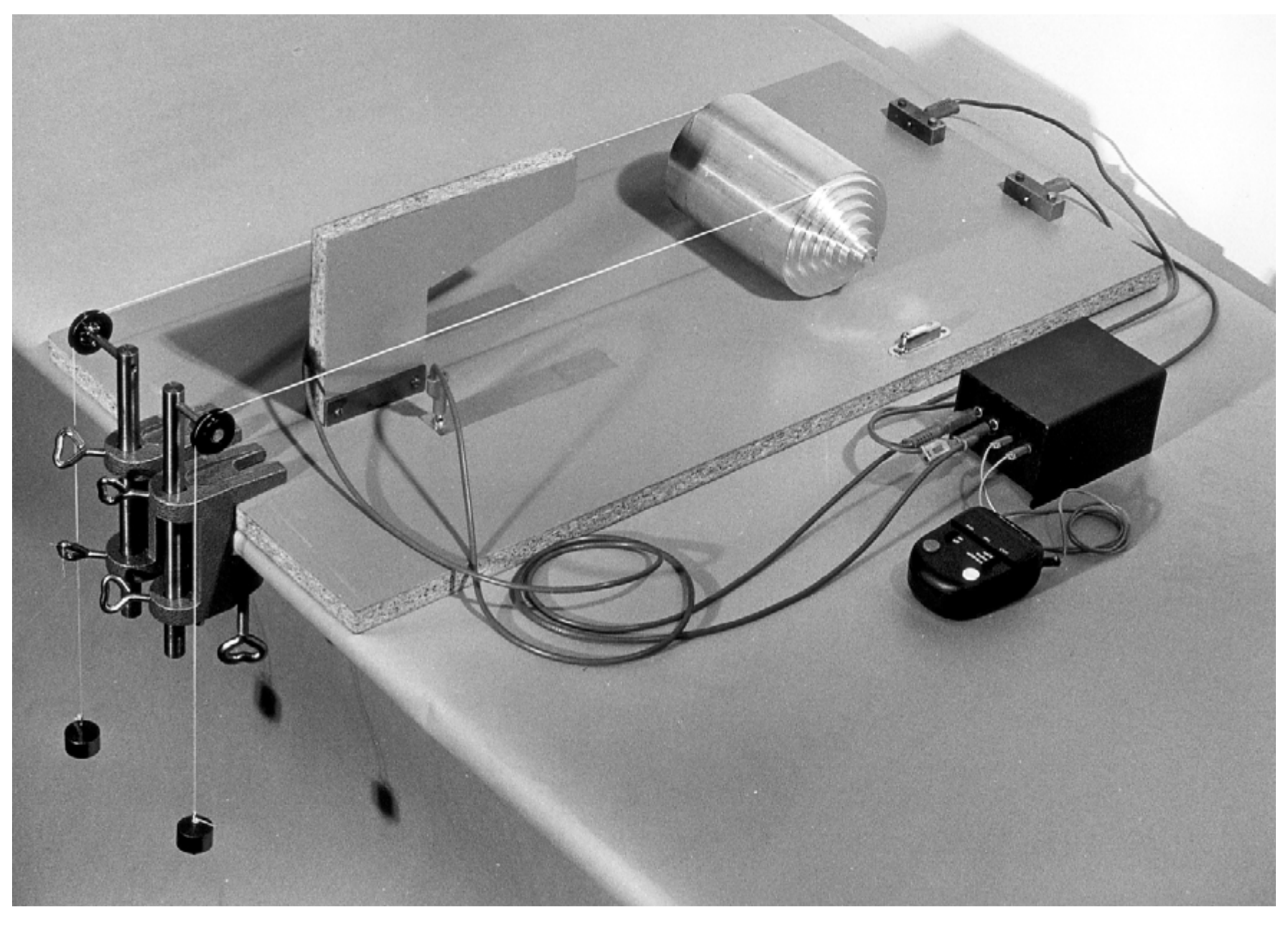
The rolling motion of a cylinder may be decomposed into rotation about its axis and horizontal translation of the center of gravity. In the present experiment only the translatory acceleration and the forces causing it are determined directly.
Given a cylinder of mass , radius , which is placed on a horizontal plane board. At a distance from the cylinder axis a force acts on it (see sketch). After letting the cylinder go, it rolls with constant acceleration.
a) Determine the linear accelerations of the cylinder axis experimentally for several distances .
b) From the accelerations and given quantities, compute the forces which act in horizontal direction between cylinder and plane board.
c) Plot the experimental values as functions of . Discuss the results.
Before starting the measurements, adjust the plane board horizontally. For present purposes it suffices to realize the horizontal position with an uncertainty of of height difference on 1 m of length; this corresponds to the distance between adjacent markings on the level. What would be the result of a not horizontal position of the plane board?
Describe the determination of auxiliary quantities and possible further adjustments; indicate the extent to which misadjustments would influence the results.
The following quantities are given:
,
,
,
,
,
Mass and friction of the pulleys c may be neglected in the evaluation of the data.
By means of knots, the strings are put into slots at the cylinder. They should be inserted as deeply as possible. You may use the attached paper clip to help in this job.
The stop watch should be connected, as shown in the sketch, with electrical contacts at A and B via an electronic circuit box. The stop watch starts running as soon as the contact at A is opened, and it stops when the contact at B is closed.
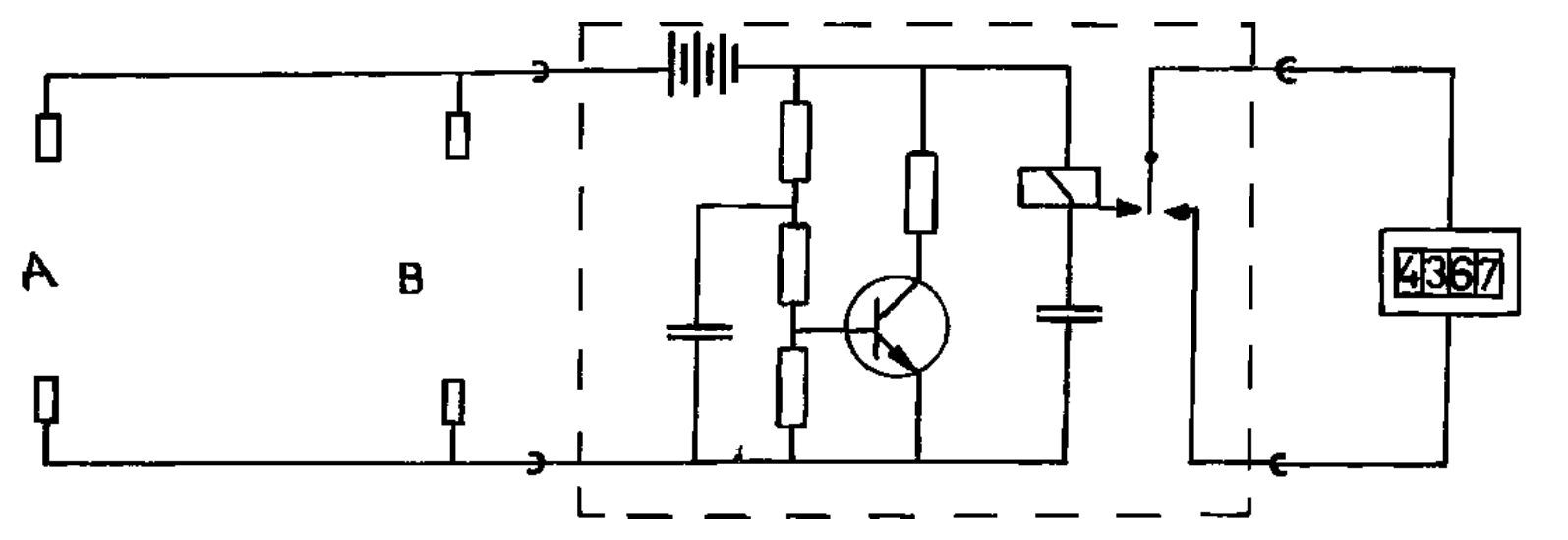
The purpose of the transistor circuit is to keep the relay position after closing of the contact at B, even if this contact is opened afterwards for a few milliseconds by a jump or chatter of the cylinder.
Решение
Theoretical considerations:
a) The acceleration of the center of mass of the cylinder is
b) Let be the acceleration of the masses and the sum of the tensions in the two strings, then
The acceleration of the center of mass of the cylinder is determined by the resultant force of the string-tension and the force of interaction between cylinder and the horizontal plane.
If the cylinder rotates through an angle the mass moves a distance .
It holds
From (2), (3) and (4) follows
c) From the experimental data we see that for small the forces and are in opposite direction and that they are in the same direction for large .
For small values of the torque produced by the string-tensions is not large enough to provide the angular acceleration required to prevent slipping. The interaction force between cylinder and plane acts into the direction opposite to the motion of the center of mass and thereby delivers an additional torque.
For large values of the torque produced by string-tension is too large and the interaction force has such a direction that an opposed torque is produced.
From the rotary-impulse theorem we find
where is the moment of inertia of the cylinder.
With (3) and (5) you may eliminate and from this equation. If the moment of inertia of the cylinder is taken as (neglecting the step-up cones) we find after some arithmetical transformations
For
For
Because it is approximately .
That means: the dependence of from is approximately linear. will be zero if .
Experimental results:
| r [cm] | t [s] | [s] | a [m/s²] | F [N] | ||
|---|---|---|---|---|---|---|
| 0.75 | 1.81 | 1.82 | 1.82 | 1.816 | 0.211 | 0.266 |
| 1.50 | 1.71 | 1.72 | 1.73 | 1.720 | 0.235 | 0.181 |
| 2.25 | 1.63 | 1.63 | 1.64 | 1.633 | 0.261 | 0.090 |
| 3.00 | 1.56 | 1.56 | 1.57 | 1.563 | 0.284 | 0.004 |
| 3.75 | 1.51 | 1.51 | 1.52 | 1.513 | 0.304 | - 0.066 |
| 4.50 | 1.46 | 1.46 | 1.46 | 1.456 | 0.328 | - 0.154 |
Grading schemes
| Problem 5: Motion of a rolling cylinder | pts. |
|---|---|
| Adjustment mentioned of strings a) horizontally and b) in direction of motion | 0.5 |
| Indication that angle offset of strings enters the formula for the acting force only quadratically, i.e. by its cosine | 0.5 |
| Explanation that with non-horizontal position, the force is to be replaced by | 1.0 |
| Determination of the running length according for formula including correct numerical result | 1.0 |
| Reliable data for rolling time | 1.0 |
| accompanied by reasonable error estimate | 0.5 |
| Numerical evaluation of the | 0.5 |
| Correct plot of | 0.5 |
| Qualitative interpretation of the result by intuitive consideration of the limiting cases and | 1.0 |
| Indication of a quantitative, theoretical interpretation using the concept of moment of inertia | 1.0 |
| Knowledge and application of the formula | 0.5 |
| Force equation for small mass and tension of the string | 1.0 |
| Connection of tension, acceleration of cylinder and reaction force | 1.0 |
| Connection between rotary and translatory motion | 0.5 |
| 0.5 | |
| Final formula for the reaction force | 1.0 |
| If final formulae are given correctly, the knowledge for preceding equations must be assumed and is graded accordingly. | |
| 12 |
Оригинал в Архива: ipho82.pdf