IPhO 1984, Теория и експеримент — Задача 4. Problem 1 (Experimental)
Problems of the XV International Physics Olympiad (Sigtuna, 1984)
Условие
You have at your disposal the following material:
(1) A sine wave voltage generator set to a frequency of 0,20 kHz.
(2) A dual ray oscilloscope.
(3) Millimeter graph paper.
(4) A diode.
(5) A capacitor of 0.10 μF (square and black).
(6) An unknown resistor (red).
(7) A coupling plate.
(8) Coupling wires.
Build the circuit shown in the figure.
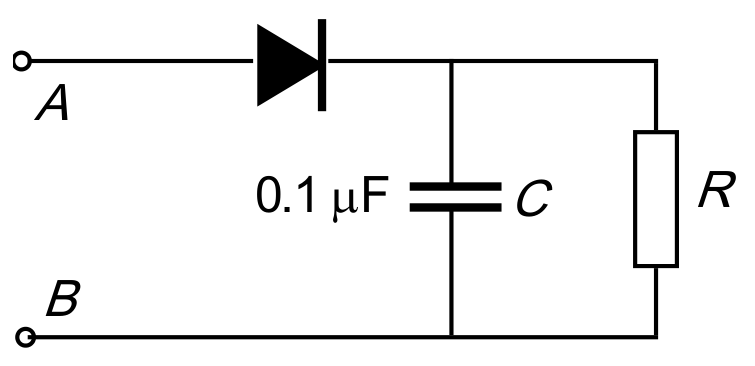
Connect the terminals and to the sine wave generator set to a frequency of 0.20 kHz. Determine experimentally the mean power developed in the resistor when the amplitude of the generator voltage is 2.0 V (that is the peak-to-peak voltage is 4.0 V).
Отговори
0.1 mW
Official solution: ⟨P⟩ ≈ 0.1 mW, with R = 7.2 kΩ.
Решение
The picture to the right shows the oscilloscope voltage over the resistor. The period of the sine wave is 5 ms and this gives the relation 1 horizontal division = 1.5 ms. The actual vertical scale was 0.85 V / division. The first rising part of the curve is a section of a sine wave, the second falling part is an exponential decay determined by the time constant of the resistor and capacitor. Reading from the display the "half-life" turns out to be 0.5 ms. This gives = 7.2 kΩ. The mean power developed in the resistor is
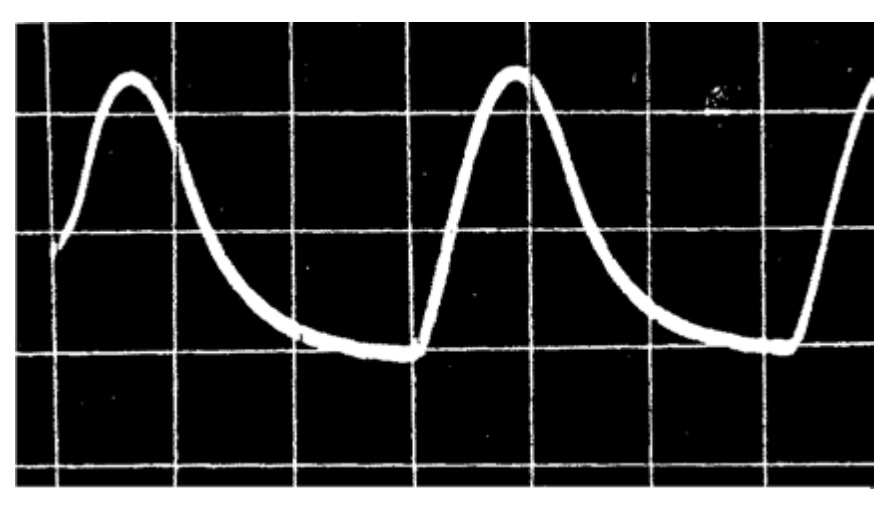
Numerical integration (counting squares) gives
from which 0.1 mW.
Оригинал в Архива: ipho84.pdf