IPhO 1984, Теория и експеримент — Задача 3. Problem 3
Problems of the XV International Physics Olympiad (Sigtuna, 1984)
Условие
An electronic frequency filter consists of four components coupled as in the upper figure. The impedance of the source can be neglected and the impedance of the load can be taken as infinite. The filter should be such that the voltage ratio has a frequency dependence shown in the lower where is the input voltage and is the output voltage. At frequency the phase lag between the two voltages is zero.
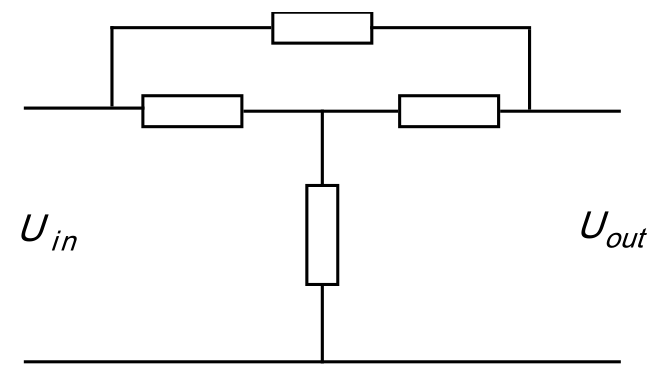
In order to build the filter you can choose from the following components:
2 resistors, 10 kΩ
2 capacitors, 10 nF
2 solenoids, 160 mH (iron-free and with negligible resistance)
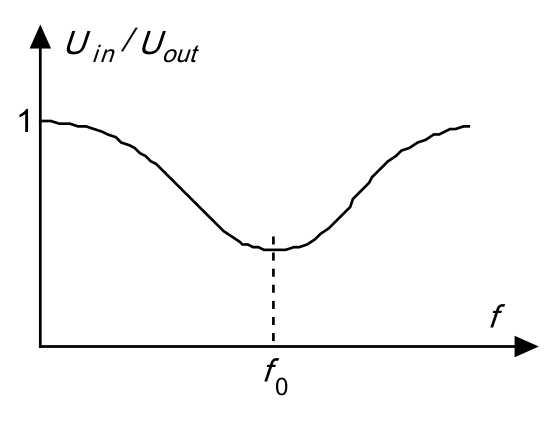
Construct, by combining four of these components, a filter that fulfils the stated conditions. Determine the frequency and the ratio at this frequency for as many component combinations as possible.
Отговори
f0 = 1/(2πRC) with Uout/Uin = 2/3 (also with resistors and capacitors switched); f0 = R/(2πL) with solenoids instead of capacitors
From the official solution, which also mentions eight further unsymmetric solutions.
Решение
The conditions at very high and very low frequencies can be satisfied with for example the following circuit
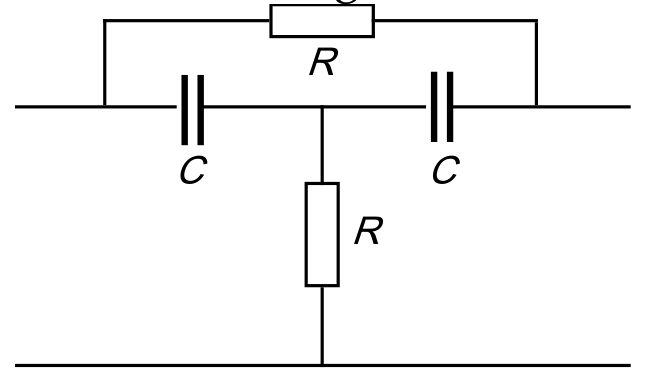
Using either the graphic vector method or the analytic jω method we can show that the minimum occurs for a frequency when the ratio between the output and input voltages is 2/3. Switching the resistors and the capacitors gives a new circuit with the same frequency . Another two possibilities is to exchange the capacitors for solenoids where we get .
There are further eight solutions with unsymmetric patterns of the electronic components.
Оригинал в Архива: ipho84.pdf