IPhO 1986, Теория — Задача 1. Q1
IPhO 1986 — Theory
Условие
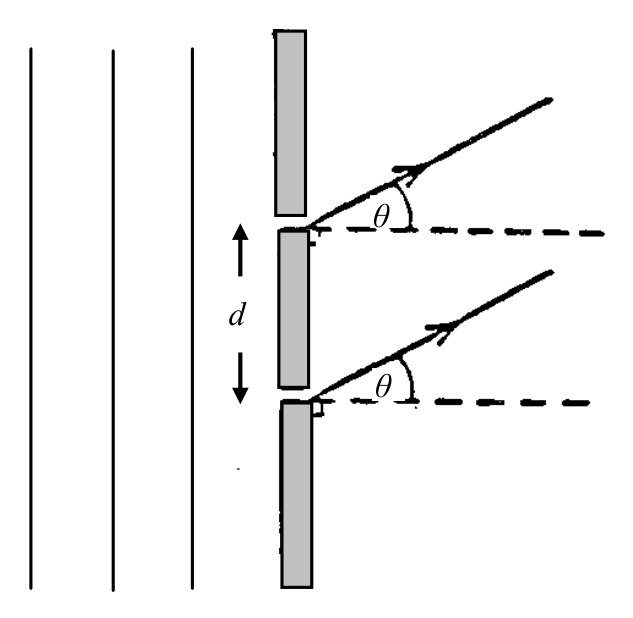
A plane monochromatic light wave, wavelength and frequency , is incident normally on two identical narrow slits, separated by a distance , as indicated in Figure 1.1. The light wave emerging at each slit is given, at a distance in a direction at time , by
where the amplitude is the same for both waves. (Assume is much larger than ).
(i) Show that the two waves observed at an angle to a normal to the slits, have a resultant amplitude A which can be obtained by adding two vectors, each having magnitude , and each with an associated direction determined by the phase of the light wave.
Verify geometrically, from the vector diagram, that
where
(ii) The double slit is replaced by a diffraction grating with equally spaced slits, adjacent slits being separated by a distance . Use the vector method of adding amplitudes to show that the vector amplitudes, each of magnitude , form a part of a regular polygon with vertices on a circle of radius given by
Deduce that the resultant amplitude is
and obtain the resultant phase difference relative to that of the light from the slit at the edge of the grating.
(iii) Sketch, in the same graph, sin and (1/sin) as a function of . On a separate graph show how the intensity of the resultant wave varies as a function of .
(iv) Determine the intensities of the principal intensity maxima.
(v) Show that the number of principal maxima cannot exceed
(vi) Show that two wavelengths and , where , produce principal maxima with an angular separation given by
Calculate this angular separation for the sodium D lines for which
Отговори
(vi) 0.0052 rad
Official solution: Δθ = 5.2×10⁻³ rads or 0.30°.
Решение
Answers Question 1
(i) Vector Diagram
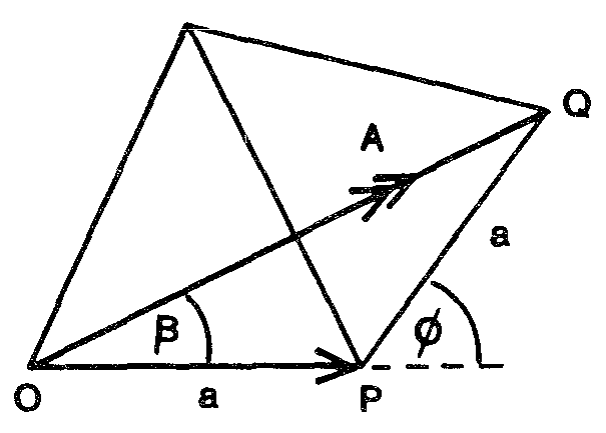
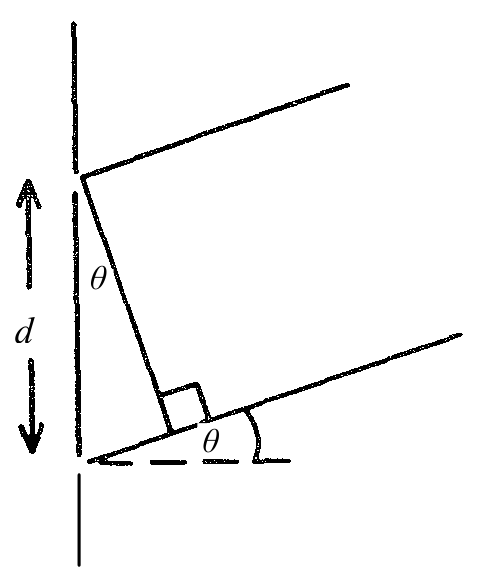
If the phase of the light from the first slit is zero, the phase from second slit is
Adding the two waves with phase difference where ,
This is a wave of amplitude and phase . From vector diagram, in isosceles triangle OPQ,
and
Thus the sum of the two waves can be obtained by the addition of two vectors of amplitude a and angular directions 0 and .
(ii) Each slit in diffraction grating produces a wave of amplitude a with phase relative to previous slit wave. The vector diagram consists of a 'regular' polygon with sides of constant length and with constant angles between adjacent sides.
Let O be the centre of circumscribing circle passing through the vertices of the polygon. Then radial lines such as OS have length R and bisect the internal angles of the polygon. Figure 1.2.
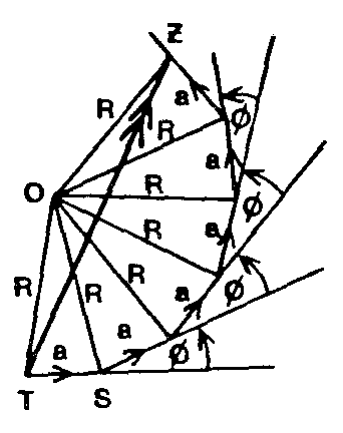
In the triangle , for example
As the polygon has faces then:
Therefore in isosceles triangle TOZ, the amplitude of the resultant wave, TZ, is given by
Hence form (1) this amplitude is
Resultant phase is
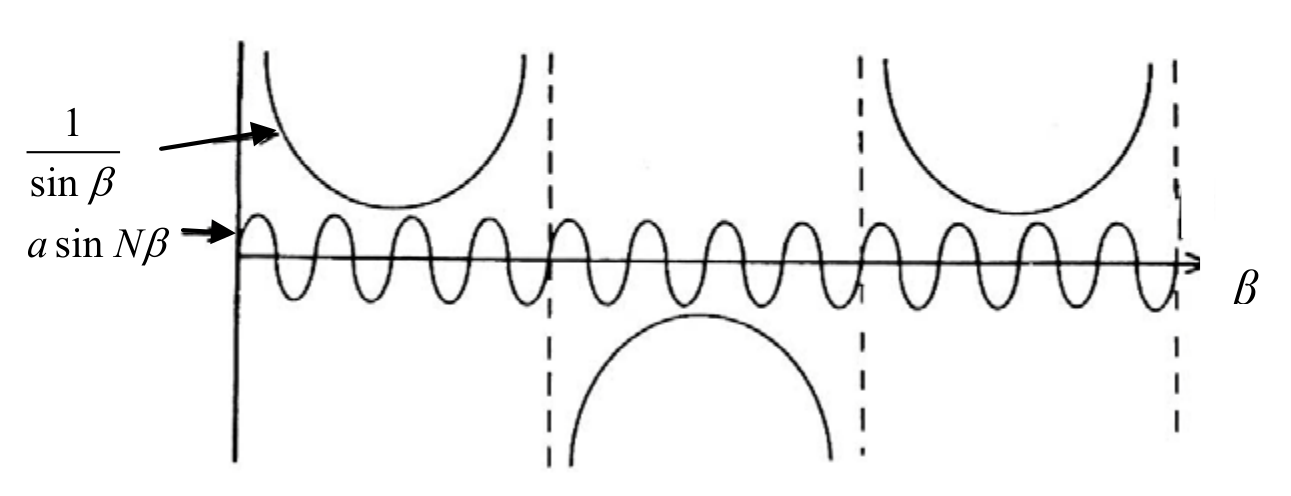
(iii)
Intensity
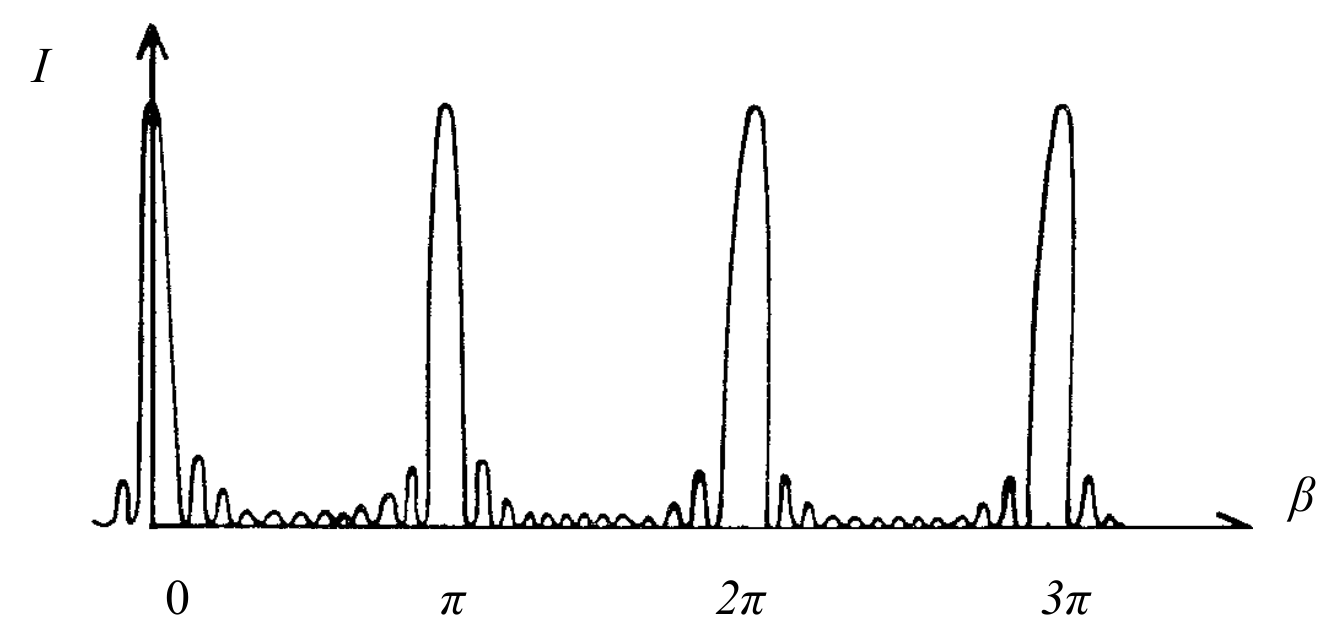
(iv) For the principle maxima where
(v) Adjacent max. estimate :
does not give a maximum as can be observed from the graph.
Adjacent zero intensity occurs for i.e.
For phase differences much greater than , .
(vi)
Differentiating w.r.t,
Substituting , . n = 2 and .
Оригинал в Архива: th.pdf · официални решения: th_sol.pdf