IPhO 1986, Теория — Задача 2. Q2
IPhO 1986 — Theory
Условие
International Physics Olympiad 1956
- Early this century a model of the earth was proposed in which it was assumed to be a sphere of radius consisting of a homogeneous isotropic solid mantle down to radius . The core region within radius contained a liquid. Figure 2.1
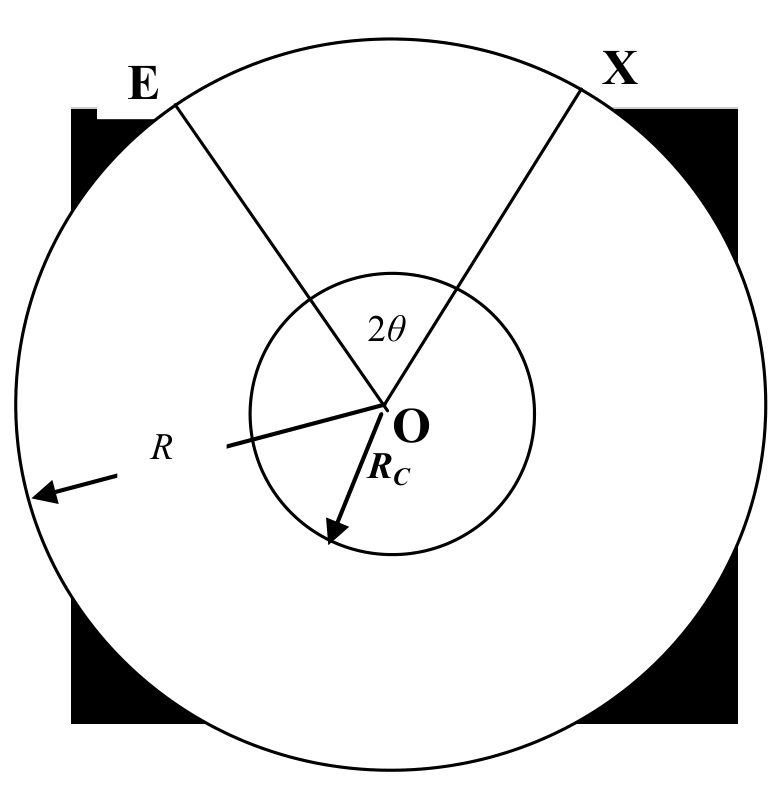
The velocities of longitudinal and transverse seismic waves P and S waves respectively, are constant, , and within the mantle. In the core, longitudinal waves have a constant velocity , , and transverse waves are not propagated.
An earthquake at E on the surface of the Earth produces seismic waves that travel through the Earth and are observed by a surface observer who can set up his seismometer at any point X on the Earth’s surface. The angular separation between E and X, given by
where O is the centre of the Earth.
(i) Show that the seismic waves that travel through the mantle in a straight line will arrive at X at a time t (the travel time after the earthquake), is given by
where for the P waves and for the S waves.
(ii) For some of the positions of X such that the seismic P waves arrive at the observer after two refractions at the mantle-core interface. Draw the path of such a seismic P wave. Obtain a relation between and , the angle of incidence of the seismic P wave at the mantle-core interface, for P waves.
(iii) Using the data
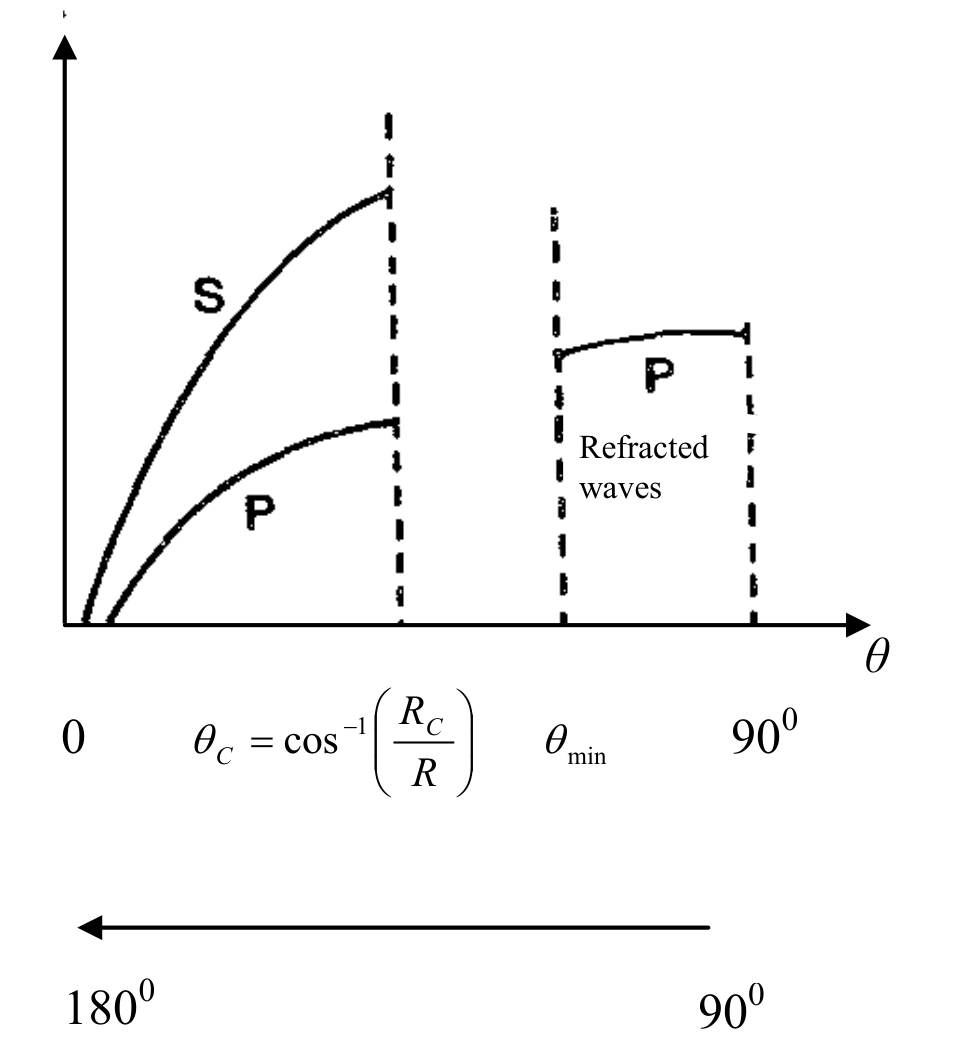
and the result obtained in (ii),draw a graph of against . Comment on the physical consequences of the form of this graph for observers stationed at different points on the Earth's surface.
Sketch the variation of the travel time taken by the P and S waves as a function of for degrees.
(iv) After an earthquake an observer measures the time delay between the arrival of the S wave, following the P wave, as 2 minutes 11 seconds. Deduce the angular separation of the earthquake from the observer using the data given in Section (iii).
(v) The observer in the previous measurement notices that some time after the arrival of the P and S waves there are two further recordings on the seismometer separated by a time interval of 6 minutes 37 seconds. Explain this result and verify that it is indeed associated with the angular separation determined in the previous section.
Отговори
(iii) 75.8 °
Official solution: the minimum of θ is θMIN = 75.8°, reached at i = 55°.
(iv) 17.84 °
Official solution: 2θ = 17.84°.
Решение
Answers Q2
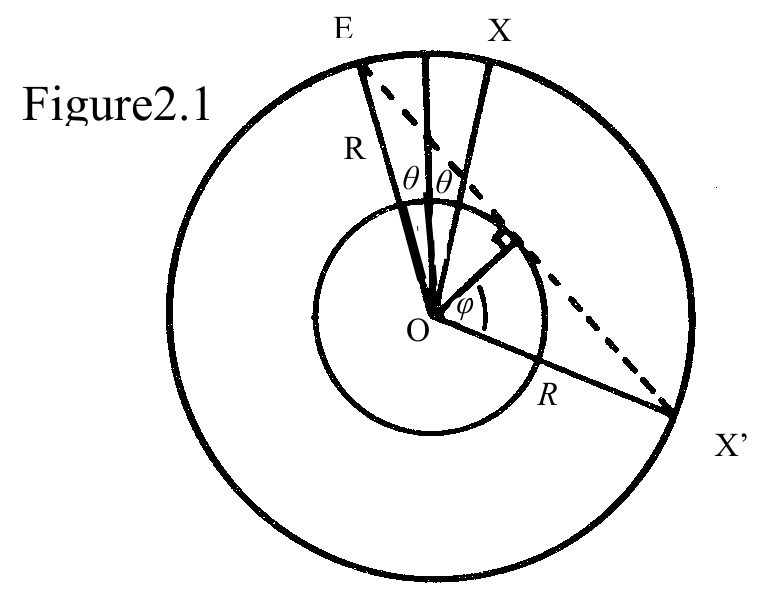
2.(i)
where for P waves and for S waves.
This is valid providing X is at an angular separation less than or equal to X', the tangential ray to the liquid core. X' has an angular separation given by, from the diagram,
Thus
where for P waves and for shear waves.
(ii) and
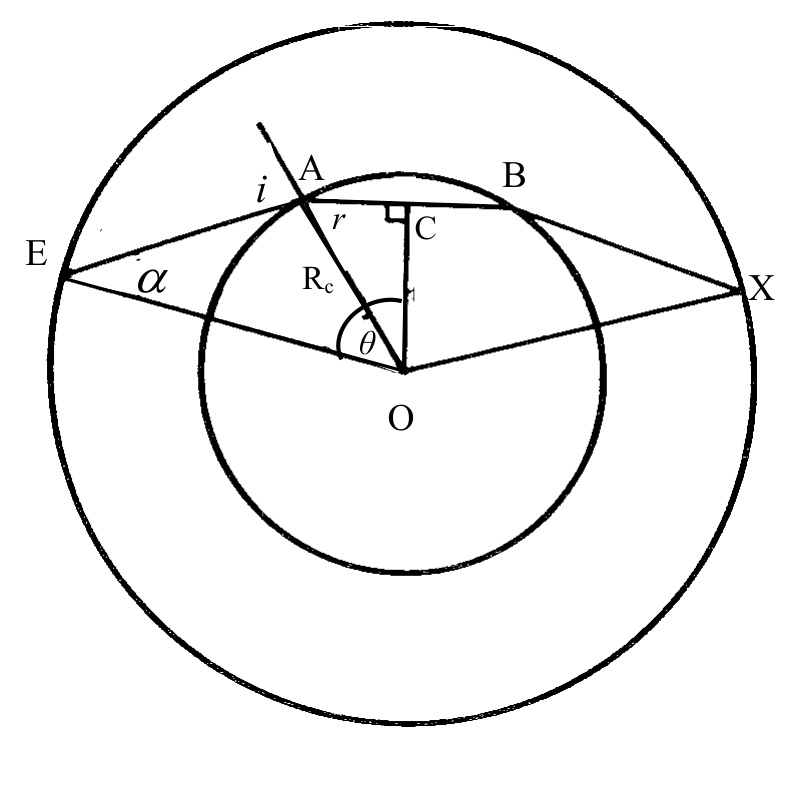
From Figure 2.2
(ii) Continued
Snell’s Law gives:
From the triangle EAO, sine rule gives
Substituting (2) and (3) into (1)
(iii)
For Information OnlyFor minimum .
Substituting gives LHS=0, this verifying the minimum occurs at this value of . Substituting into (4) gives .
Plot of against .
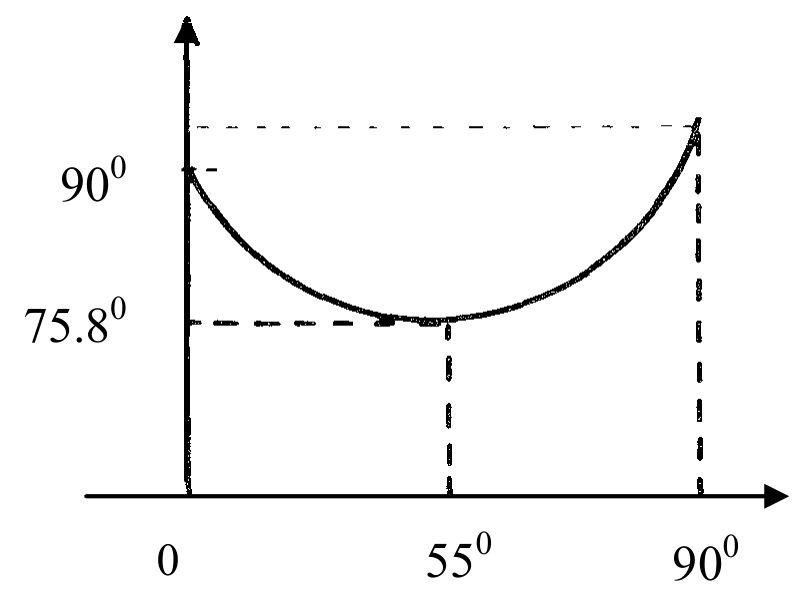
Substituting into 4:
gives
gives
Substituting numerical values for one finds a minimum value at ; the minimum values of 0, .
Physical ConsequenceAs has a minimum value of observers at position for which will not observe the earthquake as seismic waves are not deviated by angles of less than . However for the direct, non-refracted, seismic waves will reach the observer.
(iv) Using the result
the time delay is given by
Substituting the given data
Therefore the angular separation of E and X is
This result is less than
And consequently the seismic wave is not refracted through the core.
(v)
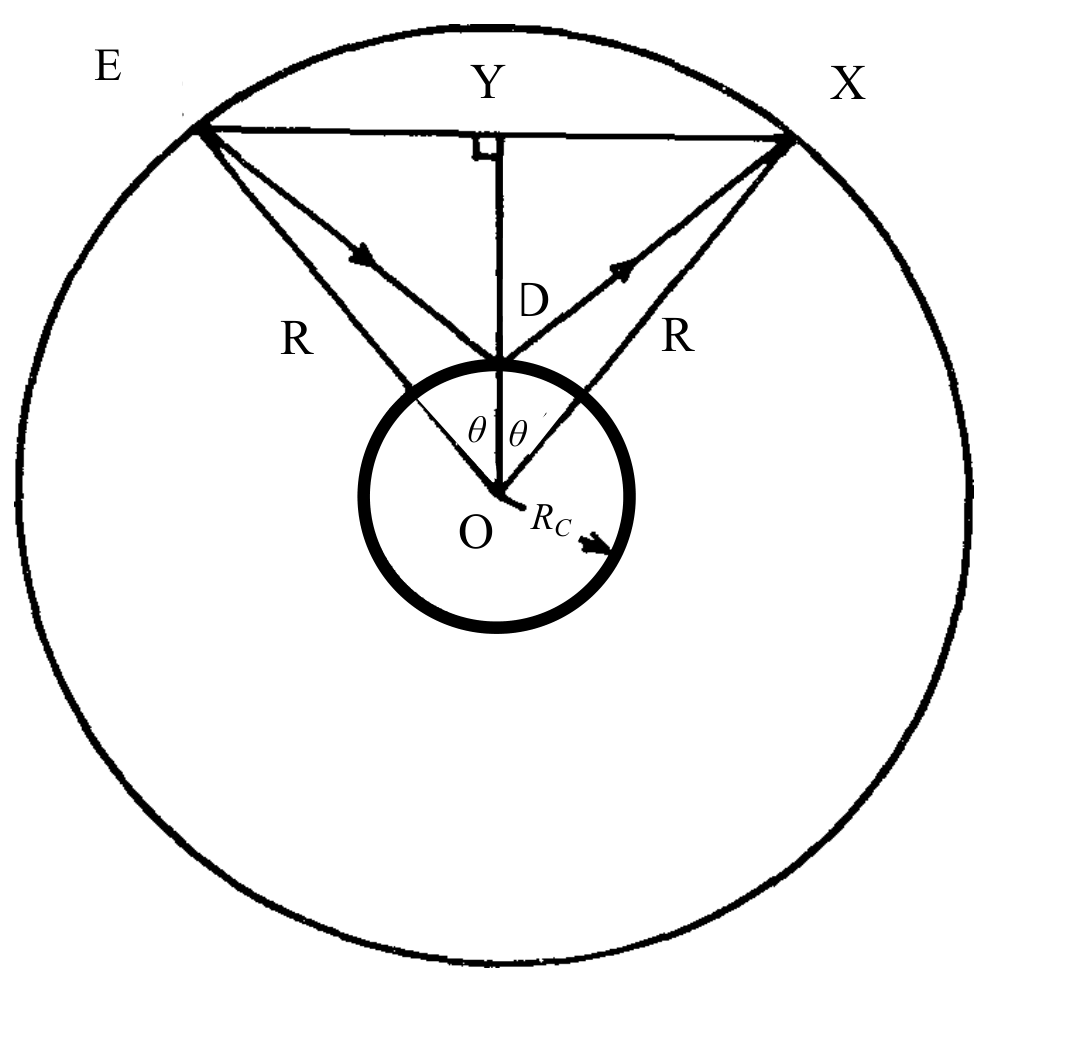
The observations are most likely due to reflections from the mantle-core interface. Using the symbols given in the diagram, the time delay is given by
In the triangle EYD,
Therefore
Using (ii)
Thus the subsequent time interval, produced by the reflection of seismic waves at the mantle core interface, is consistent with angular separation of .
Оригинал в Архива: th.pdf · официални решения: th_sol.pdf