IPhO 1986, Теория — Задача 3. Q3
IPhO 1986 — Theory
Условие
Three particles, each of mass , are in equilibrium and joined by unstretched massless springs, each with Hooke’s Law spring constant . They are constrained to move in a circular path as indicated in Figure 3.1.
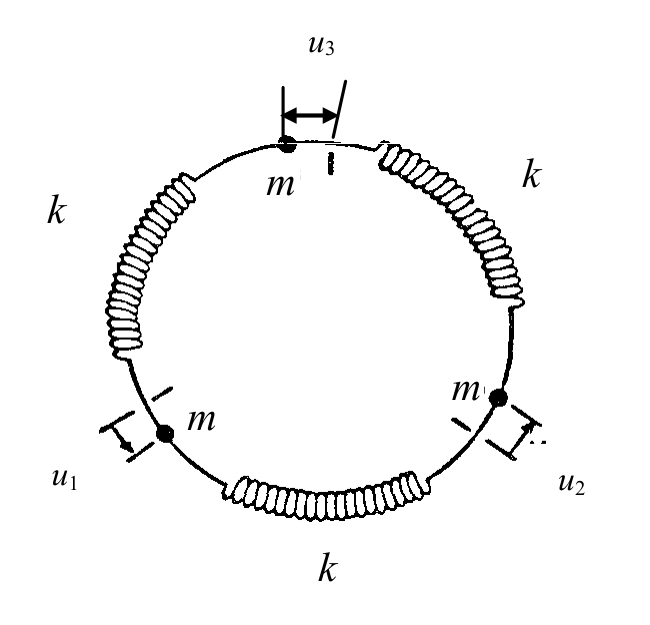
(i) If each mass is displaced from equilibrium by small displacements , and respectively, write down the equation of motion for each mass.
(ii) Verify that the system has simple harmonic solutions of the form
with accelerations, where are constant amplitudes, and , the angular frequency, can have 3 possible values,
(iii) The system of alternate springs and masses is extended to particles, each mass is joined by springs to its neighbouring masses. Initially the springs are unstretched and in equilibrium. Write down the equation of motion of the th mass ( = 1,2...) in terms of its displacement and those of the adjacent masses when the particles are displaced from equilibrium.
are oscillatory solutions where = 1, 2,... , = 1, 2, ... and where is an arbitrary phase, providing the angular frequencies are given by
where are constant amplitudes independent of .
State the range of possible frequencies for a chain containing an infinite number of masses.
(iv) Determine the ratio
for large , in the two cases:
(a) low frequency solutions
(b) , where is the maximum frequency solution.
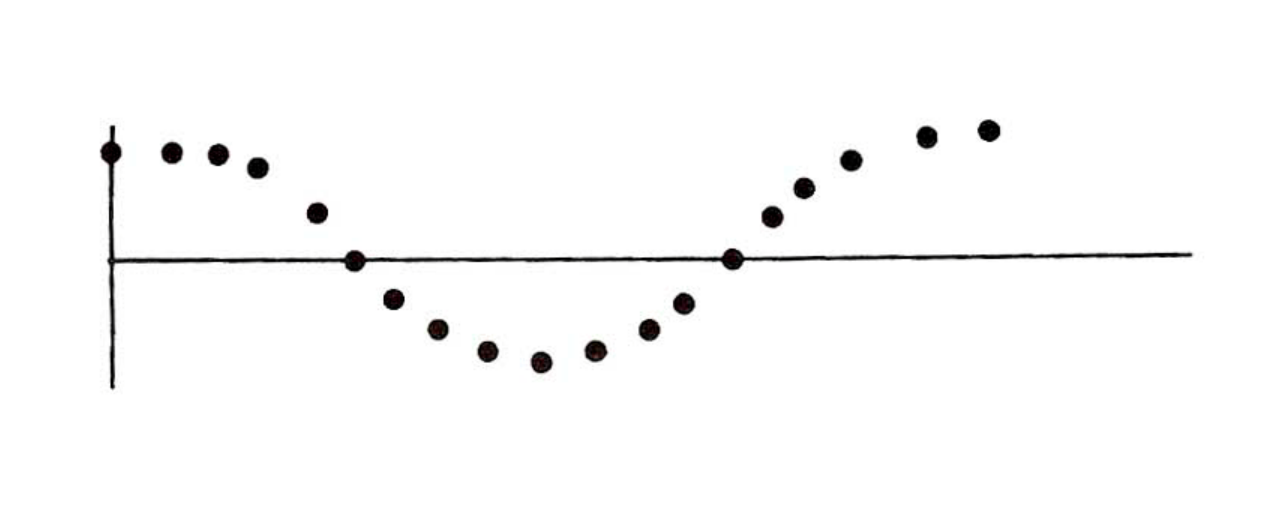
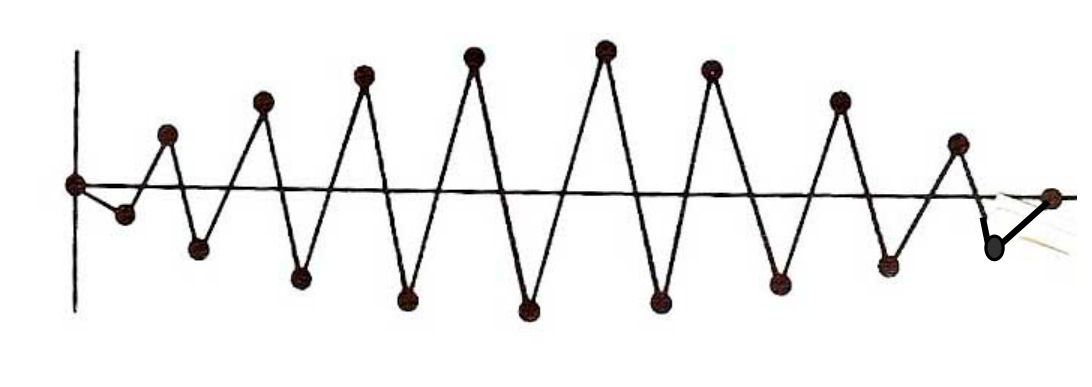
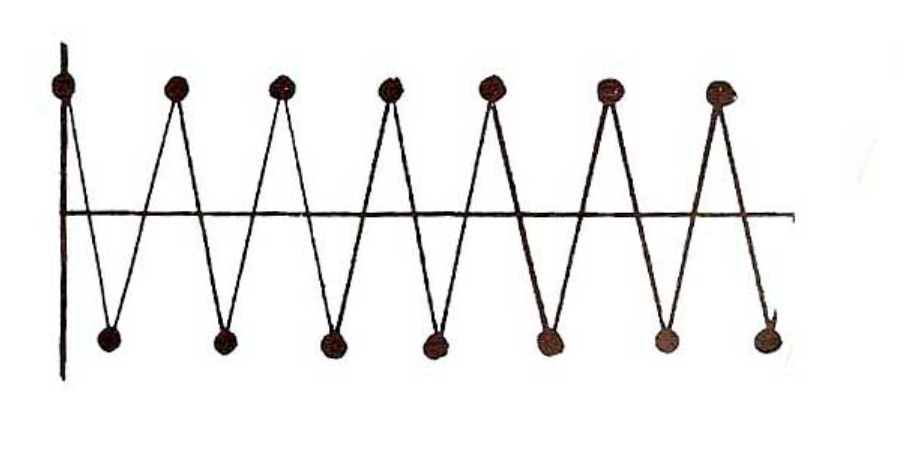
Sketch typical graphs indicating the displacements of the particles against particle number along the chain at time for cases (a) and (b).
(v) If one of the masses is replaced by a mass estimate any major change one would expect to occur to the angular frequency distribution.
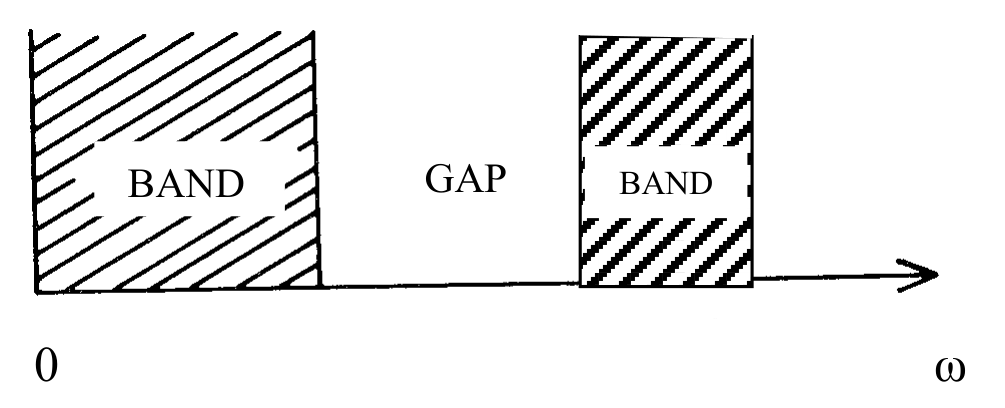
Describe qualitatively the form of the frequency spectrum one would predict for a diatomic chain with alternate masses and on the basis of the previous result.
Reminder
Решение
Answer Q3
Equations of motion:
Substituting and :
Solving for and in terms of using (a) and (b) and substituting into (c) gives the equation equivalent to
(ii) Equation of motion of the n’th particle:
Substituting
As
This gives
can have values from 0 to when ; corresponding to range to .
(iv) For s’th mode
(a) For small , , thus and , and so .
(b) The highest mode, , corresponds to
Case (a)
Case (b)
N odd
N even
(vi) If , one can consider the frequency associated with as due to vibration of between two adjacent, much heavier, masses which can be considered stationary relative to .
The normal mode frequency of , in this approximation, is given by
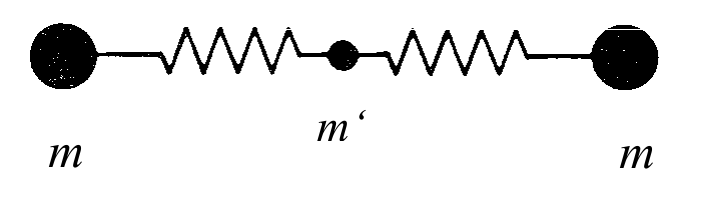
For small , will be much greater than ,
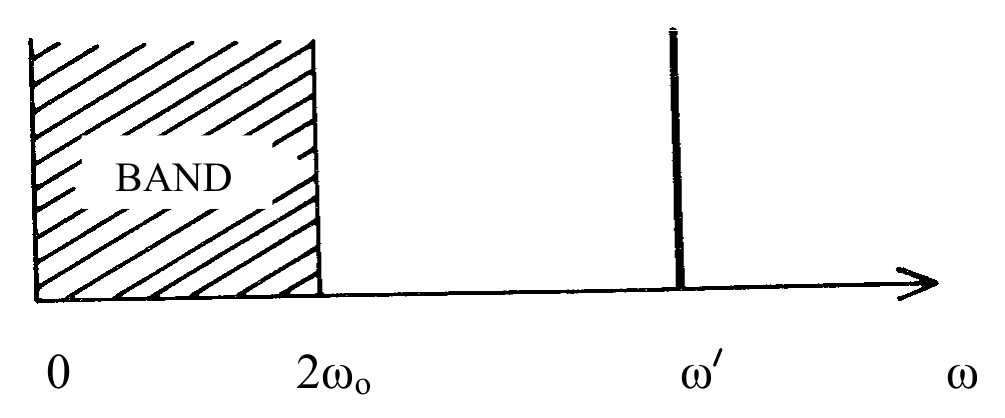
More light masses, , will increase the number of frequencies in region of giving a band-gap-band spectrum.
Оригинал в Архива: th.pdf · официални решения: th_sol.pdf