IPhO 1987, Теория и експеримент — Задача 1. Ascending moist air
Problems of the 18th International Physics Olympiad (Jena, 1987) · 10 т.
Внимание: Бележка към темата
Several hand-made figures are missing from the source file (blank space is left in their place): the diagram of the focussing points referred to in problem 2, the LC-grid circuit of problem 3, and several solution figures (toroid coordinates, LC-grid unit, the prism set-ups of problem 4).
Увод
Gunnar Friege & Gunter Lind
Leibniz-Institute for Science Education (IPN) at the University of Kiel, Germany
Abstract
The 18th International Physics Olympiad took place in 1987 in the German Democratic Republic (GDR). This article contains the competition problems, their solutions and also a (rough) grading scheme.
Introduction
The 18th international Physics olympics in 1987 was the second International Physics Olympiad hosted by the German Democratic Republic (GDR) . The organisation was lead by the ministry for education and the problems were formulated by a group of professors of different universities. However, the main part of the work was done by the physics department of the university of Jena. The company Carl-Zeiss and a special scientific school in Jena were involved also.
In the competition three theoretical and one experimental problem had to be solved. The theoretical part was quite difficult. Only the first of the three problems (“ascending moist air”) had a medium level of difficulty. The points given in the markings were equal distributed. Therefore, there were lots of good but also lots of unsatisfying solutions. The other two theoretical problems were rather difficult. About half of the pupils even did not find an adequate start in solving these problems. The third problem (“infinite LC-grid") revealed quite a few complete solutions. The high level of difficulty can probably be explained with the fact that many pupils nearly had no experience with the subject. Concerning the second problem (“electrons in a magnetic field”) only a few pupils worked on the last part 3 (see below).
The experimental problem (“refracting indices”) was much more easier than the theoretical problems. There were lots of different possibilities of solution and most of the pupils managed to come up with partial or complete solutions. Over the half of all teams got more points in the experimental part than in the theoretical part of the competition.
The problems and their solutions are based on the original German and English versions of the competition problems. Only minor changes have been made. Despite the fact that nowadays almost all printed figures are generated with the aid of special computer programmes, the original hand-made figures are published here.
Contact: Leibniz-Institute for Science Education (IPN) at the University of Kiel
Olshausenstrasse 62, 24098 Kiel, Germany
ipho@ipn.uni-kiel.de
Условие
Moist air is streaming adiabatically across a mountain range as indicated in the figure.
Equal atmospheric pressures of 100 kPa are measured at meteorological stations and and a pressure of 70 kPa at station . The temperature of the air at is 20° C.
As the air is ascending, cloud formation sets in at 84.5 kPa.
Consider a quantity of moist air ascending the mountain with a mass of 2000 kg over each square meter. This moist air reaches the mountain ridge (station ) after 1500 seconds. During that rise an amount of 2.45 g of water per kilogram of air is precipitated as rain.
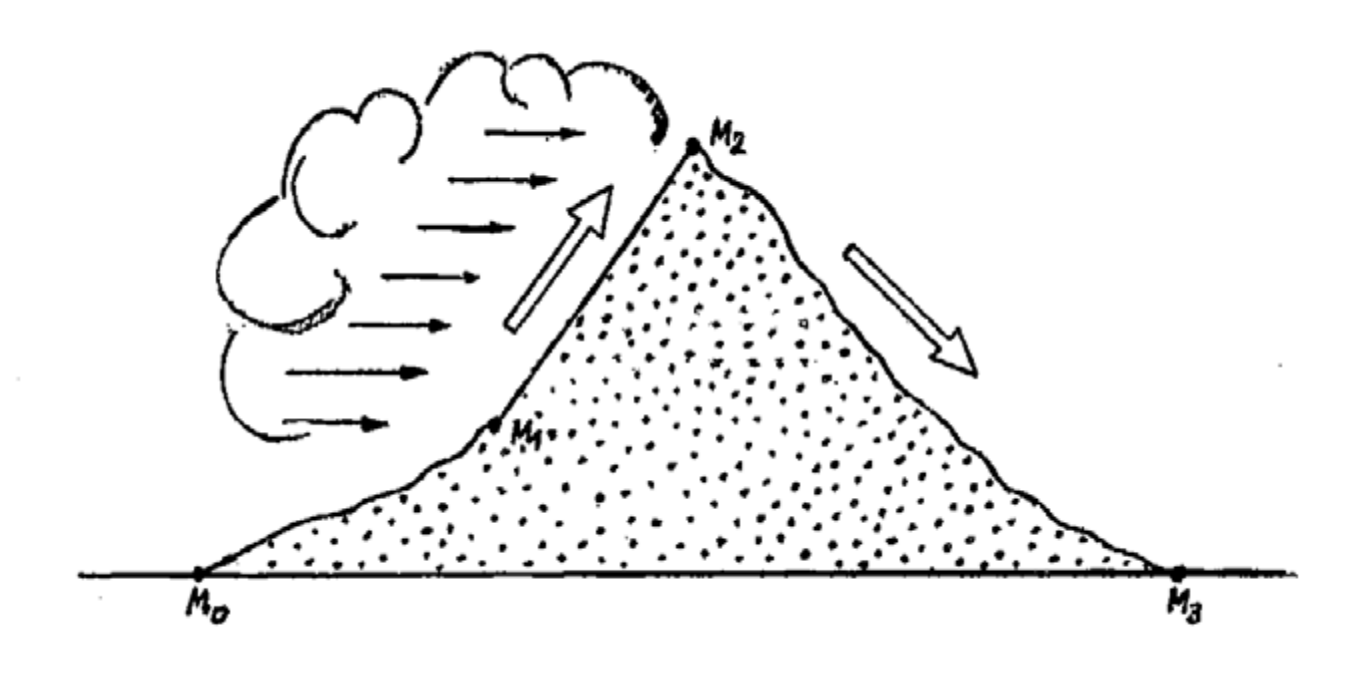
1. Determine temperature at where the cloud ceiling forms. [2 т.]
2. What is the height (at ) above station of the cloud ceiling assuming a linear decrease of atmospheric density? [2 т.]
3. What temperature is measured at the ridge of the mountain range? [2 т.]
4. Determine the height of the water column (precipitation level) precipitated by the air stream in 3 hours, assuming a homogeneous rainfall between points and . [2 т.]
5. What temperature is measured in the back of the mountain range at station ? Discuss the state of the atmosphere at station in comparison with that at station . [2 т.]
Hints and Data
The atmosphere is to be dealt with as an ideal gas. Influences of the water vapour on the specific heat capacity and the atmospheric density are to be neglected; the same applies to the temperature dependence of the specific latent heat of vaporisation. The temperatures are to be determined to an accuracy of 1 K, the height of the cloud ceiling to an accuracy of 10 m and the precipitation level to an accuracy of 1 mm.
Specific heat capacity of the atmosphere in the pertaining temperature range:
Atmospheric density for and at station :
Specific latent heat of vaporisation of the water within the volume of the cloud:
and
Отговори
1. 279 K
2. 1410 m
3. 271 K
4. 35 mm
5. 300 K
The air at M3 has become warmer and dryer than at M0.
Решение
- Temperature where the cloud ceiling forms
- Height of the cloud ceiling:
- Temperature at the ridge of the mountain.
The temperature difference when the air is ascending from the cloud ceiling to the mountain ridge is caused by two processes:
– adiabatic cooling to temperature ,
– heating by by condensation.
For each kg of air the heat produced by condensation is .
- Height of precipitated water column
- Temperature behind the mountain
The air has become warmer and dryer. The temperature gain is caused by condensation of vapour.
Grading Scheme
Theoretical problems
| Problem 1: Ascending moist art | |
|---|---|
| part 1 | 2 |
| part 2 | 2 |
| part 3 | 2 |
| part 4 | 2 |
| part 5 | 2 |
| 10 |
Оригинал в Архива: ipho87.pdf