IPhO 1987, Теория и експеримент — Задача 2. Electrons in a magnetic field
Problems of the 18th International Physics Olympiad (Jena, 1987) · 10 т.
Внимание: Бележка към темата
Several hand-made figures are missing from the source file (blank space is left in their place): the diagram of the focussing points referred to in problem 2, the LC-grid circuit of problem 3, and several solution figures (toroid coordinates, LC-grid unit, the prism set-ups of problem 4).
Увод
Gunnar Friege & Gunter Lind
Leibniz-Institute for Science Education (IPN) at the University of Kiel, Germany
Abstract
The 18th International Physics Olympiad took place in 1987 in the German Democratic Republic (GDR). This article contains the competition problems, their solutions and also a (rough) grading scheme.
Introduction
The 18th international Physics olympics in 1987 was the second International Physics Olympiad hosted by the German Democratic Republic (GDR) . The organisation was lead by the ministry for education and the problems were formulated by a group of professors of different universities. However, the main part of the work was done by the physics department of the university of Jena. The company Carl-Zeiss and a special scientific school in Jena were involved also.
In the competition three theoretical and one experimental problem had to be solved. The theoretical part was quite difficult. Only the first of the three problems (“ascending moist air”) had a medium level of difficulty. The points given in the markings were equal distributed. Therefore, there were lots of good but also lots of unsatisfying solutions. The other two theoretical problems were rather difficult. About half of the pupils even did not find an adequate start in solving these problems. The third problem (“infinite LC-grid") revealed quite a few complete solutions. The high level of difficulty can probably be explained with the fact that many pupils nearly had no experience with the subject. Concerning the second problem (“electrons in a magnetic field”) only a few pupils worked on the last part 3 (see below).
The experimental problem (“refracting indices”) was much more easier than the theoretical problems. There were lots of different possibilities of solution and most of the pupils managed to come up with partial or complete solutions. Over the half of all teams got more points in the experimental part than in the theoretical part of the competition.
The problems and their solutions are based on the original German and English versions of the competition problems. Only minor changes have been made. Despite the fact that nowadays almost all printed figures are generated with the aid of special computer programmes, the original hand-made figures are published here.
Contact: Leibniz-Institute for Science Education (IPN) at the University of Kiel
Olshausenstrasse 62, 24098 Kiel, Germany
ipho@ipn.uni-kiel.de
Условие
A beam of electrons emitted by a point source P enters the magnetic field of a toroidal coil (toroid) in the direction of the lines of force. The angle of the aperture of the beam is assumed to be small (). The injection of the electrons occurs on the mean radius R of the toroid with acceleration voltage .
Neglect any interaction between the electrons. The magnitude of , B, is assumed to be constant.
1. To guide the electron in the toroidal field a homogeneous magnetic deflection field is required. Calculate for an electron moving on a circular orbit of radius R in the torus. [3 т.]
2. Determine the value of which gives four focussing points separated by as indicated in the diagram.
Note: When considering the electron paths you may disregard the curvature of the magnetic field. [1 т.]
3. The electron beam cannot stay in the toroid without a deflection field , but will leave it with a systematic motion (drift) perpendicular to the plane of the toroid.
a) Show that the radial deviation of the electrons from the injection radius is finite.
b) Determine the direction of the drift velocity.
Note: The angle of aperture of the electron beam can be neglected. Use the laws of conservation of energy and of angular momentum. [6 т.]
Data:
Отговори
1. 0.0037 T
Printed in the solution (its part 2) as B1 = 0.37·10⁻² Vs/m².
2. 0.0148 T
Printed in the solution (its part 1) as B = 1.48·10⁻² Vs/m².
3. The radial deviation is finite (R ≤ r ≤ r1); the drift is in the direction of the negative z-axis.
Решение
- Determination of B:
The vector of the velocity of any electron is divided into components parallel with and perpendicular to the magnetic field :
The Lorentz force influences only the perpendicular component, it acts as a radial force:
Hence the radius of the circular path that has been travelled is
and the period of rotation which is independent of is
The parallel component of the velocity does not vary. Because of it is approximately equal for all electrons:
Hence the distance b between the focusing points, using eq. (5), is
From the law of conservation of energy follows the relation between the acceleration voltage and the velocity :
Using eq. (7) and eq. (4) one obtains from eq. (6)
and because of one obtains
- Determination of :
Analogous to eq. (2)
must hold.
From eq. (7) follows
- Finiteness of and direction of the drift velocity
In the magnetic field the lines of force are circles with their centres on the symmetry axis (z-axis) of the toroid.
In accordance with the symmetry of the problem, polar coordinates r and are introduced into the plane perpendicular to the z-axis (see figure below) and the occurring vector quantities (velocity, magnetic field , Lorentz force) are divided into the corresponding components.
Since the angle of aperture of the beam can be neglected examine a single electron injected tangentially into the toroid with velocity on radius R.
In a static magnetic field the kinetic energy is conserved, thus
The radial points of inversion of the electron are defined by the condition
Using eq. (12) one obtains
Such an inversion point is obviously given by
To find further inversion points and thus the maximum radial deviation of the electron the components of velocity and in eq. (13) have to be expressed by the radius.
will be determined by the law of conservation of angular momentum. The Lorentz force obviously has no component in the - direction (parallel to the magnetic field). Therefore it cannot produce a torque around the z-axis. From this follows that the z-component of the angular momentum is a constant, i.e. and therefore
will be determined from the equation of motion in the z-direction. The z-component of the Lorentz force is . Thus the acceleration in the z-direction is
That means, since B is assumed to be constant, a change of is related to a change of r as follows:
Because of and one finds
Using eq. (14) and eq. (15) one obtains for eq. (13)
where
Discussion of the curve of the right side of eq. (17) gives the qualitative result shown in the following diagram:
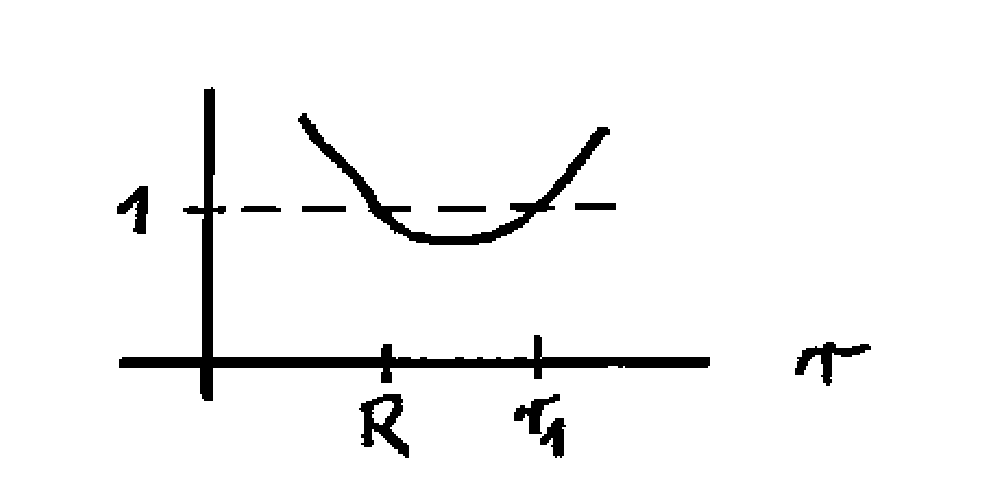
Hence is finite. Since eq. (16) yields . Hence the drift is in the direction of the negative z-axis.
Grading Scheme
| Problem 2: Electron in a magnetic field | |
|---|---|
| part 1 | 3 |
| part 2 | 1 |
| part 3 | 6 |
| 10 |
Оригинал в Архива: ipho87.pdf