IPhO 1987, Теория и експеримент — Задача 3. Infinite LC-grid
Problems of the 18th International Physics Olympiad (Jena, 1987) · 10 т.
Внимание: Бележка към темата
Several hand-made figures are missing from the source file (blank space is left in their place): the diagram of the focussing points referred to in problem 2, the LC-grid circuit of problem 3, and several solution figures (toroid coordinates, LC-grid unit, the prism set-ups of problem 4).
Увод
Gunnar Friege & Gunter Lind
Leibniz-Institute for Science Education (IPN) at the University of Kiel, Germany
Abstract
The 18th International Physics Olympiad took place in 1987 in the German Democratic Republic (GDR). This article contains the competition problems, their solutions and also a (rough) grading scheme.
Introduction
The 18th international Physics olympics in 1987 was the second International Physics Olympiad hosted by the German Democratic Republic (GDR) . The organisation was lead by the ministry for education and the problems were formulated by a group of professors of different universities. However, the main part of the work was done by the physics department of the university of Jena. The company Carl-Zeiss and a special scientific school in Jena were involved also.
In the competition three theoretical and one experimental problem had to be solved. The theoretical part was quite difficult. Only the first of the three problems (“ascending moist air”) had a medium level of difficulty. The points given in the markings were equal distributed. Therefore, there were lots of good but also lots of unsatisfying solutions. The other two theoretical problems were rather difficult. About half of the pupils even did not find an adequate start in solving these problems. The third problem (“infinite LC-grid") revealed quite a few complete solutions. The high level of difficulty can probably be explained with the fact that many pupils nearly had no experience with the subject. Concerning the second problem (“electrons in a magnetic field”) only a few pupils worked on the last part 3 (see below).
The experimental problem (“refracting indices”) was much more easier than the theoretical problems. There were lots of different possibilities of solution and most of the pupils managed to come up with partial or complete solutions. Over the half of all teams got more points in the experimental part than in the theoretical part of the competition.
The problems and their solutions are based on the original German and English versions of the competition problems. Only minor changes have been made. Despite the fact that nowadays almost all printed figures are generated with the aid of special computer programmes, the original hand-made figures are published here.
Contact: Leibniz-Institute for Science Education (IPN) at the University of Kiel
Olshausenstrasse 62, 24098 Kiel, Germany
ipho@ipn.uni-kiel.de
Условие
When sine waves propagate in an infinite LC-grid (see the figure below) the phase of the ac-voltage across two successive capacitors differs by .
a) Determine how depends on , L and C ( is the angular frequency of the sine wave). [4 т.]
b) Determine the velocity of propagation of the waves if the length of each unit is . [1 т.]
c) State under what conditions the propagation velocity of the waves is almost independent of . Determine the velocity in this case. [1 т.]
d) Suggest a simple mechanical model which is an analogue to the above circuit and derive equations which establish the validity of your model. [4 т.]
Formulae:
Отговори
- a)
- b)
- c)
Решение
a)
Current law:
Voltage law:
Capacitive voltage drop:
Note: In eq. (3) is used instead of because the current leads the voltage by 90°.
Inductive voltage drop:
Note: In eq. (4) is used instead of because the current lags behind the voltage by 90°.
The voltage is given by:
Formula (5) follows from the problem.
From eq. (3) and eq. (5):
From eq. (4) and eq. (2) and with eq. (5)
Eqs. (6), (7) and (8) must satisfy the current law. This gives the dependence of on , L and C.
This condition must be true for any instant of time. Therefore it is possible to divide by .
Hence . The result is
b) The distance is covered in the time thus the propagation velocity is
c)
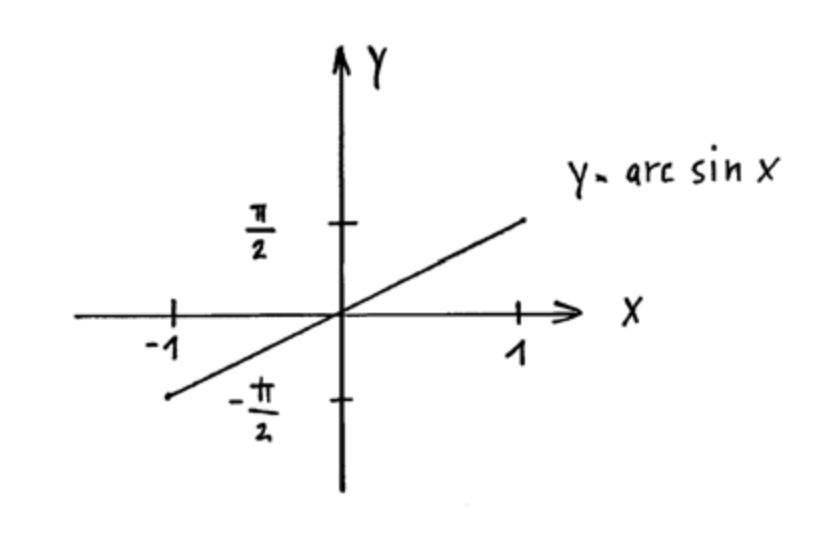
Slightly dependent means , since v is constant in that case.
This is true only for small values of . That means and therefore
d) The energy is conserved since only inductances and capacitances are involved. Using the terms of a) one obtains the capacitive energy
and the inductive energy
From this follows the standard form of the law of conservation of energy
The relation to mechanics is not recognizable in this way since two different physical quantities ( and ) are involved and there is nothing that corresponds to the relation between the locus x and the velocity .
To produce an analogy to mechanics the energy has to be described in terms of the charge Q, the current and the constants L and C. For this purpose the voltage has to be expressed in terms of the charges passing through the coil.
One obtains:
Mechanical analogue:
A (kinetic part):
B (potential part):
: displacement and : velocity.
However, could equally be another quantity (e.g. an angle). L could be e.g. a moment of inertia.
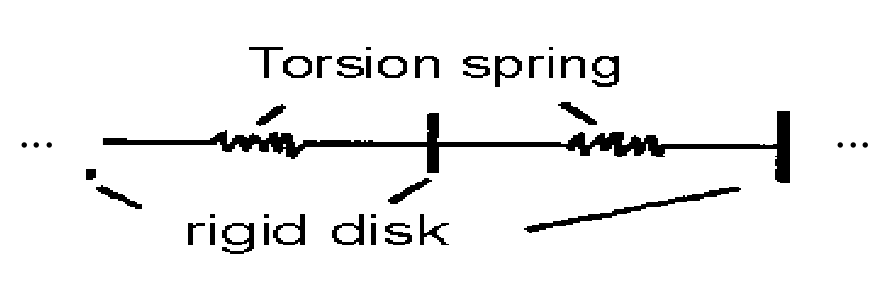
From the structure of the problems follows: Interaction only with the nearest neighbour (the force rises linearly with the distance). A possible model could be:

Another model is:
Grading Scheme
| Problem 3: Infinite LC-grid | |
|---|---|
| part a | 4 |
| part b | 1 |
| part c | 1 |
| part d | 4 |
| 10 |
Оригинал в Архива: ipho87.pdf