IPhO 1988, Теория и експеримент — Задача 1. THEORY 1 Spectroscopy of Particle Velocities
19th International Physics Olympiad - 1988 Bad Ischl / Austria
Условие
Basic Data
The absorption and emission of a photon is a reversible process. A good example is to be found in the excitation of an atom from the ground state to a higher energy state and the atoms´ subsequent return to the ground state. In such a case we may detect the absorption of a photon from the phenomenon of spontaneous emission or fluorescence. Some of the more modern instrumentation make use of this principle to identify atoms, and also to measure or calculate the value of the velocity in the velocity spectrum of the electron beam.
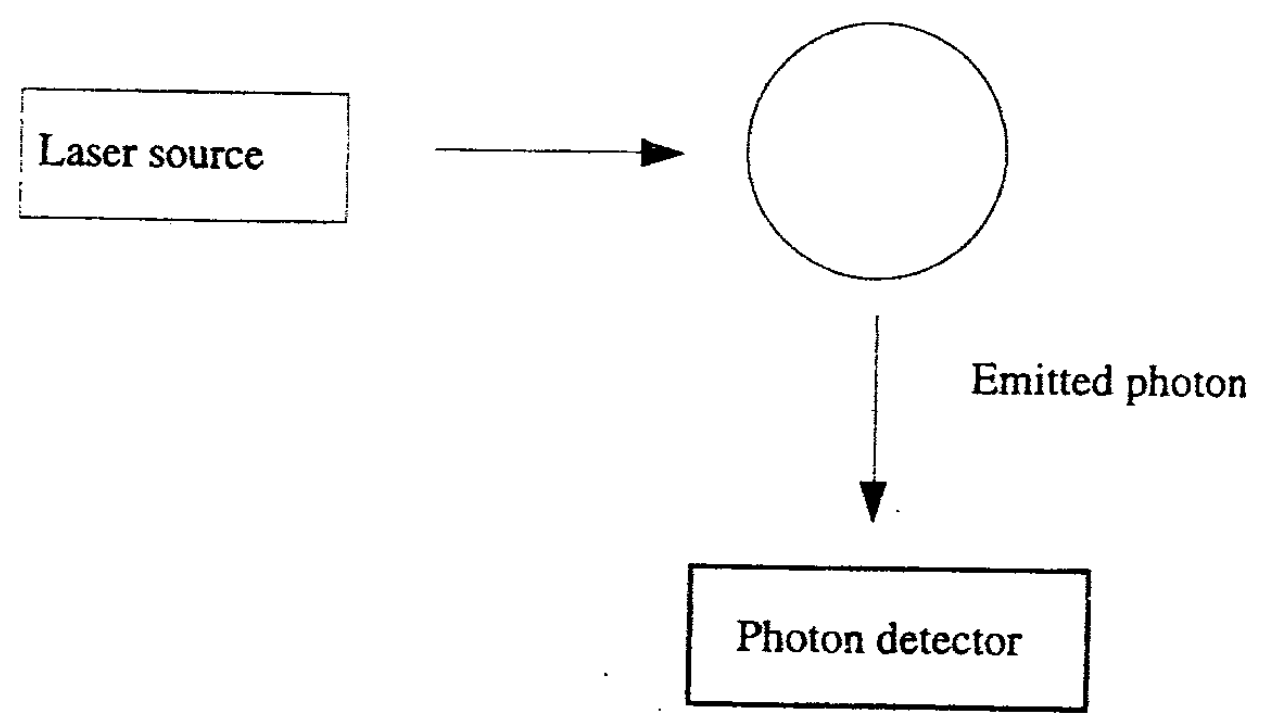
In an idealised experiment (see fig. 19.1) a single-charged ion travels in the opposite direction to light from a laser source with velocity v. The wavelength of light from the laser source is adjustable. An ion with velocity Zero can be excited to a higher energy state by the application of laser light having a wavelength of nm. If we excite a moving ion, our knowledge on Dopplers´ effect tells us that we need to apply laser light of a wavelength other than the value given above.
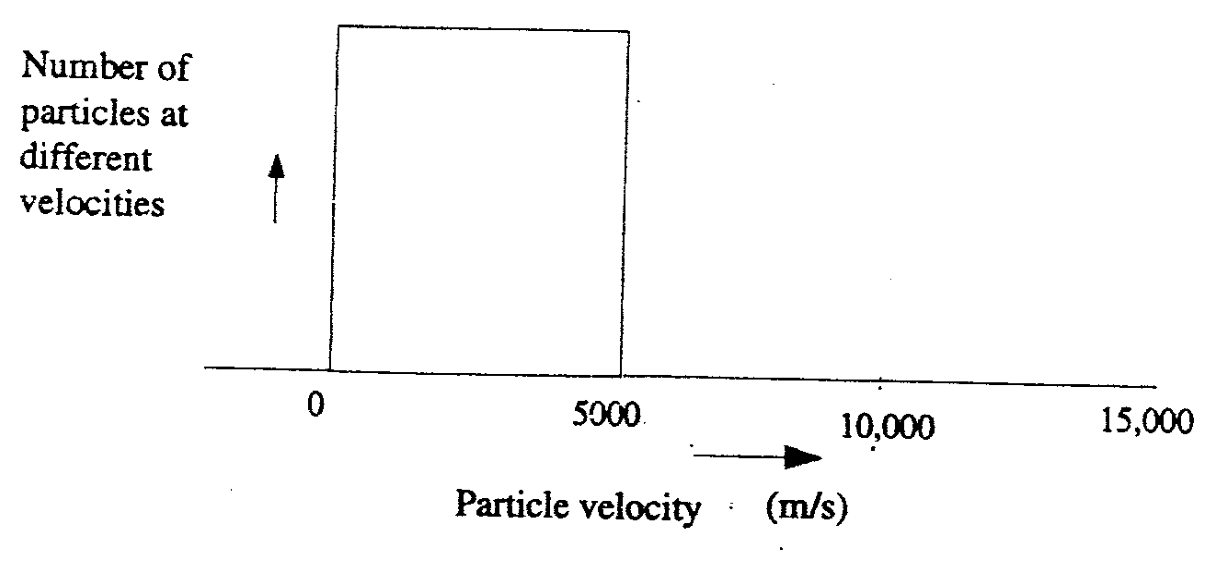
There is given a velocity spectrum embracing velocity magnitude from to . (see fig. 19.1)
1.1.1 What range of wavelength of the laser beam must be used to excite ions of all velocities in the velocity spectrum given above ?
1.1.2 A rigorous analysis of the problem calls for application of the principle from the theory of special relativity
Determine the error when the classical formula for Dopplers´ effect is used to solve the problem.
1.2 Assuming the ions are accelerated by a potential U before excited by the laser beam, determine the relationship between the width of the velocity spectrum of the ion beam and the accelerating potential. Does the accelerating voltage increase or decrease the velocity spectrum width ?
1.3 Each ion has the value , two energy levels corresponding to wavelength and wavelength . Show that lights of the two wavelengths used to excite ions overlap when no accelerating potential is applied. Can accelerating voltage be used to separate the two spectra of laser light used to excite ions so that they no longer overlap ? If the answer is positive, calculate the minimum value of the voltage required.
Отговори
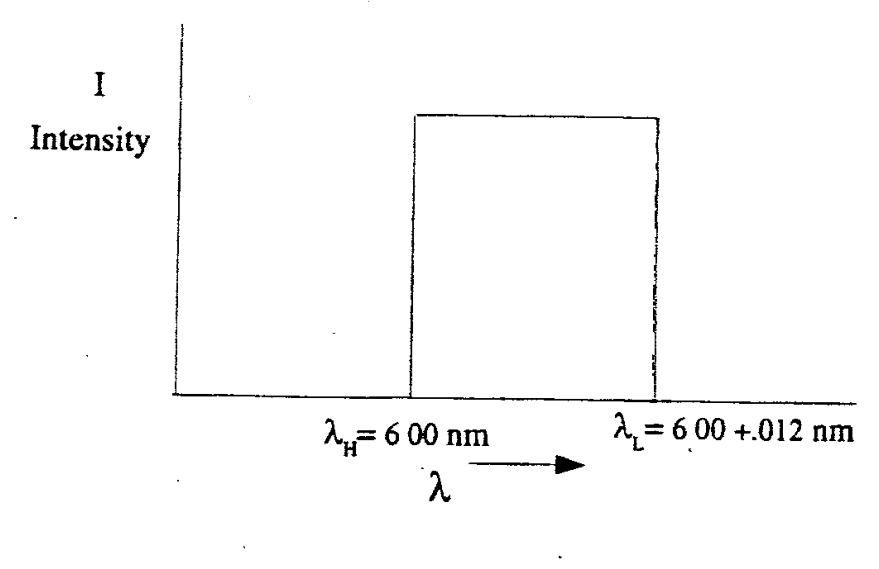
1.1.1 0.012 nm
Official solution: , i.e. from 600 nm to 600,012 nm (fig. 19.3).
1.1.2
The relative error of the classical formula is of the order of .
1.2
The width decreases as U increases and approaches 0 for large U.
1.3 162 V
Official solution: (the spectra overlap without acceleration; each has width 0,012 nm).
Решение
1.1
1.1.1
Let be the velocity of the ion towards the laser source relative to the laser source,
the frequency of the laser light as observed by the observer moving with the ion (e.g. in the frame in which the velocity of the ion is 0) and
the frequency of the laser light as observed by the observer at rest with respect to the laser source.
Classical formula for Doppler´s effect is given as
Let be the frequency absorbed by an ion (characteristic of individual ions) and
be the frequency of the laser light used to excite an ion at rest,
hence:
For a moving ion, the frequency used to excite ions must be lower than .
Let be the frequency used to excite the moving ion.
When no accelerating voltage is applied
| frequency of laser light used to excite ions | magnitude of velocity of ions | frequency of laser light absorbed by ions | wavelength of laser light used to excite ions |
|---|---|---|---|
| 0 | |||
| m/s |
Calculation of frequency absorbed by moving ions.
where Hz and m/s (2)
The difference in the values of the frequency absorbed by the stationary ion and the ion moving with the velocity v
The difference in the values of the wavelengths absorbed by the stationary ion and the ion moving with the velocity v
(higher frequency implies shorter wavelength)
from (2)
In this case
1.1.2
The formula for calculation of as observed by the observer moving towards light source based on the principle of the theory of special relativity,
where is the magnitude of the velocity of the observer towards the light source,
is the frequency absorbed by the ion moving with the velocity v towards the light source (also observed by the observer moving with velocity v towards the laser source) and
is the frequency of laser light as observed by an observer at rest.
(To put in a metaphoric way, the moving ion “sees” the laser light of frequency even though the scientist who operates the laser source insists that he is sending a laser beam of frequency ).
The second term in the brackets represents the error if the classical formula for Doppler´s effect is employed.
The error in the application of classical formula for Doppler´s effect however is of the order of the factor . This means that classical formula for Doppler´s effect can be used to analyze the problem without loosing accuracy.
1.2 When acceleration voltage is used
| frequency of laser light used to excite ions | magnitude of velocity of ions | frequency of laser light absorbed by ions | wavelength of laser light used to excite ions |
|---|---|---|---|
| Hz | |||
| Hz |
Lowest limit of the kinetic energy of ions and
Highest limit of the kinetic energy of ions
and
Spectrum width of velocity spectrum (3)
(Note that the final velocity of accelerated ions is not the sum of v and as velocity changes with time).
In equation (3) if is negligibly small, the change in the width of the spectrum is negligible, by the same token of argument if is large or approaches , the width of the spectrum of the light used in exciting the ions becomes increasingly narrow and approaches 0.
1.3
Given two energy levels of the ion, corresponding to wavelength nm and nm
For the sake of simplicity, the following sign notations will be adopted:
The superscript in the bracket indicates energy level (1) or (2) as the case may be. The sign ´ above denotes the case when accelerating voltage is applied, and also the subscripts H and L apply to absorbed frequencies (and also wavelengths) correspond to the high velocity and low velocity ends of the velocity spectrum of the ion beam respectively.
The subscript following (or ) can be either 1 or 2, with number 1 corresponding to lowest velocity of the ion and number 2 the highest velocity of the ion. When no accelerating voltage is applied, the subscript 1 implies that minimum velocity of the ion is 0, and the highest velocity of the ion is 6000 m/s. If accelerating voltage U is applied, number 1 indicates that the wavelength of laser light pertains to the ion of lowest velocity and number 2 indicates the ion of the highest velocity.
Finally the sign indicates the value of the wavelength () or frequency () absorbed by the ion (characteristic absorbed frequency).
When no accelerating voltage is applied:
For the first energy level:
| frequency of laser light used to excite ions | magnitude of velocity of ions | frequency of laser light absorbed by ions | wavelength of laser light used to excite ions |
|---|---|---|---|
| 0 | Hz | ||
| m/s | Hz |
Hz
Differences in frequencies of laser light used to excite ions
Differences of wavelengths of laser light used to excite ions
For the second energy level:
| frequency of laser light used to excite ions | magnitude of velocity of ions | frequency of laser light absorbed by ions | wavelength of laser light used to excite ions |
|---|---|---|---|
| 0 | Hz | ||
| m/s | Hz |
Hz
Differences in frequencies of laser light used to excite ions
Differences in wavelengths of laser light used to excite ions
This gives
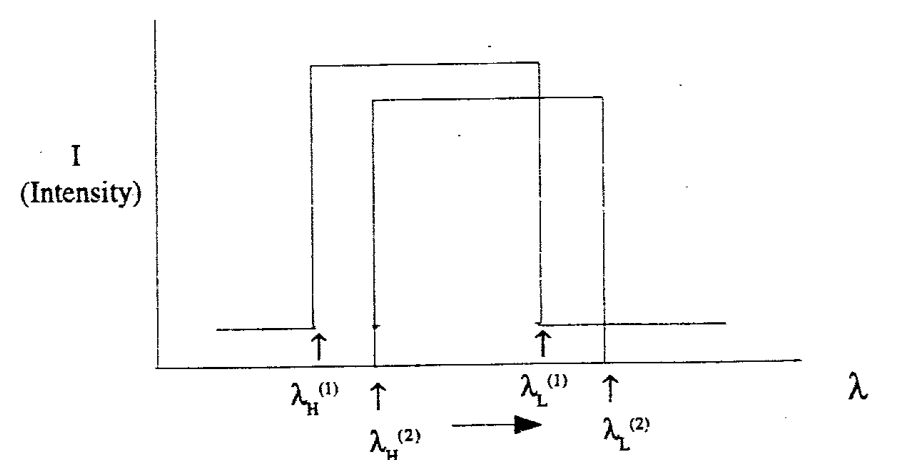
Hence the spectra of laser light (absorption spectrum) used to excite an ion at two energy levels overlap as shown in fig. 19.4.
When accelerating voltage is applied:
Let and be the range of the wavelengths used to excite ions in the first energy level, when accelerating voltage is applied. (Note the prime sign to denote the situation in which the accelerating voltage is used), and let and represent the range of the wavelengths used to excite ions in the second energy level also when an accelerating voltage is applied.
Condition for the two spectra not to overlap:
(see fig. 19.4) (4)
(Keep in mind that lower energy means longer wavelengths and vice versa).
From condition (3): (5)
The meanings of this equation is if the velocity of the ion is v, the wavelength which the ion “sees” is , when is the wavelength which the ion of zero-velocity “sees”.
Equation (5) may be rewritten in the context of the applications of accelerating voltage in order for the two spectra of laser light will not overlap as follows:
where N is the order of the energy level (6)
The subscript L relates to lowest velocity of the ion which “sees” frequency . The lowest velocity in this case is and the subscript H relates to the highest velocity of the ion, in this case .
Equation (6) will be used to calculate
- width of velocity spectrum of the ion accelerated by voltage U
- potential U which results in condition given by (4)
Let us take up the second energy level (lower energy level of the two ones) of the ion first:
substitute
nm
Hz
m/s
Considering the first energy level of the ion
In this case
Hz
m/s
m
Substitute from (8) and from (10) in (4) one gets
assume that U is of the order of 100 and over,
then
The minimum value of accelerating voltage to avoid overlapping of absorption spectra is approximately 162 V
Оригинал в Архива: ipho88.pdf