IPhO 1990, Теория и експеримент — Задача 3. The rotating neutron star.
THE 21st INTERNATIONAL PHYSICS OLYMPIAD - 1990 · 10 т.
Внимание: Бележка към темата
Complete combined archive booklet, attributed to Hans Jordens, contains three theory questions and two experiments with keys. Printed errors and gaps are preserved: the neutron-star key changes the flattening denominator and uses a square-law radius inference; the LED key references missing graphs, has printed inconsistent table values and one unassigned final value; magnet-speed tables print m/s but their values match cm/s. Native source values and all grading remain unchanged.
Условие
A 'millisecond pulsar' is a source of radiation in the universe that emits very short pulses with a period of one to several milliseconds. This radiation is in the radio range of wavelengths; and a suitable radio receiver can be used to detect the separate pulses and thereby to measure the period with great accuracy.
These radio pulses originate from the surface of a particular sort of star, the so-called neutron star. These stars are very compact: they have a mass of the same order of magnitude as that of the sun, but their radius is only a few tens of kilometers. They spin very quickly. Because of the fast rotation, a neutron star is slightly flattened (oblate).
Assume the axial cross-section of the surface to be an ellipse with almost equal axes.
Let be the polar and the equatorial radii; and let us define the flattening factor by:
Consider a neutron star with
| Quantity | Value |
|---|---|
| a mass of | |
| an average radius of | |
| and a rotation period of |
a- Calculate the flattening factor, given that the gravitational constant is . [5 т.]
In the long run (over many years) the rotation of the star slows down, due to energy loss, and this leads to a decrease in the flattening. The star has however a solid crust that floats on a liquid interior. The solid crust resists a continuous adjustment to equilibrium shape. Instead, starquakes occur with sudden changes in the shape of the crust towards equilibrium. During and after such a star-quake the angular velocity is observed to change according to figure 1.
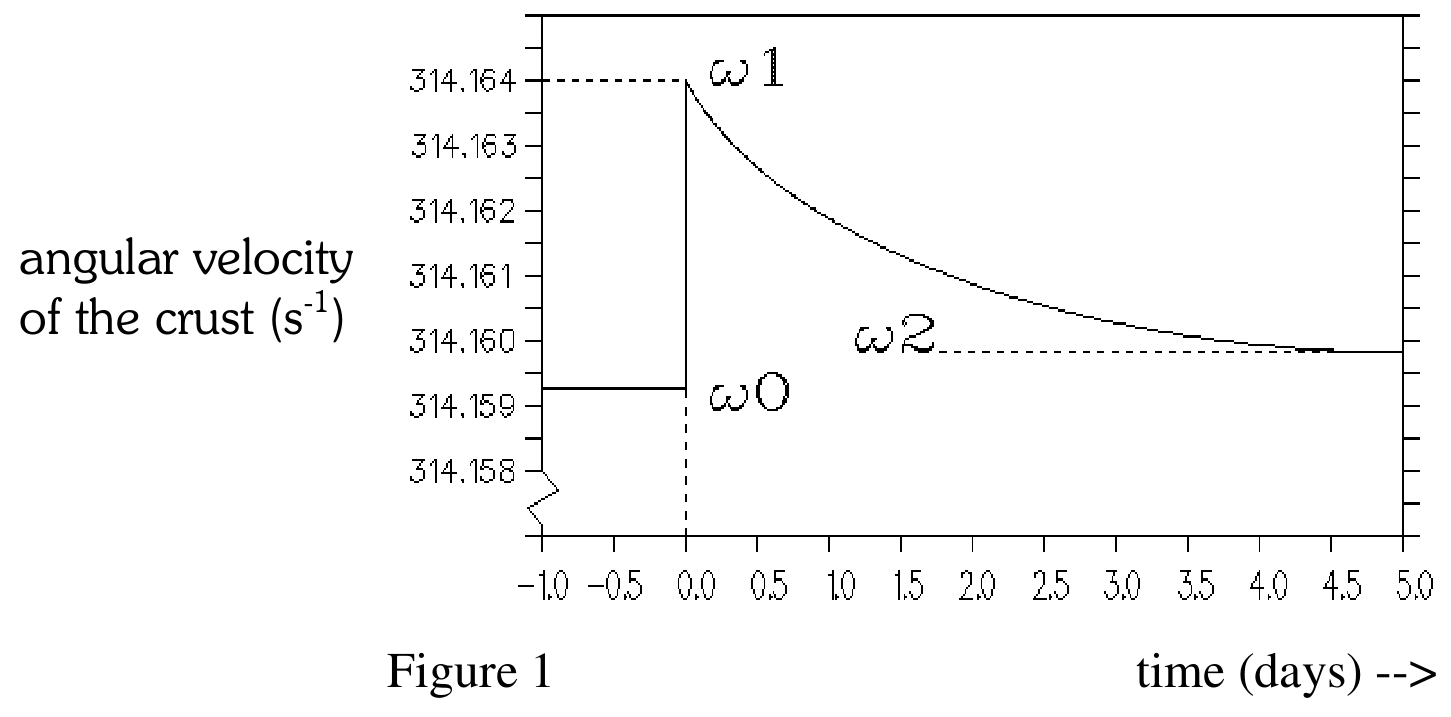
b- Calculate the average radius of the liquid interior, using the data of Fig. 1. Make the approximation that the densities of the crust and the interior are the same.
(Ignore the change in shape of the interior). [5 т.]
Решение
a- 1st method
For equilibrium we have where is normal to the surface.
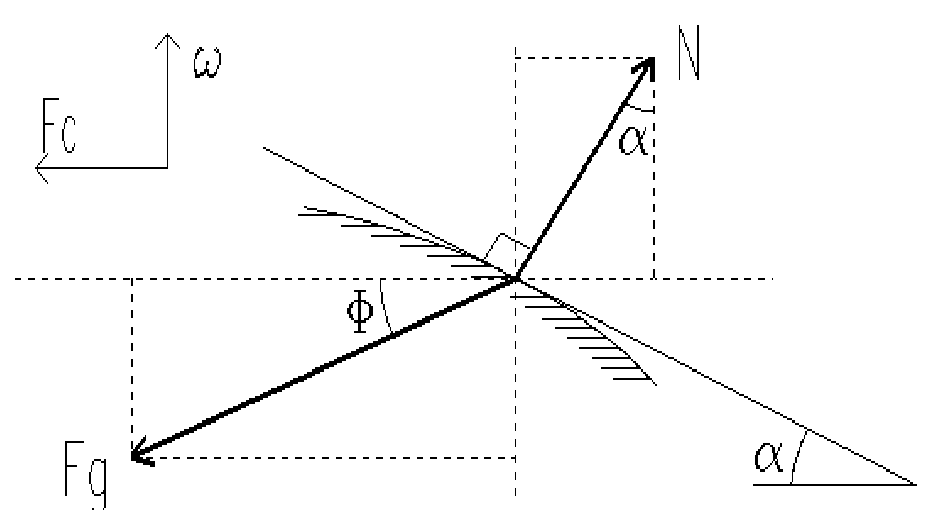
Resolving into horizontal and vertical components, we find:
From:
we find:
where:
This means that, although depends on and , the change in the factor in front of is so slight that we can take it to be constant. The solution of Eq. (1) is then an ellipse:
and from this it follows that:
2nd method
For a point mass of on the surface,
The form of the surface is such that . For the equator (, ) and for the pole (, ) we have:
Thus:
b-
As a consequence of the star-quake, the moment of inertia of the crust decreases by .
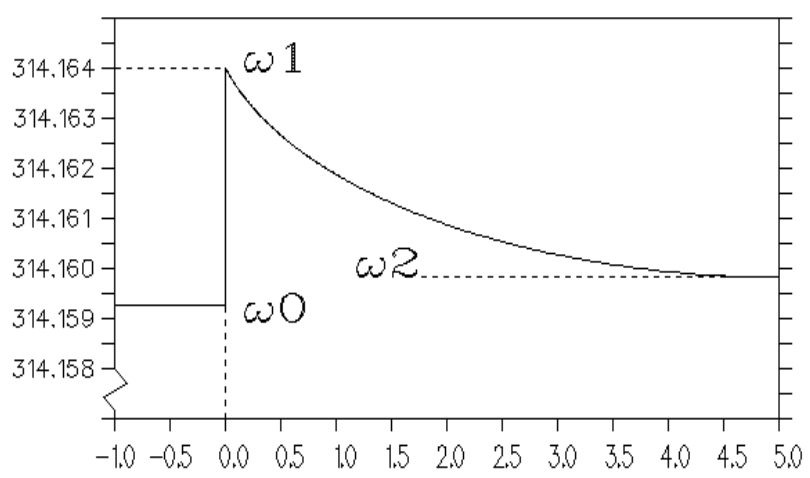
From the conservation of angular momentum, we have:
After the internal friction has equalized the angular velocities of the crust and the core, we have:
Marking breakdown
| Part | Method / criterion | Marks |
|---|---|---|
| a | 1st method — expressions for the forces | 1 |
| a | 1st method — equation for the surface | 2 |
| a | 1st method — equation of ellipse | 1 |
| a | 1st method — flattening factor | 1 |
| a | 2nd method — energy equation | 4 |
| a | 2nd method — flattening factor | 1 |
| b | conservation of angular momentum for crust | 1.5 |
| b | conservation of angular momentum for crust and core | 1.5 |
| b | moment of inertia for a sphere | 1 |
| b | ratio | 1 |
Оригинал в Архива: ipho90.pdf · решение от архива: ipho90.pdf