IPhO 1991, Теория и експеримент — Задача 1. Problem 1
THEORETICAL PROBLEMS · 10 т.
Условие
The figure 1.1 shows a solid, homogeneous ball radius . Before falling to the floor its center of mass is at rest, but the ball is spinning with angular velocity about a horizontal axis through its center. The lowest point of the ball is at a height above the floor.
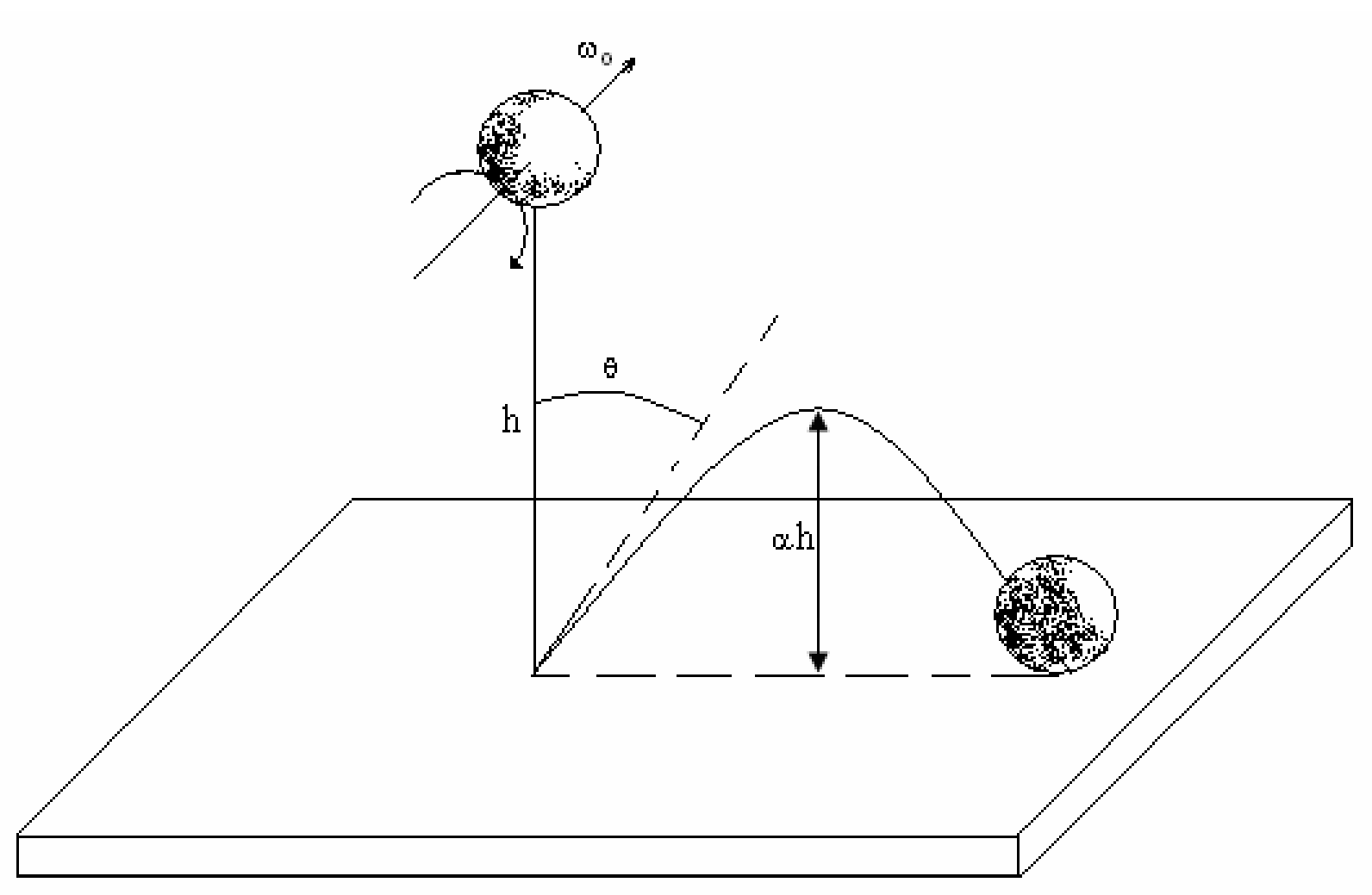
When released, the ball falls under gravity, and rebounds to a new height such that its lowest point is now above the floor. The deformation of the ball and the floor on impact may be considered negligible. Ignore the presence of the air. The impact time, although, is finite.
The mass of the ball is , the acceleration due the gravity is , the dynamic coefficient of friction between the ball and the floor is , and the moment of inertia of the ball about the given axis is:
You are required to consider two situations, in the first, the ball slips during the entire impact time, and in the second the slipping stops before the end of the impact time.
Situation I: slipping throughout the impact. (5,5 т.)
Find:
a) , where is the rebound angle indicated in the diagram; [2 т.]
b) the horizontal distance traveled in flight between the first and second impacts; [1,5 т.]
c) the minimum value of for this situations. [2 т.]
Situation II: slipping for part of the impacts. (3,5 т.)
Find, again:
a) ; [2 т.]
b) the horizontal distance traveled in flight between the first and second impacts. [1,5 т.]
Taking both of the above situations into account, sketch the variation of with .
Отговори
Situation I: slipping throughout the impact., a)
c = √α is the restitution coefficient (official solution, eq. 18).
Situation I: slipping throughout the impact., b)
Official solution, eq. 22; c = √α.
Situation I: slipping throughout the impact., c)
Official solution, eq. 20; c = √α.
Situation II: slipping for part of the impacts., a)
Official solution, eq. 19; c = √α.
Situation II: slipping for part of the impacts., b)
Official solution; c = √α.
Решение
a) Calculation of the velocity at the instant before impact
Equating the potential gravitational energy to the kinetic energy at the instant before impact we can arrive at the pre-impact velocity :
from which we may solve for as follows:
b) Calculation of the vertical component of the velocity at the instant after impact
Let and be the horizontal and vertical components, respectively, of the velocity of the mass center an instant after impact. The height attained in the vertical direction will be and then:
from which, in terms of (or the restitution coefficient ):
c) General equations for the variations of linear and angular momenta in the time interval of the Impact
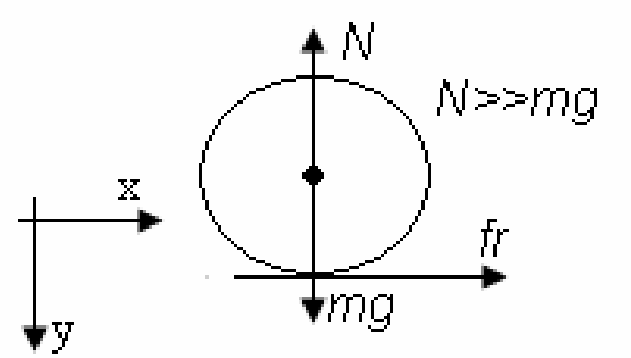
Considering that the linear impulse of the forces is equal to the variation of the linear momentum and that the angular impulse of the torques is equal to the variation of the angular momentum, we have:
Where , and are the linear and angular impulses of the acting forces and is the angular velocity after impact. The times and correspond to the beginning and end of impact.
Variants
At the beginning of the impact the ball will always be sliding because it has a certain angular velocity . There are, then, two possibilities:
I. The entire impact takes place without the friction being able to spin the ball enough for it to stop at the contact point and go into pure rolling motion.
II. For a certain time , the point that comes into contact with the floor has a velocity equal to zero and from that moment the friction is zero. Let us look at each case independently.
Case I
In this variant, during the entire moment of impact, the ball is sliding and the friction relates to the normal force as:
Substituting (8) in relations (6) and (7), and using (5), we find that:
and:
which can give us the horizontal component of the velocity and the final angular velocity in the form:
With this we have all the basic magnitudes in terms of data. The range of validity of the solution under consideration may be obtained from (11) and (12). This solution will be valid whenever at the end of the impact the contact point has a velocity in the direction of the negative . That is, if:
so, for angular velocities below this value, the solution is not valid.
Case II
In this case, rolling is attained for a time between the initial time and the final time of the impact. Then the following relationship should exist between the horizontal component of the velocity and the final angular velocity:
Substituting (14) and (6) in (7), we get that:
which can be solved for the final values:
and:
Calculation of the tangents of the angles
Case I
For we have, from (4) and (11), that:
i.e., the angle is independent of .
Case II
Here (4) and (16) determine for that:
then (18) and (19) give the solution (fig. 1.3).
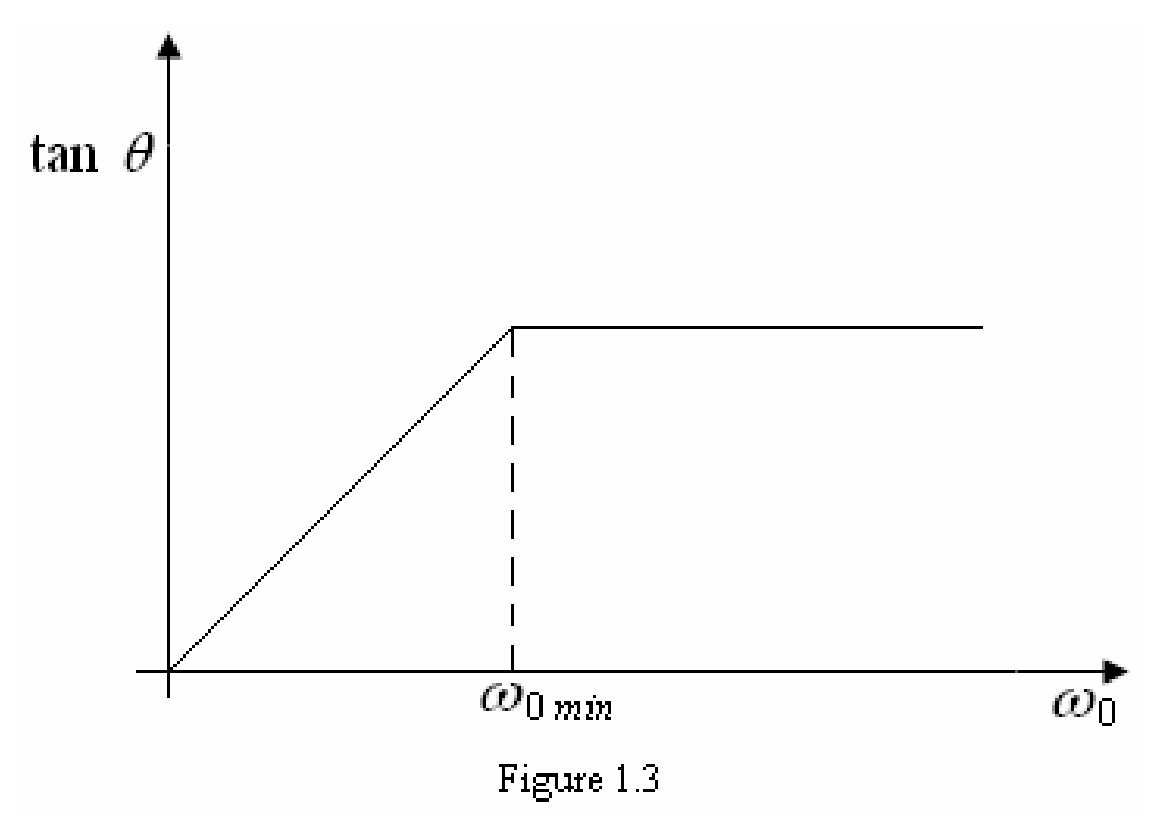
We see that does not depend on if ; where is given as:
Calculation of the distance to the second point of impact
Case I
The rising and falling time of the ball is:
The distance to be found, then, is;
which is independent of .
Case II
In this case, the rising and falling time of the ball will be the one given in (21). Thus the distance we are trying to find may be calculated by multiplying by the velocity so that:
Thus, the distance to the second point of impact of the ball increases linearly with .
Marking Code
The point value of each of the sections is:
| 1.a | 2 points |
|---|---|
| 1.b | 1.5 points |
| 1.c | 2 points |
| 2.a | 2 points |
| 2.b | 1.5 points |
| 3 | 1 point |
Оригинал в Архива: ipho91.pdf