IPhO 1991, Теория и експеримент — Задача 2. Problem 2
THEORETICAL PROBLEMS · 10 т.
Условие
In a square loop with a side length L, a large number of balls of negligible radius and each with a charge q are moving at a speed with a constant separation between them, as seen from a frame of reference that is fixed with respect to the loop. The balls are arranged on the loop like the beads on a necklace, L being much greater than , as indicated in the figure 2.1. The no conducting wire forming the loop has a homogeneous charge density per unit length in the in the frame of the loop. Its total charge is equal and opposite to the total charge of the balls in that frame.
Consider the situation in which the loop moves with velocity parallel to its side (fig. 2.1) through a homogeneous electric field of strength which is perpendicular to the loop velocity and makes an angle with the plane of the loop.
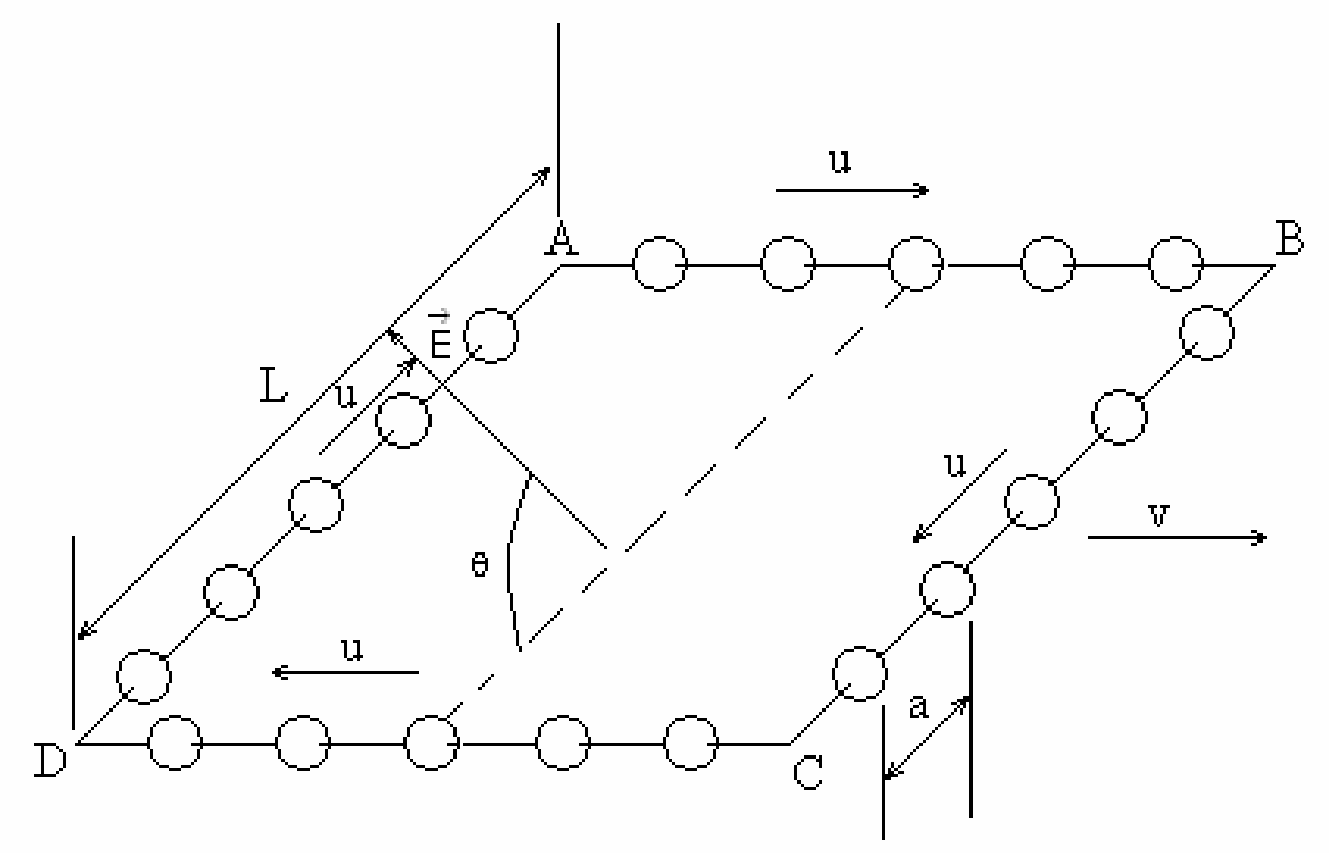
Taking into account relativistic effects, calculate the following magnitudes in the frame of reference of an observer who sees the loop moving with velocity :
a) The spacing between the balls on each of the side of the loop, , , , y . [4,5 т.]
b) The value of the net charge of the loop plus balls on each of the side of the loop: , , y, [2 т.]
c) The modulus of the electrically produced torque tending to rotate the system of the loop and the balls. [1,5 т.]
d) The energy due to the interaction of the system, consisting of the loop and the balls with the electric field. [2 т.]
All the answers should be given in terms of quantities specified in the problem.
Note. The electric charge of an isolated object is independent of the frame of reference in which the measurements takes place. Any electromagnetic radiation effects should be ignored.
Some formulae of special relativity
Consider a reference frame moving with velocity with reference to another reference frame . The axes of the frames are parallel, and their origins coincide a . is directed along the positive direction of the axis.
Relativistic sum of velocities
If a particle is moving with velocity in the direction , as measured in , the velocity of the particle measured in is given by:
Relativistic Contraction
If an object at rest in frame has length in the -direction, an observer in frame (moving at velocity in the -direction will measure its length to be:
Отговори
a)
Official solution eqs. (4), (7), (12), (13). Eq. (4) for aAB is printed with t² in place of c² and with the root over the whole fraction; by symmetry with (7) the intended result is aAB = √(1−v²/c²)·a/(1+uv/c²).
b)
Official solution eqs. (17), (19), (21.1), (21.2).
c)
Official solution eq. (25).
d)
As printed in eq. (29); eq. (28) W = −ELQAB cosθ carries a minus sign that (29) drops.
Решение
Question a:
Let’s call the lab (observer) frame of reference associated with the observer that sees the loop moving with velocity ; to the loop frame of reference (the axis of this system will be taken in the same direction as ; in the direction of side and axis, perpendicular to the plane of the loop). The axes of are parallel to those of and the origins of both systems coincide at .
- Side
will be a reference frame where the moving balls of side are at rest. Its axes are parallel to those of and . has a velocity with respect to .
According to the Lorentz contraction, the distance , between adjacent balls of , measured in , is:
(This result is valid for the distance between two adjacent balls that are in one of any sides, if , is measured in the frame of reference in which they are at rest).
Due to the relativistic sum of velocities, an observer in sees the balls moving in with velocity:
So, because of Lorentz contraction, this observer will see the following distance between balls:
Substituting (1) and (2) in (3)
- Side CD
For the observer in S, the speed of balls in CD is:
From the Lorentz contraction:
Substituting (1) and (5) in (6) we obtain:
- Side DA
In system S’, at time , let a ball be at . At the same time the nearest neighbour to this ball will be in the position .
The space-time coordinates of this balls, referred to system S, are given by the Lorentz transformation:
Accordingly, we have for the first ball in S:
And for the second:
As , the distance between two balls in S will be given by:
So:
- Side BC
If we repeat the same procedure as above, we can obtain that:
Question b:
The charge of the wire forming any of the sides, in the frame of reference associated with the loop can be calculated as:
Because L/a is the number of balls in that side. Due to the fact that the charge in invariant, the same charge can be measured in each side of the wire in the lab (observer) frame of reference.
- Side AB
The charge corresponding to balls in side AB is, in the lab frame of reference:
This is obtained from the multiplication of the number of balls in that side multiplied by the (invariant) charge of one ball. The numerator of the first factor in the right side of equation (15) is the contracted distance measured by the observer and the denominator is the spacing between balls in that side.
Replacing in (15) equation (4), we obtain:
Adding (14) and (16) we obtain for the total charge of this side:
- Side CD
Following the same procedure we have that:
And adding (14) and (18) we obtain:
The length of these sides measured by the observer in S is L and the distance between balls is a, so:
Adding (14) and (20) we obtain:
Question c:
There is electric force acting into the side AB equal to:
and the electric force acting into the side CD is:
and F, form a force pair. So, from the expression for the torque for a force pair we have that (fig. 2.2):
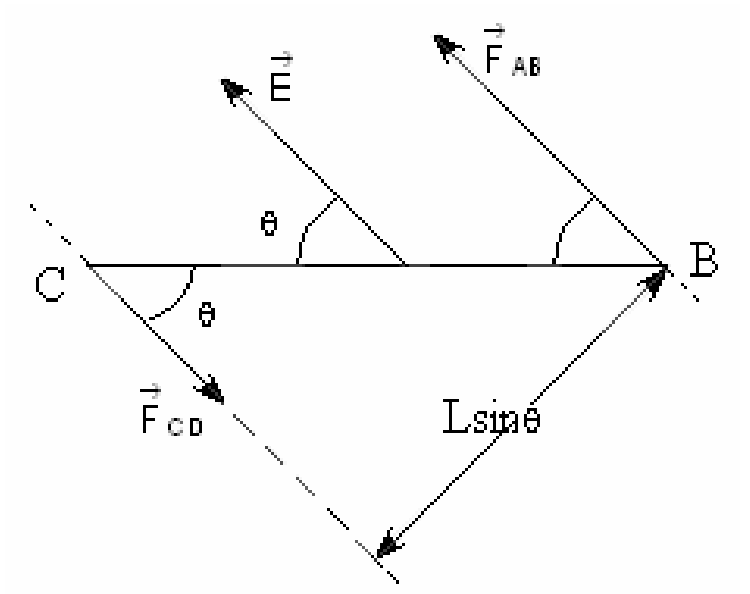
And finally:
Question d:
Let’s call and the electrostatic in the points of sides AB and CD respectively. Then:
Let’s fix zero potential () in a plane perpendicular to and in an arbitrary distance R from side AB (fig. 2.3).
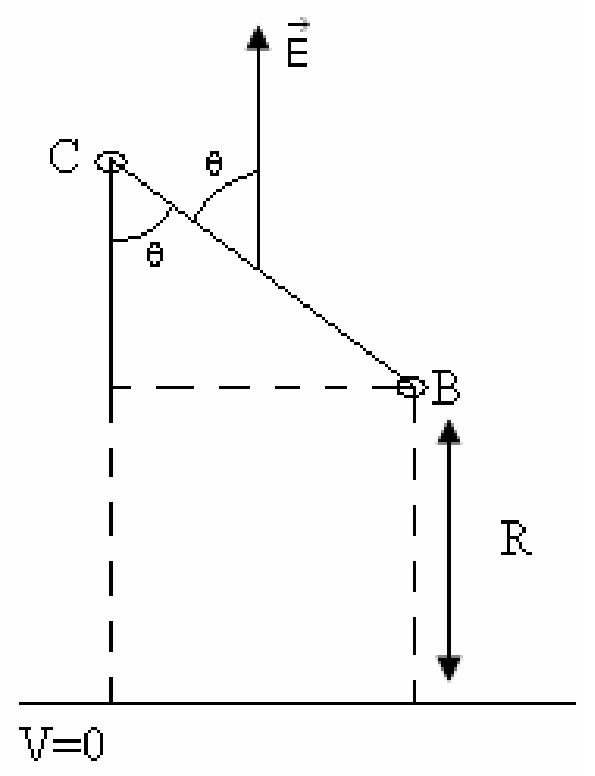
Then:
But , so:
Substituting (17) in (28) we obtain:
Marking Code
Grading for questions will be as follows:
a) 4,5 points.
b) 2,0 points.
c) 1,5 points.
d) 2,0 points.
These points are distributed in questions in the following way:
Question a:
- Obtaining expressions (4) and (7) correctly: 3,0 points. Only one of them correct: 2,0 points.
- Obtaining expressions (12) and (13) correctly including the necessary calculations to arrive to this results: 1,5 points. Only one of them correct: 1,0 points.
If the necessary calculations are not present: 0,8 point for both (12) and (13) correct; 0,5 points for only one of them correct.
Question b:
- Obtaining expressions (17) and (19) correctly: 1,0 point. Only one of them correct: 1,0 point.
- Obtaining expressions (21.1) and (21.2) correctly: 0,5 point. Only one them correct: 0,5 point.
Question d:
- Obtaining expression (29) correctly: 2,0 points.
When the modulus of a vector is not present where necessary, the student will loose 0,2 points. When the modulus of q is not present where necessary the student will loose 0,1 points.
Оригинал в Архива: ipho91.pdf