IPhO 1991, Теория и експеримент — Задача 3. Cooling Atoms by laser
THEORETICAL PROBLEMS · 10 т.
Условие
To study the properties of isolated atoms with a high degree of precision they must be kept almost at rest for a length of time. A method has recently been developed to do this. It is called “laser cooling” and is illustrated by the problem below.
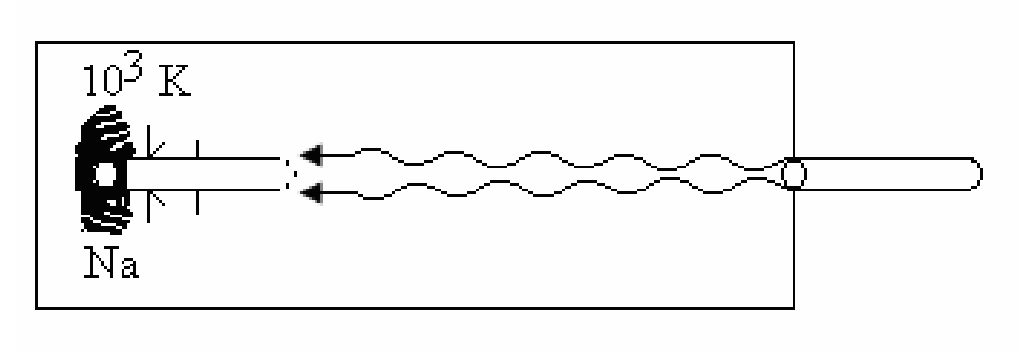
In a vacuum chamber a well collimated beam of Na atoms (coming from the evaporation of a sample at K) is illuminated head-on with a high intensity laser beam (fig. 3.1). The frequency of laser is chosen so there will be resonant absorption of a photon by those atoms whose velocity is . When the light is absorbed, these atoms are exited to the first energy level, which has a mean value above the ground state and uncertainty of (fig. 3.2).
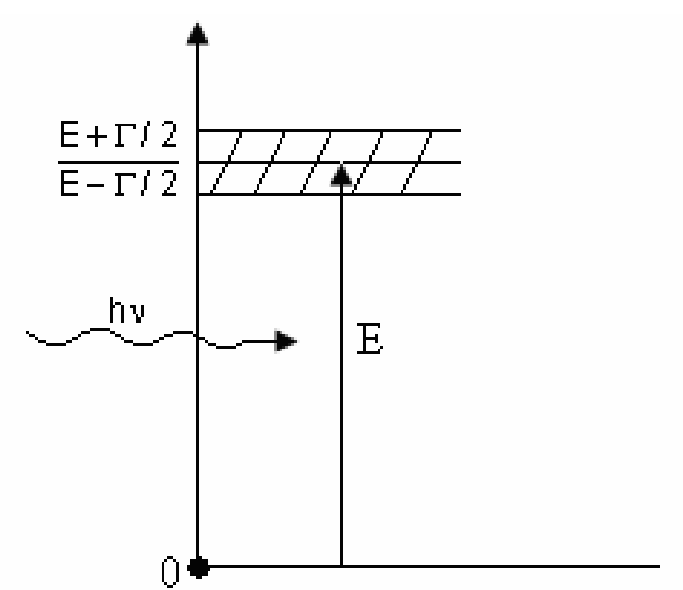
For this process, the atom’s decrease in velocity is given by . Light is then emitted by the atom as it returns to its ground state. The atom’s velocity changes by and its direction of motion changes by an angle (fig. 3.3).
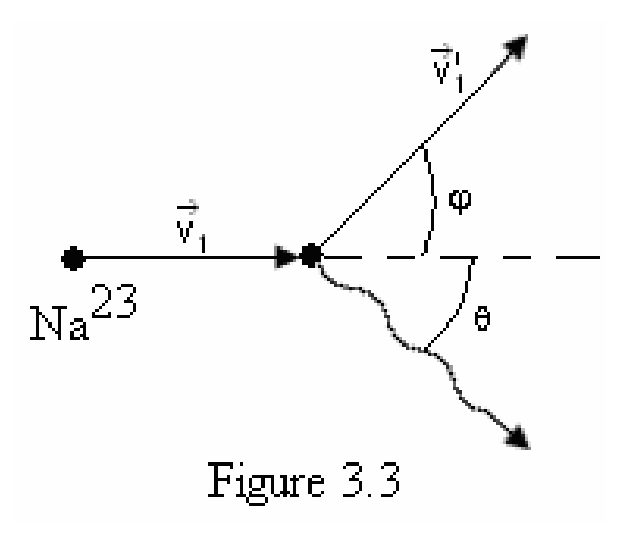
This sequence of absorption and emission takes place many times until the velocity of the atoms has decreased by a given amount such that resonant absorption of light at frequency no longer occurs. It is then necessary to change the frequency of laser so as to maintain resonant absorption. The atoms moving at the new velocity are further slowed down until some of them have a velocity close to zero.
As first approximation we may ignore any atomic interaction processes apart from the spontaneous absorption and emission light described above.
Furthermore, we may assume the laser to be so intense that the atoms spend practically no time in the ground state.
Questions
a) Find the laser frequency needed ensure the resonant absorption of the light by those atoms whose kinetic energy of the atoms inside the region behind the collimator. Also find the reduction in the velocity of these atoms, , after the absorption process. [3 т.]
b) Light of the frequency calculated in question a) is absorbed by atoms which velocities lie within a range . Calculate this velocity range. [1,5 т.]
c) When an atom emits light, its direction of motion changes by from initial direction. Calculate . [1,5 т.]
d) Find the maximum possible velocity decrease for a given frequency. [1 т.]
e) What is the approximate number of absorption-emission events necessary to reduce the velocity of an atom from is initial value -found in question a) above- almost to zero? Assume the atom travels in a straight line. [1 т.]
f) Find the time t that the process in question e takes. Calculate the distance an atom travels in this time. [2 т.]
Data
where c is speed of light, h is Planck’s constant, k is the Boltzmann constant, and mp is the mass of proton.
Отговори
a)
Official solution: vo ≈ 1,04·10³ m/s, ν = (E/h)/(1+vo/c), Δv1 = −(E/mc)/(1+vo/c).
b) 6.25 m/s
Δvo ≈ cΓ/E (official solution, eq. 6).
c) 0.00005 rad
Maximum deviation φm = arctg(E/mvc) (official solution, eq. 8).
d) 3.12 m/s
Δv = (cΓ/2E)(1+vo/c) (official solution, eq. 9).
e) 35600
N ≈ mcvo/E ≈ 3,56·10⁴ (official solution).
f)
As printed in the official solution; with N ≈ 3,56·10⁴ and τ = h/Γ ≈ 9,5·10⁻⁸ s the product Nτ is about 3,4·10⁻³ s, so the printed exponent −9 appears to be a misprint (ΔS = voΔt/2 ≈ 1,75 m agrees with 3,37·10⁻³ s).
Решение
Question a:
The velocity of the atoms whose kinetic energy is the mean of the atoms on issuing from the collimator is given is given by:
m/s because:
Since this velocity is much smaller than c, , we may disregard relativistic effects.
Light is made up of photons with energy and momentum .
In the reference system of the laboratory, the energy and momentum conservation laws applied to the absorption process imply that:
. Then and this implies , where we assume that
Combining these expressions:
and:
And substituting the numerical values:
Hz m/s
If we had analyzed the problem in the reference system that moves with regard to the laboratory at a velocity , we would have that:
Where is the frequency of the photons in the laboratory system. Disregarding we get the same two equations above.
The approximations are justifiable because:
Then
Question b:
For a fixed :
if E has an uncertainty , would have an uncertainty:
so the photons are absorbed by the atoms which velocities are in the interval
Question c:
The energy and momentum conservation laws imply that:
( – is the frequency of emitted photon)
The deviation of the atom will be greatest when , then:
since :
Question d:
As the velocity of the atoms decreases, the frequency needed for resonant absorption increases according to:
When the velocity is , absorption will still be possible in the lower part of the level if:
m/s
Question e:
If each absorption-emission event varies the velocity as , decreasing velocity from to almost zero would require N events, where:
Question f:
If absorption is instantaneous, the elapsed time is determined by the spontaneous emission. The atom remains in the excited state for a certain time, , then:
The distance covered in that time is . Assuming that the motion is uniformly slowed down:
Marking Code
| a)Finding | 1 pt | Total 3 pt | |
|---|---|---|---|
| “ | 1 pt | ||
| “ | 1 pt | ||
| b) “ | 1,5 pt | Total 1,5 pt | |
| c) “ | 1,5 pt | Total 1,5 pt | |
| d) “ | 1 pt | Total 1 pt | |
| e) “ | N | 1 pt | Total 1 pt |
| f) “ | 1 pt | Total 2 pt | |
| “ | 1 pt | ||
| Overall total 10 pts |
We suggest in all cases: 0,75 for the formula; 0,25 for the numeral operations.
Оригинал в Архива: ipho91.pdf