IPhO 1993, Теория — Задача 1. Atmospheric Electricity
Theoretical Competition · 12 юли 1993 г. · 10 т.
Внимание: Бележка към темата
The complete native cover, constants table and all three worked keys and grading schemes are included. The printed permeability value and charge-sign discrepancies are preserved and identified at their source expressions.
Native theoretical competition cover and instructions
COUNTRY: ____________________
XXIV INTERNATIONAL PHYSICS OLYMPIAD
WILLIAMSBURG, VIRGINIA, U.S.A.
THEORETICAL COMPETITION — July 12, 1993
Time available: 5 hours. READ THIS FIRST! INSTRUCTIONS:
- Use only the pen provided.
- Use only the marked side of the paper.
- Begin each problem on a separate sheet.
- Write at the top of each and every page: the number of the problem; the number of the page of your solution in each problem; the total number of pages in your solution to the problem.
Example (for Problem 1): 1 1/4; 1 2/4; 1 3/4; 1 4/4.
Native common constants table
General Tabulated Information
| Quantity | Symbol | Value |
|---|---|---|
| Earth's mean radius | ||
| acceleration due to gravity | ||
| Newtonian gravitational constant | ||
| permittivity of vacuum | ||
| permeability of vacuum | ||
| speed of light in vacuum (or air) | ||
| elementary charge | ||
| mass of electron | ||
| mass of proton | ||
| Planck constant | ||
| Avogadro constant | ||
| Boltzmann constant | ||
| molar gas constant |
The permeability value is printed in the native constants table and is preserved as a source discrepancy.
Условие
From the standpoint of electrostatics, the surface of the Earth can be considered to be a good conductor. It carries a certain total charge and an average surface charge density .
1) Under fair-weather conditions, there is a downward electric field, , at the Earth's surface equal to about 150 V/m. Deduce the magnitude of the Earth's surface charge density and the total charge carried on the Earth's surface. [1 т.]
2) The magnitude of the downward electric field decreases with height, and is about 100 V/m at a height of 100 m. Calculate the average amount of net charge per m³ of the atmosphere between the Earth's surface and 100 m altitude. [1 т.]
3) The net charge density you have calculated in (2) is actually the result of having almost equal numbers of positive and negative singly-charged ions per unit volume ( and ). Near the Earth's surface, under fair-weather conditions, . These ions move under the action of the vertical electric field. Their speed is proportional to the field strength:
where is in m/s and in V/m. How long would it take for the motion of the atmospheric ions to neutralize half of the Earth's surface charge, if no other processes (e.g. lightning) occurred to maintain it? [2 т.]
4) One way of measuring the atmospheric electric field, and hence , is with the system shown in the diagram. A pair of metal quadrants, insulated from ground but connected to each other, are mounted just underneath a grounded uniformly rotating disk with two quadrant-shaped holes cut in it. (In the diagram, the spacing has been exaggerated in order to show the arrangement.) Twice in each revolution the insulated quadrants are completely exposed to the field, and then (1/4 of a period later) are completely shielded from it. Let be the period of revolution, and let the inner and outer radii of the insulated quadrants be and as shown.
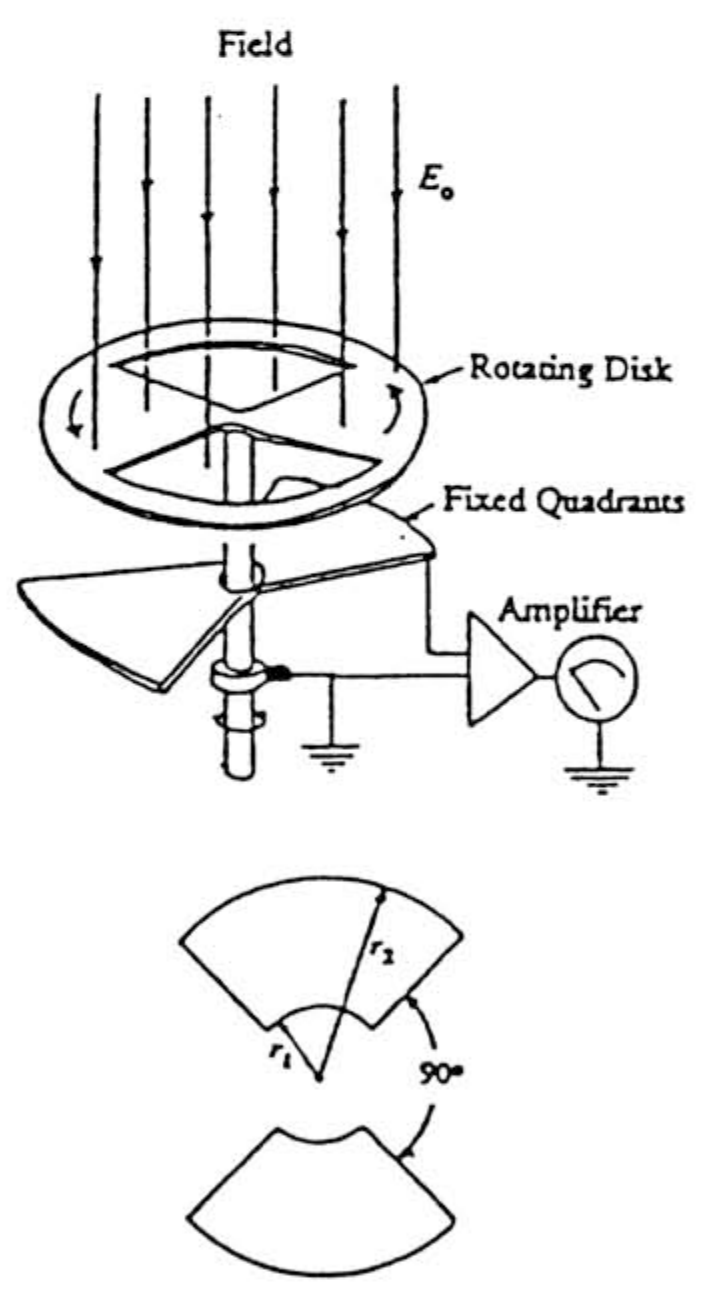
Take to be an instant when the insulated quadrants are completely shielded.
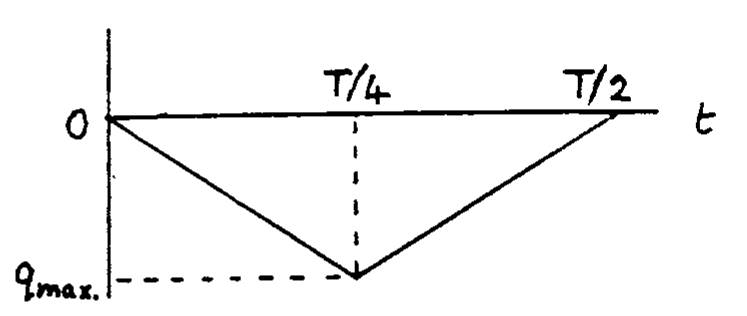
Obtain expressions that give the total charge induced on the upper surface of the insulated quadrants as a function of time between and , and sketch a graph of this variation.
[The effects of the atmospheric ion current can be ignored in this situation.] [1,5 т.]
5) The system described in (4) is connected to an amplifier whose input circuit is equivalent to a capacitor and a resistor in parallel. (You can assume that the capacitance of the quadrant system is negligible compared to .) Sketch graphs of the form of the voltage difference between the points and as a function of during one revolution of the disk, just after it has been set into rotation with period of revolution , if:
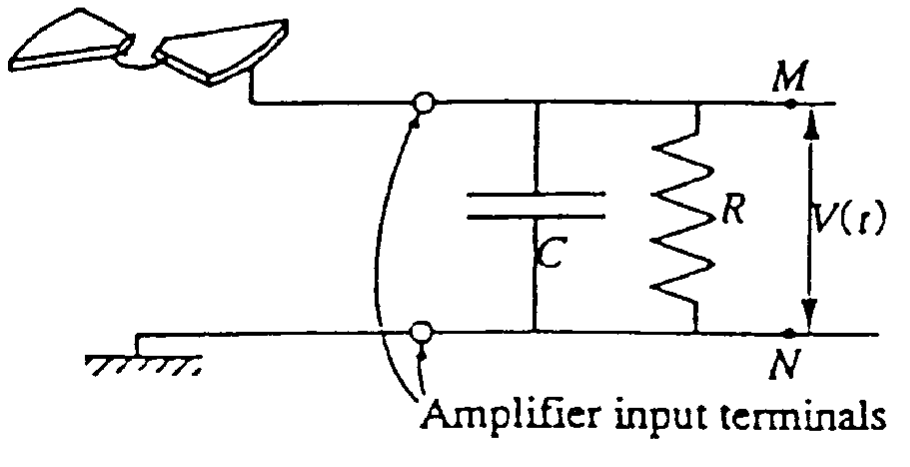
a) ;
b) .
[Assume that and have fixed values; only changes between situations (a) and (b).]
Obtain an expression for the approximate ratio, , of the largest values of in cases (a) and (b). [3,5 т.]
6) Assume that , , , , , and suppose that the disk is set into rotation at 50 revolutions per second.
Approximately, what is the largest value of during one revolution in this case? [1 т.]
Решение
1) Surface charge
By Gauss' law, .
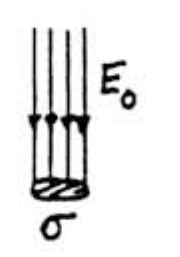
The source's intermediate product prints positive and a negative final charge; this printed sign discrepancy is retained.
2) Atmospheric charge
Consider a cylinder of cross-section with faces at heights of 0 and 100 m.
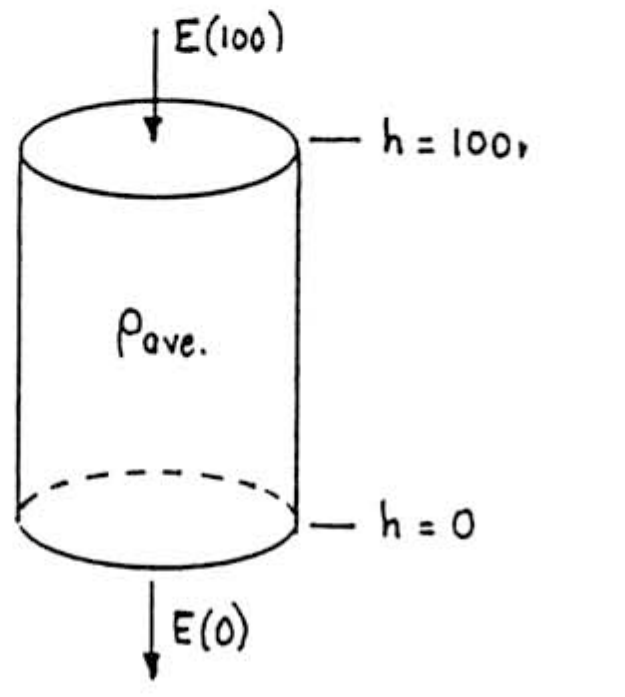
By Gauss' law,
3) Neutralization and alternative estimate
If a conductor contains charges per unit volume, each with charge and travelling with speed , the current per unit area () is given by:
Here, we have both positive and negative charges (). Clearly, with a downward electric field, the positive charges move downward and the negative charges move upward. In the situation as described, only the positive charges can contribute to neutralization of the Earth's surface charge. Hence we have (taking downward as the positive direction for this purpose):
Now is the rate of change () of the surface charge density, , and (if defined as positive downward) is equal to . Thus the above equation can be written:
This is just like the equation of radioactive decay. Its solution is an exponential decrease of with time:
Putting then gives .
[A simpler approximate solution is to assume that remains constant at its initial value :
With from part 1, we would then put:
]
4) Field-mill induced charge
If is an instant at which the insulated quadrants are completely shielded, we have the following relations:
Corresponding variations occur during all the succeeding pairs of quarter-cycles.
The maximum (negative) induced charge is given by:
5) Amplifier response in both limits
This question can be discussed without making a full circuit analysis. One only needs to realize that the rate of flow of charge into the amplifier is divided into a rate of charging of the capacitor, , and a conduction current, , through the resistor. There are then two extreme situations, depending on whether the amount of charge lost by leakage during one quarter-period is small or large compared to .
(a) If — i.e., — very little of the charge is carried away through during the time . Thus, when the insulated quadrants are charged negatively through induction, an almost equal positive charge is given to . Thus rises almost linearly with between and , and then decreases almost linearly by an equal amount between and . In this case,
where has the value obtained in part 4.
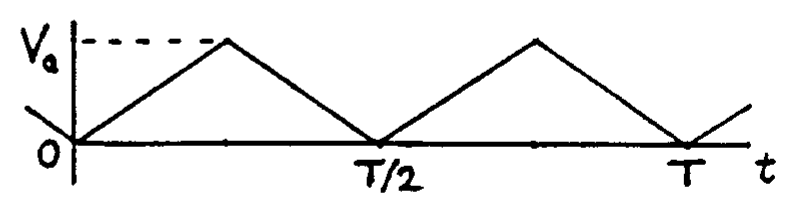
Note: Ultimately (unless is infinite) the form of will become a sawtooth varying symmetrically between . The statement of the problem avoids this complication by specifying that is measured just after the rotation has begun.
(b) If, however, — i.e., — most of the charge is quickly carried away through . A constant positive current flows through when the magnitude of is increasing, and an equal negative current when the magnitude of is decreasing. The size of this current is approximately equal to . The resulting voltage across is approximately constant during each quarter-period, and is alternately positive and negative. In this case,
The last native expression uses the signed , while its preceding current expression uses ; both are preserved.
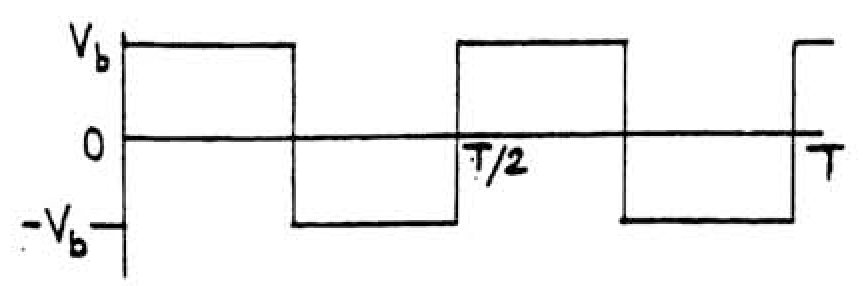
Putting these results together, we see that:
6) Numerical maximum voltage
We have , and .
Thus , which satisfies the criterion . Therefore we can use the solution 5(a) above.
We have
and so
This numerical part uses positive charge magnitudes as printed, following the negative signed charges in parts 1 and 4.
Grading Scheme
Theoretical Problem 1: Grading Scheme
| Part | Points | Allocation |
|---|---|---|
| 1 | 1 | 1/2 point for , 1/2 point for |
| 2 | 1 | |
| 3 | 2 | 1/2 point for recognizing ; 1/2 for recognizing ; 1/2 for getting ; 1/2 for final numerical answer. [1 point maximum for using .] |
| 4 | 1-1/2 | 1/2 point for each equation; 1/2 point for graph |
| 5 | 3-1/2 | 1 point for correct graphical form of (a); 1 for correct graphical form of (b); 1-1/2 for correct evaluation of |
| 6 | 1 | 1/2 point for recognizing that ; 1/2 for final answer |
Оригинал в Архива: ipho93.pdf · официални решения: ipho93.pdf