IPhO 1993, Теория — Задача 2. Laser Forces on a Transparent Prism
Theoretical Competition · 12 юли 1993 г. · 10 т.
Внимание: Бележка към темата
The complete native cover, constants table and all three worked keys and grading schemes are included. The printed permeability value and charge-sign discrepancies are preserved and identified at their source expressions.
Native theoretical competition cover and instructions
COUNTRY: ____________________
XXIV INTERNATIONAL PHYSICS OLYMPIAD
WILLIAMSBURG, VIRGINIA, U.S.A.
THEORETICAL COMPETITION — July 12, 1993
Time available: 5 hours. READ THIS FIRST! INSTRUCTIONS:
- Use only the pen provided.
- Use only the marked side of the paper.
- Begin each problem on a separate sheet.
- Write at the top of each and every page: the number of the problem; the number of the page of your solution in each problem; the total number of pages in your solution to the problem.
Example (for Problem 1): 1 1/4; 1 2/4; 1 3/4; 1 4/4.
Native common constants table
General Tabulated Information
| Quantity | Symbol | Value |
|---|---|---|
| Earth's mean radius | ||
| acceleration due to gravity | ||
| Newtonian gravitational constant | ||
| permittivity of vacuum | ||
| permeability of vacuum | ||
| speed of light in vacuum (or air) | ||
| elementary charge | ||
| mass of electron | ||
| mass of proton | ||
| Planck constant | ||
| Avogadro constant | ||
| Boltzmann constant | ||
| molar gas constant |
The permeability value is printed in the native constants table and is preserved as a source discrepancy.
Условие
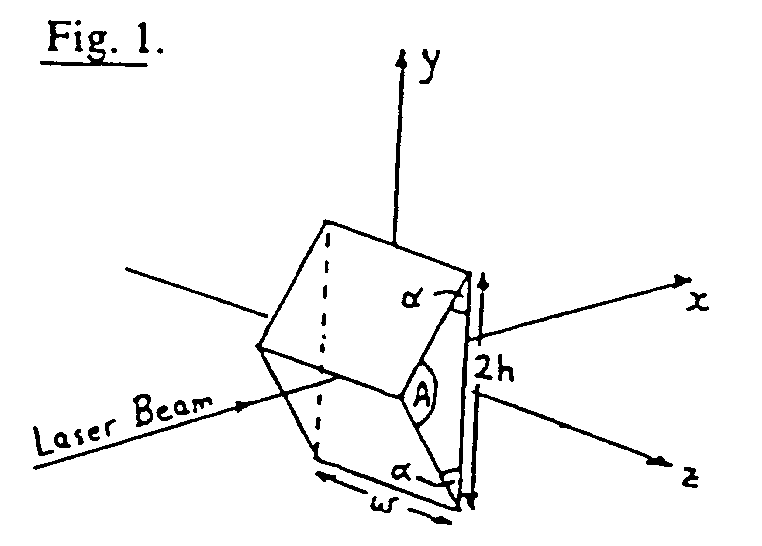
By means of refraction a strong laser beam can exert appreciable forces on small transparent objects. To see that this is so, consider a small glass triangular prism with an apex angle , a base of length and a width . The prism has an index of refraction and a mass density .
Suppose that this prism is placed in a laser beam travelling horizontally in the direction. (Throughout this problem assume that the prism does not rotate, i.e., its apex always points opposite to the direction of the laser beam, its triangular faces are parallel to the plane, and its base is parallel to the plane, as shown in Fig. 1.) Take the index of refraction of the surrounding air to be . Assume that the faces of the prism are coated with an anti-reflection coating so that no reflection occurs.
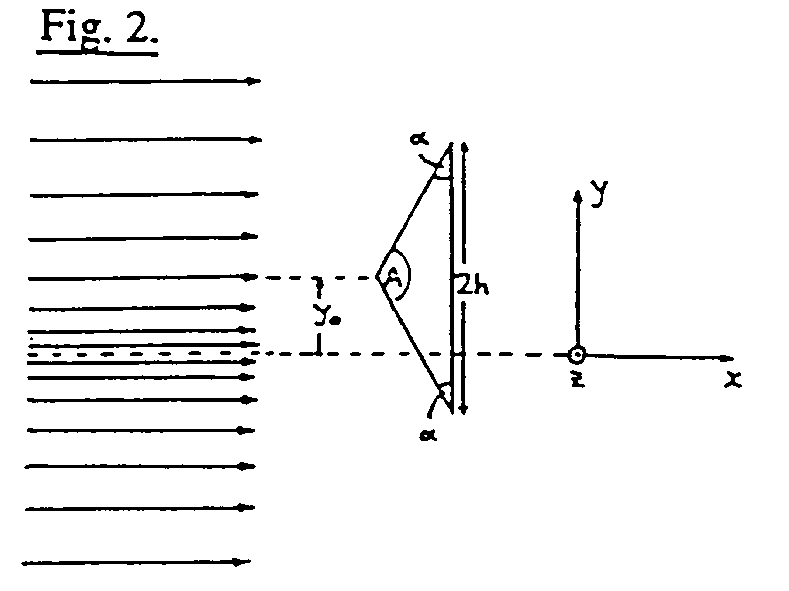
The laser beam has an intensity that is uniform across its width in the direction but falls off linearly with distance from the axis such that it has a maximum value of at and falls to zero at (Fig. 2). [Intensity is power per unit area, e.g. expressed in .]
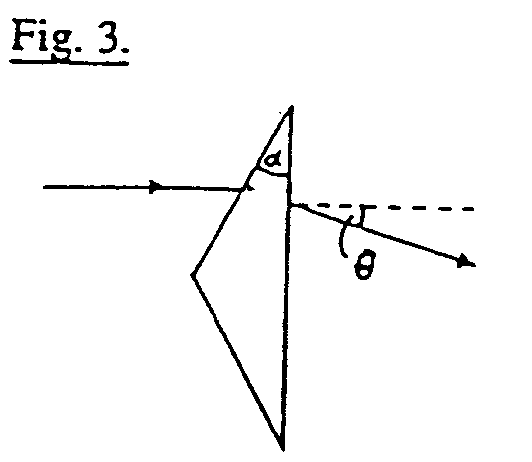
1) Write equations from which the angle (see Fig. 3) may be determined (in terms of and ) in the case when laser light strikes the upper face of the prism.
[1,5 т.]
2) Express, in terms of , , , and , the and components of the net force exerted on the prism by the laser light when the apex of the prism is displaced a distance from the axis where .
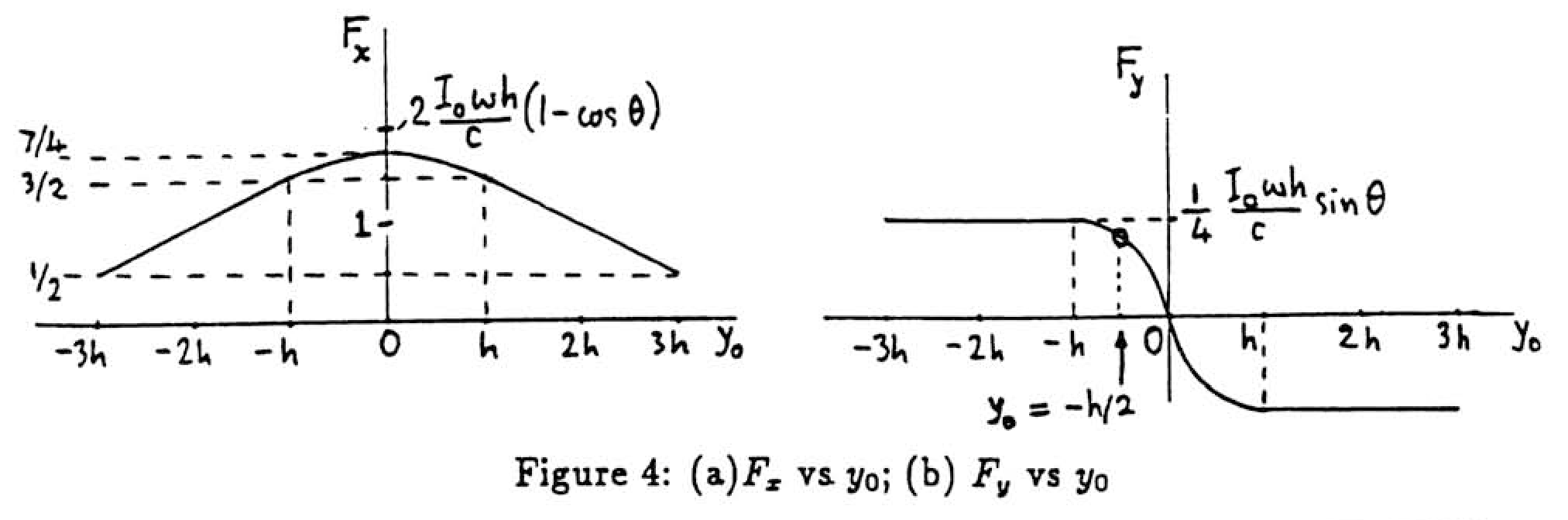
Plot graphs of the values of the horizontal and vertical components of force as functions of vertical displacement . [5 т.]
3) Suppose that the laser beam is 1 mm wide in the direction and 80 μm thick (in the direction). The prism has , , , and . How many watts of laser power would be required to balance this prism against the pull of gravity (in the direction) when the apex of the prism is at a distance (= −5 μm) below the axis of the laser beam? [1,5 т.]
4) Suppose that this experiment is done in the absence of gravity with the same prism and a laser beam with the same dimensions as in (3), but with . What would be the period of oscillations that occur when the prism is displaced and released a distance from the center line of the laser beam? [2 т.]
Решение
1) Refraction angle
This is a simple problem in geometry and Snell's Law.
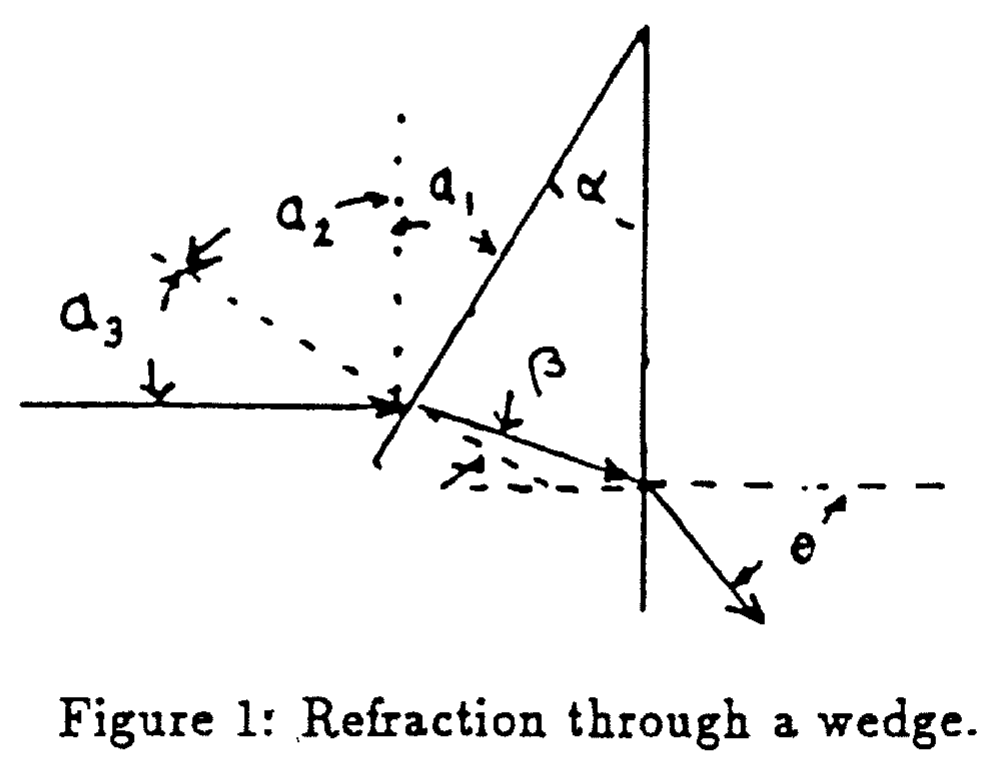
The angle of incidence because and . The angle is found from Snell's law . The angle of incidence on the base is
from which it follows that
implying that
2) Forces in both displacement ranges
The force on the prism is equal and opposite to the rate of change of momentum of the laser light passing through it. To analyze this, consider the momentum changes of the laser light incident on the upper half of the prism.
Think of the laser beam as delivering to the upper half of the prism photons per second parallel to the axis. If the energy of a photon is , then its momentum is , and a photon leaving the prism at an angle to the axis will differ in momentum from the incident photon by
The rate of charge of momentum of these photons will then be
The phrase “rate of charge of momentum” is printed in the native key.
The quantity is the power delivered to the upper face, and the recoil force produced by light refracting through the upper half of the prism will be
A similar argument gives the force on the lower half as
From these two results we see that the net force on the prism will be
The angle can be expressed in terms of (see answer to part 1). To find the values of and calculate the average intensities, and , incident on each half of the prism, and multiply by , the area of each half of the prism projected perpendicular to the laser beam. Because the intensity distribution is a linear function of , the average intensities are easily determined.
The problem states that
Now suppose that the prism is lifted a distance from the axis (). There are two distinct cases:
(a) When , the whole prism is entirely in the upper half of the beam. As Fig. 2 shows, for this case the average is equal to the intensity at the center of each face which is at for the upper face and at for the lower one. This gives
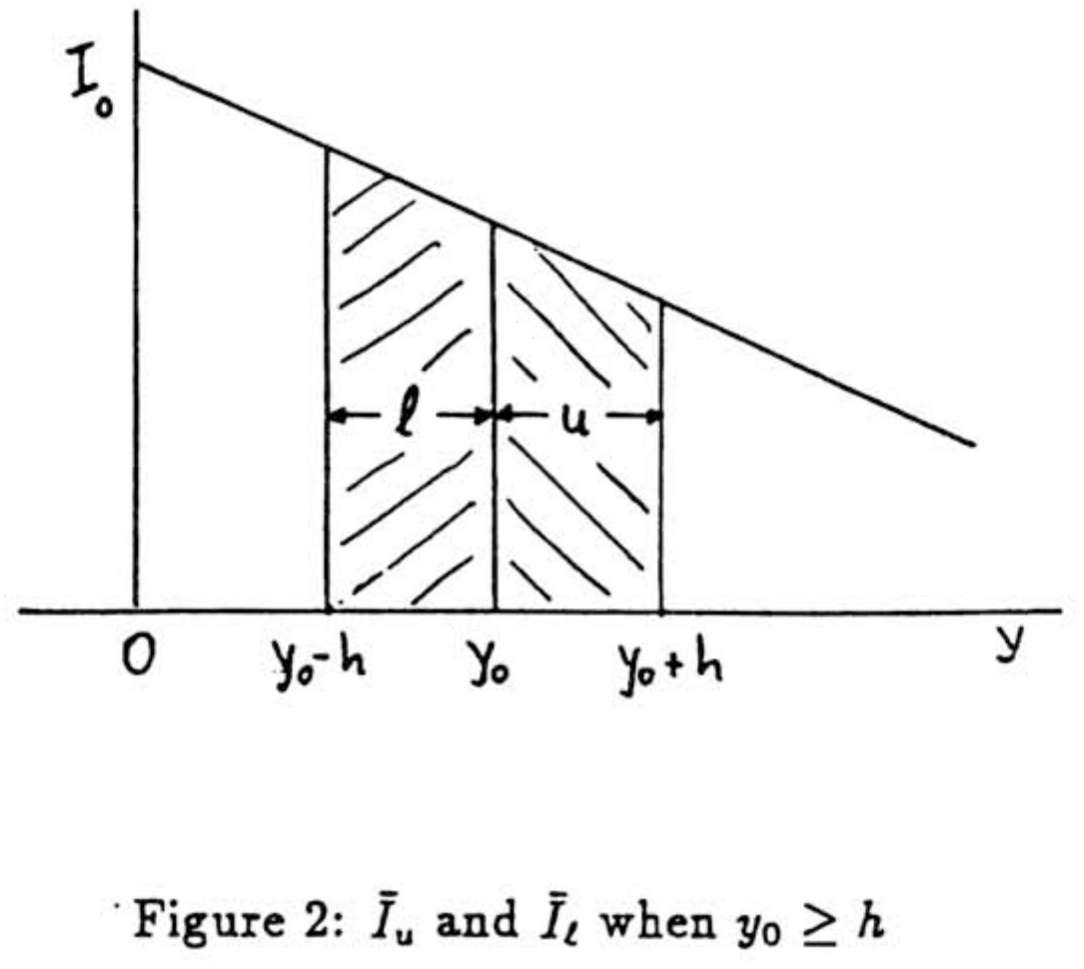
From these it follows that
(b) When , the lower half of the prism is partly in the lower half of the laser beam as shown in Fig. 3. Then the part of the lower half of the prism between 0 and has a fraction of the area of the lower half of the prism and sees an average intensity
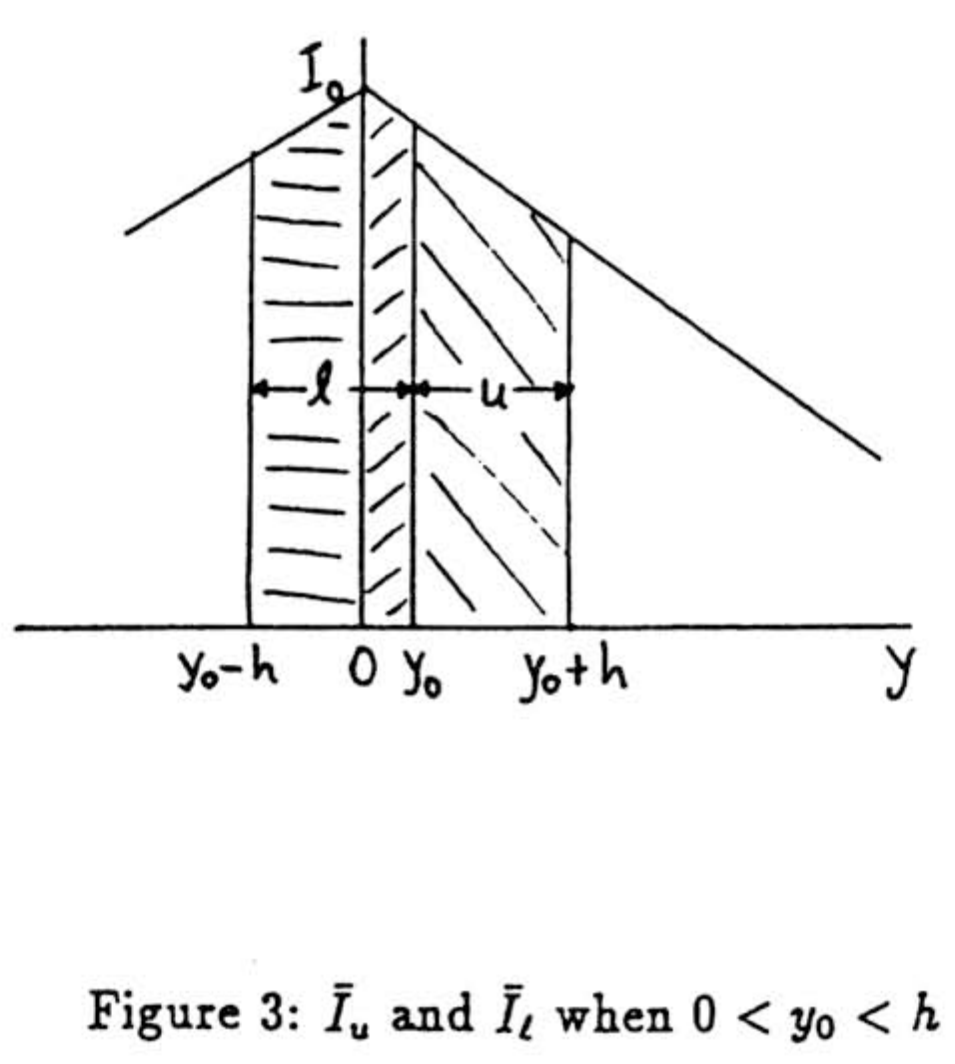
The part between 0 and has a fraction of the area and sees an average intensity of
Putting these together we get
The average intensity on the upper face has the same functional dependence on as in the first case. Therefore, as before.
Putting these together gives
from which it follows that
Because the intensity distribution is symmetric about the axis of the laser beam, the solutions for will mirror the solutions for . Graphs of and as functions of are shown in Fig. 4.
3) Laser power against gravity
Both the equation and the graph of show that to have and opposite the force of gravity, must be . Then to find the force necessary to support the prism against gravity, find the prism's mass, and equate the expression for the vertical component of force from the laser beam to the weight of the prism, and find for the parameters given. Use that result to find the total power in the laser beam. This can be done by finding the average value over the specified cross sectional area of the laser beam.
To find the mass of the prism first find its volume then
The solution to (2) assumed a displacement in the direction, but the problem is symmetric so we can use that solution. We want the value of that satisfies
when , , , .
since the power is given by where . This yields
4) Oscillation period
A displacement of corresponds to so that the vertical force component is well approximated by
This is the equation of a harmonic oscillator with angular frequency
Putting numbers into this gives
Grading Scheme
Theoretical Problem 2: Grading Scheme
| Part | Points | Allocation |
|---|---|---|
| 1 | 1.5 | |
| 2 | 5 | 2 points for obtaining expression for net force in terms of and powers , incident on upper and lower prism faces; 1 for finding and explicitly in terms of , and for ; 1 for finding and explicitly in terms of , and for ; 1 for drawing appropriate graphs |
| 3 | 1.5 | |
| 4 | 2 |
Оригинал в Архива: ipho93.pdf · официални решения: ipho93.pdf