IPhO 1993, Теория — Задача 3. Electron Beam
Theoretical Competition · 12 юли 1993 г. · 10 т.
Внимание: Бележка към темата
The complete native cover, constants table and all three worked keys and grading schemes are included. The printed permeability value and charge-sign discrepancies are preserved and identified at their source expressions.
Native theoretical competition cover and instructions
COUNTRY: ____________________
XXIV INTERNATIONAL PHYSICS OLYMPIAD
WILLIAMSBURG, VIRGINIA, U.S.A.
THEORETICAL COMPETITION — July 12, 1993
Time available: 5 hours. READ THIS FIRST! INSTRUCTIONS:
- Use only the pen provided.
- Use only the marked side of the paper.
- Begin each problem on a separate sheet.
- Write at the top of each and every page: the number of the problem; the number of the page of your solution in each problem; the total number of pages in your solution to the problem.
Example (for Problem 1): 1 1/4; 1 2/4; 1 3/4; 1 4/4.
Native common constants table
General Tabulated Information
| Quantity | Symbol | Value |
|---|---|---|
| Earth's mean radius | ||
| acceleration due to gravity | ||
| Newtonian gravitational constant | ||
| permittivity of vacuum | ||
| permeability of vacuum | ||
| speed of light in vacuum (or air) | ||
| elementary charge | ||
| mass of electron | ||
| mass of proton | ||
| Planck constant | ||
| Avogadro constant | ||
| Boltzmann constant | ||
| molar gas constant |
The permeability value is printed in the native constants table and is preserved as a source discrepancy.
Условие
An accelerating voltage produces a uniform, parallel beam of energetic electrons. The electrons pass a thin, long, positively charged copper wire stretched at right angles to the original direction of the beam, as shown in the figure. The symbol denotes the distance at which an electron would pass the wire if the wire were uncharged. The electrons then proceed to a screen (viewing surface) a distance () beyond the wire, as shown. The beam initially extends to distances with respect to the axis of the wire. Both the width of the beam and the length of the wire may be considered infinite in the direction perpendicular to the paper.
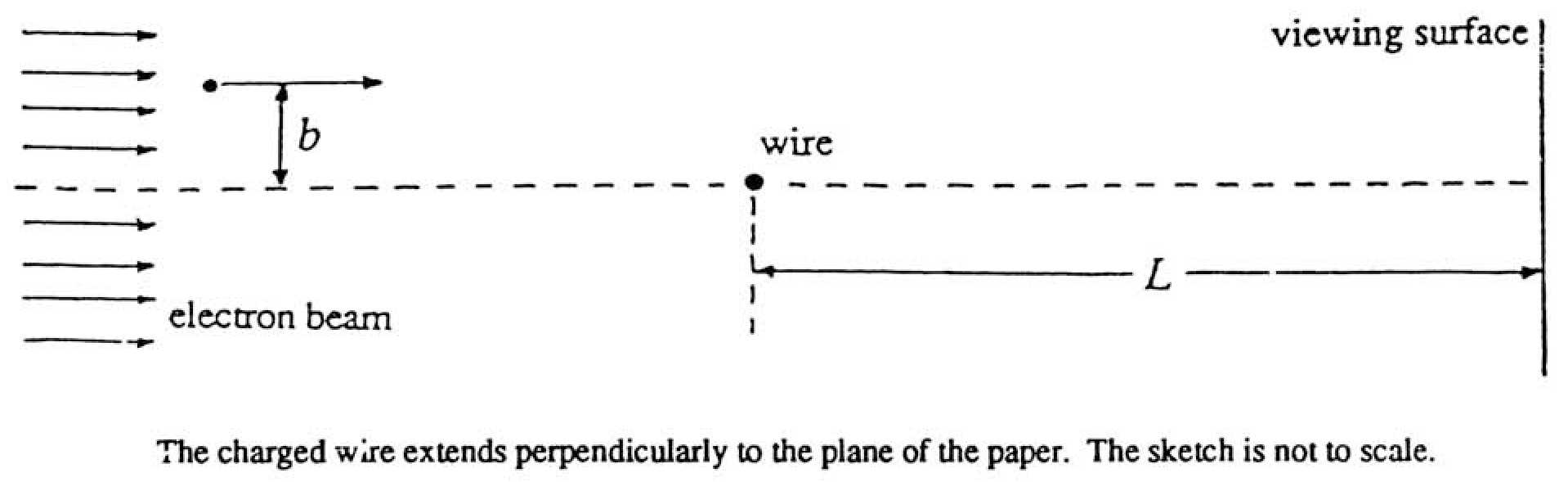
Some numerical data are provided here; you will find other numerical data in the table at the front of the examination:
| Quantity | Value |
|---|---|
| radius of wire | |
| maximum value of | |
| electric charge per unit length of wire | |
| accelerating voltage | |
| length from wire to observing screen |
Note: For parts 2–4, make reasonable approximations that lead to analytical and numerical solutions.
1) Calculate the electric field produced by the wire. Sketch the magnitude of as a function of distance from the axis of the wire. [1 т.]
2) Use classical physics to calculate the angular deflection of an electron. Do this for values of the parameter such that the electron does not strike the wire. Let denote the (small) angle between the initial velocity of the electron and the velocity when the electron reaches the viewing surface. Hence, calculate . [5 т.]
3) Calculate and sketch the pattern of impacts (i.e., the intensity distribution) on the viewing screen that classical physics predicts. [1,5 т.]
4) Quantum physics predicts a major difference in the intensity distribution (relative to what classical physics predicts). Sketch the pattern for the quantum prediction and provide quantitative detail. [2,5 т.]
Решение
1) Wire electric field
By symmetry, the electric field will point radially away from the wire, and its magnitude will depend only on the radius (in cylindrical coordinates). Place an imaginary cylinder around the wire and use Gauss's law:
for a cylinder of radius and unit length, provided . Therefore
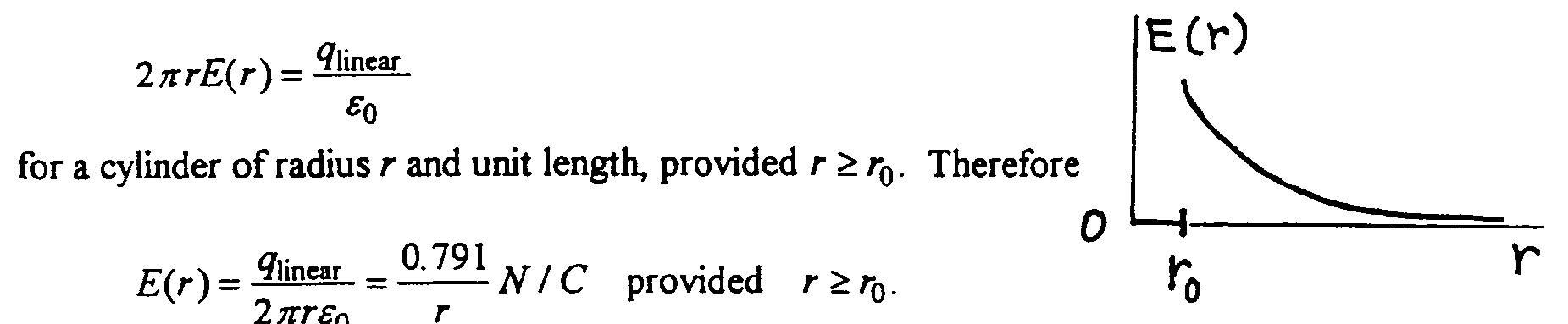
When , the electric field is zero (because copper is a good conductor), that is, the electric field is zero inside the wire.
2) Classical deflection: rough and integrated estimates
The problem stated that the angular deflection is small. Estimate the deflection angle by forming a quotient: the momentum acquired transverse to the initial velocity divided by the initial momentum:
A first estimate of the transverse momentum can be made as follows:
The transverse force (where it is significant) is of order .
The (significant) transverse force operates for a time such that the electron goes a distance of order , and hence that transverse force operates for a time of order .
The product of force and operating time gives an estimate the transverse momentum:
and so
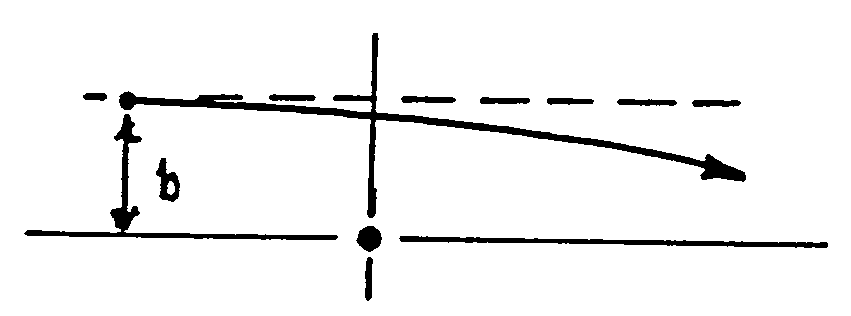
after one uses energy conservation to say . Note that the deflection is extremely small and that the deflection is independent of the impact parameter . Because the force between the positively charged wire and the electron is attractive, the deflection will bend the trajectory toward the wire — though only ever so slightly.
A more accurate estimate can be made by setting up an elementary integration for , as follows. For the sake of the integration, approximate the actual trajectory by a straight line that passes the wire at distance , as shown in the sketch.
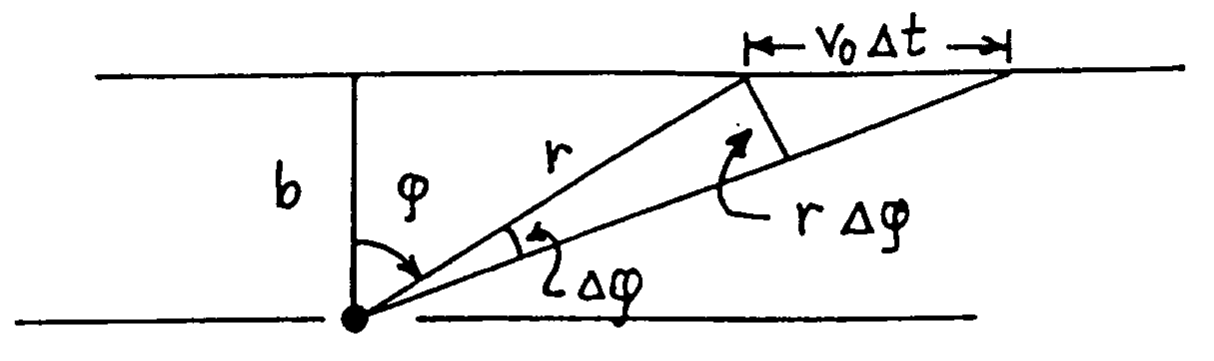
Adding up the increments in over the range to yields .
The better estimate differs from the first estimate by merely the factor . The better estimate yields
3) Classical intensity distribution
Most of the bending of the trajectory occurs within a distance from the wire of order . On the scale of , order is very small indeed. Therefore we may approximate the trajectory by two straight lines with a kink near the wire. Thus, at the viewing surface, the transverse displacement of each trajectory is
Thus the portions of the beam that pass on opposite sides of the wire have a region of overlap, as shown in the sketch.
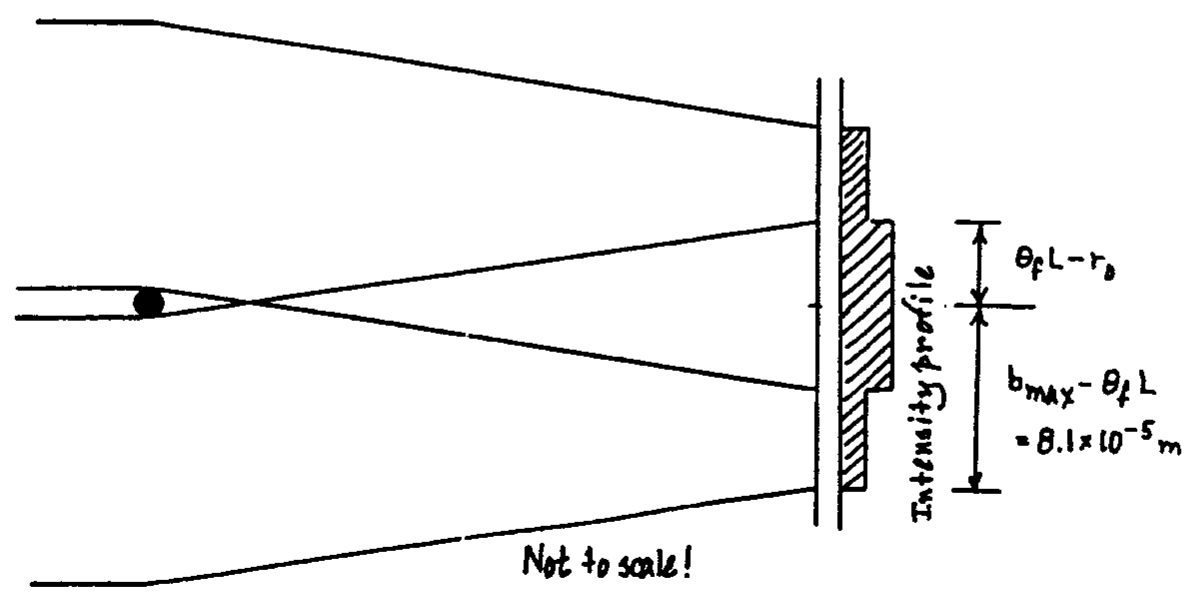
The full width of the overlap region is
The density of impacts is constant within each region and doubled in the overlap region.
4) Quantum interference and historical note
Associated with the electron beam is a quantum wave pattern whose de Broglie wavelength is
The de Broglie wavelength is so much smaller than the beam width that one may ignore “single slit diffraction” effects. Rather, to the right of the wire, two plane waves that travel at a fixed angle relative to each other (an angle ) overlap and interfere. In the region where, classically, the two halves of the original beam overlap, there will be interference maxima and minima.
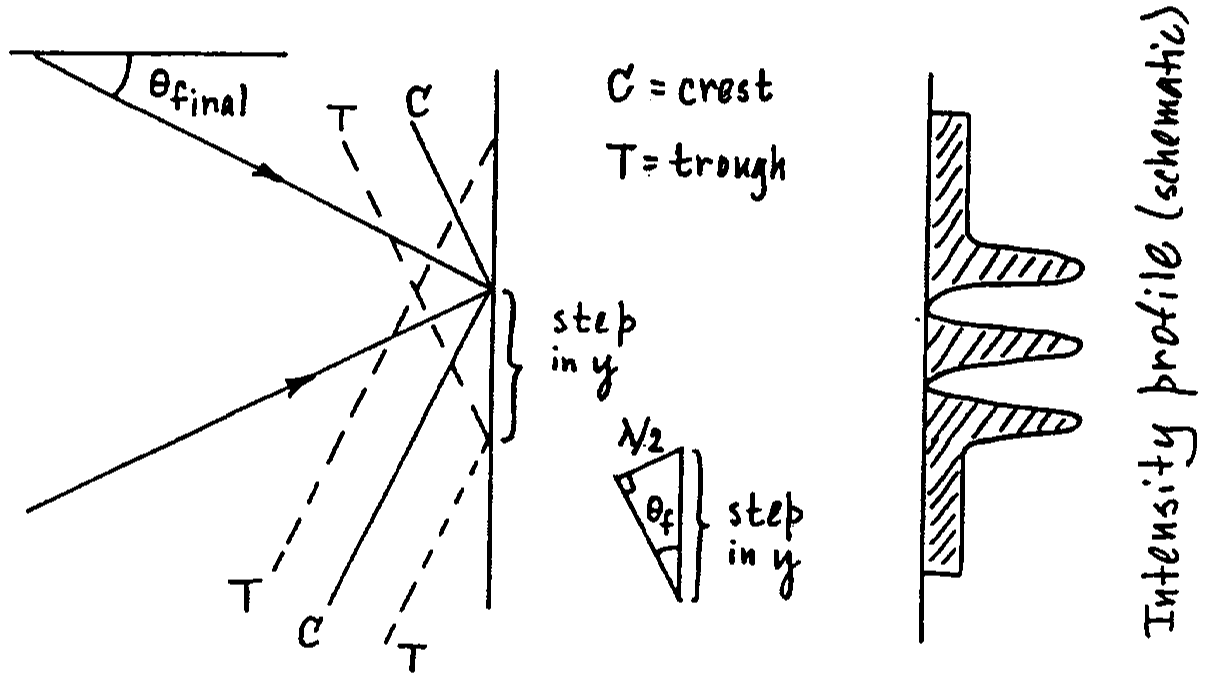
Reference to the sketch indicates that
Because the region of overlap has a full width of meter, there will be roughly 500 interference maxima. Note that the interval between adjacent maxima does not depend on either or (unlike the situation with ordinary “double slit interference”).
Historical note. This problem is based on the now-classic experiment by G. Mollenstedt and H. Duker, “Observation and Measurement of BiPrism Interference with Electron Waves,” Zeitschrift fur Physik, 145, pp. 377–397 (1956).
Grading Scheme
Theoretical Problem 3: Grading Scheme
Part 1. 1 point.
correct outside of wire: 1 point.
inside wire: ignore in the grading. (Some students may ignore the interior because there is no field there.)
Part 2. 5 points distributed as follows:
| Criterion | Points |
|---|---|
| independent of | 1 |
| or or equivalent | +1 |
| Numerical coefficient correct to within a factor of 4 | +2 |
| Numerical coefficient correct to within 20% | +1 |
Part 3. 1.5 points:
| Criterion | Points |
|---|---|
| Overlap region exists | 0.5 |
| Constant densities of impacts within each region | +0.25 |
| Correct ratio of intensities | +0.25 |
| Full width of pattern correct, given student's value for | +0.25 |
| Width of overlap region correct, given student's value for | +0.25 |
Part 4. 2.5 points:
| Criterion | Points |
|---|---|
| Recognizes that “two wave” interference occurs | 0.5 |
| Correct de Broglie wavelength | 0.5 |
| Correct separation of maxima | +1.5 |
[If separation of maxima is wrong by merely a factor of 2, then partial credit: +1 point.]
Maxima in intensity = 4 times single-wave intensity: ignore in grading.
Оригинал в Архива: ipho93.pdf · официални решения: ipho93.pdf