IPhO 1994, Теория — Задача 1. Relativistic Particle
XXV International Physics Olympiad — Beijing, People’s Republic of China — Theoretical competition, July13,1994 · 13 юли 1994 г. · 10 т.
Внимание: Бележка към темата
The complete archived booklet contains three theory tasks and two experiments. Theory is shown here separately using original pages1–21. Points are taken from the native marking schemes; the round total30 is their sum. Native source errors are retained: inconsistent S/Sprime/Sdoubleprime labels, the first quark-table header beta*x/e, Fig1 L=p0/f withoutc, inconsistent rubric subtotals, signed-current/rate wording in the magnet key, Vprime_tn in collision Eq2 and missing multiplicativeV in Eq9. These are printed source defects, not silently corrected solutions. The leading 0 of the upper0.5A label in native Fig7c is already clipped in the original page; the complete available source graphic is retained.
Theoretical competition — July13,1994 — Time available:5hours
- Use only the ball pen provided.
- Your graphs should be drawn on the answer sheets attached to the problem.
- Your solutions should be written on the sheets of paper attached to the problems.
- Write at the top of the first page of each problem:
- The total number of pages in your solution to the problem
- Your name and code number
Условие
In the theory of special relativity the relation between energy and momentum or a free particle with rest mass is
When such a particle is subject to a conservative force, the total energy of the particle, which is the sum of and the potential energy, is conserved. If the energy of the particle is very high, the rest energy of the particle can be ignored (such a particle is called an ultra relativistic particle).
1) consider the one dimensional motion of a very high energy particle (in which rest energy can be neglected) subject to an attractive central force of constant magnitude . Suppose the particle is located at the centre of force with initial momentum at time . Describe the motion of the particle by separately plotting, for at least one period of the motion: against time , and momentum against space coordinate . Specify the coordinates of the “turning points” in terms of given parameters and . Indicate, with arrows, the direction of the progress of the mothon in the diagram. There may be short intervals of time during which the particle is not ultrarelativistic. However, these should be neglected.
Use Answer Sheet 1.
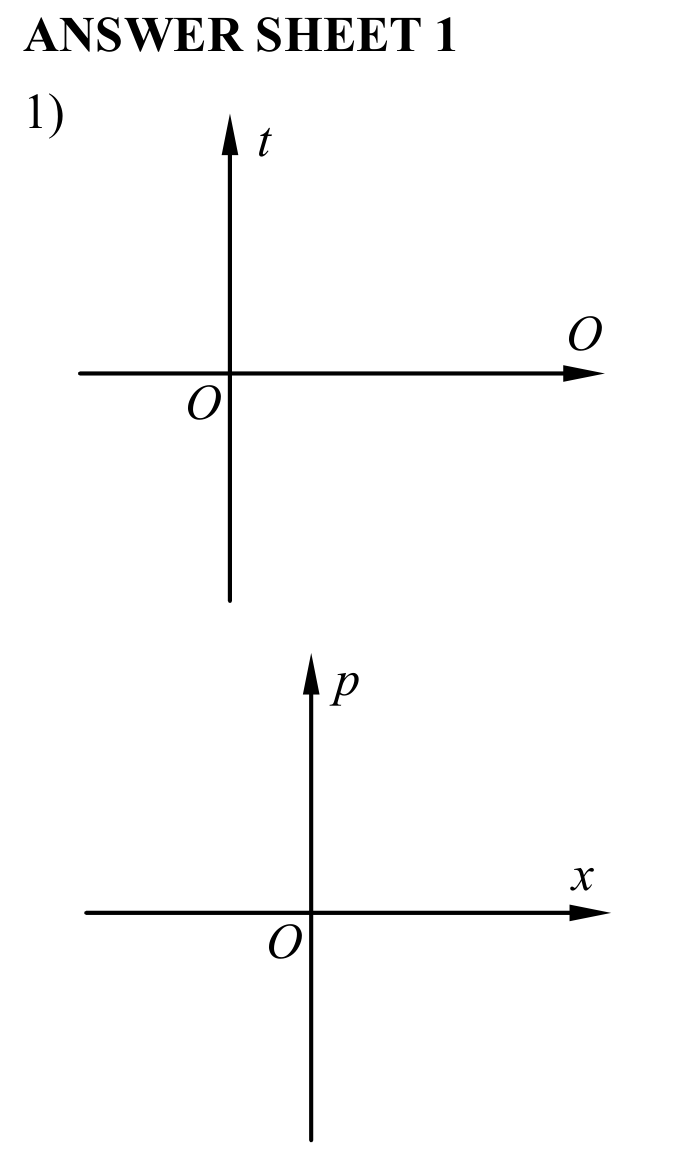
[2 т.]
2) A meson is a particle made up of two quarks. The rest mass of the meson is equal to the total energy of the two-quark system divided by .
Consider a one-dimensional model for a meson at rest, in which the two quarks are assumed to move along the -axis and attract each other with a force of constant magnitude . It is assumed they can pass through each other freely. For analysis of the high energy motion of the quarks the rest mass of the quarks can be neglected. At time the two quarks are both at . Show separately the motion of the two quarks graphically by a diagram and a diagram, specify the coordinates of the “turning points” in terms of and , indicate the direction of the process in your diagram, and determine the maximum distance between the two quarks.
Use Answer Sheet 2.
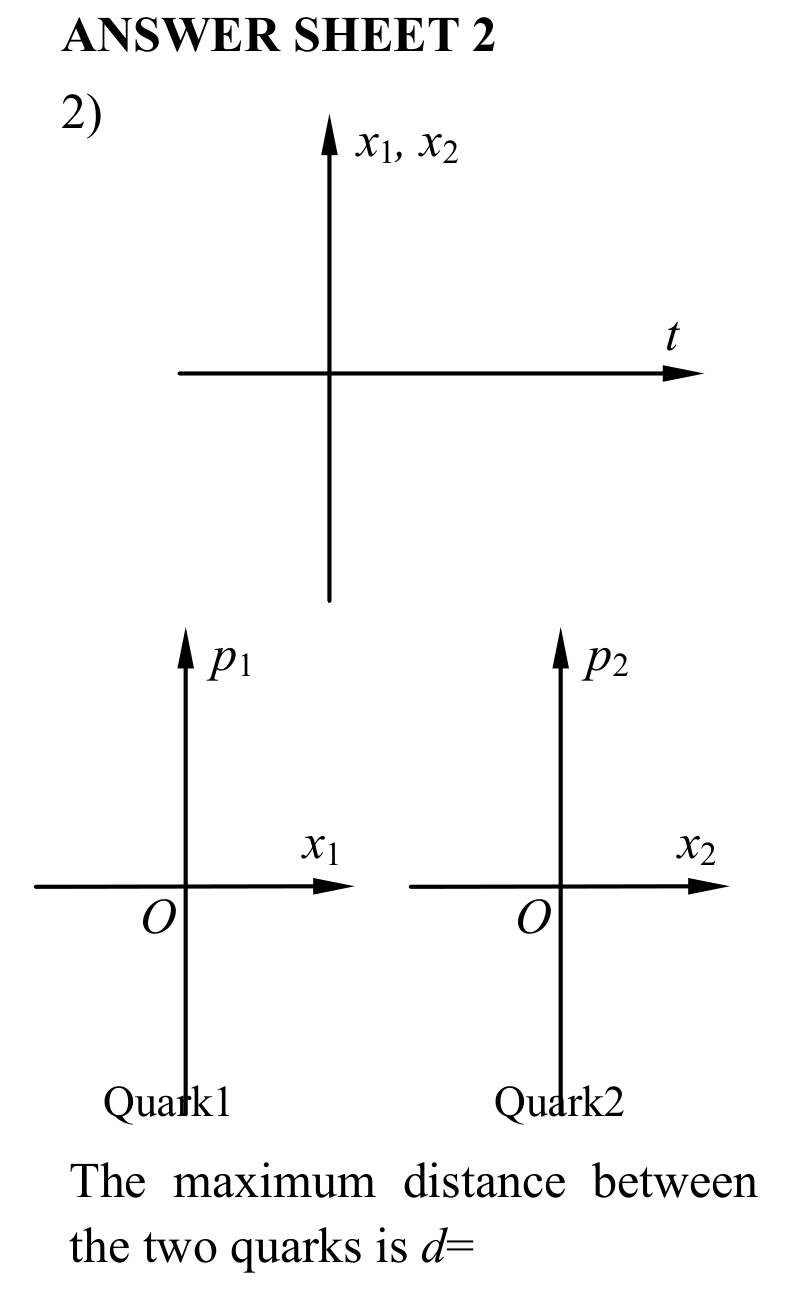
[4 т.]
3) The reference frame used in part 2 will be referred to as frame , the Lab frame, referred to as , moves in the negative -direction with a constant velocity . the coordinates in the two reference frames are so chosen that the point in coincides with the point in at time . Plot the motion of the two quarks graphically in a diagram. Specify the coordinates of the turning points in terms of , and , and determine the maximum distance between the two quarks observed in Lab frame .
Use Answer Sheet 3.
The coordinates of particle observed in reference frames and are related by the Lorentz transformation
where , and is the velocity of frame moving relative to the frame .
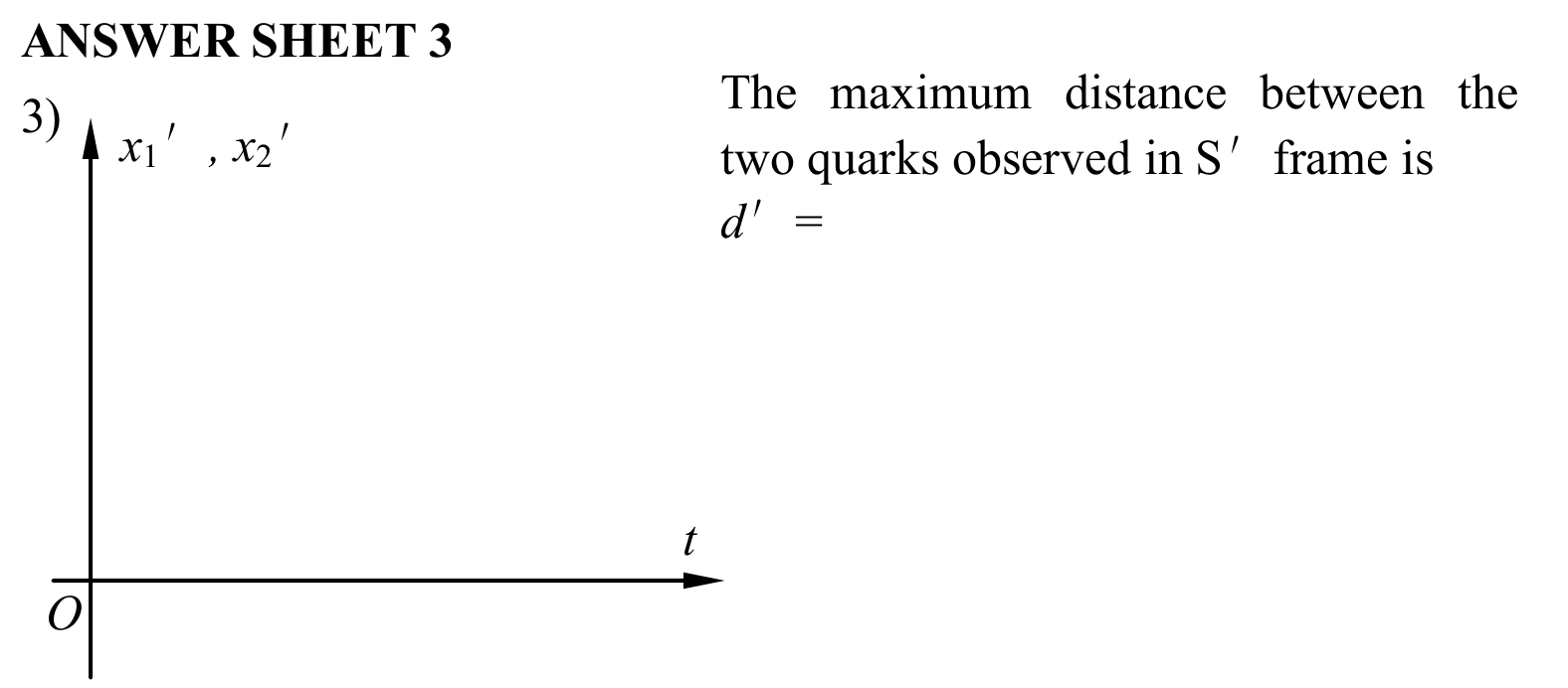
[3 т.]
4) For a meson with rest energy and velocity relative to the Lab frame , determine its energy in the Lab Frame . [1 т.]
Решение
1)
1a. Taking the force center as the origin of the space coordinate and the zero potential point, the potential energy of the particle is
The total energy is
1b. Neglecting the rest energy, we get
Since is conserved throughout the motion, so we have
Let the axis be in the direction of the initial momentum of the particle,
The maximum distance of the particle from the origin, let it be , corresponds to . It is
1c. From Eq. 3 and Newton’s law
we can get the speed of the particle as
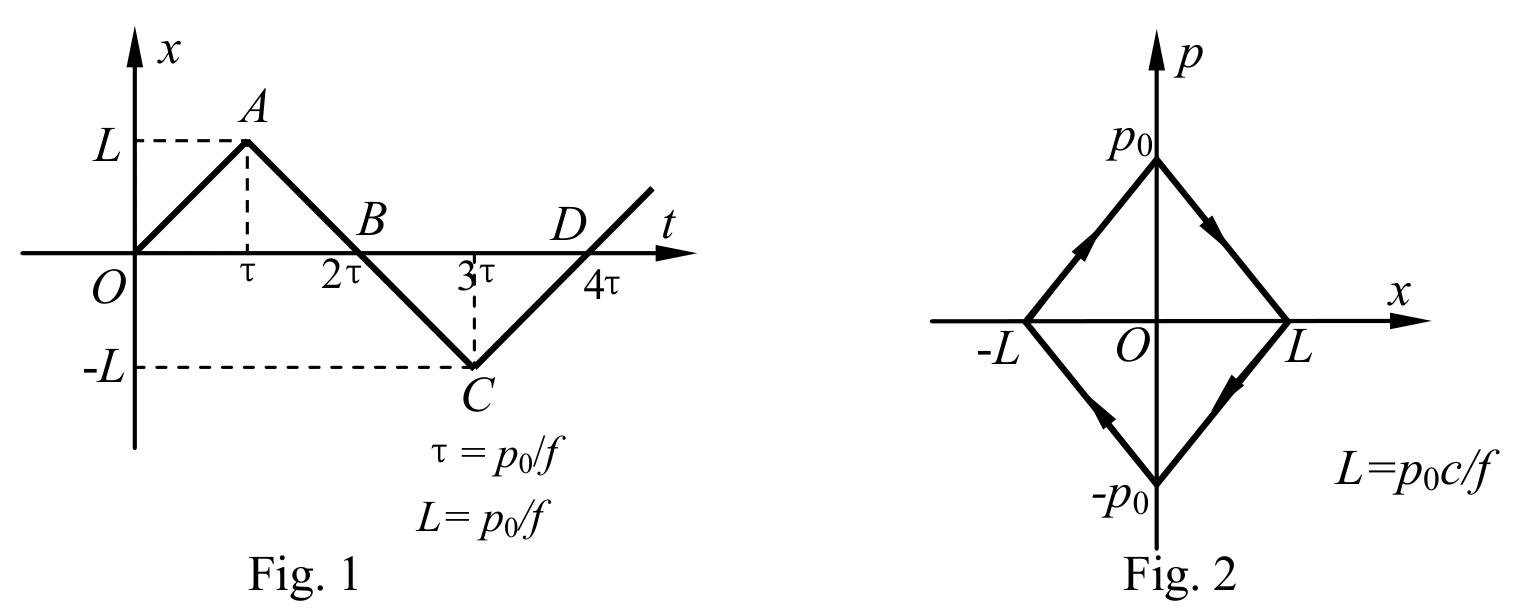
i.e. the particle with very high energy always moves with the speed of light except that it is in the region extremely close to the points . The time for the particle to move from origin to the point , let it be denoted by , is
So the particle moves to and for between and with speed and period . The relation between and is
The required answer is thus as given in Fig. 1 and Fig. 2.
2)
The total energy of the two-quark system can be expressed as
where are the position coordinates and are the momenta of quark 1 and quark 2 respectively. For the rest meson, the total momentum of the two quarks is zero and the two quarks move symmetrically in opposite directions, we have
Let denote the momentum of the quark 1 when it is at , then we have
From Eq. 8, 9 and 10, the half of the total energy can be expressed in terms of and of quark 1:
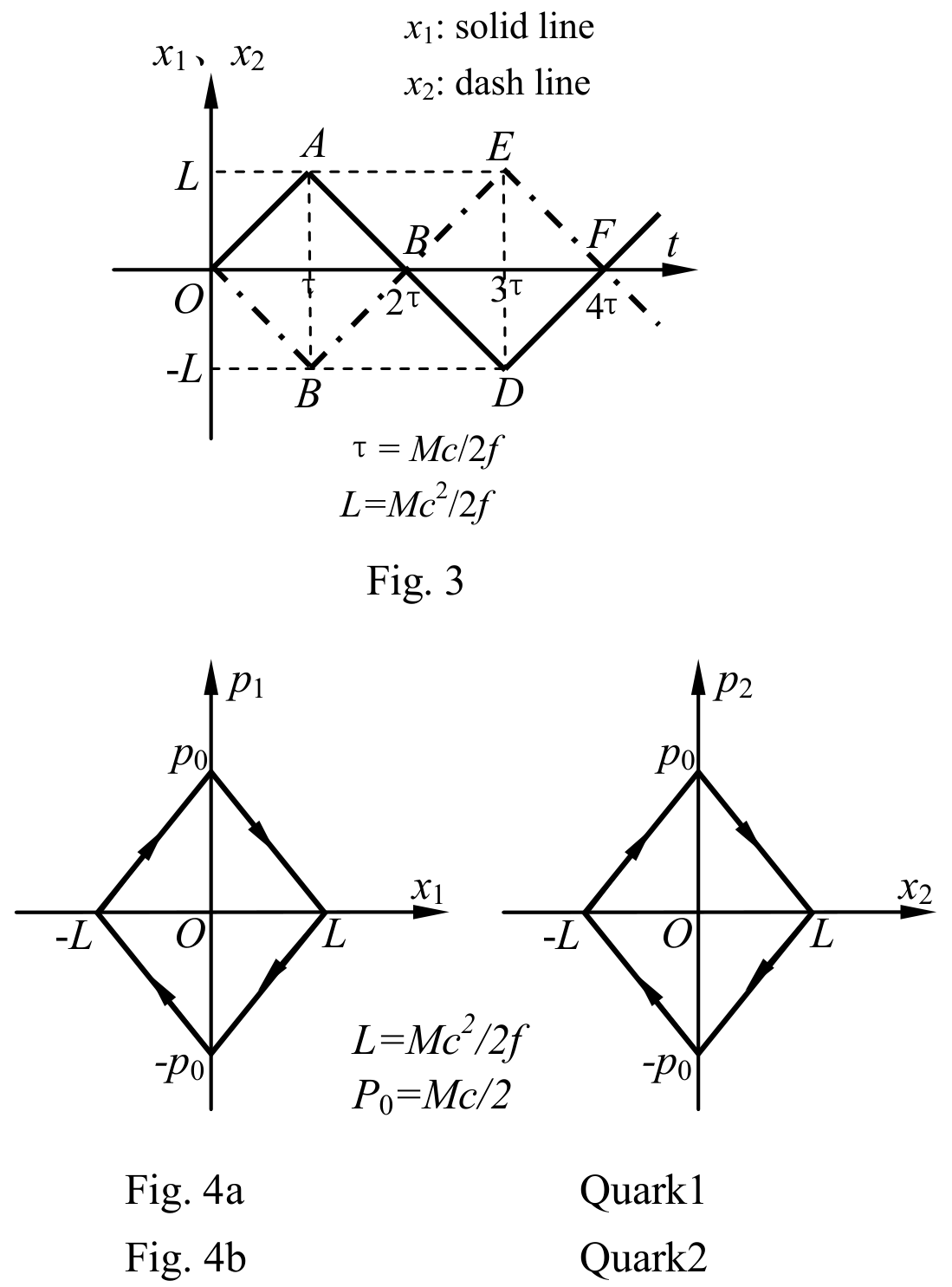
just as though it is a one particle problem as in part 1 (Eq. 3) with initial momentum . From the answer in part 1 we get the diagram and diagram of the motion of quark 1 as shown in Figs. 3 and 4. For quark 2 the situation is similar except that the signs are reversed for both and ; its and diagrams are shown in Figs. 3 and 4.
The maximum distance between the two quarks as seen from Fig. 3 is
3)
The reference frame moves with a constant velocity relative to the Lab frame in the axis direction, and the origins of the two frames are coincident at the beginning . The Lorentz transformation between these two frames is given by:
where , and . With , we have , and . Since the Lorenta transformation is linear, a straight line in the diagram transforms into a straight line the diagram, thus we need only to calculate the coordinates of the turning points in the frame .
For quark 1, the coordinates of the turning points in the frames and are as follows:
| Frame : | Frame : | ||
|---|---|---|---|
where , .
For quark 2, we have
| Frame : | Frame : | ||
|---|---|---|---|
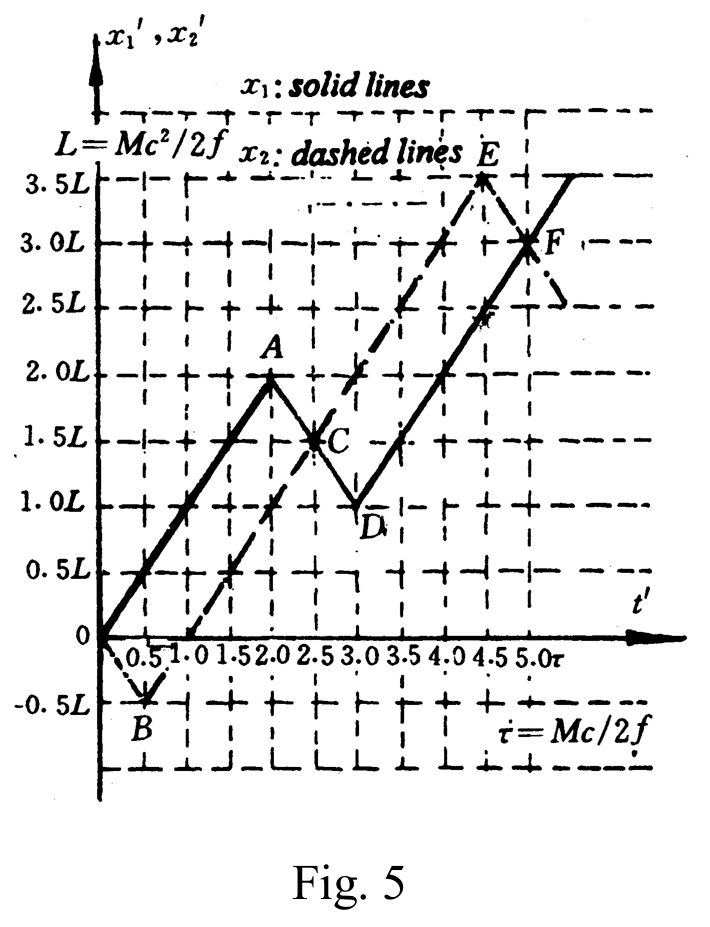
With the above results, the diagrams of the two quarks are shown in Fig. 5. The equations of the straight lines OA and OB are:
The distance between the two quarks attains its maximum when , thus we have maximum distance
4)
It is given the meson moves with velocity relative to the Lab frame, its energy measured in the Lab frame is
Grading Scheme
Part 1 — 2 points, distributed as follows:
- 0.4 point for the shape of in Fig. 1;
- 0.3 point for 4 equal intervals in Fig. 1; (0.3 for correct derivation of the formula only)
- 0.1 each for the coordinates of the turning points A and C, 0.4 point in total;
- 0.4 point for the shape of in Fig. 2; (0.2 for correct derivation only)
- 0.1 each for specification of , , , and arrows, 0.5 point in total. (0.05 each for correct calculations of coordinate of turning points only).
Part 2 — 4 points, distributed as follows:
- 0.6 each for the shape of and , 1.2 points in total;
- 0.1 each for the coordinates of the turning points A, B, D and E in Fig. 3, 0.8 point in total;
- 0.3 each for the shape of and , 0.6 point in total;
- 0.1 each for , , , and arrows in Fig. 4a and Fig. 4b, 1 point in total;
- 0.4 point for .
Part 3 — 3 point, distributed as follows:
- 0.8 each for the shape of and , 1.6 points in total;
- 0.1 each for the coordinates of the turning points A, B, D and E in Fig. 5, 0.8 point in total; (0.05 each for correct calculations of coordinate of turning points only).
- 0.6 point for .
Part 4 — 1 point (0.5 point for the calculation formula; 0.5 point for the numerical value and units).
Оригинал в Архива: ipho94.pdf · решение от архива: ipho94.pdf