IPhO 1994, Теория — Задача 3. Collision of Discs with Surface Friction
XXV International Physics Olympiad — Beijing, People’s Republic of China — Theoretical competition, July13,1994 · 13 юли 1994 г. · 10 т.
Внимание: Бележка към темата
The complete archived booklet contains three theory tasks and two experiments. Theory is shown here separately using original pages1–21. Points are taken from the native marking schemes; the round total30 is their sum. Native source errors are retained: inconsistent S/Sprime/Sdoubleprime labels, the first quark-table header beta*x/e, Fig1 L=p0/f withoutc, inconsistent rubric subtotals, signed-current/rate wording in the magnet key, Vprime_tn in collision Eq2 and missing multiplicativeV in Eq9. These are printed source defects, not silently corrected solutions. The leading 0 of the upper0.5A label in native Fig7c is already clipped in the original page; the complete available source graphic is retained.
Theoretical competition — July13,1994 — Time available:5hours
- Use only the ball pen provided.
- Your graphs should be drawn on the answer sheets attached to the problem.
- Your solutions should be written on the sheets of paper attached to the problems.
- Write at the top of the first page of each problem:
- The total number of pages in your solution to the problem
- Your name and code number
Условие
A homogeneous disc A of mass and radius moves translationally on a smooth horizontal - plane in the direction with a velocity (see the figure on the next page). The center of the disk is at a distance from the -axis. It collides with a stationary homogeneous disc B whose center is initially located at the origin of the coordinate system. The disc B has the same mass and the same thickness as A, but its radius is . It is assumed that the velocities of the discs at their point of contact, in the direction perpendicular to the line joining their centers, are equal after the collision. It is also assumed that the magnitudes of the relative velocities of the discs along the line joining their centers are the same before and after the collision.
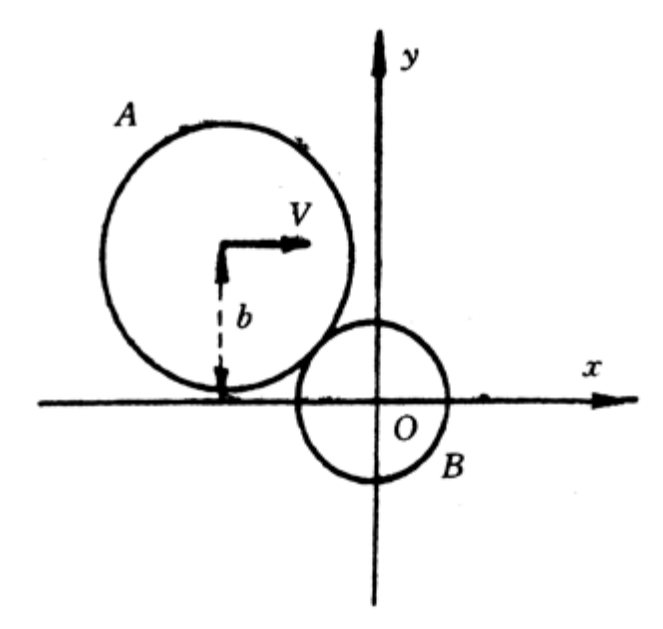
1) For such a collision determine the and components of the velocities of the two discs after the collision, i.e. , , and in terms of , , , and . [8 т.]
2) Determine the kinetic energies for disc A and for disc B after the collision in terms of , , , and . [2 т.]
Решение
1)
When disc A collides with disc B, let be the unit vector along the normal to the surfaces at the point of contact and be the tangential unit vector as shown in the figure. Let be the angle between and the axis. Then we have
The momentum components of A and B along and before collision are:
Denote the corresponding momentum components of A and B after collision by , , , and . Let and be the angular velocities of A and B about the axes through their centers after collision, and and be their corresponding moments of intertia. Then,
The conservation of momentum gives
The conservation of angular momentum about the axis through O gives
The impulse of the friction force exerted on B during collision will cause a momentum change of along and produces an angular momentum simultaneously. They are related by.
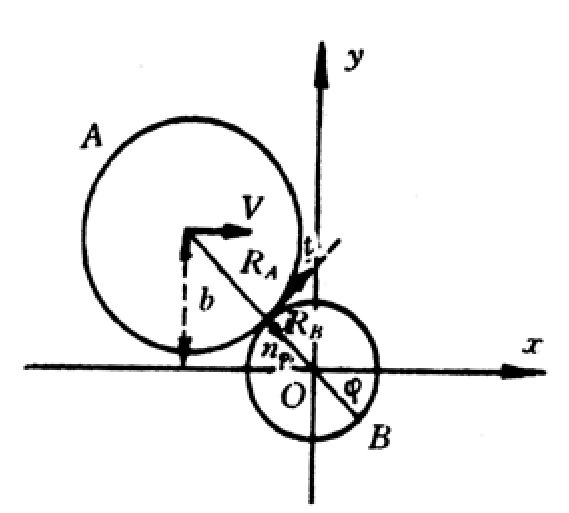
During the collision at the point of contact A and B acquires the same tangential velocities, so we have
It is given that the magnitudes of the relative velocities along the normal direction of the two discs before and after collision are equal, i.e.
From Eqs. 1 and 6 we get
From Eqs. 2 to 5, we get
The and components of the velocities after collision are:
2)
After the collision, the kinetic energy of disc A is
while the kinetic energy of disc B is
Grading Scheme
- After the collision, the velocity components of discs A and B are shown in Eq. 7, 8, 9 and 10 of the solution respectively. The total points of this part is 8.0. If the result in which all four velocity components are correct has not been obtained, the point is marked according to the following rules.
- 0.8 point for each correct velocity component;
- 0.8 point for the correct description of that the magnitudes of the relative velocities of the discs along the line joining their centers are the same before and after the collision.
- 0.8 point for the correct description of the conservation for angular momentum;
- 0.8 point for the correct description of the equal tangential velocity at the touching point;
- 0.8 point for the correct description of the relation between the impulse and the moment of the impulse.
- After the collision, the kinetic energies of disc A and disc B are shown in Eqs. 11 and 12 of the solution respectively.
- 1.0 point for the correct kinetic energies of disc A;
- 1.0 point for the correct kinetic energies of disc B;
The total points of this part is 2.0.
Оригинал в Архива: ipho94.pdf · решение от архива: ipho94.pdf