IPhO 1995, Експеримент — Задача 1. Terminal velocity in a viscous liquid
Experimental Question 1 · 20 т.
Условие
An object falling in a liquid will eventually reach a constant velocity, called the terminal velocity. The aim of this experiment is to measure the terminal velocities of objects falling through glycerine.
For a sphere of radius falling at velocity through a viscous liquid, the viscous force is given by . Here is a property of the liquid called the viscosity. In this experiment you will measure the terminal velocity of metal cylinders (because cylinders are easier to make than spheres). The diameter of each cylinder is equal to its length, and we will assume the viscous force on such a cylinder is similar to the viscous force on a sphere of the same diameter, :
where , for a sphere.
Preliminary Calculation of terminal velocity (2 marks)
If is the density of the cylinder and is the density of the liquid, show that the terminal velocity of the cylinder is given by
where is a constant and derive a expression for . [2 т.]
Experiment Use the equipment available to determine the numerical value of the exponent (10 marks) and the density of glycerine (8 marks). [18 т.]
Notes
- For consistency, try to ensure that the cylinders fall in the same orientation, with the axis of the cylinder horizontal.
- The tolerances on the diameter and the length of the cylinders are 0.05 mm (you need not measure them yourself).
- There is a brass sieve inside the container that you should use to retrieve the metal cylinders. Important: make sure the sieve is in place before dropping objects into the glycerine, otherwise you will not be able to retrieve them for repeat measurements.
- When glycerine absorbs water from the atmosphere, it becomes less viscous. Ensure that the cylinder of glycerine is covered with the plastic film provided when not in use.
- Do not mix cylinders of different size and different material after the experiment.
| Material | Density (kgm) |
|---|---|
| Aluminium | |
| Titanium | |
| Stainless steel | |
| Copper |
Отговори
Preliminary
Experiment m ≈ 1.33 (uncertainty of order ±0.1); ρ' = (1.1 ± 0.2) × 10³ kg.m⁻³
Typical results from the official sample data. The marking scheme states the "Correct" density as "1.260 kg.m⁻³" (printed as such; presumably 1.260 × 10³ kg.m⁻³).
Решение
Preliminary: Calculation of Terminal Velocity
When the cylinder is moving at its terminal velocity, the resultant of the three forces acting on the cylinder, gravity, viscous drag and buoyant force, is zero.
where is the volume of a cylinder (whose height is ).
This gives
where
Experiment
Determination of the exponent
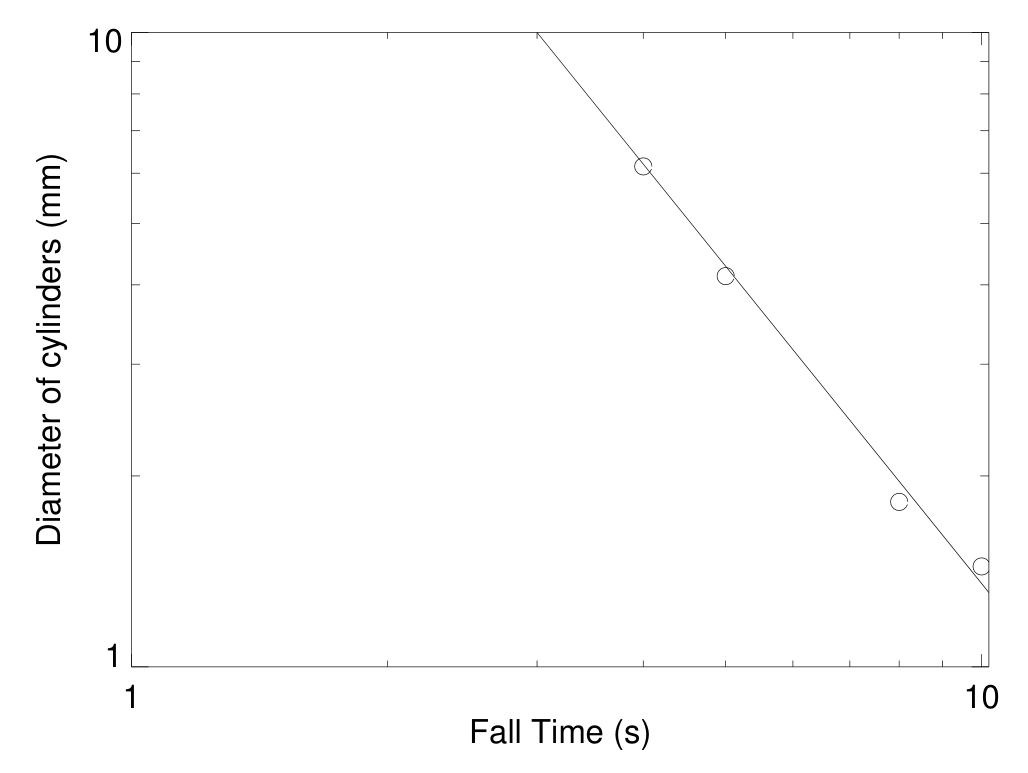
Aluminium cylinders of different diameters are dropped into the glycerine. Fall times between specified marks on the measuring cylinder containing the glycerine are recorded for each cylinder. A preliminary experiment should establish that the cylinders have reached their terminal velocity before detailed results are obtained. The measurements are repeated several times for each cylinder and an average fall time is calculated. Table 1 shows a typical set of data. To find the value of a graph of log(fall time) as a function of log(diameter) is plotted as in figure 1. The slope of the resulting straight line graph is from which a value of can be determined. A reasonable value for is 1.33 with an uncertainty of order . The uncertainty is estimated by the deviation from the line of best fit through the data points obtained by drawing other possible lines.
Determination of the density of glycerine
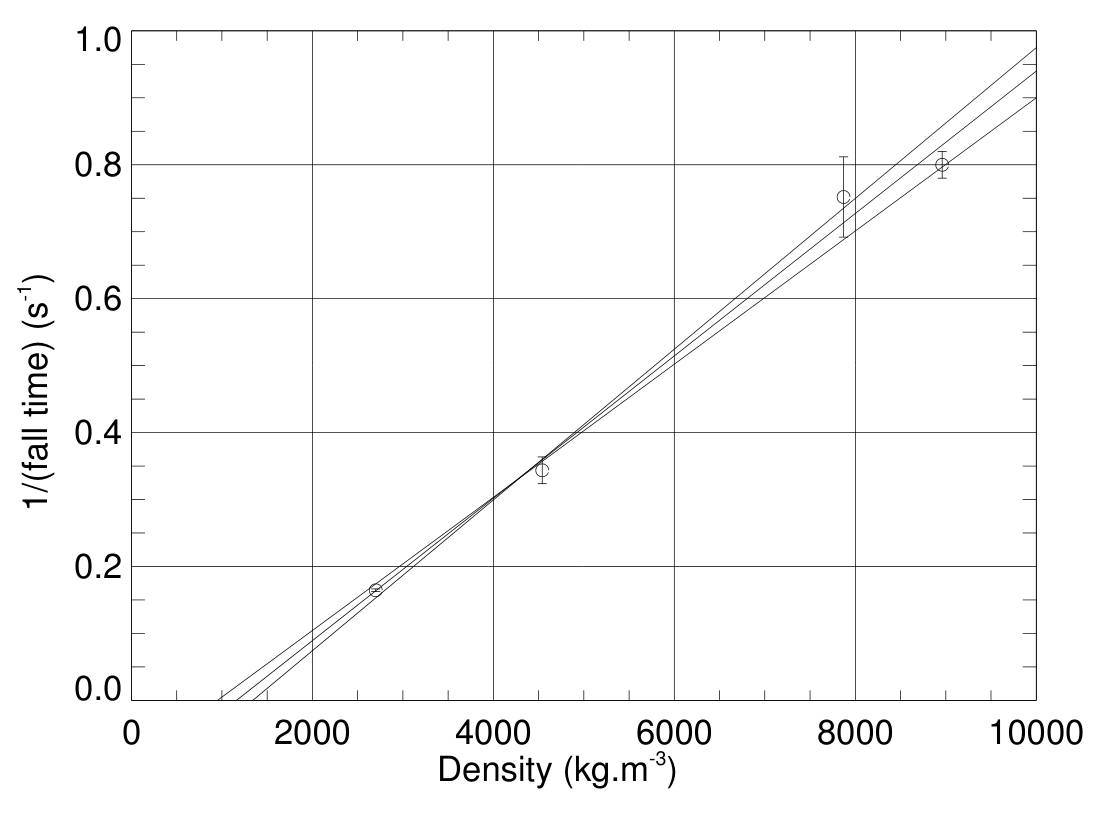
Cylinders with the same geometry but different densities are dropped into the glycerine and timed as in the first part of the experiment. Table 2 shows a typical set of results. From equation (2) a linear plot of as a function of density should yield a straight line with an intercept on the density axis corresponding to the density of glycerine. Figure 2 shows a typical plot. Alternatively the terminal velocities could be calculated and plotted against density which would again lead to the same intercept on the density axis. The uncertainty in the measurement can be estimated by drawing other possible straight lines through the data points and noting the change in the value of the intercept.
| Diameter (mm) | Individual readings (s) | Mean (s) | |||||
|---|---|---|---|---|---|---|---|
| 10 | 1.44 | 1.56 | 1.44 | 1.37 | 1.44 | 1.41 | 1.44 |
| 4 | 6.22 | 6.06 | 6.16 | 6.13 | 6.13 | 6.22 | 6.15 |
| 8 | 1.80 | 1.82 | 1.78 | 1.84 | 1.82 | 1.81 | 1.82 |
| 5 | 4.06 | 4.34 | 4.09 | 4.12 | 4.25 | 4.13 | 4.13 |
Table 1: Sample data set
| Material | Individual readings (s) | Mean (s) | |||||
|---|---|---|---|---|---|---|---|
| Ti | 3.00 | 2.91 | 2.97 | 2.91 | 2.84 | 2.75 | 2.91 |
| Cu | 1.25 | 1.25 | 1.28 | 1.25 | 1.22 | 1.22 | 1.25 |
| S.Steel | 1.31 | 1.32 | 1.38 | 1.44 | 1.31 | 1.34 | 1.33 |
| Al | 6.03 | 6.09 | 6.09 | 6.16 | 6.06 | 6.06 | 6.08 |
Table 2: Sample data set
Detailed mark allocation
| Section I | |
|---|---|
| Reasonable range of data points with a scatter of s | [2] |
| Check that the cylinders have reached their terminal velocity | |
| Visual check, or check referred to | [1] |
| Specific data presented | [1] |
| Labelled log-log graph | [2] |
| Data points for all samples, with a reasonable scatter about a straight line on the log-log graph | [1] |
| Calculation of from graph | [1] |
| including estimate of error in determining | [1] |
| Reasonable value of , | [1] |
| Subtotal | [10] |
| Section 2 | |
| Reasonable range of data points | [1] |
| Check that the cylinders have reached their terminal velocity | [1] |
| Labelled graph of (falltime) vs. density of cylinder | [1] |
| Data points for all samples, with a reasonable scatter about a straight line on the (falltime) vs. density of cylinder graph | [1] |
| Calculation of the density of glycerine () from this graph | [1] |
| Estimate of uncertainty in | [1] |
| Reasonable value of . “Correct” value is 1.260 kg.m | [1] |
| Subtotal | [8] |
| TOTAL | 20 |
Оригинал в Архива: exp1.pdf · официални решения: exp1_sol.pdf