IPhO 1995, Теория — Задача 4. Original Theoretical Question 3: Laser and Mirror
XXVI IPhO — Theoretical Questions
Условие
The following question was not used in the XXVI IPhO examination.
(a) Light of frequency and speed is directed at an angle of incidence to the normal of a mirror, which is receding at speed in the direction of the normal. Assuming the photons in the light beam undergo an elastic collision in the rest frame of the mirror, determine in terms of and the angle of reflection of the light and the reflected frequency , with respect to the original frame.
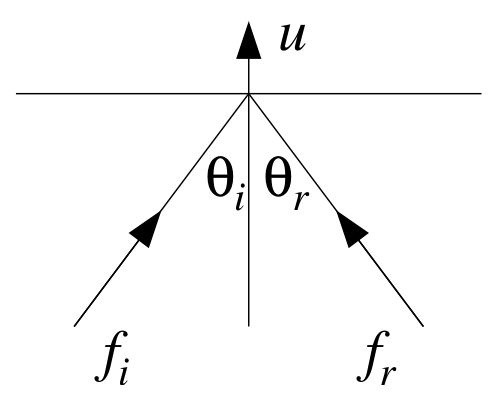
[You may assume the following Lorentz transformation rules apply to a particle with energy and momentum :
where is the relative velocity between the two inertial frames; stands for the component of momentum perpendicular to and represents the component of momentum parallel to .]
(b) A thin rectangular light mirror, perfectly reflecting on each side, of width and mass , is mounted in a vacuum (to eliminate air resistance), on essentially frictionless needle bearings, so that it can rotate about a vertical axis. A narrow laser beam operating continuously with power is incident on the mirror, at a distance from the axis, as drawn.
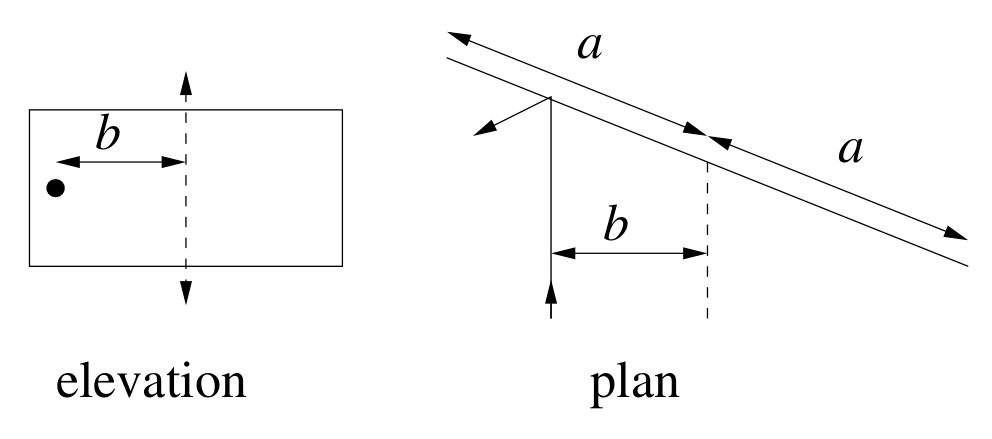
Suppose the mirror is originally at rest. The impact of the light causes the mirror to acquire a very small but not constant angular acceleration. To analyse the situation approximately, assume that at any given stage in the acceleration process the angular velocity of the mirror is constant throughout any one complete revolution, but takes on a slightly larger value in the next revolution due to the angular momentum imparted to the mirror by the light during the preceding revolution. Ignoring second order terms in the ratio (mirror velocity / ), calculate this increment of angular momentum per revolution at any given value of . [HINT: You may find it useful to know that .]
(c) Using the fact that the velocity of recoil of the mirror remains small compared with , derive an approximate expression for as a function of time.
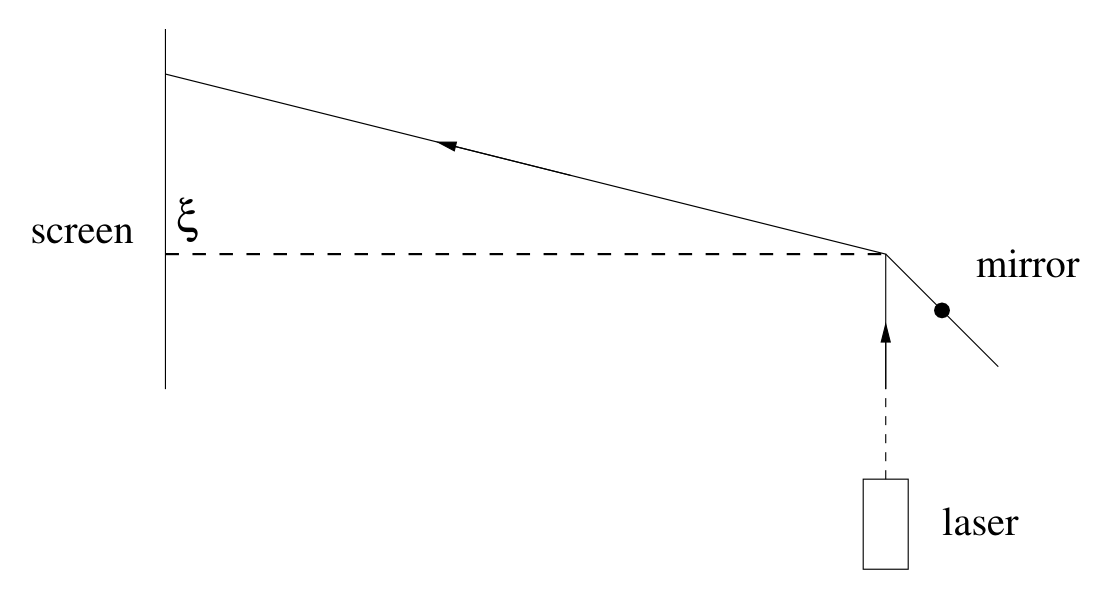
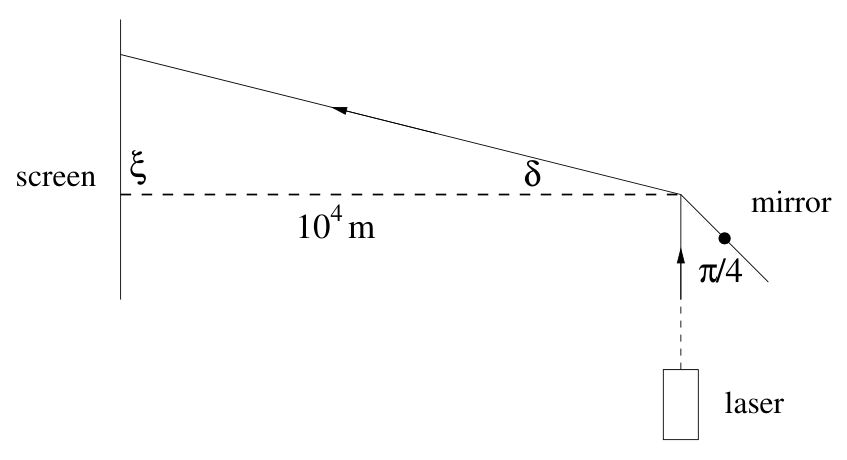
(d) As the mirror rotates, there will be instants when the light is reflected from its edge, giving the reflected ray an angle of somewhat more than with respect to the incident beam.. A screen 10 km away, with its normal perpendicular to the incident beam, intercepts the beam reflected from near the mirror’s edge. Find the deviation of that extreme spot from its initial position (as shown by the dashed line, when the mirror was almost at rest), after the laser has operated for 24 hours. You may suppose the laser power is W, that the mirror has mass gram and that the geometry of the apparatus corresponds to . Neglect diffraction effects at the edge.
Отговори
- (a)
- (b)
- (c)
- (d) 2.9 mm
Решение
(a)
Choose a frame where is along the normal to the mirror and the light rays define the – plane. For convenience, recording the energy-momentum in the four-vector form, , the initial photon has
where .
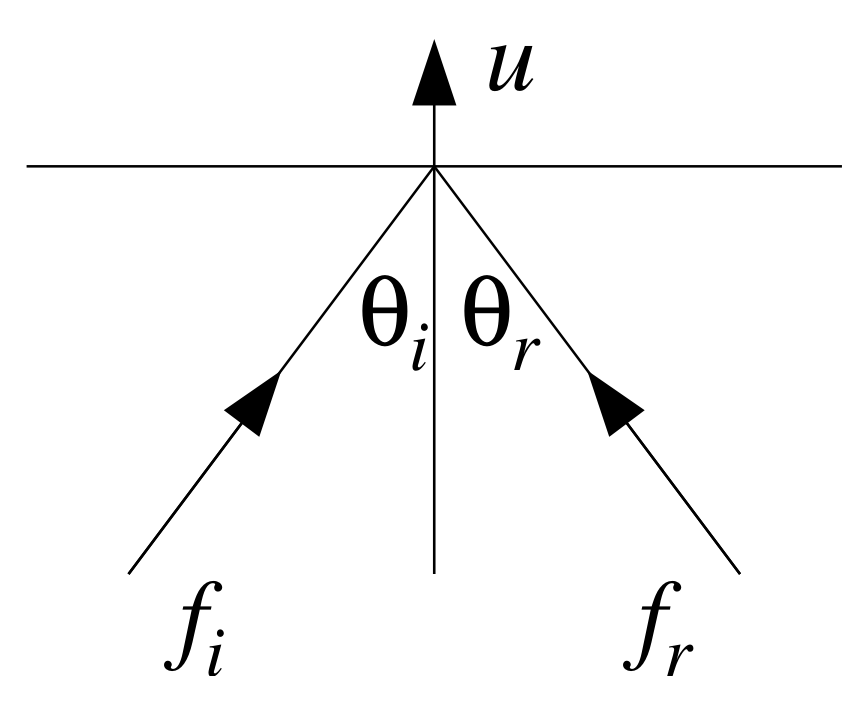
By the given Lorentz transformation rules, in the moving mirror frame the energy-momentum of the incident photon reads
Assuming the collision is elastic in that frame, the reflected photon has energy-momentum,
Transforming back to the original frame, we find that the reflected photon has
Simplifying these expressions, the energy-momentum of the reflected photon in the original frame is
Hence the angle of reflection is given by
while the ratio of reflected frequency to incident frequency is simply the energy ratio,
[For future use we may record the changes to first order in :
Thus, and .]
(b)
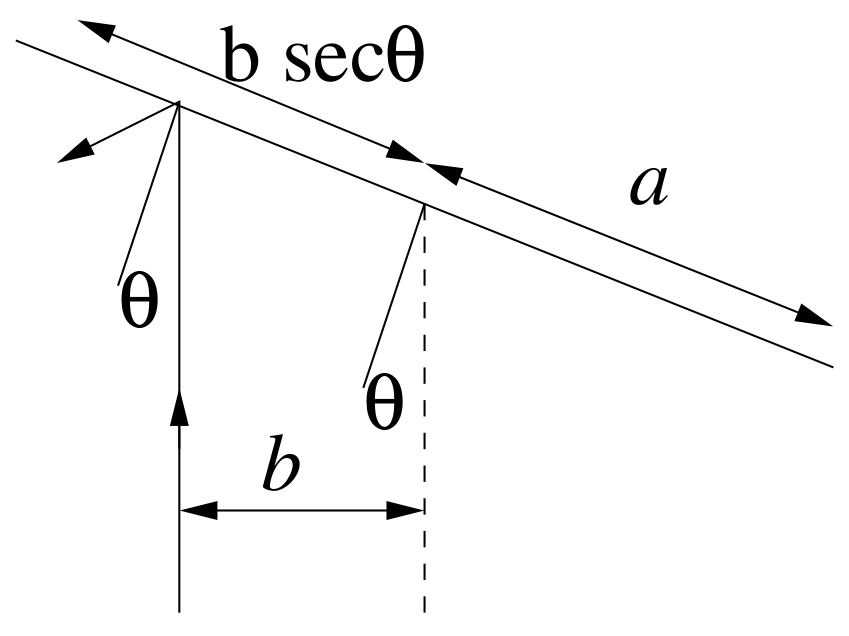
Hereafter define . Provided that the laser light will reflect off the mirror, so is needed for photon energy-momentum to be imparted to the mirror. Let us then define a critical angle via .
The change in the normal component of the momentum of a single photon is
Since , per photon. Suppose photons strike every second (and is less than the critical angle ). Then in time we have photons. But , so in this time we have,
Thus the change in per revolution is
where refers to the number of revolutions. So
since each photon has energy and laser power equals .
Clearly always, so ; thus
(c)
Therefore if is the moment of inertia of the mirror about its axis of rotation,
[Some students may derive the rate of change of angular velocity using energy conservation, rather than considering the increase of angular momentum of the mirror: To first order in , , therefore the energy imparted to the mirror is
In one revolution, the number of photons intersected is
Therefore the rate of increase of rotational energy is
Thus , leading to , again.]
(d)
To estimate the deflection of the beam, one first needs to work out the moment of inertia of a rectangle of mass and side about the central axis. This is just like a rod. From basic principles,
With the stated geometry, , or , so
At the edge, , and the angle of deviation is
[Interestingly, it is determined by the ratio of the energy produced by the laser to the rest-mass energy of the mirror.]
Using the given numbers, and in SI units, the deviation is
Оригинал в Архива: th.pdf · официални решения: th_sol.pdf