IPhO 1995, Теория — Задача 3. Cylindrical Buoy
XXVI IPhO — Theoretical Questions · 20 т.
Условие
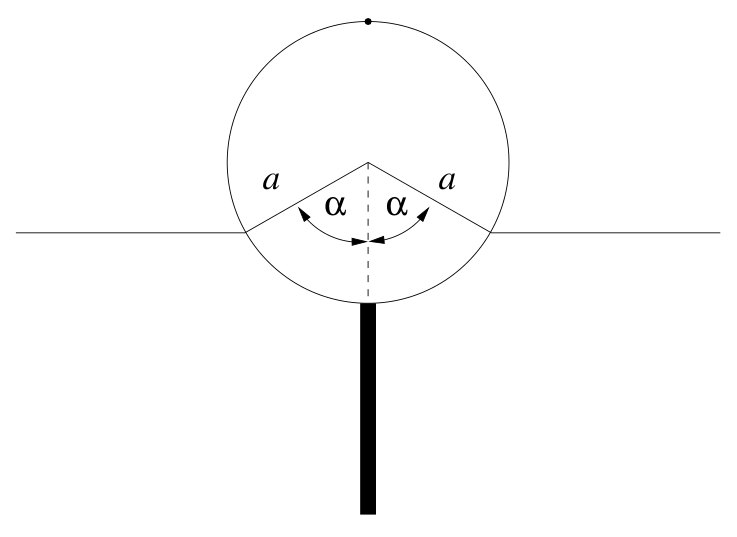
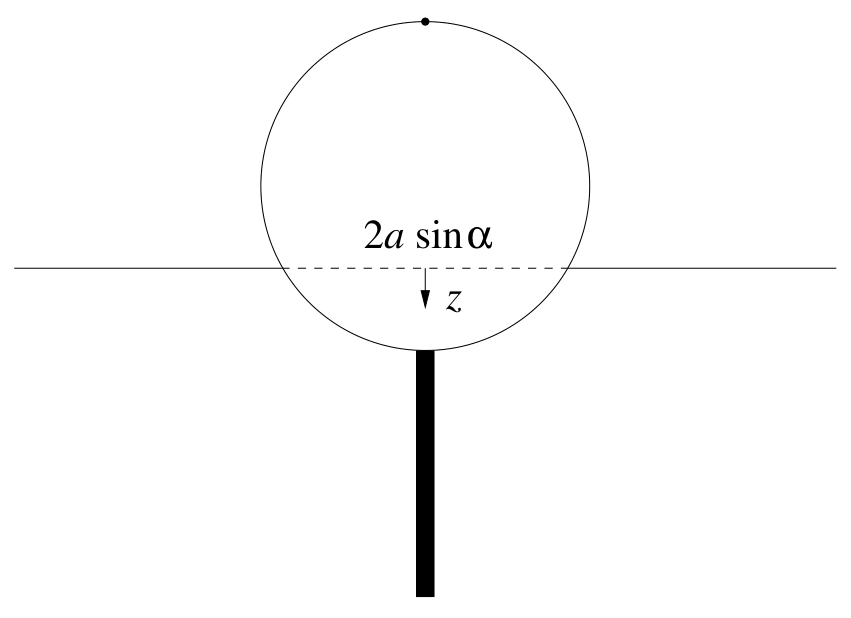
(a) A buoy consists of a solid cylinder, radius , length , made of lightweight material of uniform density with a uniform rigid rod protruding directly outwards from the bottom halfway along the length. The mass of the rod is equal to that of the cylinder, its length is the same as the diameter of the cylinder and the density of the rod is greater than that of seawater. This buoy is floating in sea-water of density .
In equilibrium derive an expression relating the floating angle , as drawn, to . Neglect the volume of the rod. [3 т.]
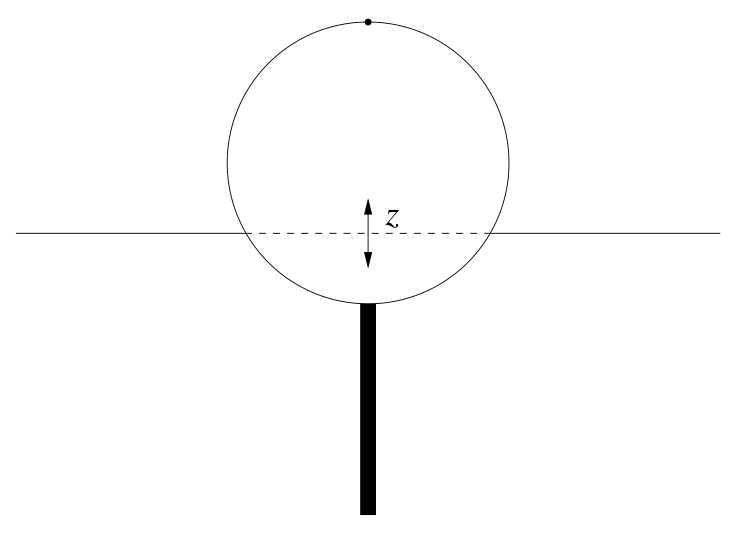
(b) If the buoy, due to some perturbation, is depressed vertically by a small amount , it will experience a nett force, which will cause it to begin oscillating vertically about the equilibrium floating position. Determine the frequency of this vertical mode of vibration in terms of , and , where is the acceleration due to gravity. Assume the influence of water motion on the dynamics of the buoy is such as to increase the effective mass of the buoy by a factor of one third. You may assume that is not small. [4 т.]
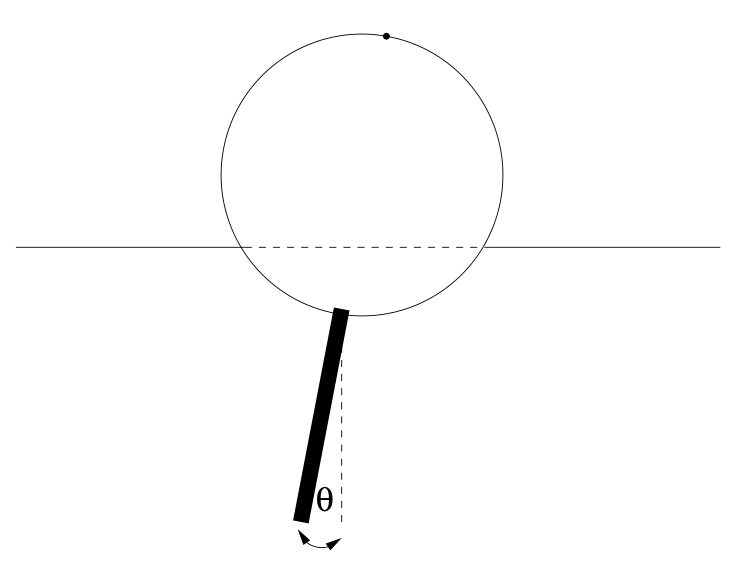
(c) In the approximation that the cylinder swings about its horizontal central axis, determine the frequency of swing again in terms of and . Neglect the dynamics and viscosity of the water in this case. The angle of swing is assumed to be small. [8 т.]
(d) The buoy contains sensitive accelerometers which can measure the vertical and swinging motions and can relay this information by radio to shore. In relatively calm waters it is recorded that the vertical oscillation period is about 1 second and the swinging oscillation period is about 1.5 seconds. From this information, show that the floating angle is about and thereby estimate the radius of the buoy and its total mass, given that the cylinder length equals .
[You may take it that and .] [5 т.]
Отговори
- (a)
- (b)
- (c)
- (d) α ≈ π/2; a ≈ 0.237 m; total mass 2M ≈ 20.9 kg
Решение
(a)
The mass of the rod is given equal to the mass of the cylinder which itself is . Thus the total mass equals . The mass of the displaced water is surely less than (when the buoy is on the verge of sinking). Using Archimedes’ principle, we may at the very least expect that
In fact, with the floating angle as drawn, the volume of displaced water is obtained by geometry:
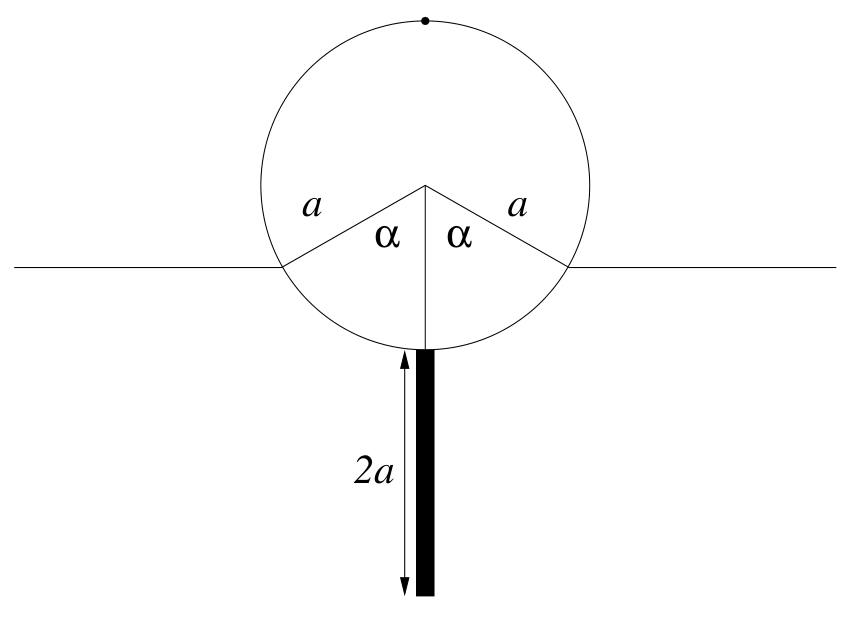
By Archimedes’ principle, the mass of the buoy equals the mass of displaced water. Therefore, , i.e. is determined by the relation
(b)
If the cylinder is depressed a small distance vertically from equilibrium, the nett upward restoring force is the weight of the extra water displaced or , directed oppositely to . This is characteristic of simple harmonic motion and hence the Newtonian equation of motion of the buoy is (upon taking account of the extra factor 1/3)
and this is the standard sinusoidal oscillator equation (like a simple pendulum). The solution is of the type , with the angular frequency
where we have used the relation worked out at the end of the first part.
(c)
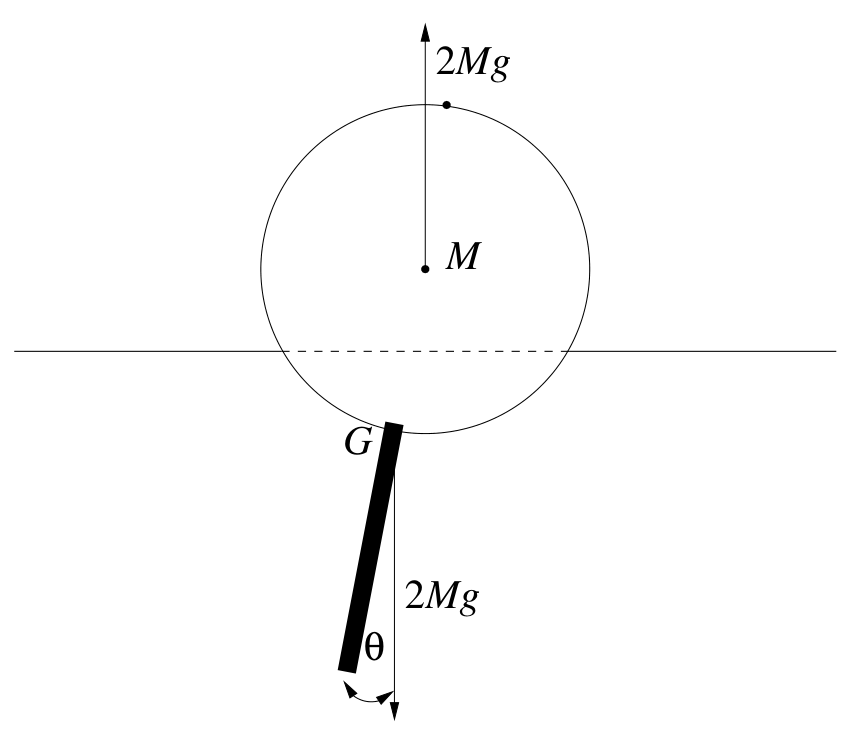
Without regard to the torque and only paying heed to vertical forces, if the buoy is swung by some angle so that its weight is supported by the nett pressure of the water outside, the volume of water displaced is the same as in equilibrium. Thus the centre of buoyancy remains at the same distance from the centre of the cylinder. Consequently we deduce that the buoyancy arc is an arc of a circle centred at the middle of the cylinder. In other words, the metacentre of the swinging motion is just the centre of the cylinder. In fact the question assumes this.
We should also notice that the centre of mass of the buoy is at the point where the rod touches the cylinder, since the masses of rod and cylinder each equal . Of course the cylinder will experience a nett torque when the rod is inclined to the vertical. To find the period of swing, we first need to determine the moment of inertia of the solid cylinder about the central axis; this is just like a disc about the centre. Thus if is the cylinder mass
The next step is to find the moment of inertia of the rod about its middle,
Finally, use the parallel axis theorem to find the moment of inertia of the buoy (cylinder + rod) about the metacentre ,
(In this part we are neglecting the small horizontal motion of the centre of mass; the water is the only agent which can supply this force!) When the buoy swings by an angle about equilibrium the restoring torque is for small angles, which represents simple harmonic motion (like simple pendulum). Therefore the Newtonian rotational equation of motion is
The solution is a sinusoidal function, , with angular frequency
(d)
The accelerometer measurements give
Hence
producing the (transcendental) equation
Since 1.61 is not far from 1.57 we have discovered that a physically acceptable solution is , which was to be shown. (In fact a more accurate solution to the above transcendental equation can be found numerically to be .) Setting hereafter, to simplify the algebra, and to a good approximation. Since the vertical period is 1.0 sec,
giving the radius m.
We can now work out the mass of the buoy (in SI units),
Оригинал в Архива: th.pdf · официални решения: th_sol.pdf