IPhO 1995, Теория — Задача 2. Sound Propagation
XXVI IPhO — Theoretical Questions · 20 т.
Условие
Introduction
The speed of propagation of sound in the ocean varies with depth, temperature and salinity. Figure 1(a) below shows the variation of sound speed with depth for a case where a minimum speed value occurs midway between the ocean surface and the sea bed. Note that for convenience at the depth of this sound speed minimum, at the surface and at the sea bed. Above , is given by
Below , is given by
In each case , that is, is the magnitude of the sound speed gradient with depth; is assumed constant.
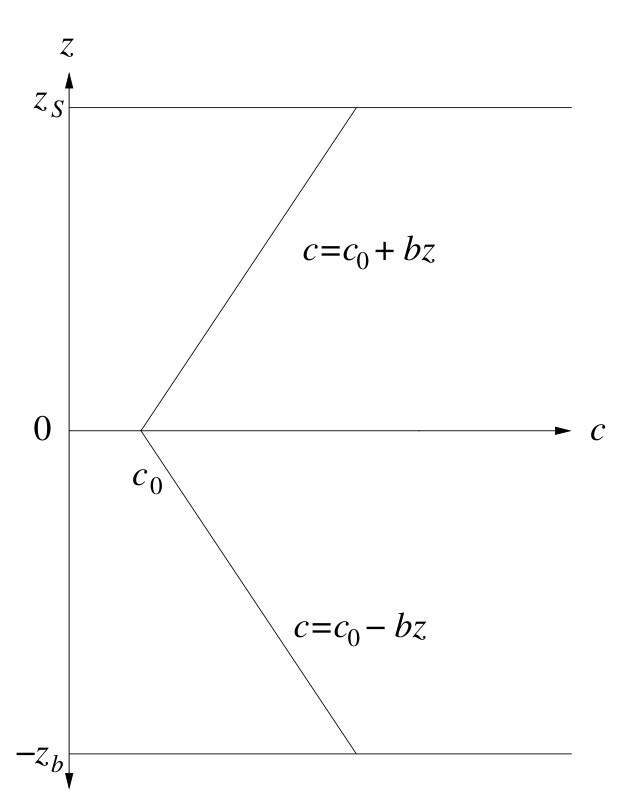
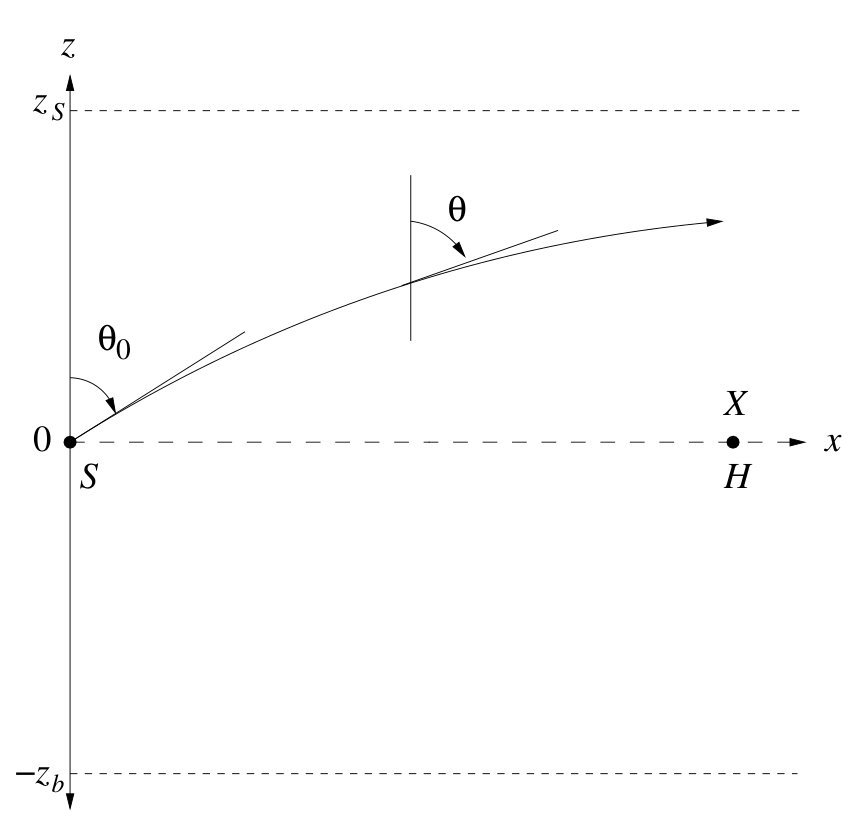
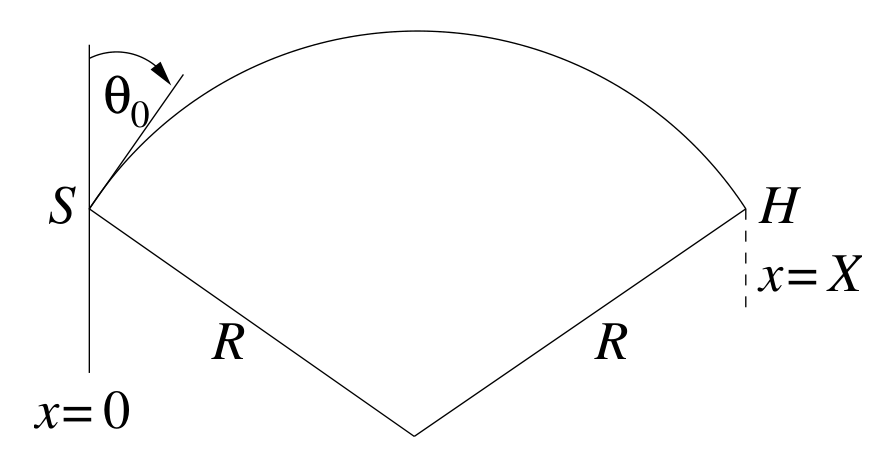
Figure 1(b) shows a section of the – plane through the ocean, where is a horizontal direction. The variation of with respect to is shown in figure 1(a). At the position , , a sound source is located. A ‘sound ray’ is emitted from at an angle as shown. Because of the variation of with , the ray will be refracted.
(a) Show that the trajectory of the ray, leaving the source and constrained to the – plane forms an arc of a circle with radius where
[6 т.]
(b) Derive an expression involving , and to give the smallest value of the angle for upwardly directed rays which can be transmitted without the sound wave reflecting from the sea surface. [3 т.]
(c) Figure 1(b) shows the position of a sound receiver which is located at the position , . Derive an expression involving , and to give the series of angles required for the sound ray emerging from to reach the receiver . Assume that and are sufficiently large to remove the possibility of reflection from sea surface or sea bed. [4 т.]
(d) Calculate the smallest four values of for refracted rays from to reach when
- [2 т.]
(e) Derive an expression to give the time taken for sound to travel from to following the ray path associated with the smallest value of angle , as determined in part (c). Calculate the value of this transit time for the conditions given in part (d). The following result may be of assistance:
Calculate the time taken for the direct ray to travel from to along . Which of the two rays will arrive first, the ray for which , or the ray with the smallest value of as calculated for part (d)? [5 т.]
Отговори
- (b)
- (c)
- (d) θ0 = 86.19°, 88.09°, 88.73°, 89.04° (n = 1, 2, 3, 4)
- (e) t13 = −(2/b) ln tan(θ0/2) = 6.6546 s for n = 1; direct ray t = X/c0 = 6.6666 s; the n = 1 ray arrives first.
Решение
(a)
Snell’s Law may be expressed as
where is the speed of sound.
Consider some element of ray path and treat this as, locally, an arc of a circle of radius . Note that may take up any value between 0 and . Consider a ray component which is initially directed upward from .
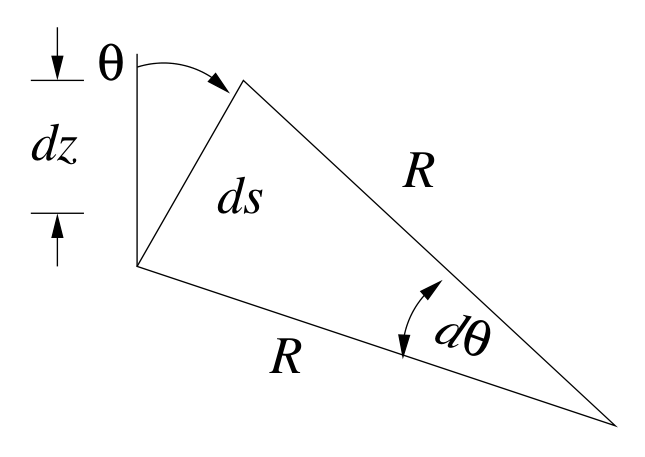
In the diagram, , or .
From equation (1), for a small change in speed ,
For the upwardly directed ray so and
We may also write (here treating as straight) . So
Hence
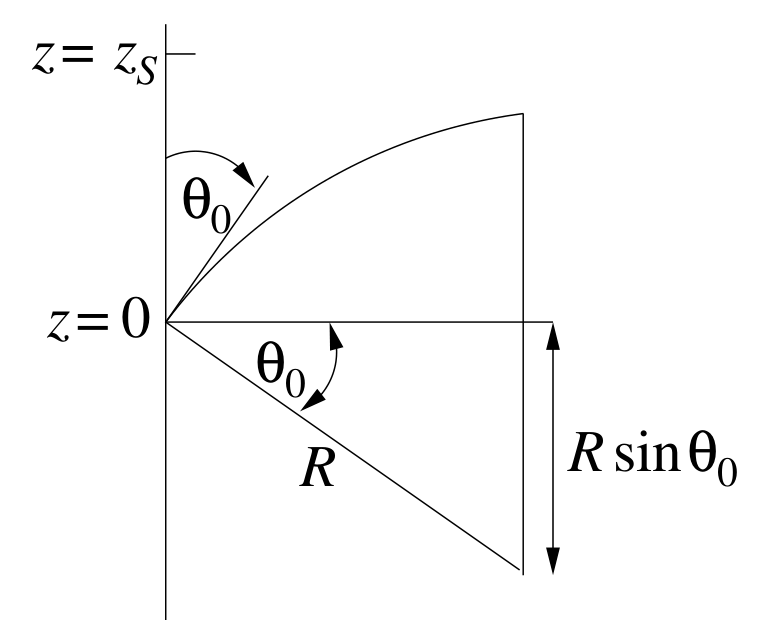
This result strictly applies to the small arc segments . Note that from equation (1), however, it also applies for all , i.e. for all points along the trajectory, which therefore forms an arc of a circle with radius until the ray enters the region .
(b)
Here
from which
(c)
The simplest pathway between and is a single arc of a circle passing through and . For this pathway:
Hence
The next possibility consists of two circular arcs linked as shown.
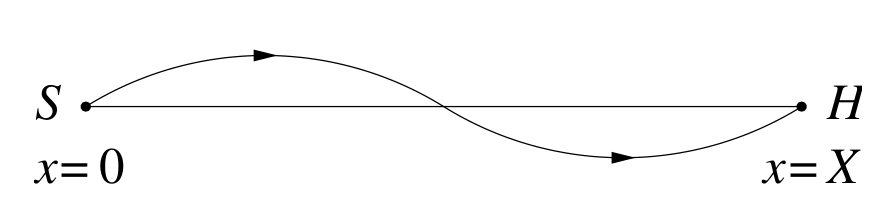
For this pathway:
i.e.
In general, for values of , rays emerging from will reach in arcs for launch angles given by
where
Note that when , as expected for the axial ray.
(d)
With the values cited, the four smallest values of launch angle are
| (degrees) | |
|---|---|
| 1 | 86.19 |
| 2 | 88.09 |
| 3 | 88.73 |
| 4 | 89.04 |
(e)
The ray path associated with the smallest launch angle consists of a single arc as shown:
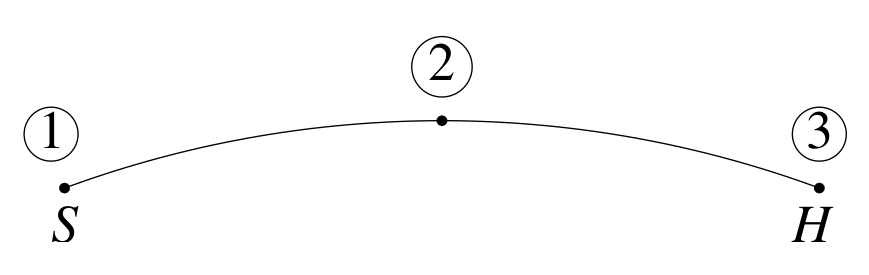
We seek
Try first:
Using
gives
so that
Noting that gives
For the specified , this gives a transit time for the smallest value of launch angle cited in the answer to part (d), of
The axial ray will have travel time given by
For the conditions given,
thus this axial ray travels slower than the example cited for , thus the ray will arrive first.
Оригинал в Архива: th.pdf · официални решения: th_sol.pdf