IPhO 1995, Теория — Задача 1. Gravitational Red Shift and the Measurement of Stellar Mass
XXVI IPhO — Theoretical Questions · 20 т.
Условие
(a) A photon of frequency possesses an effective inertial mass determined by its energy. Assume that it has a gravitational mass equal to this inertial mass. Accordingly, a photon emitted at the surface of a star will lose energy when it escapes from the star’s gravitational field. Show that the frequency shift of the photon when it escapes from the surface of the star to infinity is given by
for where:
- gravitational constant
- radius of the star
- velocity of light
- mass of the star.
Thus, the red-shift of a known spectral line measured a long way from the star can be used to measure the ratio . Knowledge of will allow the mass of the star to be determined. [3 т.]
(b) An unmanned spacecraft is launched in an experiment to measure both the mass and radius of a star in our galaxy. Photons are emitted from He ions on the surface of the star. These photons can be monitored through resonant absorption by He ions contained in a test chamber in the spacecraft. Resonant absorption occurs only if the He ions are given a velocity towards the star to allow exactly for the red shifts.
As the spacecraft approaches the star radially, the velocity relative to the star () of the He ions in the test chamber at absorption resonance is measured as a function of the distance from the (nearest) surface of the star. The experimental data are displayed in the accompanying table.
Fully utilize the data to determine graphically the mass and radius of the star. There is no need to estimate the uncertainties in your answer.
Data for Resonance Condition
| Velocity parameter | 3.352 | 3.279 | 3.195 | 3.077 | 2.955 | |
|---|---|---|---|---|---|---|
| Distance from surface of star | 38.90 | 19.98 | 13.32 | 8.99 | 6.67 |
[12 т.]
(c) In order to determine and in such an experiment, it is usual to consider the frequency correction due to the recoil of the emitting atom. [Thermal motion causes emission lines to be broadened without displacing emission maxima, and we may therefore assume that all thermal effects have been taken into account.]
(i) (4 marks)
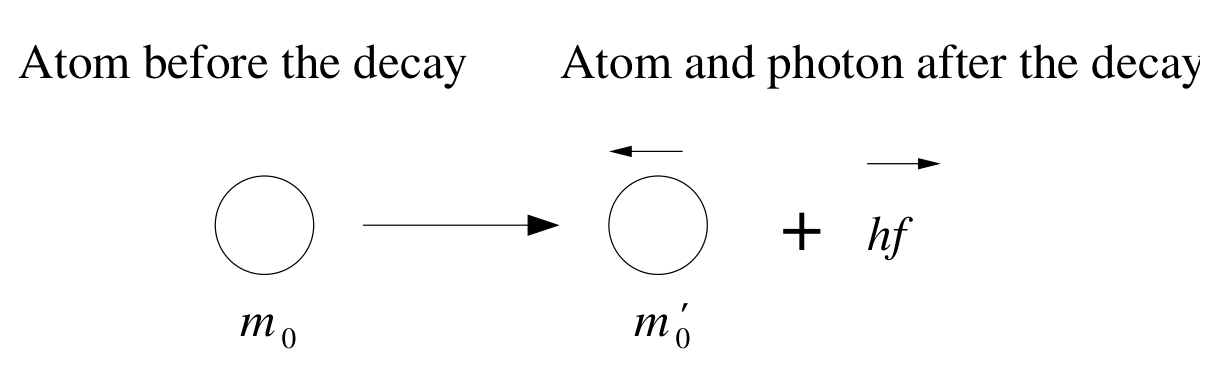
Assume that the atom decays at rest, producing a photon and a recoiling atom. Obtain the relativistic expression for the energy of a photon emitted in terms of (the difference in rest energy between the two atomic levels) and the initial rest mass of the atom.
(ii) (1 mark)
Hence make a numerical estimate of the relativistic frequency shift for the case of He ions.
Your answer should turn out to be much smaller than the gravitational red shift obtained in part (b). [5 т.]
Data:
Отговори
(a)
(b) R ≈ 1.104 × 10⁸ m, M ≈ 5.11 × 10³⁰ kg
Values of the official solution (graph of 1/β against 1/d); the solution also prints R = 1.11 × 10⁸ m and M = 5.2 × 10³⁰ kg as the values from the given data.
(c)
As printed in the official solution. With the printed data (ΔE = 40.8 eV, m0c² = 4 × 938 MeV) the ratio is about 5.44 × 10⁻⁹; the solution prints m0c² = 3.752 × 10⁶ eV and 5.44 × 10⁻¹².
Решение
(a)
If a photon has an effective inertial mass determined by its energy then or . Now, assume that gravitational mass = inertial mass, and consider a photon of energy (mass ) emitted upwards at a distance from the centre of the star. It will lose energy on escape from the gravitational field of the star.
Apply the principle of conservation of energy:
Change in photon energy = change in gravitational energy, where subscript initial state and subscript final state.
The negative sign shows red-shift, i.e. a decrease in , and an increase in wavelength.
Thus, for a photon emitted from the surface of a star of radius , we have
Since the change in photon energy is small, ,
(b)
The change in photon energy in ascending from to is given by
In the experiment, is the radius of the star, is the distance from the surface of the star to the spacecraft and the above equation becomes:
The frequency of the photon must be doppler shifted back from to in order to cause resonance excitation of the He ions in the spacecraft.
Thus apply the relativistic Doppler principle to obtain:
where is the frequency as received by He ions in the spacecraft, and .
That is, the gravitationally reduced frequency has been increased to because of the velocity of the ions on the spacecraft towards the star. Since ,
Alternatively, since , use the classical Doppler effect directly.
Thus
or
Since must be equal to for resonance absorption, we have
Substitution of 2 into 1 gives
Given the experimental data, we look for an effective graphical solution. That is, we require a linear equation linking the experimental data in and .
Rewrite equation 3:
Inverting the equation gives:
or
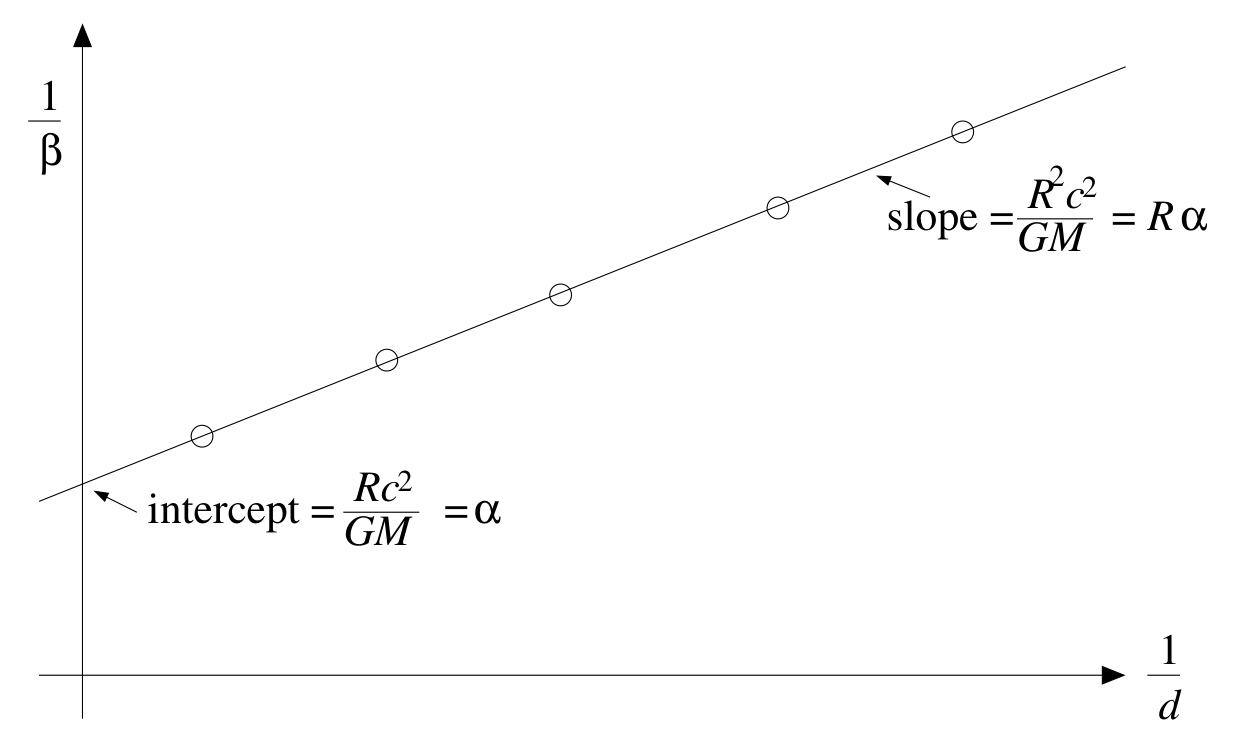
Graph of vs.
The slope is (A)
The -intercept is (B)
and the -intercept is (C)
and can be conveniently determined from (A) and (B). Equation (C) is redundant. However, it may be used as an (inaccurate) check if needed.
From the given data:
From the graph, the slope (A)
The -intercept (B)
Dividing (A) by (B)
Substituting this value of back into (B) gives:
or
(c)
(i)
For the photon, photon momentum is and photon energy is .
Use the mass-energy equivalence, , to relate the internal energy change of the atom to the rest-mass change. Thus:
In the laboratory frame of reference the energy before emission is
Recalling the relativistic relation
The energy after emission of a photon is
where also by conservation of momentum.
Conservation of energy requires that (2) = (3), so that:
Carrying out the algebra and using equation (1):
(ii)
For the emitted photon,
If relativistic effects are ignored, then
Hence the relativistic frequency shift is given by
For He transition , applying Bohr theory to the hydrogen-like helium ion gives:
Also, . Therefore the frequency shift due to the recoil gives
This is very small compared to the gravitational red-shift of , and may be ignored in the gravitational red-shift experiment.
Оригинал в Архива: th.pdf · официални решения: th_sol.pdf