IPhO 1997, Теория — Задача 2. Nuclear Masses and Stability
28th International Physics Olympiad, Sudbury, Canada — THEORETICAL COMPETITION · 17 юли 1997 г. · 10 т.
Read This First:
- Use only the pen provided.
- Use only the front side of the answer sheets and paper.
- In your answers please use as little text as possible; express yourself primarily in equations, numbers and figures. Summarize your results on the answer sheet.
- Please indicate on the first page the total number of pages you used.
- At the end of the exam please put your answer sheets, pages and graphs in order.
This set of problems consists of 11 pages.
Условие
All energies in this question are expressed in MeV - millions of electron volts.
One MeV = J, but it is not necessary to know this to solve the problem.
The mass of an atomic nucleus with protons and neutrons (i.e. the mass number ) is the sum of masses of the free constituent nucleons (protons and neutrons) minus the binding energy .
The graph shown below plots the maximum value of for a given value of , vs. . The greater the value of , in general, the more stable is the nucleus.
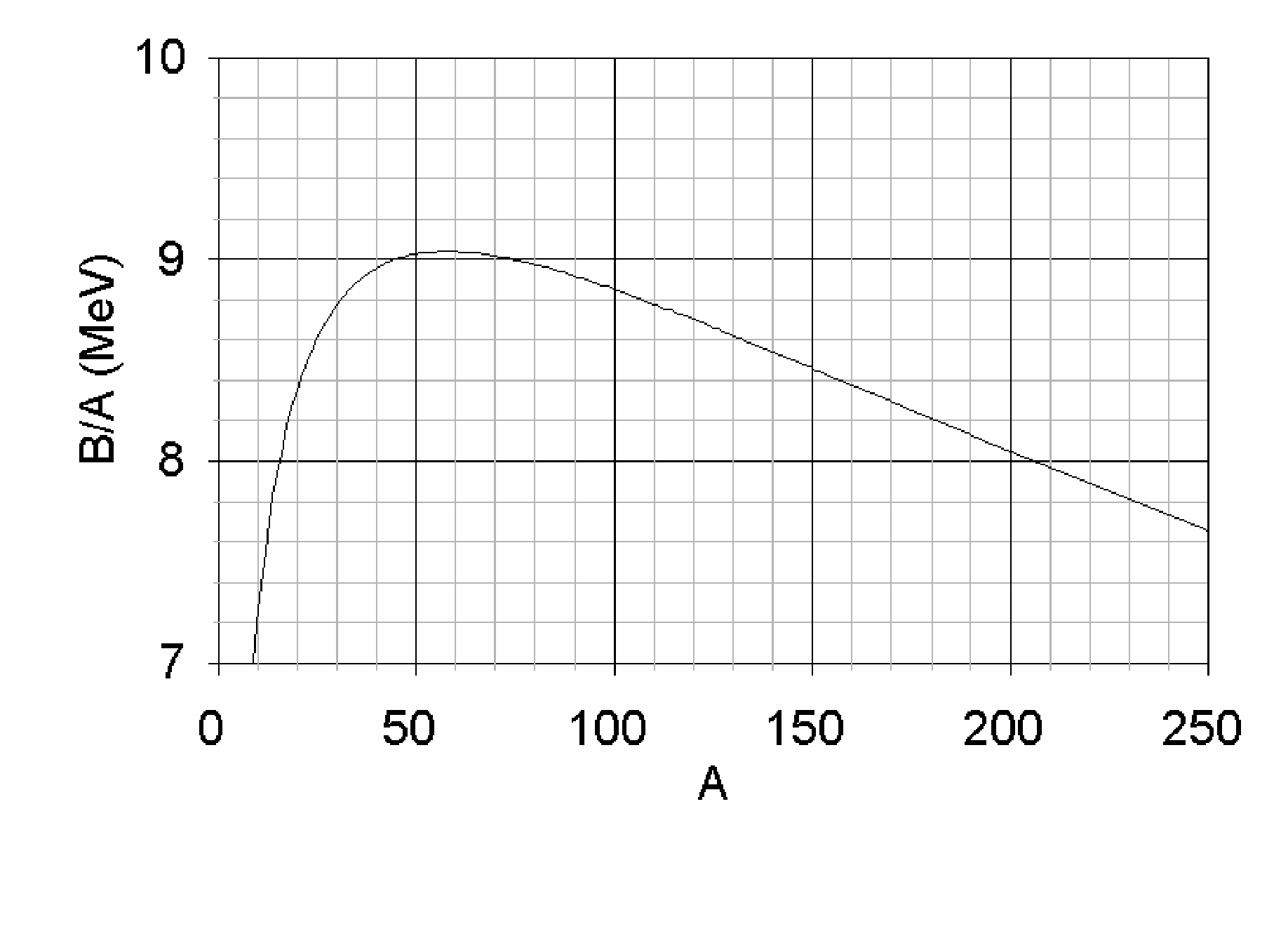
(a) Above a certain mass number , nuclei have binding energies which are always small enough to allow the emission of alpha-particles (). Use a linear approximation to this curve above to estimate . (3 marks) [3 т.]
For this model, assume the following:
- Both initial and final nuclei are represented on this curve.
- The total binding energy of the alpha-particle is given by MeV (this cannot be read off the graph!).
(b) The binding energy of an atomic nucleus with protons and neutrons () is given by a semi-empirical formula:
The value of is given by:
for odd-N/odd-Z nuclei
0 for even-N/odd-Z or odd-N/even-Z nuclei
for even-N/even-Z nuclei
The values of the coefficients are:
MeV; MeV; MeV; MeV; MeV.
(i) Derive an expression for the proton number of the nucleus with the largest binding energy for a given mass number . Ignore the -term for this part only. (2 marks) [2 т.]
(ii) What is the value of for the nucleus with the largest ? Include the effect of the -term. (2 marks) [2 т.]
(iii) Consider the three nuclei with A = 128 listed in the table on the answer sheet. Determine which ones are energetically stable and which ones have sufficient energy to decay by the processes listed below. Determine as defined in part (i) and fill out the table on your answer sheet.
In filling out the table, please:
- Mark processes which are energetically allowed thus: √
- Mark processes which are NOT energetically allowed thus: 0
- Consider only transitions between these three nuclei.
Decay processes:
(1) - decay; emission from the nucleus of an electron (2) - decay; emission from the nucleus of a positron (3) - decay; emission from the nucleus of two electrons simultaneously (4) Electron capture; capture of an atomic electron by the nucleus.
The rest mass energy of an electron (and positron) is MeV; that of a proton is MeV; that of a neutron is MeV.
(3 marks) [3 т.]
Question 2: Answer Sheet
(a) Numerical value for :
(b) (i) Expression for :
(b) (ii) Numerical value of :
(b) (iii)
| Nucleus/Process | - decay | - decay | Electron-capture | - decay |
|---|---|---|---|---|
Notation :
X = Chemical Symbol
Отговори
(a) 211
Official solution: A > 13.5/0.064 = 211.
(i)
(ii) 80
Without the δ-term Zmax = 79.25; the even-even nucleus Z = 80 has the largest B/A.
(iii) ¹²⁸₅₃I: β⁻ √, β⁺ 0, electron capture 0, β⁻β⁻ √; ¹²⁸₅₄Xe: all 0 (stable); ¹²⁸₅₅Cs: β⁻ 0, β⁺ √, electron capture √, β⁻β⁻ 0.
Решение
(a) The alpha-decay process is as follows:
Therefore the energy criterion for decay to happen is:
The number and type of nucleons in the decay is preserved so we only have to consider the binding energies:
If we write , where and are constants to be found from the graph, then this equation becomes:
By inspecting the graph, a good linear approximation to above is:
i.e. MeV and MeV, and the condition becomes:
Part (b).
(i) Because is fixed we only need to consider the penultimate two terms which depend on .
(ii)
The full expression for the differential equation in (a) is:
The last term is positive if a change in of +1 changes the nucleus from an even-even to an odd-odd, and negative if the reverse is true. Note is positive in this case.
How do we deal with the last term?
The number has to be an integer, and even numbers are favoured over odd so we can guess . To check, evaluate the last three terms for various values of :
| 77 | 979.241 |
| 78 | 975.915 |
| 79 | 976.295 |
| 80 | 975.341 |
| 81 | 978.093 |
| 82 | 979.512 |
| 83 | 984.637 |
This confirms that ; this is an even-even nucleus.
(iii) Consider only the last three terms in the equation; the rest are constant if is constant. Call the sum of these quantities . To find out whether these nuclei are stable we need to find differences in between neighbouring species and to compare these differences with the energy requirements for each would-be decay process.
(i) - decay; , need MeV
(ii) - decay; , need MeV
(iii) - decay; , need MeV
(iv) Electron capture; , need MeV
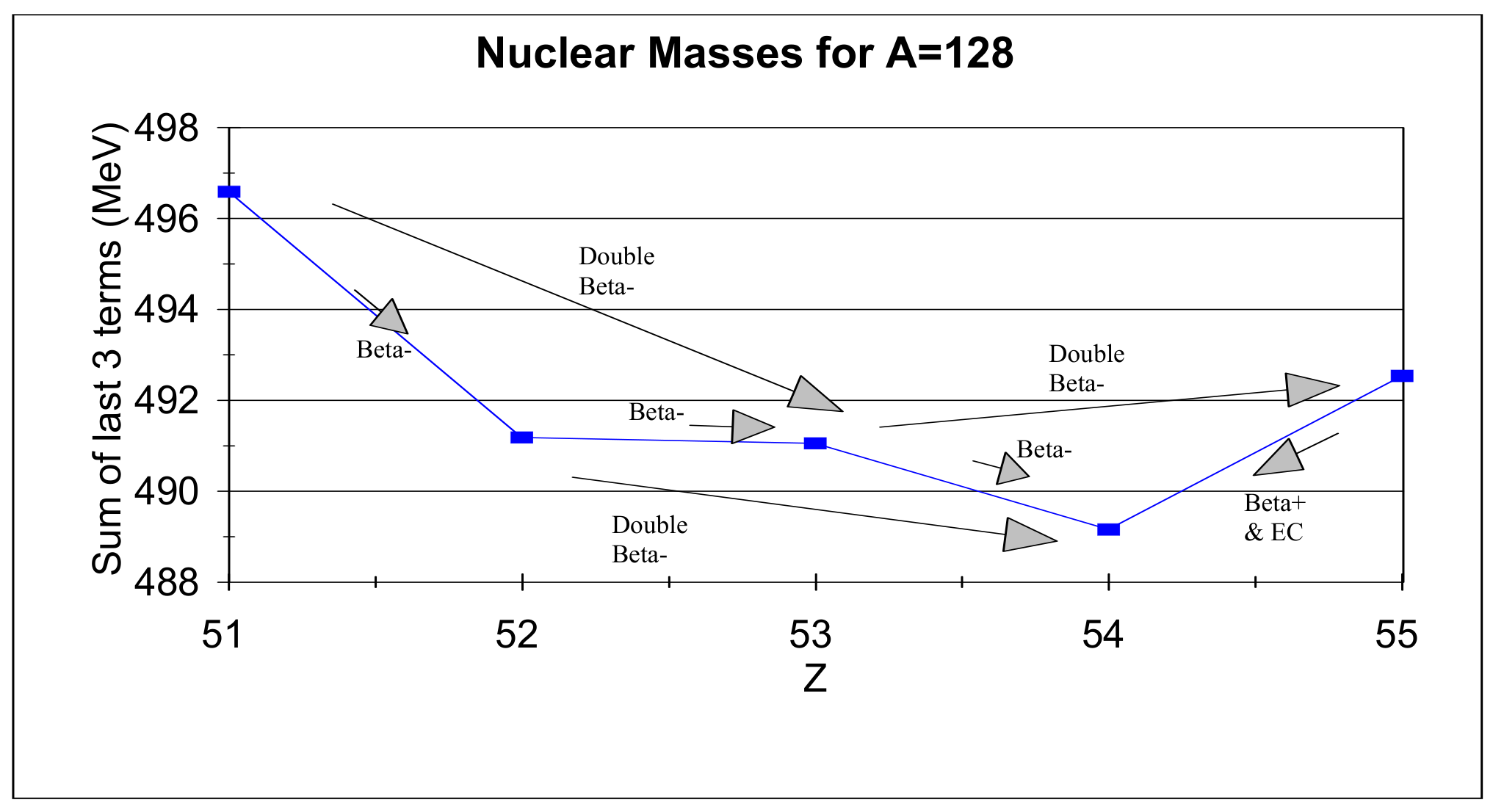
↑ For information: graph not expected from students
| Nucleus/Process | (MeV) |
|---|---|
| 496.59 | |
| 491.19 | |
| 491.06 | |
| 489.16 | |
| 492.54 |
↑ For information: table not expected from students
| Nucleus/Process | - decay | - decay | Electron-capture | - decay |
|---|---|---|---|---|
| √ | 0 | 0 | √ | |
| 0 | 0 | 0 | 0 | |
| 0 | √ | √ | 0 |
Students will fill out this table
Theory Question No.2: Mark Distribution
Smallest fractional mark allowed: 0.25
Marks allowed for errors consistently propagated only if physically reasonable.
| (a) | Approach | 1.5 | |
| Correct Answer | 1.5 | ||
| 3 | |||
| (b)(i) | Approach | 1 | |
| Correct Answer | 1 | ||
| 2 | |||
| (b)(ii) | Approach | 1 | |
| Correct Answer | 1 | ||
| 2 | |||
| (b)(iii) | 0.25 for each of 12 entries | 3 | |
| 3 | |||
| Grand Total | 10 |
Оригинал в Архива: IPhO_1997_Theoretical Questions.pdf · официални решения: IPhO_1997_Theoretical Solutions.pdf