IPhO 1997, Теория — Задача 3. Solar-Powered Aircraft
28th International Physics Olympiad, Sudbury, Canada — THEORETICAL COMPETITION · 17 юли 1997 г. · 10 т.
Read This First:
- Use only the pen provided.
- Use only the front side of the answer sheets and paper.
- In your answers please use as little text as possible; express yourself primarily in equations, numbers and figures. Summarize your results on the answer sheet.
- Please indicate on the first page the total number of pages you used.
- At the end of the exam please put your answer sheets, pages and graphs in order.
This set of problems consists of 11 pages.
Условие
We wish to design an aircraft which will stay aloft using solar power alone. The most efficient type of layout is one with a wing whose top surface is completely covered in solar cells. The cells supply electrical power with which the motor drives the propeller.
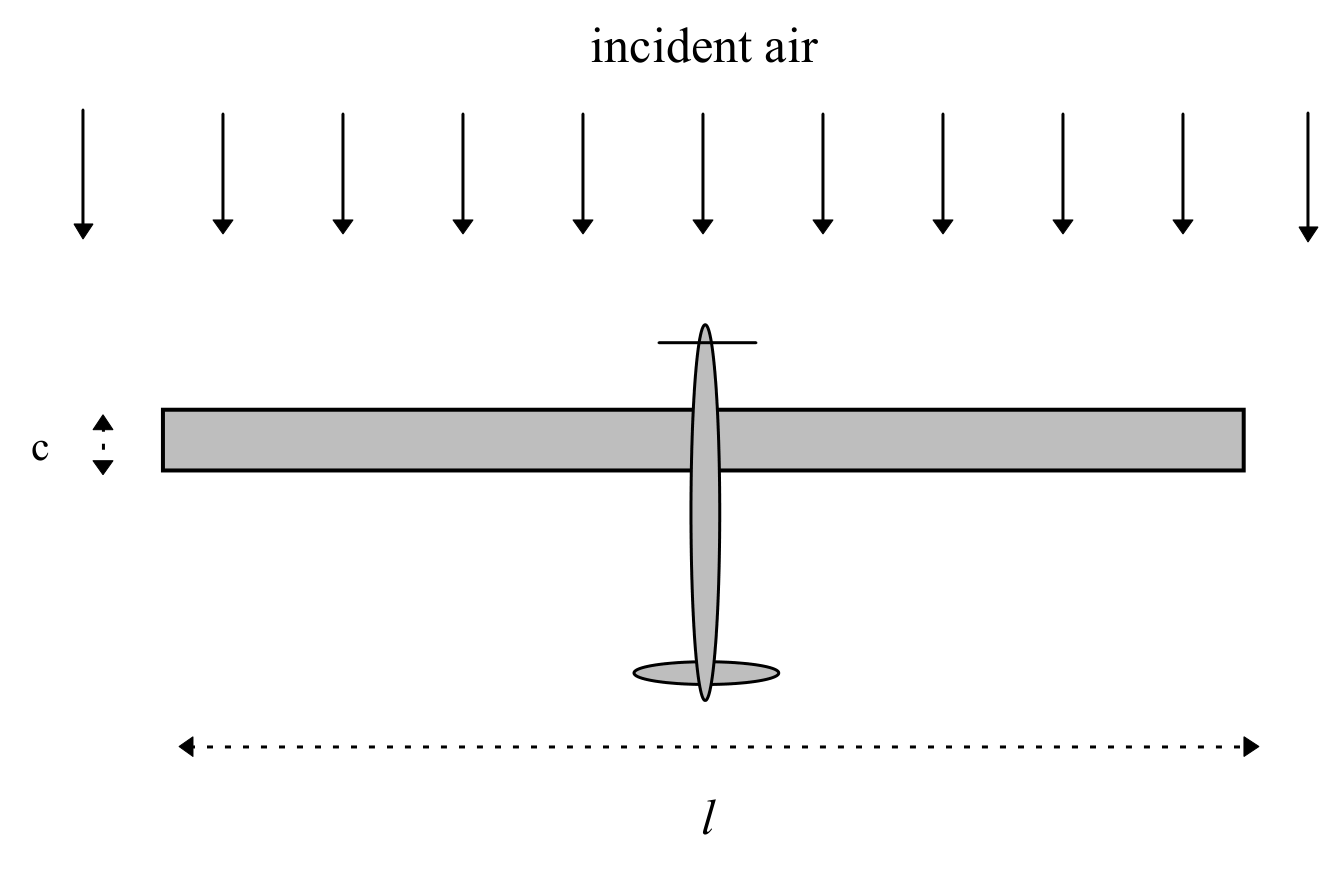
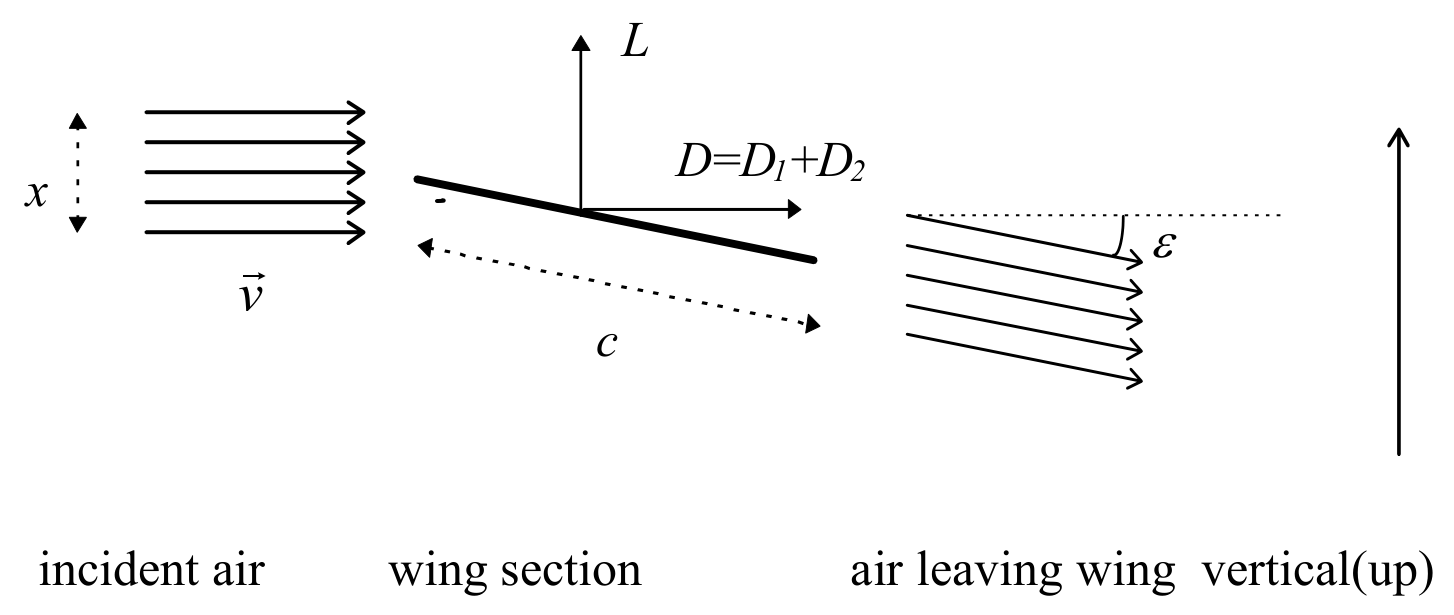
Consider a wing of rectangular plan-form with span , chord (width) ; the wing area is , and the wing aspect ratio . We can get an approximate idea of the wing’s performance by considering a slice of air of height and length being deflected downward at a small angle with only a very small change in speed. Control surfaces can be used to select an optimal value of for flight. This simple model corresponds closely to reality if , and we can assume this to be the case. The total mass of the aircraft is and it flies horizontally with velocity relative to the surrounding air. In the following calculations consider only the air flow around the wing.
Top view of aircraft (in its own frame of reference):
Side view of wing (in a frame of reference moving with the aircraft):
Ignore the modification of the airflow due to the propeller.
(a) Consider the change in momentum of the air moving past the wing, with no change in speed while it does so. Derive expressions for the vertical lift force and the horizontal drag force on the wing in terms of wing dimensions, , , and the air density . Assume the direction of air flow is always parallel to the plane of the side-view diagram. (3 marks) [3 т.]
(b) There is an additional horizontal drag force caused by the friction of air flowing over the surface of the wing. The air slows slightly, with a change of speed ( 1% of ) given by:
The value of is independent of .
Find an expression (in terms of , , , , and - the acceleration due to gravity) for the flight speed corresponding to a minimum power being needed to maintain this aircraft in flight at constant altitude and velocity. Neglect terms of order or higher. (3 marks)
You may find the following small angle approximation useful:
[3 т.]
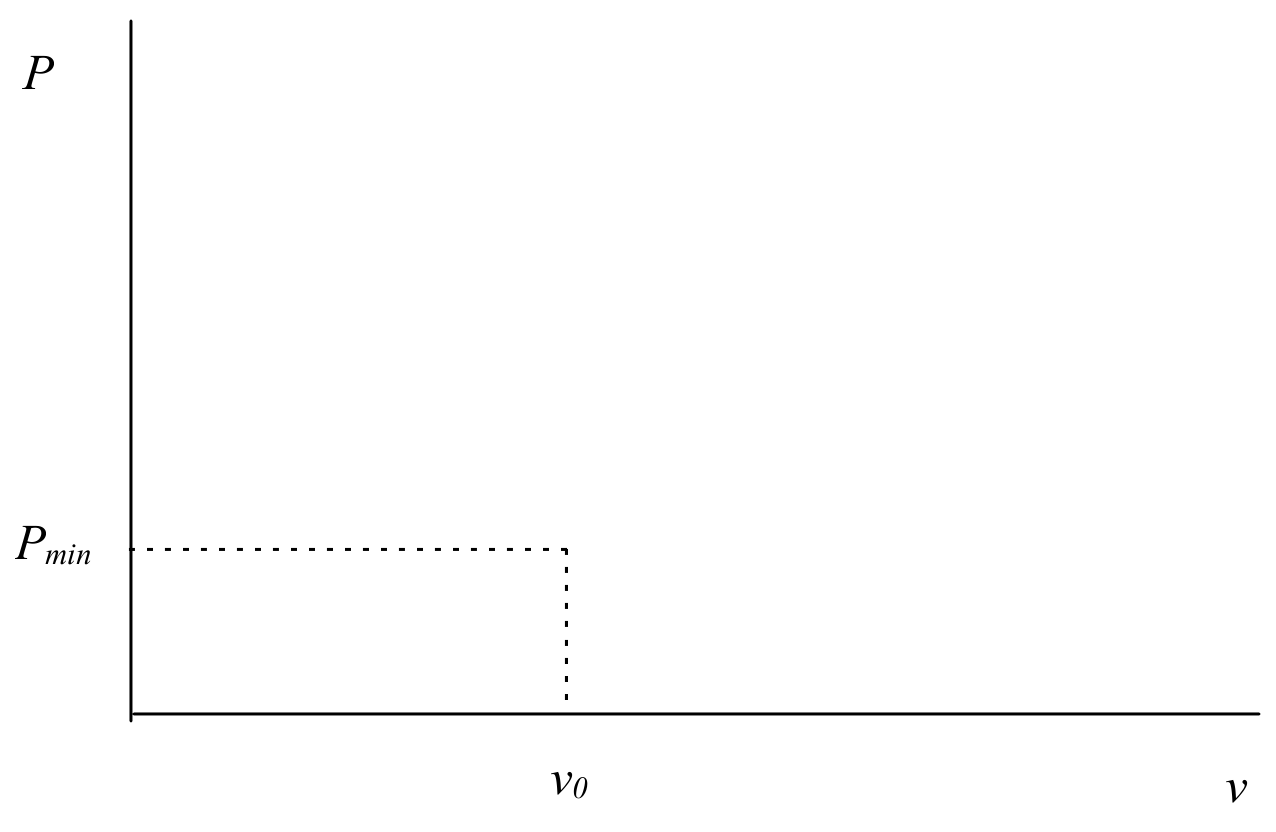
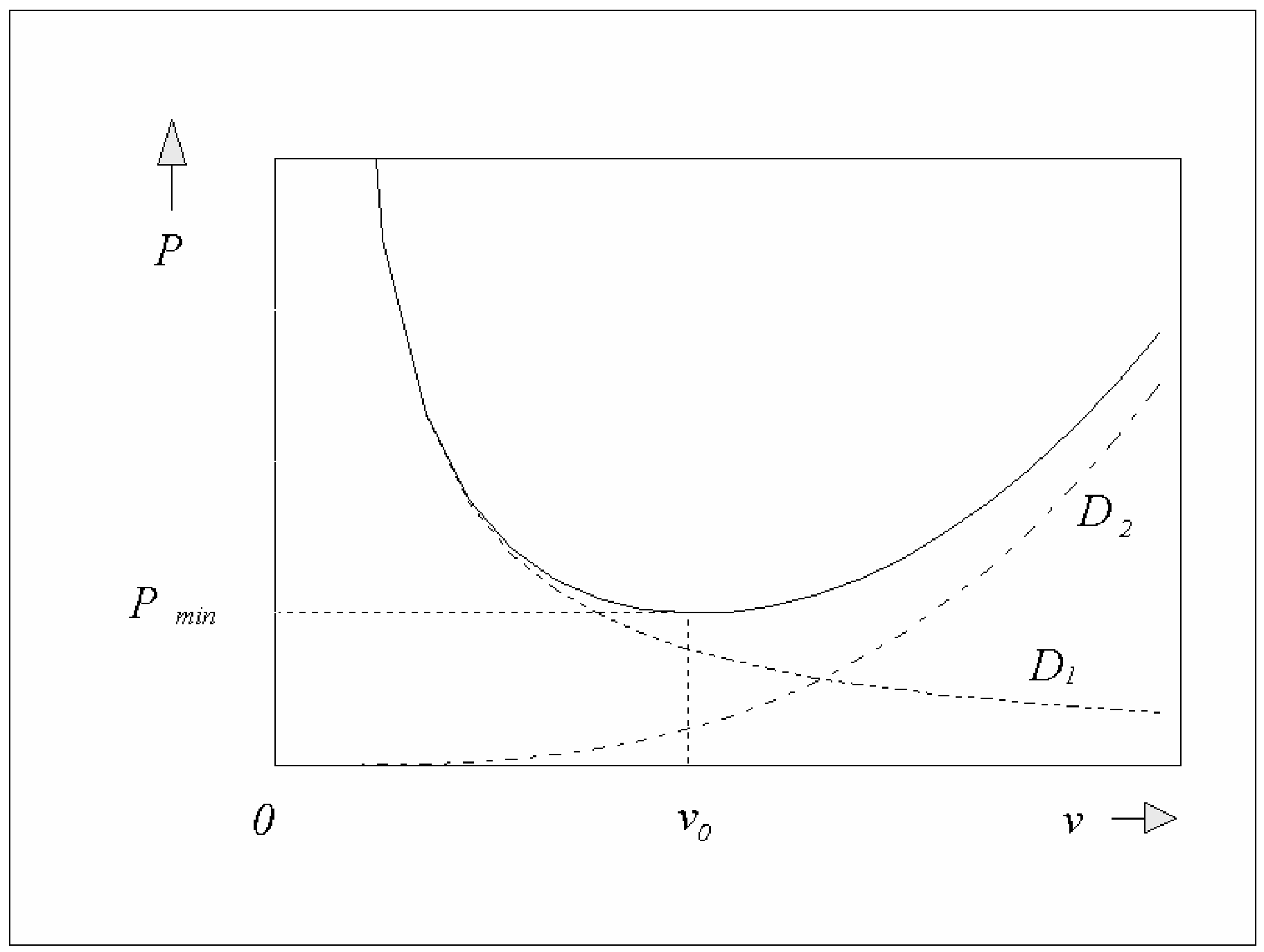
(c) On the answer sheet, sketch a graph of power versus flight speed . Show the separate contributions to the power needed from the two sources of drag. Find an expression (in terms of , , , , and ) for the minimum power, . (2 marks) [2 т.]
(d) If the solar cells can supply sufficient energy so that the electric motors and propellers generate mechanical power of watts per square metre of wing area, calculate the maximum wing loading () for this power and flight speed (m/s). Assume , , . (2 marks) [2 т.]
Отговори
(a)
(b)
(c)
(d) 35.6 N/m²
Maximum wing loading Mg/S = 35.6 N/m²; flight speed v0 = 8.60 m/s.
Решение
(a) The force required to change the velocity of a fluid whose flow rate is is given by:
In this case the flow rate is:
The vertical component of is:
The horizontal component of is:
We can now write expressions for the lift and drag (called form drag).
Approximations using instead of etc. are allowed.
(b) The power required to keep the aircraft flying straight and level is given by:
The horizontal drag force (frictional drag) is given by the rate of change of momentum of the air flowing past the wing due to friction:
Since the wing is neither a source nor a sink, the mass flow of air into the wing must be the same as the mass flow from the wing therefore:
Substituting and :
(This drag is necessarily along the wing surface; when the wing is at an angle , the horizontal component is this value multiplied by :
so to the order given, our simple answer is correct.)
The total drag force is dependent on the deflection angle and the drag coefficient :
In making this approximation can be expressed in terms of the mass, speed and wing dimensions of the aircraft. Note that for level flight the lift has to be equal to the weight of the craft.
We can now minimize power with respect to either or ; here we choose .
Flight velocity for minimum power:
(c) The graph of power vs. velocity is as follows:
Substitute for :
(d) Equate this to available power, :
The numerical answers are:
Theory Question No.3: Mark Distribution
Smallest fractional mark allowed: 0.25
Marks allowed for errors consistently propagated only if physically reasonable.
| MAXIMUM | SCORE | SUBTOTAL | |
|---|---|---|---|
| (a) Formulation of Newton II | 1 | ||
| Approach to drag | .5 | ||
| formula: | .5 | ||
| Approach to lift | .5 | ||
| L formula: | .5 | ||
| (a) | |||
| (b) Correct approach to | .5 | ||
| Correct expression for | .5 | ||
| Correct minimization approach | 1 | ||
| Expression for | 1 | ||
| (b) | |||
| (c) Correct expression for power | 1 | ||
| Graph (, forms) | 1 | ||
| (c) | |||
| (d) Correct wing loading | 1 | ||
| Correct speed | 1 | ||
| (d) | |||
| TOTAL | 10 | Total |
Committee Chair
Chris Waltham, Department of Physics & Astronomy, University of British Columbia
Оригинал в Архива: IPhO_1997_Theoretical Questions.pdf · официални решения: IPhO_1997_Theoretical Solutions.pdf