IPhO 2001, Теория — Задача 1. Question 1
IPhO2001 - theoretical competition. Theoretical Competition, Monday, July 2nd, 2001 · 2 юли 2001 г. · 10 т.
Внимание: Бележка към темата
The official solution printed for Question 3 does not follow the printed question labels: “Part 3a” answers questions a) and b), “Part 3b” answers c), and “Part 3c” answers d) and then continues with items 2 and 3 (a phase of π/36, skin depth, “The correct choice is (iii)”) that belong to a different version of the question and are not asked in the printed paper.
Please read this first:
The time available is 5 hours for the theoretical competition.
Use only the pen provided.
Use only the front side of the paper.
Begin each part of the problem on a separate sheet.
For each question, in addition to the blank sheets where you may write, there is an answer form where you must summarize the results you have obtained. Numerical results should be written with as many digits as are appropriate to the given data.
Write on the blank sheets of paper whatever you consider is required for the solution of the question. Please use as little text as possible; express yourself primarily in equations, numbers, figures, and plots.
Fill in the boxes at the top of each sheet of paper used by writing your Country No and Country Code, your student number (Student No), the number of the question (Question No), the progressive number of each sheet (Page No), and the total number of blank sheets used for each question (Total No of pages). Write the question number and the section letter of the part you are answering at the top of each sheet. If you use some blank sheets of paper for notes that you do not wish to be marked, put a large X across the entire sheet and do not include it in your numbering.
At the end of the exam, arrange all sheets for each problem in the following order;
- answer form
- used sheets in order
- the sheets you do not wish to be marked
- unused sheets and the printed question
Place the papers inside the envelope and leave everything on your desk. You are not allowed to take any sheets of paper out of the room.
Условие
1a) KLYSTRON (2,5 т.)
Klystrons are devices used for amplifying very high-frequency signals. A klystron basically consists of two identical pairs of parallel plates (cavities) separated by a distance , as shown in the figure.
An electron beam with an initial speed traverses the entire system, passing through small holes in the plates. The high-frequency voltage to be amplified is applied to both pairs of plates with a certain phase difference (where period T corresponds to phase) between them, producing horizontal, alternating electric fields in the cavities. The electrons entering the input cavity when the electric field is to the right are retarded and vice versa, so that the emerging electrons form bunches at a certain distance. If the output cavity is placed at the bunching point, the electric field in this cavity will absorb power from the beam provided that its phase is appropriately chosen. Let the voltage signal be a square wave with period s, changing between volts. The initial velocity of the electrons is m/s and the charge to mass ratio is C/kg. The distance is so small that the transit time in the cavities can be neglected. Keeping 4 significant figures, calculate;
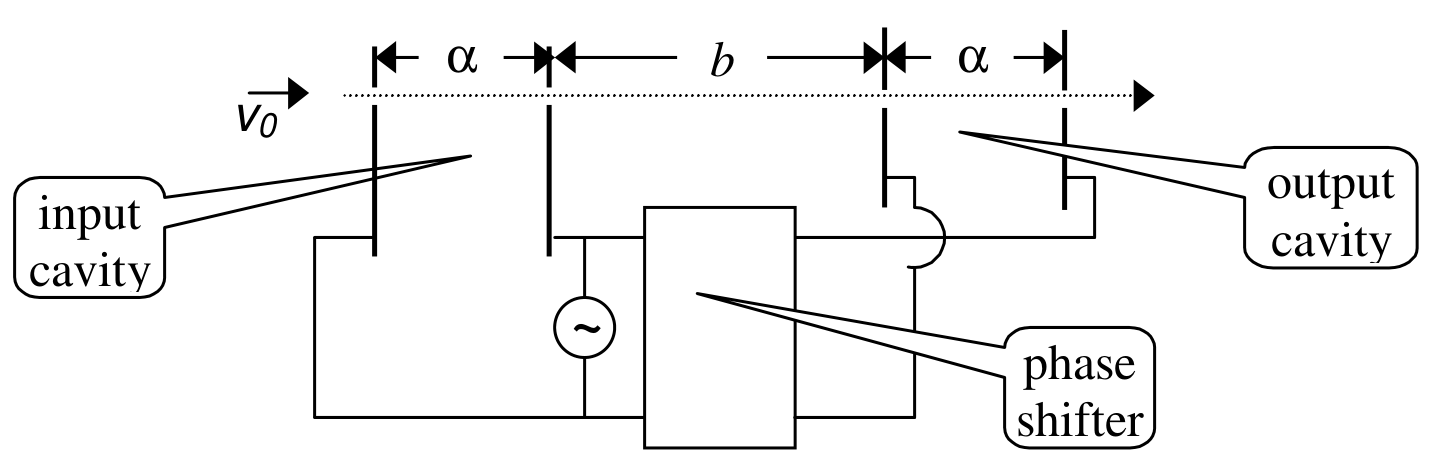
a) the distance , where the electrons bunch. Copy your result onto the answer form. [1.5 pts] [1,5 т.]
b) the necessary phase difference to be provided by the phase shifter. Copy your result onto the answer form. [1.0 pts] [1 т.]
1b) INTERMOLECULAR DISTANCE (2,5 т.)
Let and represent the average distances between molecules of water in the liquid phase and in the vapor phase, respectively. Assume that both phases are at 100 °C and atmospheric pressure, and the vapor behaves like an ideal gas. Using the following data, calculate the ratio and copy your result onto the answer form. [2.5 pts]
Density of water in liquid phase: ,
Molar mass of water: kg/mol
Atmospheric pressure:
Gas constant: J/molK
Avagadro’s number: /mol
1c) SIMPLE SAWTOOTH SIGNAL GENERATOR (2,5 т.)
A sawtooth voltage waveform can be obtained across the capacitor in Fig. 1. is a variable resistor, is an ideal battery, and is a spark gap consisting of two electrodes with an adjustable distance between them. When the voltage across the electrodes exceeds the firing voltage , the air between the electrodes breaks down, hence the gap becomes a short circuit and remains so until the voltage across the gap becomes very small.
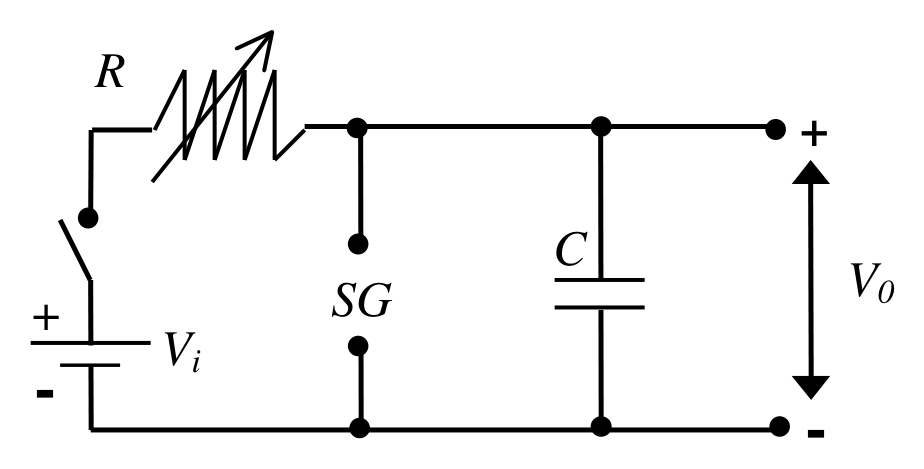
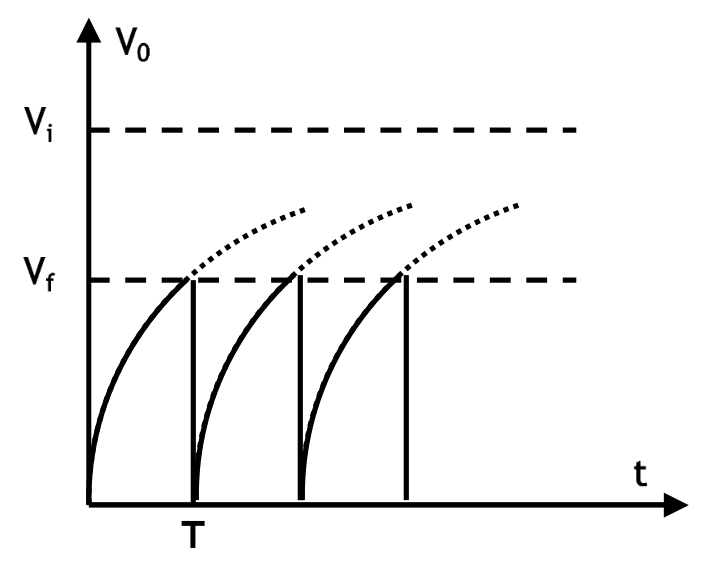
a) Draw the voltage waveform versus time , after the switch is closed. [0.5 pts] [0,5 т.]
b) What condition must be satisfied in order to have an almost linearly varying sawtooth voltage waveform ? Copy your result onto the answer form. [0.2 pts] [0,2 т.]
c) Provided that this condition is satisfied, derive a simplified expression for the period of the waveform. Copy your result onto the answer form. [0.4 pts] [0,4 т.]
d) What should you vary( and/or ) to change the period only? Copy your result onto the answer form. [0.2 pts] [0,2 т.]
e) What should you vary ( and/or ) to change the amplitude only? Copy your result onto the answer form. [0.2 pts] [0,2 т.]
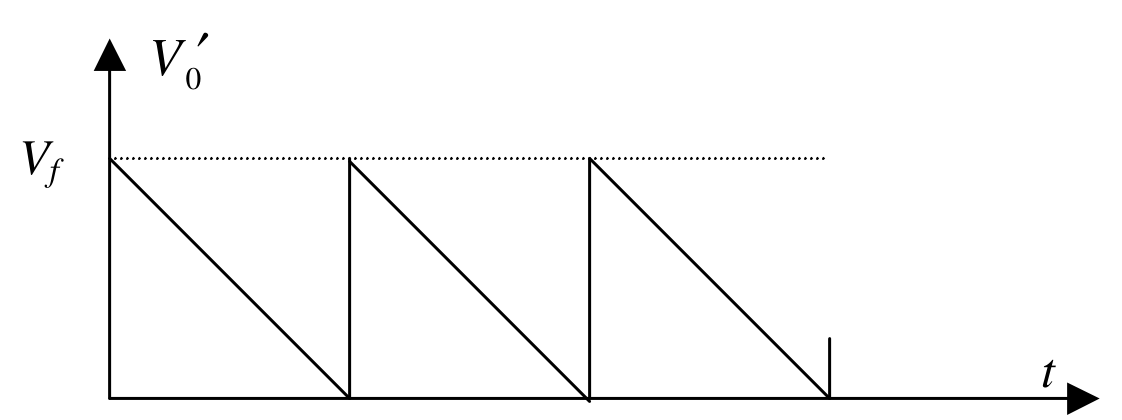
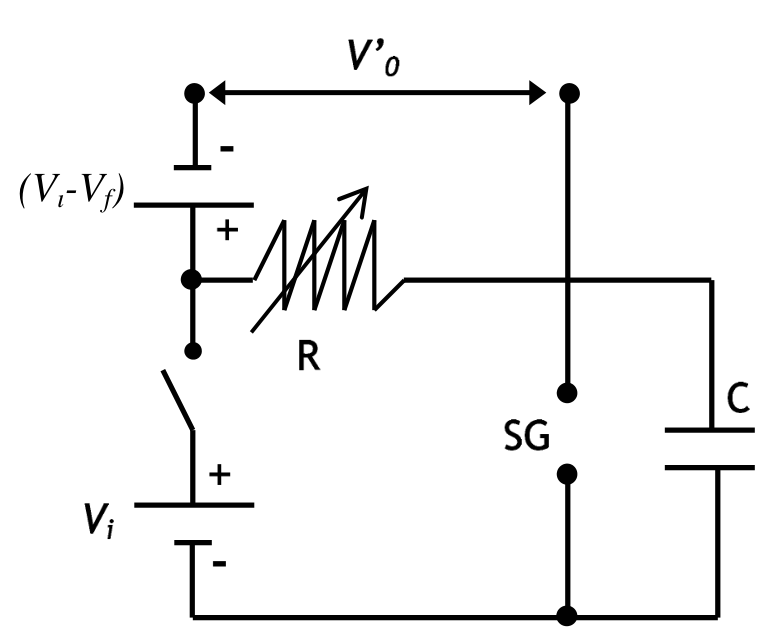
f) You are given an additional, adjustable DC voltage supply. Design and draw a new circuit indicating the terminals where you would obtain the voltage waveform described in Fig. 2. [1.0 pts] [1 т.]
1d) ATOMIC BEAM (2,5 т.)
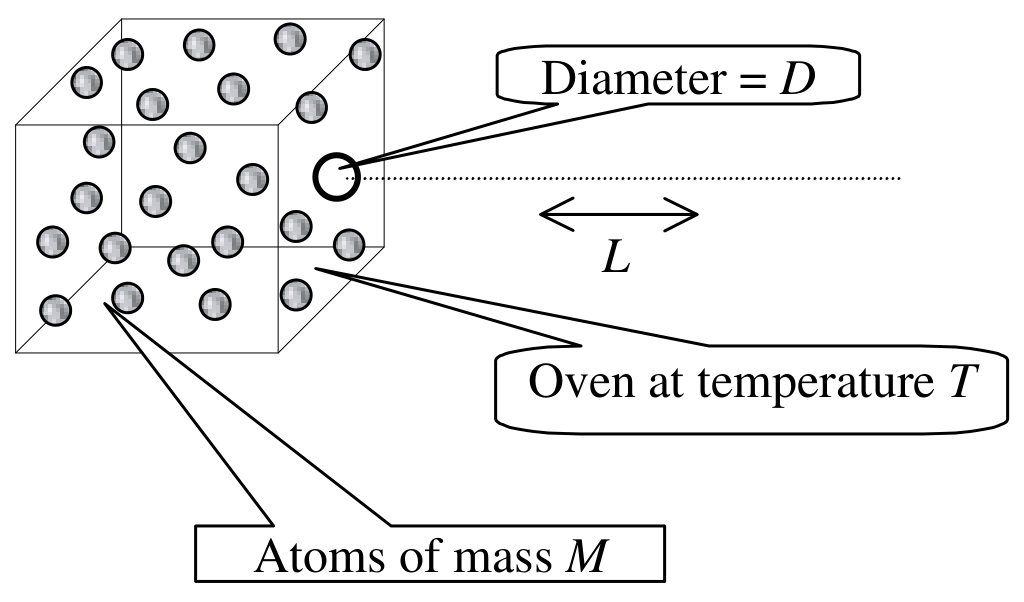
An atomic beam is prepared by heating a collection of atoms to a temperature and allowing them to emerge horizontally through a small hole (of atomic dimensions) of diameter in one side of the oven. Estimate the diameter of the beam after it has traveled a horizontal length along its path. The mass of an atom is . Copy your result onto the answer form. [2.5 pts]
Отговори
Final result of 1d. 1a: b = 2.272×10⁻² m, Δφ = ±220° or ±140°; 1b: dV/dL = 12; 1c: Vi ≫ Vf, T = (Vf/Vi)RC, vary R (period), SG and R (amplitude).
1a) KLYSTRON, a) 0.02272 m
Official solution: b = 2.272×10⁻² m.
1a) KLYSTRON, b) Δφ = ±220° (or Δφ = ±140°)
1c) SIMPLE SAWTOOTH SIGNAL GENERATOR, a) Official solution: a sketch of repeated exponential charging of V0 towards Vi, cut off at Vf with period T.
1c) SIMPLE SAWTOOTH SIGNAL GENERATOR, b) Vi ≫ Vf
1c) SIMPLE SAWTOOTH SIGNAL GENERATOR, c)
1c) SIMPLE SAWTOOTH SIGNAL GENERATOR, d) R
1c) SIMPLE SAWTOOTH SIGNAL GENERATOR, e) SG and R
1c) SIMPLE SAWTOOTH SIGNAL GENERATOR, f) Official solution: a circuit with an additional supply (Vi − Vf) in series, with the correct polarity; V0′ is taken between the free terminal of this supply and the spark-gap node.
Решение
Part 1a
a.
(0.5 pts)
(0.5 pts)
(0.3 pts)
(0.2 pts)
b. The phase difference:
(1.0 pts)
OR
Part 1b
(0.3 pts)
where is the number of molecules per cubic meter in the liquid phase
Average distance between the molecules of water in the liquid phase:
(0.2 pts)
,
where n is the number of moles (0.6 pts)
where is the number of molecules per cubic meter in the vapor phase. (0.9 pts)
(0.2 pts)
(0.3 pts)
Part 1c
a. (0.5 pts.)
b. (0.2 pts)
c.
(0.2 pts)
If
, ,
then
(0.2 pts)
d. R (0.2 pts)
e. SG and R (0.2 pts)
f. Correct circuit (0.4 pts)
(0.3 pts)
with the correct polarity (0.3 pts)
Total (1.0 pts)
Part 1d
As the beam passes through a hole of diameter D the resulting uncertainty in the y-component of the momentum;
(0.6 pts)
and the corresponding velocity component;
(0.4 pts)
Diameter of the beam grows larger than the diameter of the hole by an amount
,
where t is the time of travel. (0.2 pts)
If the oven temperature is T, a typical atom leaves the hole with kinetic energy
(0.4 pts)
(0.2 pts)
Beam travels the horizontal distance L at speed v in time
, so (0.2 pts)
(0.4 pts)
Hence the new diameter after a distance L will be;
(0.1 pts)
Оригинал в Архива: IPhO2001-Theo Questions(pdf).pdf · официални решения: IPhO2001-Theo Solutions(pdf).pdf