IPhO 2001, Теория — Задача 2. Question 2 — BINARY STAR SYSTEM
IPhO2001 - theoretical competition. Theoretical Competition, Monday, July 2nd, 2001 · 2 юли 2001 г. · 10 т.
Внимание: Бележка към темата
The official solution printed for Question 3 does not follow the printed question labels: “Part 3a” answers questions a) and b), “Part 3b” answers c), and “Part 3c” answers d) and then continues with items 2 and 3 (a phase of π/36, skin depth, “The correct choice is (iii)”) that belong to a different version of the question and are not asked in the printed paper.
Please read this first:
The time available is 5 hours for the theoretical competition.
Use only the pen provided.
Use only the front side of the paper.
Begin each part of the problem on a separate sheet.
For each question, in addition to the blank sheets where you may write, there is an answer form where you must summarize the results you have obtained. Numerical results should be written with as many digits as are appropriate to the given data.
Write on the blank sheets of paper whatever you consider is required for the solution of the question. Please use as little text as possible; express yourself primarily in equations, numbers, figures, and plots.
Fill in the boxes at the top of each sheet of paper used by writing your Country No and Country Code, your student number (Student No), the number of the question (Question No), the progressive number of each sheet (Page No), and the total number of blank sheets used for each question (Total No of pages). Write the question number and the section letter of the part you are answering at the top of each sheet. If you use some blank sheets of paper for notes that you do not wish to be marked, put a large X across the entire sheet and do not include it in your numbering.
At the end of the exam, arrange all sheets for each problem in the following order;
- answer form
- used sheets in order
- the sheets you do not wish to be marked
- unused sheets and the printed question
Place the papers inside the envelope and leave everything on your desk. You are not allowed to take any sheets of paper out of the room.
Условие
a) It is well known that most stars form binary systems. One type of binary system consists of an ordinary star with mass and radius , and a more massive, compact neutron star with mass , rotating around each other. In all the following ignore the motion of the earth. Observations of such a binary system reveal the following information:
- The maximum angular displacement of the ordinary star is , whereas that of the neutron star is (see Fig. 1).
- The time it takes for these maximum displacements is .
- The radiation characteristics of the ordinary star indicate that its surface temperature is and the radiated energy incident on a unit area on earth’s surface per unit time is .
- The calcium line in this radiation differs from its normal wavelength by an amount , due only to the gravitational field of the ordinary star. (For this calculation the photon can be considered to have an effective mass of .)
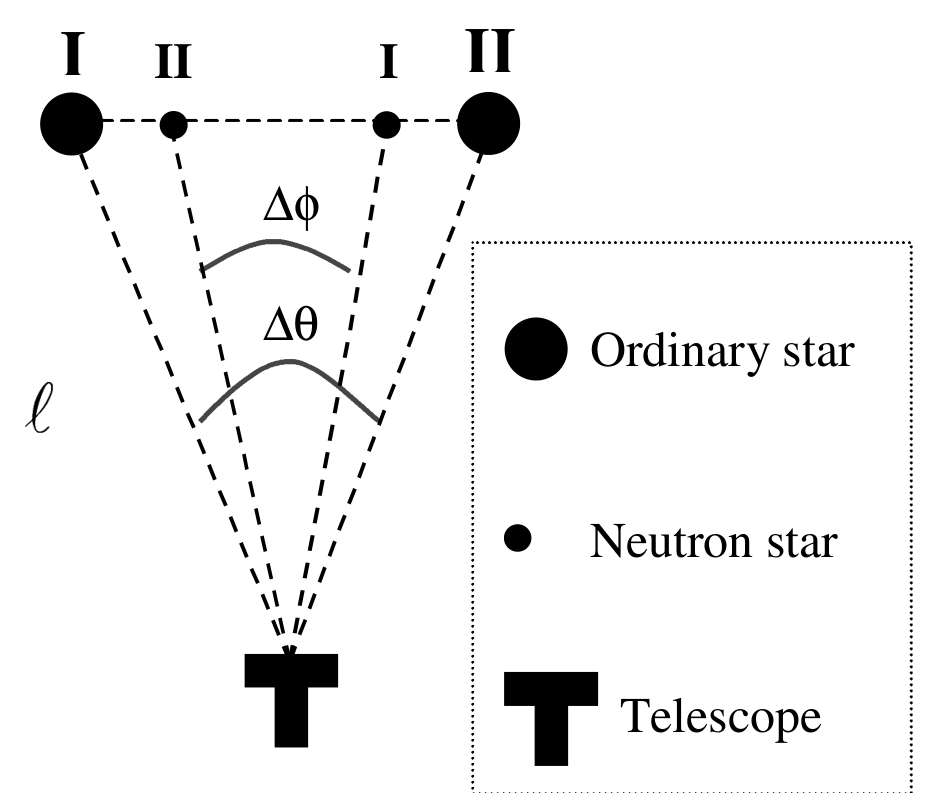
Find an expression for the distance from earth to this system, only in terms of the observed quantities and universal constants. Copy your result onto the answer form. [7 pts]
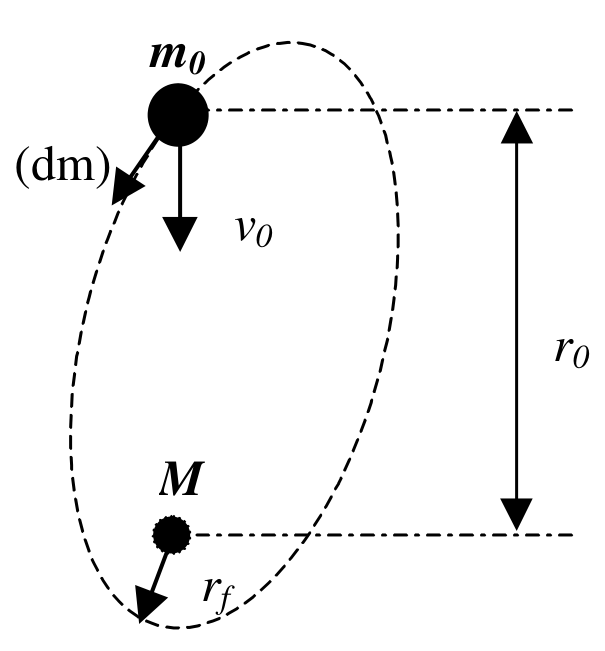
b) Assume that , so that the ordinary star is basically rotating around the neutron star in a circular orbit of radius . Assume that the ordinary star starts emitting gas toward the neutron star with a speed , relative to the ordinary star (see Fig. 2). Assuming that the neutron star is the dominant gravitational force in this problem and neglecting the orbital changes of the ordinary star find the distance of closest approach shown in Fig. 2. Copy your result onto the answer form. [3pts]
Отговори
- a)
- b)
Решение
Part 2a
The total energy radiated per second = , where is the Stephan-Boltzmann constant. The energy incident on a unit area on earth per second is;
(0.8 pts)
The energy of a photon is . The equivalent mass of a photon is . Conservation of photon energy:
(0.8 pts)
yielding
and (2) yields,
(0.2 pts)
The stars are rotating around the center of mass with equal angular speeds:
(4) (0.2 pts)
The equilibrium conditions for the stars are;
(0.8 pts)
with
(0.4 pts)
Substituting (3), (4) and (6) into (5) yields
(0.8 pts)
Part 2b
Conservation of angular momentum for the ordinary star;
(0.6 pts.)
Conservation of angular momentum for dm:
(0.6 pts)
where is the angular velocity of the ring. Equilibrium in the original state yields,
(0.8 pts)
and (7), (8) and (9) give,
(0.4 pts)
Conservation of energy for dm;
(1.2 pts)
Substituting (10);
Since , if , and terms can be neglected. Hence,
(0.8 pts)
To show that change in the linear momentum of the ordinary star in its reference frame:
(0.8 pts)
and (13) implies the existence of an outward force initially and hence r starts growing. Using (7) one can write
Hence, . (0.4 pts)
where m is definitely decreasing. If r starts decreasing at some time also, this ratio starts decreasing, which is a contradiction.
So . (0.4 pts)
Оригинал в Архива: IPhO2001-Theo Questions(pdf).pdf · официални решения: IPhO2001-Theo Solutions(pdf).pdf