IPhO 2001, Теория — Задача 3. Question 3 — MAGNETOHYDRODYNAMIC (MHD) GENERATOR
IPhO2001 - theoretical competition. Theoretical Competition, Monday, July 2nd, 2001 · 2 юли 2001 г. · 10 т.
Внимание: Бележка към темата
The official solution printed for Question 3 does not follow the printed question labels: “Part 3a” answers questions a) and b), “Part 3b” answers c), and “Part 3c” answers d) and then continues with items 2 and 3 (a phase of π/36, skin depth, “The correct choice is (iii)”) that belong to a different version of the question and are not asked in the printed paper.
Please read this first:
The time available is 5 hours for the theoretical competition.
Use only the pen provided.
Use only the front side of the paper.
Begin each part of the problem on a separate sheet.
For each question, in addition to the blank sheets where you may write, there is an answer form where you must summarize the results you have obtained. Numerical results should be written with as many digits as are appropriate to the given data.
Write on the blank sheets of paper whatever you consider is required for the solution of the question. Please use as little text as possible; express yourself primarily in equations, numbers, figures, and plots.
Fill in the boxes at the top of each sheet of paper used by writing your Country No and Country Code, your student number (Student No), the number of the question (Question No), the progressive number of each sheet (Page No), and the total number of blank sheets used for each question (Total No of pages). Write the question number and the section letter of the part you are answering at the top of each sheet. If you use some blank sheets of paper for notes that you do not wish to be marked, put a large X across the entire sheet and do not include it in your numbering.
At the end of the exam, arrange all sheets for each problem in the following order;
- answer form
- used sheets in order
- the sheets you do not wish to be marked
- unused sheets and the printed question
Place the papers inside the envelope and leave everything on your desk. You are not allowed to take any sheets of paper out of the room.
Условие
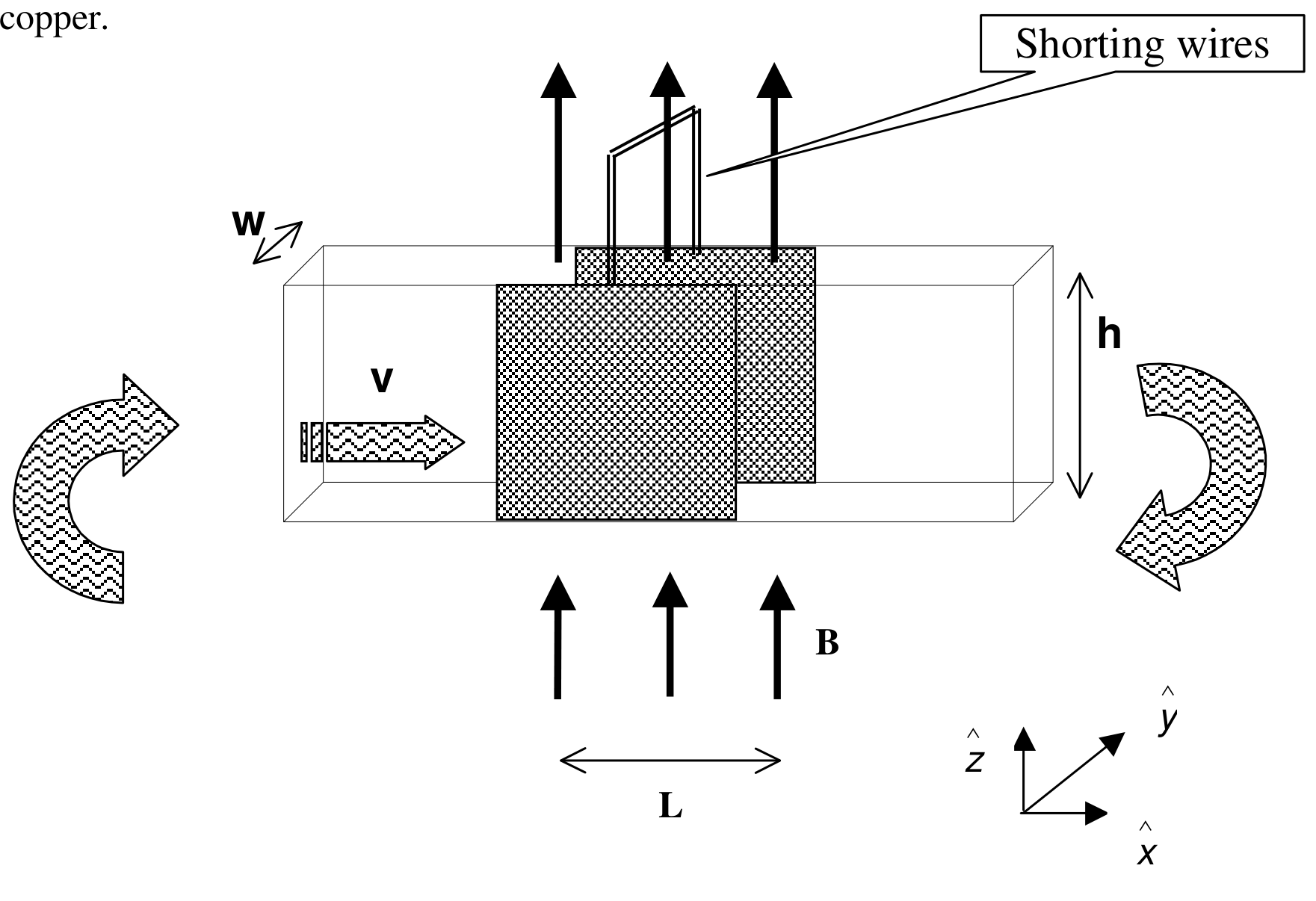
A horizontal rectangular plastic pipe of width and height , which closes upon itself, is filled with mercury of resistivity . An overpressure is produced by a turbine which drives this fluid with a constant speed . The two opposite vertical walls of a section of the pipe with length are made of copper.
The motion of a real fluid is very complex. To simplify the situation we assume the following:
- Although the fluid is viscous, its speed is uniform over the entire cross section.
- The speed of the fluid is always proportional to the net external force acting upon it.
- The fluid is incompressible.
These walls are electrically shorted externally and a uniform, magnetic field B is applied vertically upward only in this section. The set up is illustrated in the figure above, with the unit vectors , , to be used in the solution.
a) Find the force acting on the fluid due to the magnetic field (in terms of , , , , and the new velocity ) [2.0 pts]
b) Derive an expression for the new speed of the fluid (in terms of , , , and ) after the magnetic field is applied. [3.0 pts]
c) Derive an expression for the additional power that must be supplied by the turbine to increase the speed to its original value . Copy your result onto the answer form. [2.0 pts]
d) Now the magnetic field is turned off and mercury is replaced by water flowing with speed . An electromagnetic wave with a single frequency is sent along the section with length in the direction of the flow. The refractive index of water is , and . Derive an expression for the contribution of the fluid’s motion to the phase difference between the waves entering and leaving section . Copy your result onto the answer form. [3.0 pts]
Отговори
a)
Official solution: the force is in the −x direction.
b)
c)
d)
Решение
Part 3a
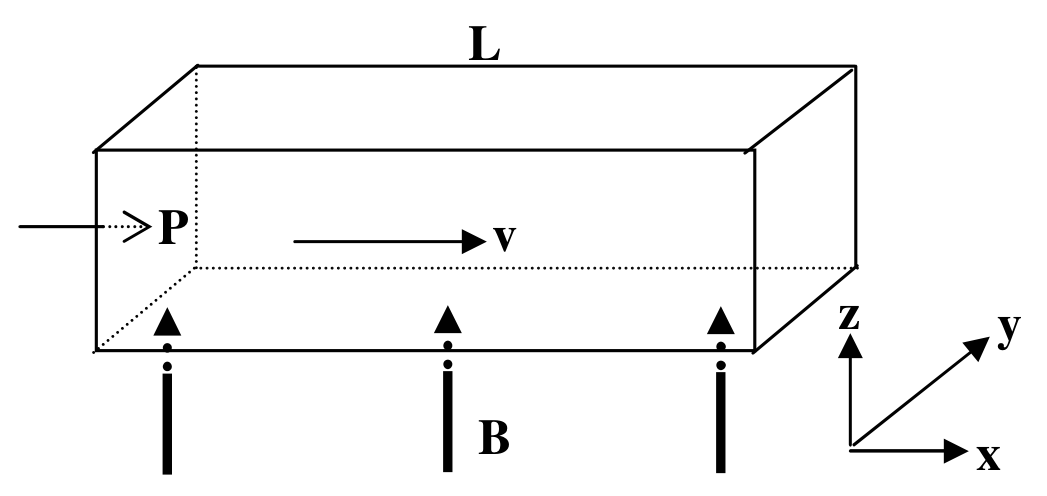
The net force on a charged particle must be zero in the steady state
(0.4 pts)
(0.6 pts)
Force is in the -x direction (0.8 pts)
This creates a back pressure
(0.6 pts)
, (0.6 pts)
(0.4 pts)
(0.6 pts)
Part 3b
From conservation of energy:
or,
to recover the pump must supply an additional pressure (1.0 pts)
Part 3c
(0.5 pts)
For small v ();
neglect the terms containing in the expansion of
(0.5 pts)
(0.5 pts)
so that, (0.5 pts)
a phase of results in (0.4 pts)
(0.2 pts)
which is not physical. (0.4 pts)
For v=20 m/s, Hz. But for this value of f, skin depth is about 25 nm. This means that amplitude of the signal reaching the end of the tube is practically zero. Therefore mercury should be replaced with water. (0.6 pts)
On the other hand if water is used instead of mercury, at 25 Hz m. Signal reaches to the end but m/s, is still nonphysical. Therefore frequency should be readjusted. (0.6 pts)
For v=20 m/s electromagnetic wave of Hz has a skin depth of about δ≈5.6 cm in water and the emerging wave is out of phase by with respect to the incident wave. (The amplitude of the wave reaching to the end of the section is about 17% of the incident amplitude). (0.6 pts)
Therefore mercury should be replaced with water and frequency should be adjusted to Hz. The correct choice is (iii) (0.2 pts)
Оригинал в Архива: IPhO2001-Theo Questions(pdf).pdf · официални решения: IPhO2001-Theo Solutions(pdf).pdf