IPhO 2012, Експеримент — Задача 1. Problem E1. The magnetic permeability of water
The 43rd International Physics Olympiad — Experimental Competition · 19 юли 2012 г. · 10 т.
Внимание: Бележка към темата
The complete alternate archive files Experiment/exp.pdf and Experiment/exp_sol.pdf contain the same two experiments and worked solutions as the primary originals. All 18 native pages of both editions were read. The printed question allocates 0.7 points to E1 B.iii, while its solution labels it 0.5 points; both are preserved. Native E1 Part C sign conventions, E2 charging formula Ic, Vmax unit mVs and angular-frequency unit MHz are preserved as printed. The cover mentions blank Answer, Solution and Draft Sheets, which are absent from these standalone source PDFs; no forms or extra marking scheme are invented.
Корица
- The examination lasts for 5 hours. There are 2 problems worth in total 20 points. There are two tables in your disposal (in two neighbouring cubicles), the apparatus of Problem E1 is on one table and the apparatus of Problem E2 is on the other table; you can move freely between these tables. However, you are not allowed to move any piece of experimental setup from one table to the other.
- Initially the experimental equipment on one table is covered and on the other table is boxed. You must neither remove the cover nor open the box nor open the envelope with the problems before the sound signal of the beginning of competition (three short signals).
- You are not allowed to leave your working place without permission. If you need any assistance (malfunctioning equipment, broken calculator, need to visit a restroom, etc), please raise the corresponding flag (“help” or “toilet” with a long handle at your seat) above your seat box walls and keep it raised until an organizer arrives.
- Use only the front side of the sheets of paper.
- For each problem, there are dedicated Solution Sheets (see header for the number and pictogramme). Write your solutions onto the appropriate Solution Sheets. For each Problem, the Solution Sheets are numbered; use the sheets according to the enumeration. Copy the final answers into the appropriate boxes of the Answer Sheets. There are also Draft papers; use these for writing things which you don’t want to be graded. If you have written something what you don’t want to be graded onto the Solution Sheets (such as initial and incorrect solutions), cross these out.
- If you need more paper for a certain problem, please raise the flag “help” and tell an organizer the problem number; you are given two Solution sheets (you can do this more than once).
- You should use as little text as possible: try to explain your solution mainly with equations, numbers, tables, symbols and diagrams.
- Avoid unnecessary movements during the experimental examination and do not shake the walls of your cubicle - the laser experiment requires stability.
- Do not look into the laser beam or its reflections! It may permanently damage your eyes!
- The first single sound signal tells you that there are 30 min of solving time left; the second double sound signal means that 5 min is left; the third triple sound signal marks the end of solving time. After the third sound signal you must stop writing immediately. Put all the papers into the envelope at your desk. You are not allowed to take any sheet of paper out of the room. If you have finished solving before the final sound signal, please raise your flag.
Условие
The effect of a magnetic field on most of substances other than ferromagnetics is rather weak. This is because the energy density of the magnetic field in substances of relative magnetic permeability is given by the formula , and typically is very close to 1. Still, with suitable experimental techniques such effects are firmly observable. In this problem we study the effect of a magnetic field, created by a permanent neodymium magnet, on water and use the results to calculate the magnetic permeability of water. You are not asked to estimate any uncertainties throughout this problem and you do not need to take into account the effects of surface tension.
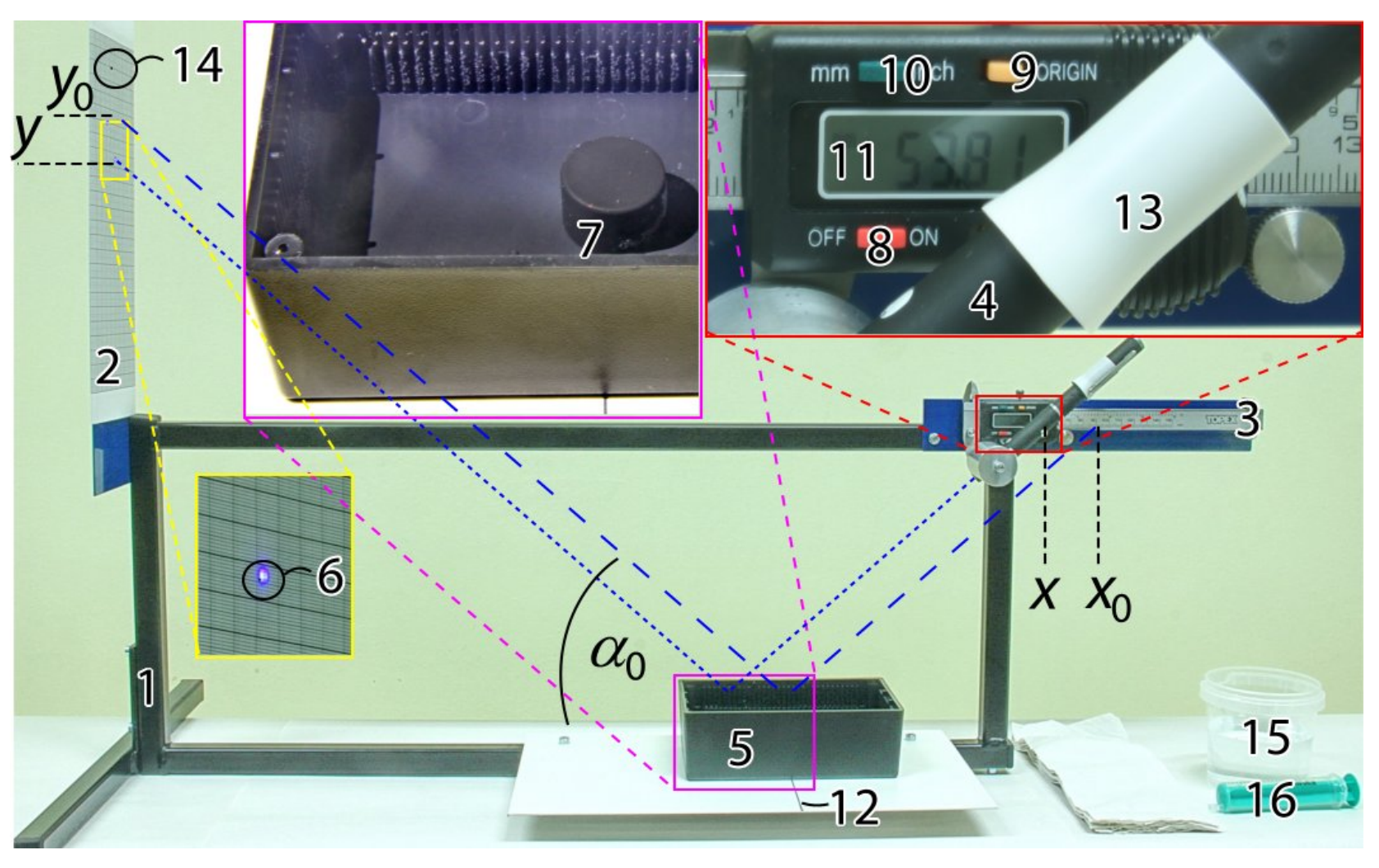
The setup comprises of 1 a stand (the highlighted numbers correspond to the numbers in the fig.), 3 a digital caliper, 4 a laser pointer, 5 a water tray and 7 a cylindrical permanent magnet in the water tray (the magnet is axially magnetised). The water tray is fixed to the base of the stand by the magnet’s pull. The laser is fixed to the caliper, the base of which is fastened to the stand; the caliper allows horizontal displacement of the laser. The on-off button of the laser can be kept down with the help of 13 the white conical tube. Do not leave the Laser switched on unnecessarily. The depth of the water above the magnet should be reasonably close to 1 mm (if shallower, the water surface becomes so curved that it will be difficult to take readings from the screen). 15 A cup of water and 16 a syringe can be used for the water level adjustment (to raise the level by 1 mm, add 13 ml of water). 2 A sheet of graph paper (the “screen”) is to be fixed to the vertical plate with 14 small magnetic tablets. If the laser spot on the screen becomes smeared, check for a dust on the water surface (and blow away).
The remaining legend for the figure is as follows: 6 the point where the laser beam hits the screen; 11 the LCD screen of the caliper, 10 the button which switches the caliper units between millimeters and inches; 8 on-off switch; 9 button for setting the origin of the caliper reading. Beneath the laser pointer, there is one more button on the caliper, which temporarily re-sets the origin (if you pushed it inadvertently, push it once again to return to the normal measuring mode).
Numerical values for your calculations:
Horizontal distance between the magnet’s centre and the screen . Check (and adjust, if needed) the alignment of the centre of the magnet in two perpendicular directions. The vertical axis of the magnet must intersect with the laser beam, and it must also intersect with 12 the black line on the support plate.
Magnetic induction (magnetic field strength) on the magnet’s axis, at a height of 1 mm from the flat surface,
Density of water
Acceleration of free-fall
Permeability of a vacuum
WARNINGS:
- The laser orientation is pre-adjusted, do not move it!
- Do not look into the laser beam or its reflections!
- Do not try to remove the strong neodymium magnet!
- Do not put magnetic materials close to the magnet!
- Turn off the laser when not used, batteries drain in 1 h!
Part A Qualitative shape of the water surface (1 points)
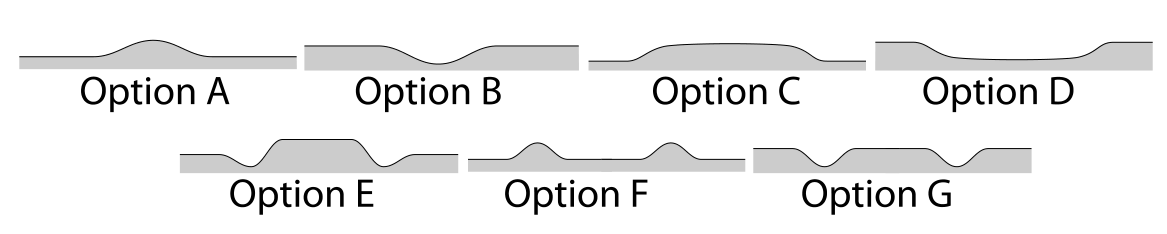
When a cylindrical magnet is placed below water surface, the latter becomes curved. By observation, determine the shape of the water surface above the magnet. Based on this observation, decide if the water is diamagnetic () or paramagnetic ().
Write the letter corresponding to the correct option into the Answer Sheet, together with an inequality or .
For this part, you do not need to justify your answer. [1 т.]
Part B, i. Exact shape of the water surface (7 points)
Curving of the water surface can be checked with high sensitivity by measuring the reflection of the laser beam from the surface. We use this effect to calculate the dependence of the depth of the water on the horizontal position above the magnet.
(1.6 pts) Measure the dependence of the vertical position of the laser spot on the screen on the caliper reading (see figure). You should cover the whole usable range of caliper displacements. Write the results into the Table in the Answer Sheet. [1,6 т.]
ii. (0.7 pts) Draw the graph of the measured dependence.
iii. (0.7 pts) Using the obtained graph, determine the angle between the beam and the horizontal surface of the water.
iv. (1.4 pts) please note that the slope () of the water surface can be expressed as follows:
where is the vertical position of the laser spot on the screen when the beam is reflected from the water surface at the axis of the magnet, and is the respective position of the caliper. Calculate the values of the slope of the water surface and enter them into the Table on the Answer Sheet. Please note that it may be possible to simplify your calculations if you substitute some combination of terms in the given expression for the slope with a reading from the last graph.
v. (1.6 pts) Calculate the height of the water surface relative to the surface far from the magnet, as a function of , and write it into the Table on the Answer Sheet.
vi. (1.0 pts) Draw the graph of the latter dependence. Indicate on it the region where the beam hits the water surface directly above the magnet.
Part C Magnetic permeability (2 points)
Using the results of Part B, calculate the value of (the so-called magnetic susceptibility), where is the relative magnetic permeability of the water. Write your final formula and the numerical result into the Answer Sheet. [2 т.]
Отговори
Part A D
Official solution: Option D and (water is diamagnetic); full marks are given also for Option B.
iii. 38 °
Official value for the official data set. The official solution prints this sub-task as (0.5 pts), the problem sheet as (0.7 pts).
Part C
Official result with (depth of the water surface at the magnet axis) for the official data set.
Решение
Part A. Qualitative shape of the water surface (1 points)
Observing reflections from the water surface (in particular, those of straight lines, such as the edge of a sheet of paper), it is easy to see that the profile has one minimum and has a relatively flat bottom, ie. the correct answer is “Option D” (full marks are given also for Option B). This profile implies that water is pushed away from the magnet, which means (recall that ferromagnets with are pulled).
Part B. Exact shape of the water surface (7 points)
i. (1.6 pts) The height of the spot on the screen is tabulated below as a function of the horizontal position of the caliper. Note that the values of in millimetres can be rounded to integers (this series of measurements aimed as high as possible precision).
| x (mm) | 10 | 15 | 20 | 25 | 30 | 32 | 34 | 36 |
|---|---|---|---|---|---|---|---|---|
| y (mm) | 11.5 | 15.6 | 19.8 | 24.3 | 30.2 | 33.2 | 37.2 | 40.5 |
| x (mm) | 38 | 40 | 42 | 44 | 46 | 48 | 50 | 52 |
| y (mm) | 42.2 | 41.4 | 40.3 | 40.3 | 40.8 | 42 | 43.2 | 44.4 |
| x (mm) | 54 | 56 | 58 | 60 | 62 | 64 | 66 | 68 |
| y (mm) | 45.3 | 45.8 | 45.4 | 44.4 | 43.6 | 46.2 | 50 | 53.6 |
| x (mm) | 70 | 72 | 74 | 76 | 78 | 80 | 85 | 90 |
| y (mm) | 56.7 | 59.5 | 61.6 | 63.5 | 65.3 | 67 | 70.9 | 74.9 |
ii. (0.7 pts)
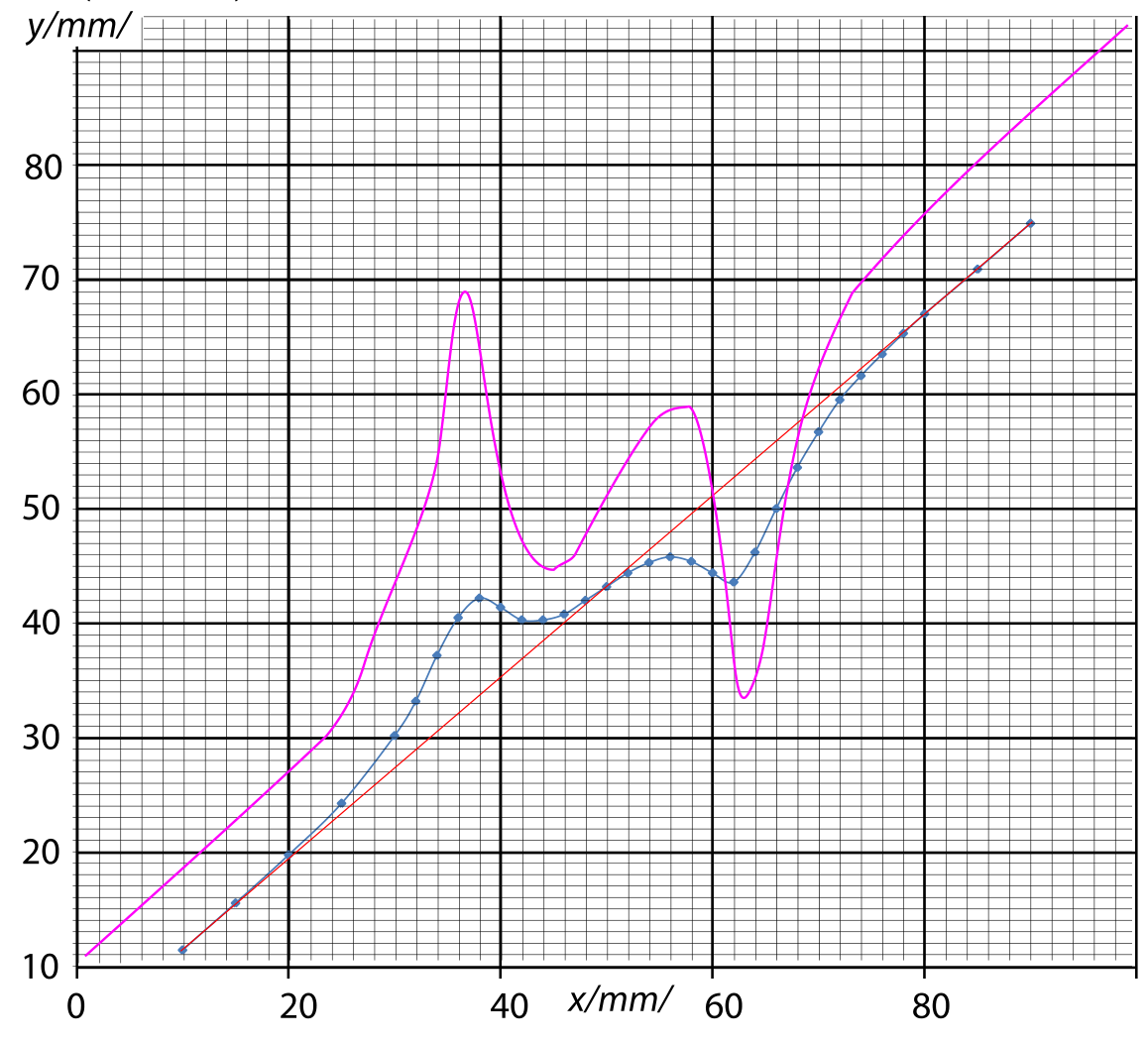
On this graph, the data of to two different water levels are depicted; blue curve corresponds to a water depth of ca 2 mm (data given in the table above); the violet one — to 1 mm.
iii. (0.5 pts) If the water surface were flat, the dependence of on would be linear, and the tangent of the angle would be given by , where is a horizontal displacement of the pointer, and — the respective displacement of the spot height. For the extreme positions of the pointer, the beam hits the water surface so far from the magnet that there, the surface is essentially unperturbed; connecting the respective points on the graph, we obtain a line corresponding to a flat water surface — the red line. Using these two extreme data points we can also easily calculate the angle .
iv. (1.4 pts) For faster calculations, (appearing in the formula given) can be read from the previous graph as the distance between red and blue line; the red line is given by equation . One can also precalculate . The calculations lead to the following table (with ; as mentioned above, during the competition, lesser precision with two significant numbers is sufficient).
| x (mm) | 10 | 15 | 20 | 25 | 30 | 32 | 34 | 36 |
|---|---|---|---|---|---|---|---|---|
| z | 0 | 10 | 27 | 66 | 204 | 303 | 473 | 591 |
| x (mm) | 38 | 40 | 42 | 44 | 46 | 48 | 50 | 52 |
| z | 597 | 428 | 239 | 128 | 53 | 26 | 0 | -26 |
| x (mm) | 54 | 56 | 58 | 60 | 62 | 64 | 66 | 68 |
| z | -72 | -145 | -278 | -449 | -606 | -536 | -388 | -254 |
| x (mm) | 70 | 72 | 74 | 76 | 78 | 80 | 85 | 90 |
| z | -154 | -74 | -40 | -20 | -6 | 2 | -2 | 0 |
v. (1.6 pts) The water height can be obtained as the integral . Thus, we calculate the water height row-by-row, by adding to the height in the previous row the product of the horizontal displacement with the average slope .
| (mm) | 10 | 15 | 20 | 25 | 30 | 32 | 34 | 36 |
|---|---|---|---|---|---|---|---|---|
| (m) | 0 | 0 | 1 | 4 | 10 | 15 | 23 | 34 |
| (mm) | 38 | 40 | 42 | 44 | 46 | 48 | 50 | 52 |
| (m) | 46 | 56 | 63 | 66 | 68 | 69 | 69 | 69 |
| (mm) | 54 | 56 | 58 | 60 | 62 | 64 | 66 | 68 |
| (m) | 68 | 66 | 61 | 54 | 44 | 32 | 23 | 17 |
| (mm) | 70 | 72 | 74 | 76 | 78 | 80 | 85 | 90 |
| (m) | 12 | 10 | 9 | 8 | 8 | 8 | 8 | 8 |
Note that the water level height at the end of the table should be also 0 (this corresponds also to an unperturbed region); the non-zero result is explained by the measurement uncertainties. One can improve the result by subtracting from a linear trend .
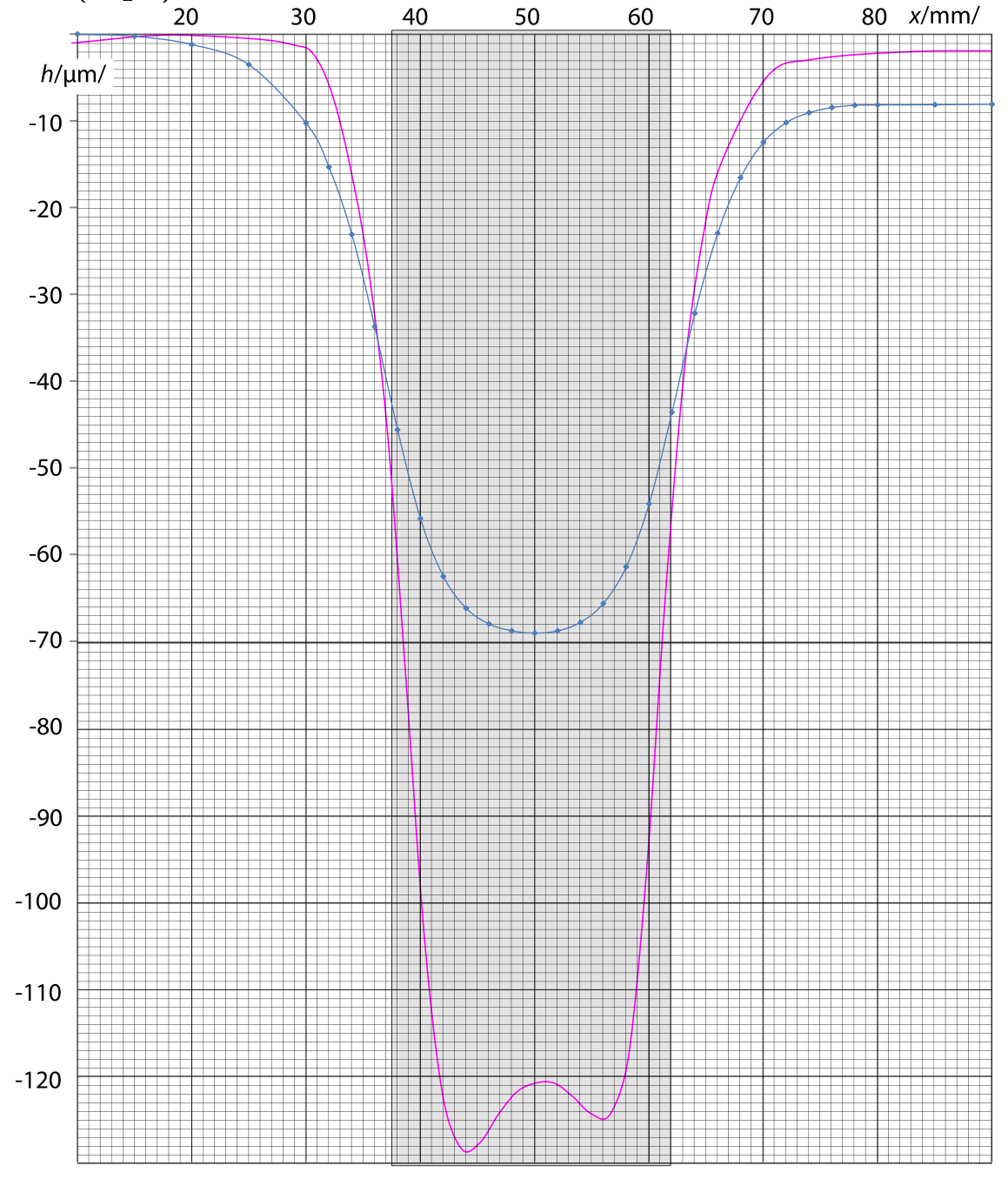
If the water level above the magnet is 1 mm, the water level descends below its unperturbed level at the axis of the magnet by ca .
vi. (1 pt)
Similarly to the previous figure, blue curve corresponds to a water depth of ca 2 mm, (data given in the table above), and the violet one — to 1 mm.
The position of the magnet can be found by measuring the caliper (find the positions when the laser beam hits the edges of the magnet and determine the distance between these positions — the result is ca 24 mm), and using the symmetry: magnet is placed symmetrically with respect to the surface elevation curve.
Part C. Magnetic permeability (2 points)
Water surface takes an equipotential shape; for a unit volume of water, the potential energy associated with the magnetic interaction is ; the potential energy associated with the Earth’s gravity is . At the water surface, the sum of those two needs to be constant; for a point at unperturbed surface, this expression equals to zero, so and hence, . Here, stands for the depth of the water surface at the axis of the magnet; note that we have compensated the cumulative error as described at the end of the previous task and obtained as the difference between the depth at the magnet’s axis () and the half-depth at the right-hand-side of the graph (). Putting in the numbers, we obtain .
Оригинал в Архива: 2012-08-09 IPhO2012_Experimental_problems.pdf · официални решения: 2012-08-09 IPhO2012 Experiment_Solutions_ENG.pdf · допълнителни данни: exp.pdf · допълнителни данни: exp_sol.pdf