IPhO 2015, Теория — Задача 3.1. Fuel Pin
The Design of a Nuclear Reactor
Footnote 1
Joseph Amal Nathan (BARC) and Vijay A. Singh (ex-National Coordinator, Science Olympiads) were the principal authors of this problem. The contributions of the Academic Committee, Academic Development Group and the International Board are gratefully acknowledged.
Условие
Uranium occurs in nature as UO with only 0.720% of the uranium atoms being U. Neutron induced fission occurs readily in U with the emission of 2-3 fission neutrons having high kinetic energy. This fission probability will increase if the neutrons inducing fission have low kinetic energy. So by reducing the kinetic energy of the fission neutrons, one can induce a chain of fissions in other U nuclei. This forms the basis of the power generating nuclear reactor (NR).
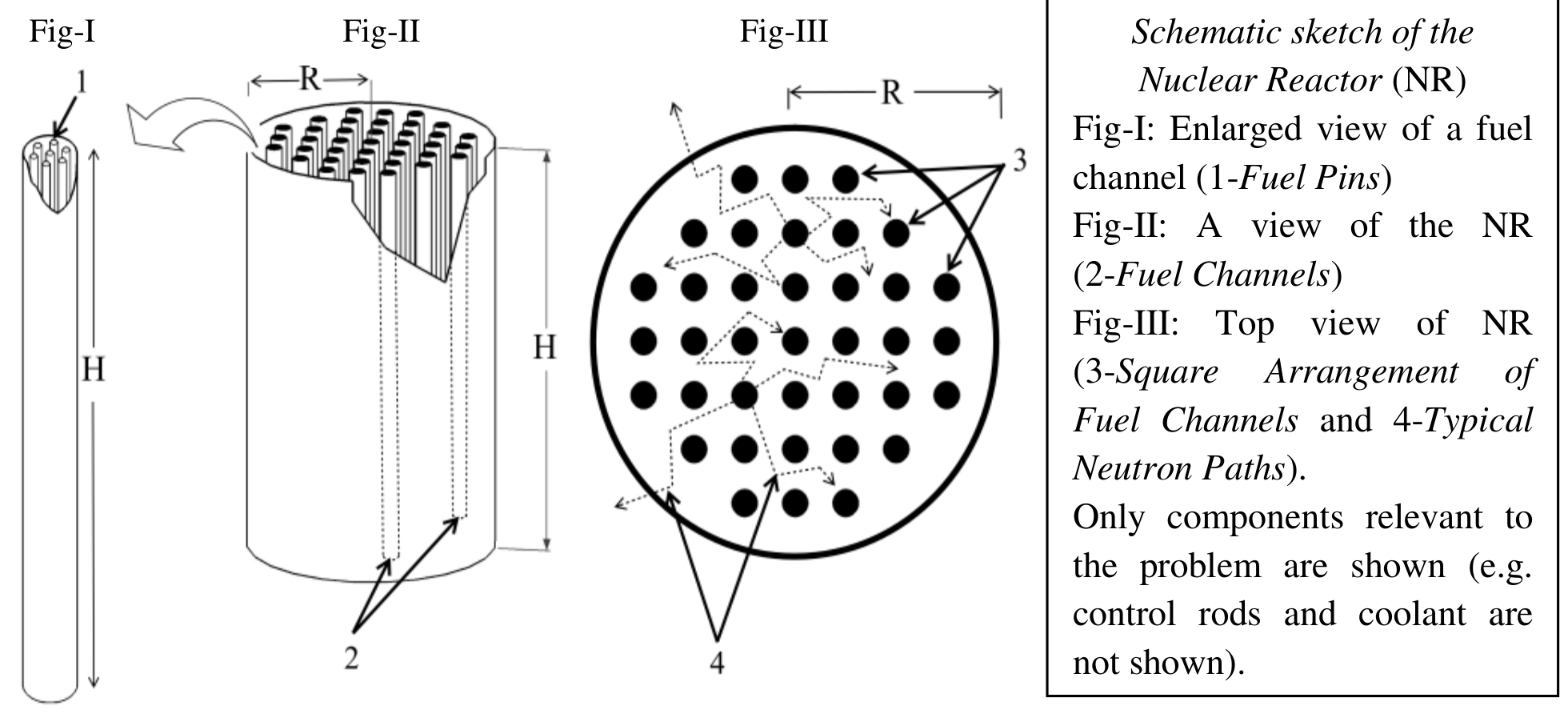
A typical NR consists of a cylindrical tank of height and radius filled with a material called moderator. Cylindrical tubes, called fuel channels, each containing a cluster of cylindrical fuel pins of natural UO in solid form of height , are kept axially in a square array. Fission neutrons, coming outward from a fuel channel, collide with the moderator, losing energy and reach the surrounding fuel channels with low enough energy to cause fission (Figs I-III). Heat generated from fission in the pin is transmitted to a coolant fluid flowing along its length. In the current problem we shall study some of the physics behind the (A) Fuel Pin, (B) Moderator and (C) NR of cylindrical geometry.
A Fuel Pin
| Data for UO | ||
|---|---|---|
| 1. Molecular weight | 2. Density | |
| 3. Melting point | 4. Thermal conductivity |
A1 Consider the following fission reaction of a stationary U after it absorbs a neutron of negligible kinetic energy.
Estimate (in MeV) the total fission energy released. The nuclear masses are: u; u; u; u and 1 u = 931.502 MeV c. Ignore charge imbalance. [0,8 т.]
A2 Estimate the number of U atoms per unit volume in natural UO. [0,5 т.]
A3 Assume that the neutron flux density, on the fuel is uniform. The fission cross-section (effective area of the target nucleus) of a U nucleus is . If 80.00% of the fission energy is available as heat, estimate (in W m), the rate of heat production in the pin per unit volume. 1MeV = J [1,2 т.]
A4 The steady-state temperature difference between the center () and the surface () of the pin can be expressed as , where is a dimensionless constant and is the radius of the pin. Obtain by dimensional analysis. Note that is the thermal conductivity of UO. [0,5 т.]
A5 The desired temperature of the coolant is K. Estimate the upper limit on the radius of the pin. [1 т.]
Отговори
A1 208.684 MeV
Acceptable range printed in the official solution: 208.000 to 209.000.
A2 m⁻³
Acceptable range printed in the official solution: 1.650 to 1.750 (×10²⁶ m⁻³).
A3 W/m³
Acceptable range printed in the official solution: 4.800 to 5.000 (×10⁸ W/m³).
A4
A5 0.008267 m
Решение
A1
Solution: MeV
Detailed solution: The energy released during the transformation is
Since the data is supplied in terms of unified atomic masses (u), we have
MeV [Acceptable Range (208.000 to 209.000)] from the given data.
A2
Solution:
Detailed solution: The number of UO molecules per m of the fuel is given in the terms of its density , the Avogadro number and the average molecular weight as
Each molecule of UO contains one uranium atom. Since only 0.72% of these are U,
[Acceptable Range (1.650 to 1.750)]
A3
Solution:
Detailed solution: It is given that 80% of the fission energy is available as heat thus the heat energy available per fission is from a-(i)
The total cross-section per unit volume is . Thus the heat produced per unit volume per unit time is
[Acceptable Range (4.800 to 5.000)]
A4
Solution: .
Detailed solution: The dimensions of is temperature. We write this as . Once can similarly write down the dimensions of , and . Equating the temperature to powers of , and , one could state the following dimensional equation:
This yields the following algebraic equations
equating powers of temperature
equating powers of mass or time. From the previous equation we get
Next equating powers of length. This yields .
Thus we obtain where we insert the dimensionless factor 1/4 as suggested in the problem. No penalty if the factor 1/4 is not written.
Note: Same credit for alternate ways of obtaining .
A5
Solution: m.
Detailed solution: The melting point of UO is 3138 K and the maximum temperature of the coolant is 577 K. This sets a limit on the maximum permissible temperature to be less than (3138 - 577 = 2561 K) to avoid “meltdown”. Thus one may take a maximum of K.
Noting that W/m - K, we have
Where we have used the value of from A2. This yields m. So m constitutes an upper limit on the radius of the fuel pin.
Note: The Tarapur 3 & 4 NR in Western India has a fuel pin radius of m.