IPhO 2019, Теория — Задача 3. Thermoacoustic Engine
Theory — IPhO Israel 2019 — Q3 — Thermoacoustic Engine · 10 т.
Условие
A thermoacoustic engine is a device that converts heat into acoustic power, or sound waves - a form of mechanical work. Like many other heat machines, it can be operated in reverse to become a refrigerator, using sound to pump heat from a cold to a hot reservoir. The high operating frequencies reduce heat conduction and eliminate the need for any working chamber confinement. Unlike many other engine types, the thermoacoustic engine has no moving parts except the working fluid itself.
The efficiencies of thermoacoustic machines are typically lower than other engine types, but they have advantages in set up and maintenance costs. This creates opportunities for renewable energy applications, such as solar-thermal power plants and utilization of waste heat. Our analysis will focus on the creation of acoustic energy within the system, ignoring the extraction or conversion for powering external devices.
Part A: Sound wave in a closed tube (3.7 points)
Consider a thermally insulating tube of length and cross-sectional area , whose axis lies along the direction. The two ends of the tube are located at and . The tube is filled with an ideal gas and is sealed on both ends. At equilibrium, the gas has temperature , pressure and mass density . Assume that viscosity can be ignored and that the gas motion is only in the direction. The gas properties are uniform in the perpendicular and directions.
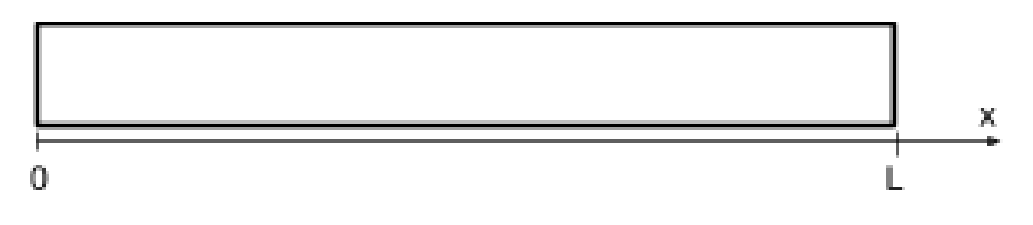
A.1 When a standing sound wave forms, the gas elements oscillate in the direction with angular frequency . The amplitude of the oscillations depends on each element's equilibrium position along the tube. The longitudinal displacement of each gas element from its equilibrium position is given by
(please note the here describes the displacement of a gas element)
where is a positive constant, is the wavenumber and is the wavelength. What is the maximum possible wavelength in this system? [0,3 т.]
We will assume throughout the question an oscillation mode of .
Now, consider a narrow parcel of gas, located at rest between and (). As a result of the displacement wave of Task A.1, the parcel oscillates along the axis and undergoes a change in volume and other thermodynamic properties.
Throughout the following tasks assume all these changes to the thermodynamic properties to be small compared to the unperturbed values.
A.2 The parcel volume oscillates around the equilibrium value of and has the form
Obtain an expression for in terms of , , and . [0,5 т.]
A.3 Assume that the total pressure of the gas, as a result of the sound wave, takes the approximate form
Considering the forces acting on the parcel of gas, compute the amplitude of the pressure oscillation to leading order, in terms of the position , the equilibrium density , the displacement amplitude and the wave parameters and . [0,7 т.]
At acoustic frequencies, the thermal conductivity of the gas can be neglected. We will treat the expansion and contraction of gas parcels as purely adiabatic, satisfying the relation , where is the adiabatic constant.
A.4 Use the relation above and the results of the previous tasks to obtain an expression for the speed of sound waves in the tube, to first order. Express your answer in terms of and the adiabatic constant . [0,3 т.]
A.5 The change in the gas temperature due to the adiabatic expansion and contraction, as a result of the sound wave, takes the form:
Compute the amplitude of the temperature oscillations in terms of , , , and . [0,7 т.]
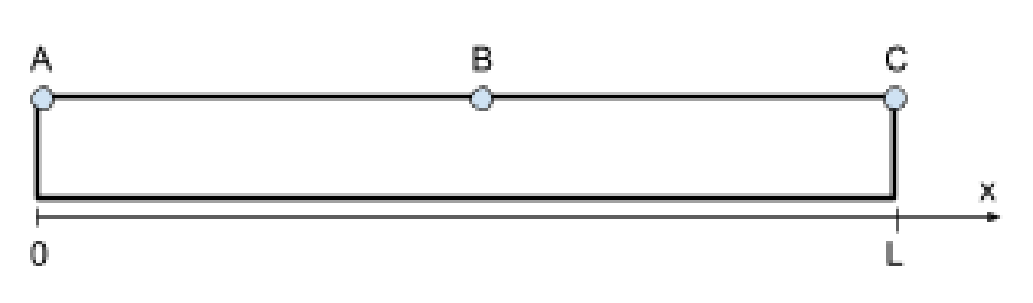
A.6 For the purpose of this task only, we assume a weak thermal interaction between the tube and the gas. As a result, the standing sound wave remains almost unchanged, but the gas can exchange a small amount of heat with the tube. The heating due to viscosity can be neglected.
For each of the points in Figure 2 (A, C at the edges of the tube, B at the center) state whether the temperature of the tube at that point will increase, decrease or remain the same over a long time. [1,2 т.]
Part B: Sound wave amplification induced by external thermal contact (6.3 points)
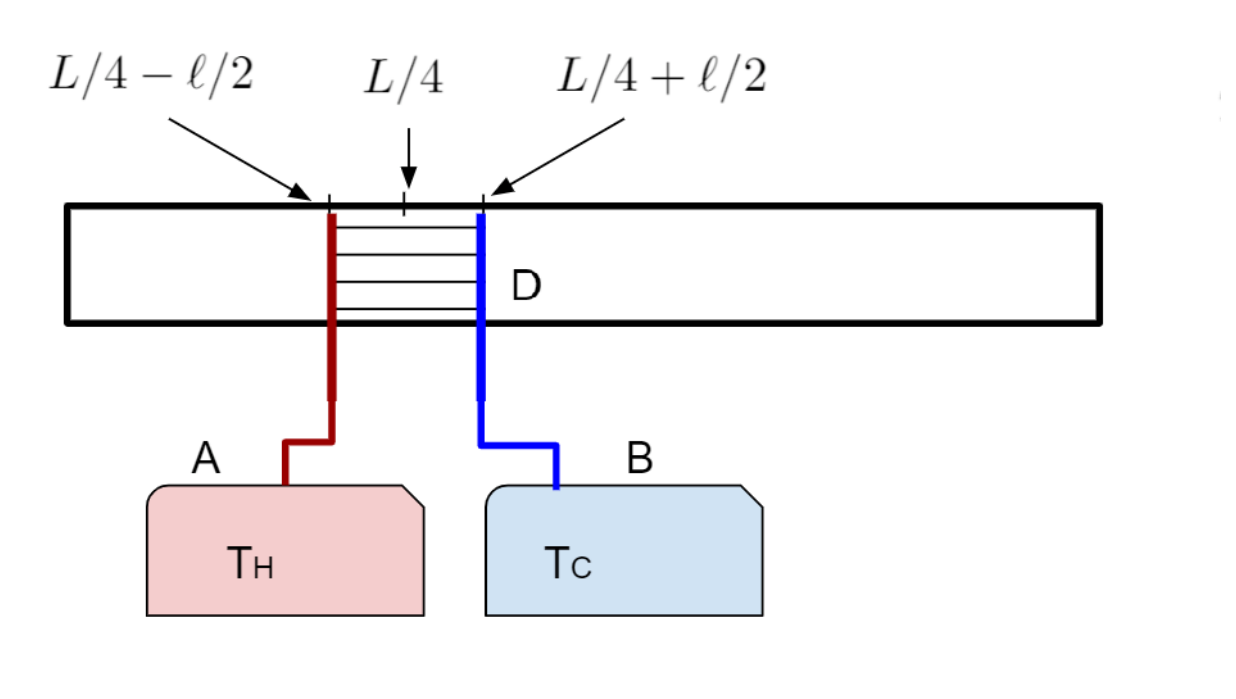
A stack of thin well-spaced solid plates is placed inside the tube. The plates of the stack are aligned in parallel to the tube axis, so as not to obstruct the flow of gas along the tube. The center of the stack is positioned at , and spans a width of along the tube axis, filling its entire cross section. The right and left edges of the stack are held at temperature difference . The left edge of the stack, at , is held by an external thermal reservoir at temperature , and at the same time, its right edge, at , is held at a temperature .
The plate stack allows a slight longitudinal heat flow to maintain a constant temperature gradient between its edges, such that .
To analyze the effect of the thermal contact between the plate stack and the gas on the sound waves in the tube, make the following assumptions:
- As in the previous part, all changes to the thermodynamic properties are small compared to the unperturbed values.
- The system operates in the fundamental standing-wave mode of the longest possible wavelength. It is only slightly modified by the presence of the plate stack.
- The stack is much shorter than the wavelength , and can be positioned far enough from both displacement and pressure nodes, so that the displacement and the pressure may be considered uniform over the entire length of the stack.
- We may neglect any edge effects, caused by the parcels moving in and out of the stack.
- The temperature difference between the ends of the plate stack, i.e. between the hot and the cold reservoirs, is small compared to the absolute temperature: .
- Heat conduction through the stack, through the gas, and along the tube are all negligible. The only significant sources of heat transfer are convection due to the motion of the gas and conduction between the gas and the stack.
B.1 Consider a specific parcel of gas in the region of the stack, originally at . As the parcel moves within the stack, the local temperature of the nearby part of the stack changes as follows:
Express in terms of , and . [0,4 т.]
B.2 Above which critical temperature difference will the gas be conveying heat from the hot reservoir to the cold one? Express in terms of , , and . [1 т.]
B.3 Obtain the general approximate expression for the heat flow into a small parcel of gas as a linear function of its volume and pressure change rates. Express your answer in terms of the rate of volume change , the rate of pressure change , the unperturbed equilibrium values of parcel pressure and volume , and the adiabatic index . (You may use the expression for the molar heat capacity at constant volume , where is the gas constant.) [0,8 т.]
The limited heat flow rate between the parcel and the stack causes a phase difference between the pressure and volume oscillations of the parcel. We will see how this generates work.
Let the heat flux into the parcel from the stack be proportional to the temperature difference between the parcel and the neighboring element of the stack, given approximately by . Here and are the temperature oscillation amplitudes of the gas parcel and the neighbouring stack from Tasks A.5 and B.1, respectively, and is a constant. Assume that at the machine's operating frequencies, the change in gas temperature as a result of this heat flow is insignificant compared to both and .
B.4 In order to calculate work, we will consider a change to the volume of the moving parcel as a result of the thermal contact with the stack. Let us write the pressure and the volume of the parcel under the stack's influence in the form:
Given and , find the coefficients and . Express your answer in terms of , , , , , , , , , and . [1,9 т.]
B.5 Obtain an approximate expression for the acoustic work per unit volume produced by the gas parcel over one cycle. Integrate over the volume of the stack to obtain the total work generated by the gas over one cycle. Express in terms of , , , , , , and . [0,8 т.]
B.6 Obtain an approximate expression for the heat transported from the left side of the plane to the right, over a cycle. Express your answer in terms of , , , , , , .
(Hint: you may use the formula for the heat current due convection.) [0,8 т.]
B.7 Find the efficiency of the thermoacoustic engine. The efficiency is defined as the ratio of the generated acoustic work to the heat drawn from the hot reservoir. Express your answer in terms of the temperature difference between the hot and the cold reservoir, the critical temperature difference and the Carnot efficiency . [0,6 т.]
Отговори
- A.1
- A.2
- A.3
- A.4
- A.5
- A.6 The tube heats up near A and C and cools down near B.
- B.1
- B.2
- B.3
- B.4
- B.5
- B.6
- B.7
Решение
Thermoacoustic engine – Solution
Part A: Sound wave in a closed tube
A.1. The boundary conditions are: . As a result, , so we get .
A.2. We get
Thus,
A.3. We use Newton's Second Law to deduce , so that
A.4. Using , we obtain . As a result, , and .
A.5. The relative change in is the sum of the relative changes in and . As a result,
A.6. The movement of the gas parcels inside the tube conveys heat along its boundary. To determine the direction of the convection, we combining the result of Task A.5 and the expression (1) for . We see that when , the gas is colder when the displacement is positive. Likewise, when , the gas is colder when the displacement is negative. Hence, heat flows into the gas near the point B, cooling it down, and out of the gas near the points A and C, heating them up.
Part B: Sound wave amplification induced by external thermal contact
B.1. We get
so that:
B.2. The gas will convey heat from the hot reservoir to the cold one if the parcels are colder than the environment when , and hotter when . This occurs precisely if
Plugging in the results of Tasks A.5 and B.1, we get
B.3. Using the first law of thermodynamics, we get
Plugging in the relation , we see that:
B.4. We plug the expression for into the result of Task B.3. This gives:
We now plug in the data given in equation (6), and get (by considering terms with and separately):
and thus, we can already express as
For , we plug in the results of Tasks B.1 and B.2,
giving:
B.5. We want to integrate the mechanical work generated, , and averaging the result over a long time. To do this, we substitute our expressions (6) for the perturbed and . Since the average of is 0, and that of and is , we get:
Using the result of B.4, we get
To leading order, is the unperturbed wave . Simplifying, we get
B.6. We want to compute the amount of heat convection over one cycle. This means that we need to take the amount of heat moving in or out of the parcel, and weigh it by the position of the parcel at that time. Thus, the total heat conveyed by the parcel, integrated along a cycle, is:
This expression can be computed to leading order using and the unperturbed displacement . This gives
B.7. Dividing the results of Tasks B.5 and B.6, we obtain the expression: