IPhO 2022, Теория — Задача 3. Scaling laws
Theory — Q3-1, English (Official) — 52nd IPhO 2022 International Physics Olympiad — Scaling laws · 8 т.
Условие
Scaling laws describe the functional relationship between two physical quantities that scale with each other over a significant interval. This functional relationship can be a power law, but there are other possibilities, too. Oftentimes, exact expressions are beyond reach, but scaling laws can still be derived.
Part A. Spaghetto (2.0 points) (2 т.)
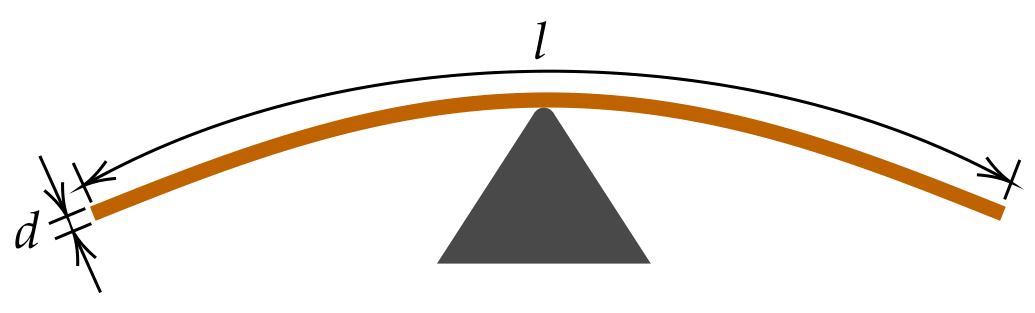
A.1 A spaghetto straw of diameter is being balanced horizontally from its middle. If , the straw breaks under its own weight once its length reaches . What is the maximum length of the straw of diameter before it breaks under its own weight? [2 т.]
Part B. Sand castle (2.0 points) (2 т.)
B.1 The average grain volume of coarse-grained sand is 10 times as large as that of fine-grained sand. Wet fine-grained sand and wet coarse-grained sand have both optimal water content (i.e. assuming the maximal strength of the constructions from it) and are used to build two cylinders of exactly the same shape and size. The strength of each cylinder is tested by pressing it between two parallel plates. The cylinder made of coarse-grained sand gets destroyed once the force applied to press the plates reaches . How large is the force needed to destroy the cylinder made of fine-grained sand? You may ignore the effects of gravity. [2 т.]
Part C. Interstellar travel (2.0 points) (2 т.)
C.1 The spaceship of an interstellar expedition travels at a constant magnitude of the proper acceleration , i.e., this is the acceleration of the spaceship in the inertial frame of reference where it is instantaneously at rest. The passengers must be able to return to Earth within their remaining expected lifetime of 50 years. The maximum distance from Earth reached by the spaceship is . If the acceleration is increased to , the spaceship can reach a farther distance . What is the ratio ?
Hint 1. You may wish to use the relativistic velocity addition formula, however, there are also other approaches.
Hint 2. You may need to deal with hyperbolic functions defined as follows: , , .
Hint 3. Depending on your approach, you may need one or more of these integrals: , , , where and are the inverse functions of the respective hyperbolic functions. [2 т.]
Part D. That sinking feeling (2.0 points) (2 т.)
D.1 A solid wooden ball of radius is floating in the water. Ignoring frictional effects, the frequency of small oscillations would be , but because of viscous friction, after being displaced vertically, the frequency of decaying oscillations is actually . What is the minimum radius of a wooden ball floating in water that undergos small oscillations when displaced? Hint: the viscous drag force acting on a given body is proportional to its speed relative to the bulk of the fluid, and to the viscosity of the fluid it is moving in. The unit of the viscosity is . [2 т.]
Отговори
- Part A. Spaghetto (2.0 points), A.1 158 cm
- Part B. Sand castle (2.0 points), B.1 21.5 N
- Part C. Interstellar travel (2.0 points), C.1 480
- Part D. That sinking feeling (2.0 points), D.1
Решение
T3: Scaling laws (8 pts)
Task A: Spaghetti (2 pts)
This is section 2.2.2 (Statics) of the syllabus.
Consider only the left half of the spaghetti straw.
Torque balance at its right endpoint implies that the torque applied to its right endpoint must balance out the torque due to gravity: . This torque arises from the gradient in the horizontal stress. If the typical horizontal stress is , then the typical force is , so the torque is . Hence, we obtain
so
Marking scheme: (0.4 pts); (0.5 pts); (0.5 pts); (0.4 pts); Answer: 158 cm (0.2 pts).
Task B: Sand castle (2 pts)
This is Section 2.2.2 (statics) and 2.2.5 (hydrodynamics) of the syllabus
Due to wetting of the surfaces of the sand grains and its large surface tension water acts like a glue for sand. This means that all the grains need to be bound together by air-water interface. To achieve this there needs to be neither too little nor too much water: if there is too little water, most of the grains are dry with now surface tension binding them, and if there is too much water, almost all the grains are immersed into water, and again, there is no surface tension binding the grains. So, the overall strength of the buildings from wet sand depends on the water content; we assume that for the both types of sand, the water content is optimal, and the shape of the grains is statistically similar. Let us consider two neighbouring grains connected by a water meniscus — or "neck", as we shall be referring to it henceforth. Note that the "neck" may extend perpendicularly to the figure plane far away; so, more specifically, what the word "neck" will refer to is that part of the water-air interface for which the closest two grains are the ones under consideration.

There are two processes binding the sand grains together. The first one is the force due to the surface tension, , where denotes the surface tension coefficient, and — the perimeter of the "neck"; with , where denotes the length scale of a single grain, we obtain . The second one is the pressure force caused by the negative capillary pressure in the neck, , where is the cross-sectional area of the "neck", and . With we obtain . Thus, the both components are of the same order of magnitude and using either of them will lead to the correct scaling law. These forces press the grains against each other, hence the normal force and friction force between the grains is also on the order of and .
Solution 1: Based on what has been said above, the typical force needed to delocate a grain of sand is . The force needed to delocate an entire layer of sand is then , where is the number of grains in a layer. The force of cylinder destruction thus satisfies
so
Marking scheme: a) Either or (0.5 pts); b) (0.5 pts); c) (0.5 pts); d) (0.3 pts); Answer: 21.5 N (0.2 pts).
Notes: If the student only qualitatively explains the mechanism by which the grains of sand are held together, a maximum of 0.5 pts are given. Points b)-c) are given only if derived from a).
Solution 2: We have seen above that grains to one side of a fictitious surface exert force per cross-sectional area on the order of magnitude as the capillary pressure . In order to get the grains moving, a pressure of the same order of magnitude needs to be applied externally. For the both cylinders, the surface area where the force is applied is the same, hence the force scales as the capillary pressure, .
Marking scheme: The applied pressure must be (0.6 pts); The curvature radius of the interface is (0.6 pts); Capillary pressure (0.6 pts); Answer: 21.5 N (0.2 pts).
Solution 3: The compression force serves to break the surface tension bonds between sand grains. Consider the energy required to push a single layer of sand into the layer beneath it. , where is the force required and is the typical height of a layer (i.e., the typical length scale of a grain). On the other hand, , where is the surface tension of water and is the total amount by which the surface of the water in the layer stretches before all the "water bonds" between the sand grains are broken. Here, is proportional to the area of a layer and is thus a constant between the two cylinders. Hence, is a constant between the two cylinders, i.e., .
Marking scheme: (0.5 pts); (0.5 pts); (0.5 pts); (0.3 pts); Answer: 21.5 N (0.2 pts).
Solution 4: First of all, the force should be proportional to the cylinder's base area . The force required to destroy a cylinder with base area is equal to the force required to destroy cylinders each with base area . As a result, . In addition, depends on the grain's length scale and the water's surface tension . Dimensional analysis thus gives
for fixed and .
Marking scheme: (0.6 pts); (0.6 pts); (0.6 pts); Answer: 21.5 N (0.2 pts).
Note: If the student only qualitatively explains the mechanism by which the grains of sand are held together, a maximum of 0.5 pts are given.
Task C: Interstellar travel (2 pts)
This is Section 2.5 (Relativity) of the syllabus
Let be the astronauts' total travel time. For maximal travel distance, the spaceship accelerates at constant proper acceleration for proper time , during which a distance of is traveled. The spaceship then decelerates at for proper time to come to a rest, during which another distance is traveled. The spaceship then returns to Earth using the same procedure.
Solution 0: (incorrect)
If we ignore relativity, then , which gives an answer of 1.5.
Marking scheme: (0.2 pts); Answer: 1.5 (0.1 pts).
Solution 1: One way to approach the problem is to notice that constant acceleration in spaceship's frame means a constant force in the Earth's frame. This follows directly from the Lorentz transform for the electromagnetic field, more specifically from the fact that when going to a frame moving parallel to the -axis, the -directional electric field remains unchanged. Hence, on the one hand, the force exerted on an accelerating particle of rest mass and carrying a charge remains constant in the lab frame. On the other hand, the acceleration of that particle in an inertial frame moving with velocity , where denotes the particle's velocity at a certain moment of time , is always equal to , regardless of the value of , i.e. constant in time.
Those who are not familiar with the Lorenz transform for electromagnetic field can derive the above described property from the Lorenz transform for momentum and coordinates. We use again (i) the lab frame, and (ii) an inertial frame moving with velocity , where denotes the spaceship's velocity at a certain moment of time which will be used as the origin, ; let primes denote quantities in the second frame. Assuming a very short time period , we can neglect terms quadratic in time so that in the frame (ii), the momentum, coordinate and the relativistic mass can be expressed as , , , respectively; applying the Lorenz transform yields and . On the other hand, in the frame (i), ; comparing this with the previous result yields .
It appears that in either case, the spaceship's speed will reach almost much faster than the travel time. Hence, using for convenience the system of units where , the travel distance equals with a very good precision the travel time , .
What is left to do is to relate to the proper time ,
upon integration we obtain
So we conclude that the ratio of the travel distances is
Note that an exact relationship between and could have been obtained by expressing the energy of the spaceship as , and the momentum as . Then the Lorenz invariant yields , hence .
is Lorentz invariant (0.4 pts); (0.4 pts); (0.2 pts); (0.2 pts); (0.2 pts); (0.2 pts); (0.2 pts); Answer: 480 (0.2 pts).
Solution 2: Let be the rapidity of the spaceship, defined as , where is the spaceship's velocity. Then , the Lorentz factor , and its momentum . As shown by Solution 1, a spaceship experiencing a constant proper acceleration experiences a constant three-force
Meanwhile, time dilation relates to the spaceship's proper time as
Integrating yields . Recalling that , we get the following as the total distance traveled over a quarter of the spaceship's trip:
The answer is thus
Marking scheme: (0.5 pts); (0.1 pts); (0.4 pts); (0.1 pts); (0.1 pts); (0.3 pts); (0.2 pts); (0.1 pts); Answer: 480 (0.2 pts).
Solution 3: The problem can be also solved by using the century-old trick of depicting things in --diagram. The benefit of using this diagram is that the relativistic invariant transforms into Euclidean squared distance with . This means that in that diagram, we can use the knowledge of Euclidean geometry. In particular, the Lorentz transform is now the rotation of the Euclidean --space by an angle . Now, consider the trajectory of the space ship; its infinitesimal arc length is , where is the differential of the proper time, and the infinitesimal rotation angle of its tangent is . Therefore, the curvature radius is constant, i.e. the trajectory is a circle of radius . Now we can easily relate the travel distance to the arc length :
Marking scheme: const in x-it-diag. (0.5 pts); (0.5 pts); missing '' (-0.2 pts); partial credit for (0.2 pts); (0.5 pts); (0.3 pts); Answer: 480 (0.2 pts).
Solution 4: The problem can be solved by using the velocity addition formula. Let be the speed of the spaceship in the lab frame, be the lab time, and — the proper time. Also, we consider a frame which moves with constant speed in which the spaceship accelerates from rest:
Thus,
From relativistic time dilation formula we obtain
so that the travel distance
which leads to the same answer as before.
Marking scheme: a) (0.3 pts); b) (0.2 pts); c) (0.2 pts); d) (0.3 pts); e) (0.2 pts); f) (0.2 pts); g) (0.2 pts); h) (0.2 pts); i) Answer: 480 (0.2 pts).
Remark: if integration in f) is done over proper time, no points are given for f).
Task D: That sinking feeling (2 pts)
(This is Sections 2.2.5 (Hydrodynamics) and 2.4.1 (Single oscillator) of the syllabus
The oscillation of the half sink sphere is driven by the gravity. The non-damped angular frequency depends on the gravitational acceleration and a characteristic length, which is, for a sphere, its radius , so
is the only dimensionally correct possible function.
The drag force depends on the sphere's speed [m/s], its size [m], and viscosity of the liquid [Pas]. Dimensional analysis thus gives . The damping factor is thus
Since the mass scales with , we have
Then the relation
scales as
Oscillations only occur if , so solve
Notes: 1. To obtain without dimensional analysis, note that a small displacement changes the submerged volume of the ball by , so the change in buoyant force , which gives . 2. To obtain without dimensional analysis, note that the typical length scale in the variations in the velocity field of the water is proportional to . Thus, the viscous shear . The total drag force is thus , where is ball's area of contact with the water.
Marking scheme: (0.4 pts); no justification (-0.2 pts); (0.6 pts); no justification (-0.3 pts); (0.3 pts); (0.4 pts); (0.2 pts); Answer: 0.271 (0.1 pts).
Оригинал в Архива: IPhO_2022_Q3.pdf · официални решения: T3_solution.pdf