IPhO 2026, Теория — Задача 1.2. Electron-positron pair
QUESTION T1 [10 pts]. Three problems · 3,5 т.
QUESTION T1 [10 pts]. Three problems
This question consists of three independent problems.
Условие
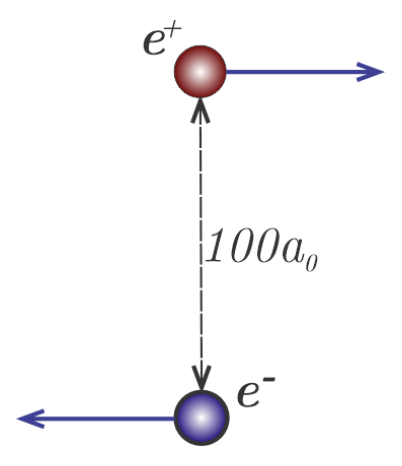
At a certain instant of time, a positron is located at a distance of from an electron . The particles are moving in such a way that their velocities are antiparallel at that instant, perpendicular to their separation, as shown in figure 1b. It is known that each particle has an angular momentum of magnitude with respect to the system's center of mass, where is a dimensionless numerical factor. Assume that the only interaction between and is electrostatic (both particles have the same mass and equal magnitude of the charge but of opposite sign). Furthermore, assume that this system remains isolated and that its dynamics are classical and non-relativistic.
The Bohr radius is given by .
T1-B1 If , the system is bound, meaning that the particles move in a closed orbit around the system's center of mass. Find the maximum separation distance between and in terms of . [1 т.]
T1-B2 If , the system is unbound, meaning that the particles are no longer in closed orbit around the system's center of mass. Let be the velocity of relative to as the separation distance between them tends to infinity. Calculate the angle between and the initial line of motion of . Give your answer in degrees. [2,5 т.]
Hint 1: The eccentricity of a conic trajectory for the present case is given by
where E and L are the total energy and the magnitude of the total angular momentum, respectively. k is Coulombs constant .
Hint 2: The equation of a conic in polar coordinates is
Отговори
T1-B1
T1-B2 -16.6 °
Official answer: θ = 90° − θ′ = −16.60°, with θ′ = arccos(−2/7) = 106.60° measured from the y-axis (the direction is below the initial line of motion of e⁺).
Решение
T1-B [2.5 pts]. Electron-positron pair
From the definition of angular momentum,
The total energy of the system is
T1-B1 [1.0 pts].
For ,
SOLUTION 1:
At the critical separation distances, and . The energy at and can be written as
Using and the conservation of energy,
The maximum separation corresponds to the solution with the plus sign,
SOLUTION 2:
Since the energy is negative and the electrostatic force is central and proportional to , the trajectory of the particles will be elliptical with respect to the CM. The energy can be written in terms of the semi-major axis as
Since is perpendicular to the vector that connects the two particles, the initial position must correspond to either or . The other critical distance, is given by the definition of :
Which is greater than and corresponds to
SOLUTION 3:
The general equation for the trajectory in polar coordinates is
with the semi-latus rectum and the eccentricity, as given by the hint in question T1-B2. The maximum separation distance is reached when :
Calculating the values of and ,
Replacing these values in the expression for ,
T1-B2 [2.5 pts].
For ,
The distance between particles follows
Since the initial position corresponds to the closest approach, it is convenient to measure the angle with respect to the y axis so that , . For ,
Calculating the eccentricity,
Replacing this value in the expression for ,
Since this is the angle with respect to the -axis but the initial velocity is directed towards the positive -axis, heading downward
.
Оригинал в Архива: T1.pdf · официални решения: theory_sol.pdf