IPhO 2026, Теория — Задача 1.3. Photodissociation of ozone
QUESTION T1 [10 pts]. Three problems · 3,5 т.
QUESTION T1 [10 pts]. Three problems
This question consists of three independent problems.
Условие
A photon with angular frequency strikes an ozone molecule O at rest, dissociating it (breaking it apart) into an oxygen molecule O and an oxygen atom O, as shown in figure 1c. The photon is absorbed in this process. Let and be the ground state energies of the ozone and oxygen molecules, respectively. Assume that this system remains isolated and that its dynamics is classical (potential energies do not contribute to mass and the motion of the Oxygen atoms are non-relativistic). Use the relation for the linear momentum of the photon, where is its energy.
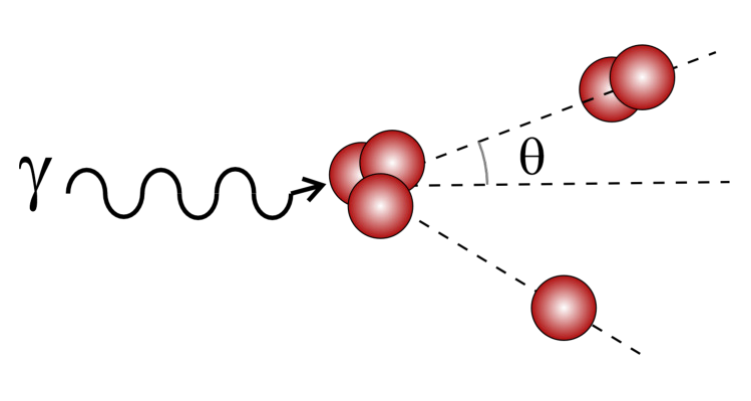
T1-C1 If the angle that the momentum of the outgoing O with respect to the incident photon is , determine the minimum angular frequency required for this dissociation to occur at this angle. Write your answer in terms of , , , , and the mass of an oxygen atom. [2,5 т.]
T1-C2 If , calculate the value of . Give your answer in electronvolts (eV). Take eV and amu. [1 т.]
Hint:
Отговори
T1-C1
For θ ≥ 90° the official solution states the formula is the same with θ = 90°.
T1-C2 eV
Решение
T1-C [3.5 pts]. Photodissociation of ozone
T1-C1 [2.5 pts].
SOLUTION 1: pure algebra
The momentum conservation is
where and are the momentum of the O and the O, respectively. Solving for ,
The energy conservation reads
where .
For a given , can be written in terms of . Replacing on energy balance and simplifying, we get
This gives a quadratic equation on . For to be real, the discriminant must be positive.
The previous bound determines as the minimal root of the quadratic equation on
The smallest root . Thus, simplifying, one gets
SOLUTION 2: Center of mass approach
Part I: Conservation laws
First, find the velocity of the center of mass. We get
We will use for calculations
We want to relate the relative velocities in CM. We have by magnitude
And is the single oxygen atom (the one we don’t want). The energy conservation equation is
We can now find in terms of .
Part 2: geometry and critical condition
We see that the set of possible velocities form a circle (they have constant ). We need to consider that is the angle between and (this is the full velocity of particle 1).
If the circle of radius is too small there is no solution (the straight line at the angle will not intersect the circle). If the radius is big enough, there will always be two solutions intersecting the circle. The critical case (crossover from no solution to two) is when the circle is tangent to the straight line. This is the case we need.
In that case the triangle formed by is a right triangle.
Warning: This can only happen if . The other case will be dealt with separately.
This way
Replace above to find that in conservation of energy
now we can solve the quadratic equation for . We get (we need to choose the correct solution of the quadratic equation)
Note: Any of the following expressions are the same:
Rewrite as the angular frequency
Special case: , this is essentially impossible to see in a brute force algebraic solution, but it is an important feature of the problem. Needs a small amount of points in this solution
For angle greater than , as soon as the circle reaches the answer for it becomes big enough to allow all angles. Formula is the same with .
T1-C2 [1.0 pts].
Up to second order in
Оригинал в Архива: T1.pdf · официални решения: theory_sol.pdf