III International Zhautykov Olympiad — THEORETICAL COMPETITION, January 16, 2007 · 16 януари 2007 г.
Please read this first:
The time available for the theoretical competition is 4 hours. There are three questions.
Use only the pen provided.
You are provided with Writing sheet and additional paper. You can use the additional paper for drafts of your solutions but these papers will not be checked. Your final solutions which will be evaluated should be on the Writing sheets. Please use as little text as possible. You should mostly use equations, numbers, figures and plots.
Use only the front side of Writing sheets. Write only inside the bordered area.
Begin each question on a separate sheet.
Fill the boxes at the top of each sheet of paper with your country (Country), your student code (Student Code), the question number (Question Number), the progressive number of each sheet (Page Number), and the total number of Writing sheets used (Total Number of Pages). If you use some blank Writing sheets for notes that you do not wish to be evaluated, put a large X across the entire sheet and do not include it in your numbering.
At the end of the exam, arrange all sheets for each problem in the following order:
Used Writing sheets in order;
The sheets you do not wish to be evaluated
Unused sheets and the printed question.
Place the papers inside the envelope and leave everything on your desk. You are not allowed to take any paper out of the room.
Условие
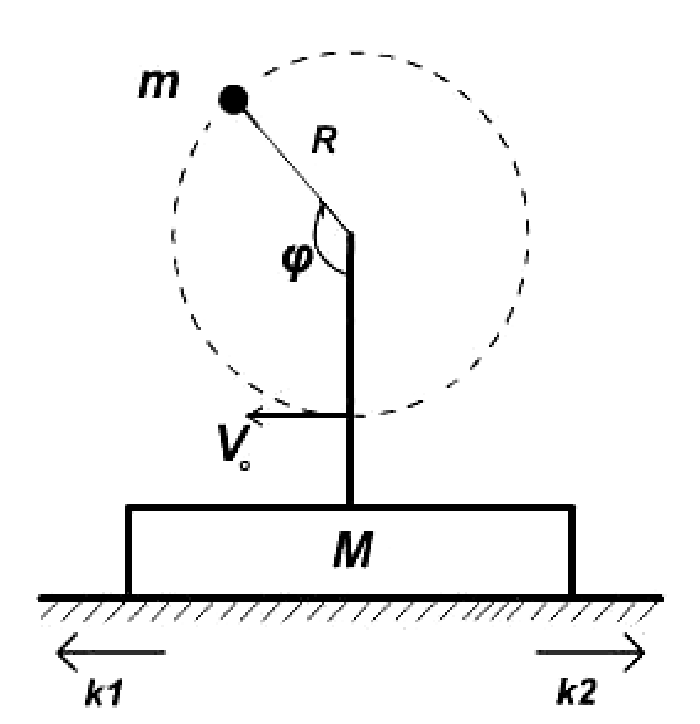
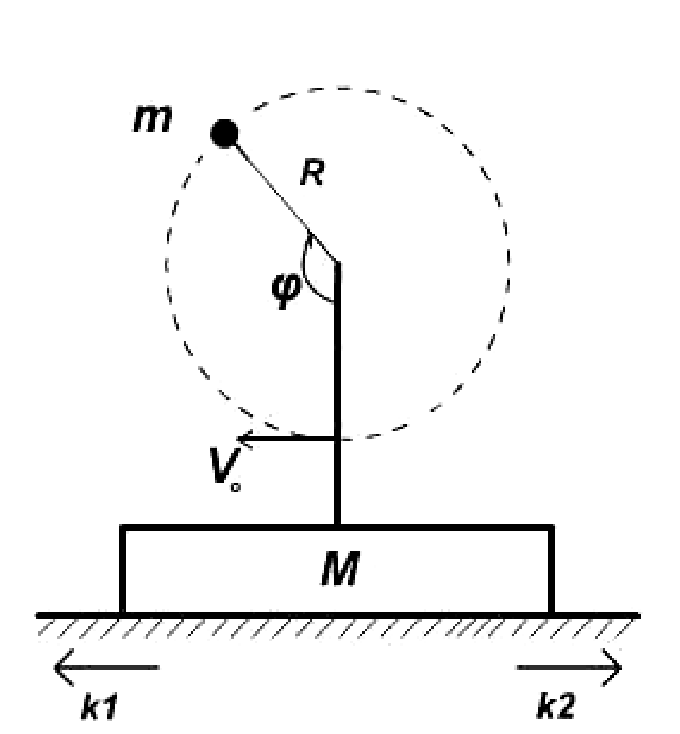
A weightless rod is attached to a massive block with a mass M. An object with a mass m is attached to the rod by a weightless string of length R. The object can rotate in a vertical plane not touching the rod. The coefficient of friction between the block and the floor depends on the direction of sliding, k1=μ, k2=∞. The object is launched with an initial velocity V0 in the direction as shown in the picture 1. V0 is sufficiently big so that the object makes at least one rotation around the rod.
In this problem you are asked to examine the movement of the system during the first rotation of the object. You can assume that the block does not detach from the floor and does not turn over and that the string is stretched while the object is moving. Let’s describe the position of the object by the angle φ (Fig 1). Assume M≫m.
Fig.1
1.[1 point] In this part of the question assume that the parameters are such that the block does not move at all. Derive the condition that will guarantee that the change in absolute velocity of the object is considerably smaller than V0 in the process of rotation. [1 т.]
From this point onwards you can assume that the block’s velocity is considerably smaller than V0, and that the change in absolute velocity of the object during first rotation is considerably smaller than V0.
2.[2 points] Find the minimum initial velocity V0min which will cause the block to slide when the object is rotating. [2 т.]
3. a) For V0>V0min find:
[1 point] At which angle φ0 sliding will start; [1 т.]
3. b)[1 point] At which angle ψ the velocity of block’s motion V will be largest. [1 т.]
4. a)[1 point] Find Vmax which corresponds to the angle ψ from b) above; [1 т.]
4. b)[1 point] Write down the condition for angle θ, at which the block stops. [1 т.]
5. a) Numerical data:
μ=2π−1≈0.57,
g=10m/s2,
M=10kg
V0=10m/s,
R=0.1m,
m=0.057kg.
[0.5 points] Calculate φ0, ψ и θ. [0,5 т.]
5. b)[0.5 points] Calculate Vmax.[0,5 т.]
5. c)[1 point] For the given numerical values, calculate the displacement of the block in one rotation of the object. [1 т.]
5. d)[1 point] In first non vanishing order, estimate the change in the velocity of the object at the lowest point after the first rotation in comparison to V0. [1 т.]
Note:
The following formulas might be useful for solution:
Relative change ΔV/V0; the solution estimates −510⁻⁴ by order of magnitude and gives the exact value −310⁻⁴.
Решение
Fig.1
[1 point] From the energy conservation law for the object:
V02−Vtop2=4gR≈2V0ΔV,ΔV/V=2gR/V02≪1
[2 point] Maximal angle of deviation of the floor’s total reaction force (Normal force + friction force) from vertical is
α=arctgμ.
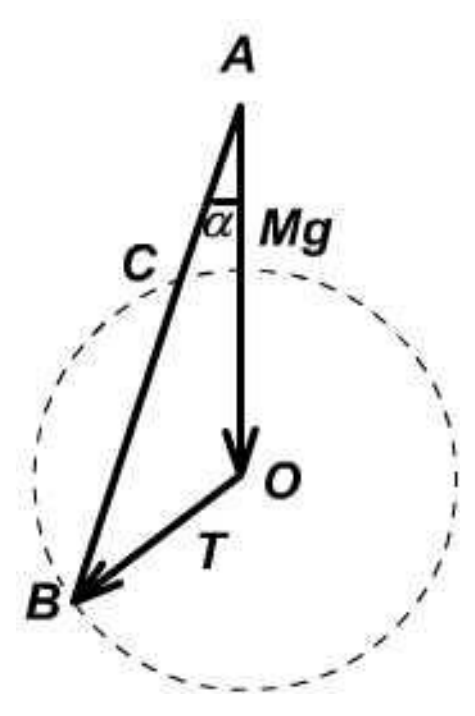
Fig.2
Denote
T=mV02/R,ω=V0/R.
From the picture above we can see (see Fig.2) that the maximum angle of deviation of
Mg+T
is arcsin(T/Mg) when T≤Mg (Mg+T is tangent to the circle). If the deviation angle of Mg+T from the vertical line is greater than α, then the equilibrium is impossible and the block will start to slide. The condition that we are looking for is
V0min=m1+μ2MgRμ
From Fig 2, the beginning of sliding corresponds to point B. The block accelerates on the portion of path BC, and decelerates afterwards.. Since the line intersects the rotation circle at two points, ∠ABO<π/2, and therefore from the sine theorem for the triangle ABO :
∠ABO=arcsin(Mgmω2Rsinα)=arcsin(mω2R1+μ2μMg)
a) [1 point] Then
φ0=α+∠ABO=arctgμ+arcsin(mω2R1+μ2μMg).
b) [1 point] Similarly
ψ=α+π−∠ABO=arctgμ+π−arcsin(mω2R1+μ2μMg).
To calculate the acceleration we can first decompose the forces into x and y components and write down Newton’s second law
d) [1 point] The change in object’s velocity occurs because the kinetic energy is lowered due to work by friction force. In first nonvanishing order, the change in velocity is determined from the Law of change in energy, where the work of friction force is calculated assuming constant absolute velocity of the object: