IZhO 2007, Теория — Задача 2
III International Zhautykov Olympiad — THEORETICAL COMPETITION, January 16, 2007 · 16 януари 2007 г.
Please read this first:
The time available for the theoretical competition is 4 hours. There are three questions.
Use only the pen provided.
You are provided with Writing sheet and additional paper. You can use the additional paper for drafts of your solutions but these papers will not be checked. Your final solutions which will be evaluated should be on the Writing sheets. Please use as little text as possible. You should mostly use equations, numbers, figures and plots.
Use only the front side of Writing sheets. Write only inside the bordered area.
Begin each question on a separate sheet.
Fill the boxes at the top of each sheet of paper with your country (Country), your student code (Student Code), the question number (Question Number), the progressive number of each sheet (Page Number), and the total number of Writing sheets used (Total Number of Pages). If you use some blank Writing sheets for notes that you do not wish to be evaluated, put a large X across the entire sheet and do not include it in your numbering.
At the end of the exam, arrange all sheets for each problem in the following order:
- Used Writing sheets in order;
- The sheets you do not wish to be evaluated
- Unused sheets and the printed question.
Place the papers inside the envelope and leave everything on your desk. You are not allowed to take any paper out of the room.
Условие
This problem consists of two unrelated parts
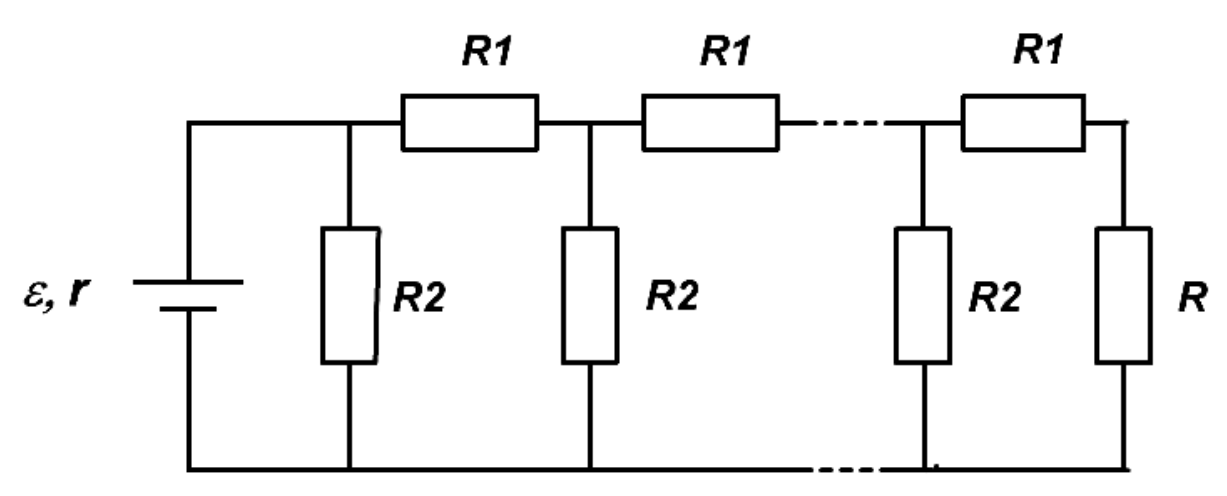
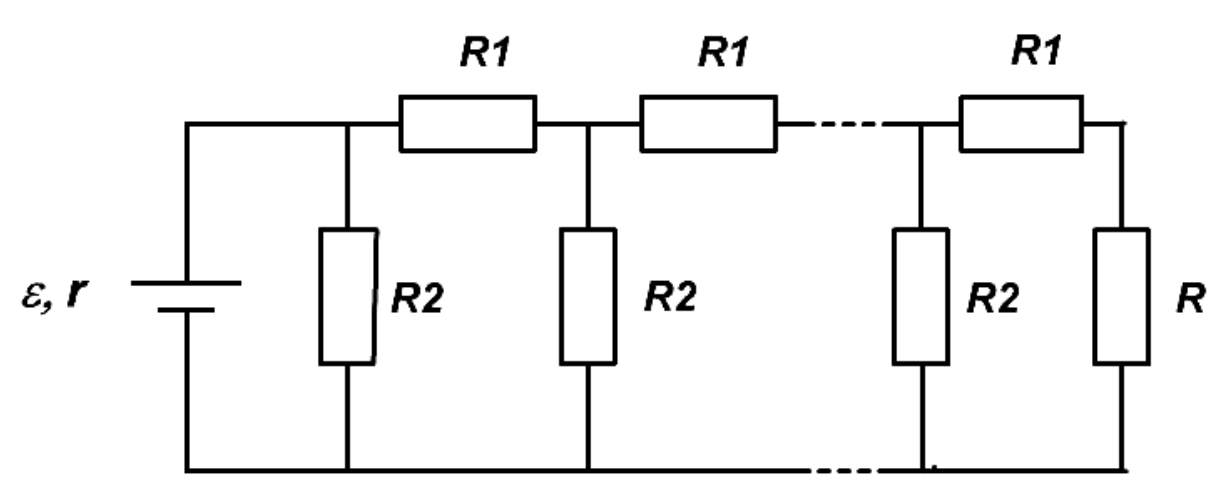
A. [5 points] Find the current through resistance R = 17 Ohm, in the Fig 2. The internal resistance of the battery is r = 3 Ohm, Electromotive force ε = 10 V. The section with resistance R₁= 1 Ohm and R₂= 6 Ohm is repeated 17 times
B. [3 Points] A thin lens creates the image of an object. If a flat mirror is put right next to this lens perpendicular to the main optical axis, then this whole system creates an image with the same absolute optical magnification as before provided that the object is at the same distance as before. Determine the magnification.
Отговори
- A. 0.0005 A
- B. 3
Решение
A
[5 points] Direct calculation of the current through resistance R is very complicated and takes a long time.
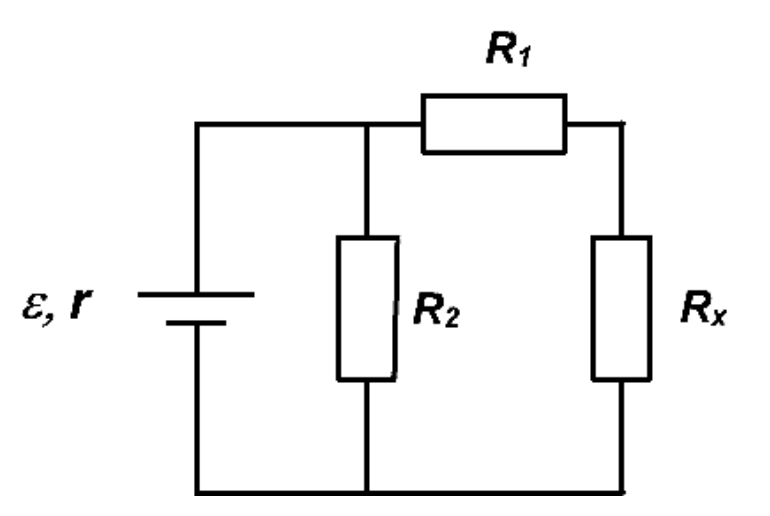
Therefore let’s first examine the Fig 4. Let current I flow through resistance Rₓ. Then the current through resistance R₂ will be
Accordingly the current through the source is
The second rule of Kirchgoff for external contour is
From here we can find the value of current I, plugging in the values R₁ and R₂. Then
If we take into account that the internal resistance is r = 3 Ohms, we can write
In other words the circuit in Fig 4 is equivalent to the circuit in Fig. 5 where
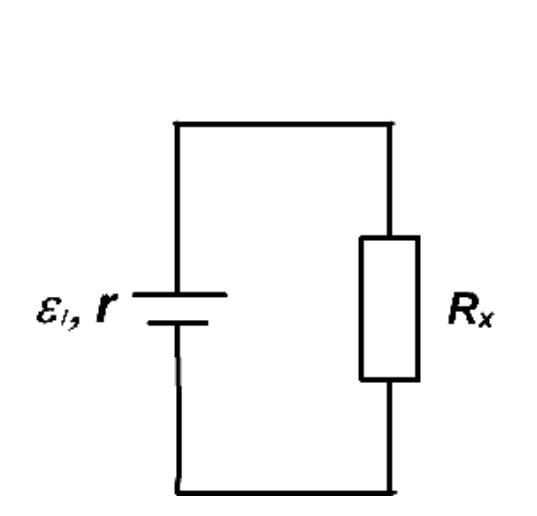
Then using this transformation 17 times we get the final result
B
[3 points] Light goes through the lens, reflects form the mirror and goes through the lens again. Therefore, putting a flat mirror next to the lens is equivalent to putting an identical lens next to the first lens. The distance of the object from the single lens and from the lens-mirror system is the same. The absolute magnification is the same as well. Since Γ = f/d, then absolute distance to the image is also the same(here f is the distance till the image, and d is the distance till the object). But the focal distance of the lens is twice as big as the focal distance of the lens-mirror system. It is easy to see that both images cannot be real at the same time or both virtual at the same time. Indeed, if both images are real, then
So Γ₁ = Γ₂ implies F₁ = F₂. The same would hold if both images were virtual. We are left with the only alternative that one image is real and the other is virtual. Since F₁>F₂ = F₁/2, the image produced by a single lens is virtual, and the image produced by lens-mirror system is real. (For a virtual image d < F, and for a real image d > F.) Then
Taking into account that |Γ₁ |= |Γ₂ | we get d = 2F/3, hence Γ = 3.
Оригинал в Архива: IZhO-2007-Theory_eng_sf.doc · официални решения: IZhO-2007-Theory_eng_sol_sf.doc