IZhO 2007, Теория — Задача 3. Nuclear fusion
III International Zhautykov Olympiad — THEORETICAL COMPETITION, January 16, 2007 · 16 януари 2007 г.
Please read this first:
The time available for the theoretical competition is 4 hours. There are three questions.
Use only the pen provided.
You are provided with Writing sheet and additional paper. You can use the additional paper for drafts of your solutions but these papers will not be checked. Your final solutions which will be evaluated should be on the Writing sheets. Please use as little text as possible. You should mostly use equations, numbers, figures and plots.
Use only the front side of Writing sheets. Write only inside the bordered area.
Begin each question on a separate sheet.
Fill the boxes at the top of each sheet of paper with your country (Country), your student code (Student Code), the question number (Question Number), the progressive number of each sheet (Page Number), and the total number of Writing sheets used (Total Number of Pages). If you use some blank Writing sheets for notes that you do not wish to be evaluated, put a large X across the entire sheet and do not include it in your numbering.
At the end of the exam, arrange all sheets for each problem in the following order:
- Used Writing sheets in order;
- The sheets you do not wish to be evaluated
- Unused sheets and the printed question.
Place the papers inside the envelope and leave everything on your desk. You are not allowed to take any paper out of the room.
Условие
One of the most important problems of modern plasma physics is the so-called controlled nuclear fusion. The most promising way of achieving the controlled nuclear fusion is the TOKAMAK, that is the magnetic trap for confining hot plasma.
The most perspective fusion reaction is based on hydrogen isotopes that are deuterium (D) and tritium (T) and it is symbolically written as
whereas the reaction products are the helium isotope and neutron .
a) [1 point] Assuming the particle masses are known, determine, analytically and numerically, the energy , released in a single fusion reaction (1). [1 т.]
b) [0.5 points] In nuclear physics the energy is frequently counted in electron-volts (eV). One electron-volt is the energy that a single electron acquires passing an accelerating voltage of one volt. Calculate, analytically and numerically, the energy, found in question a), in electron-volts. [0,5 т.]
c) [1 point] Neglecting the initial energies of reacting particles, determine, analytically and numerically, the amounts of energy taken away by the helium nucleus and the neutron . [1 т.]
d) [1 point] In Tokamaks the deuterium-tritium mixture is heated up to a very high temperature, such that all the atoms are fully ionized (such a state is called a plasma) and their average kinetic energy is equal to . To make reaction (1) possible it is necessary to overcome the Coulomb repulsion of reacting nuclei and bring them close to a distance of where nuclei attraction forces prevail. Estimate, analytically and numerically, the temperature at which reaction (1) becomes possible for the majority of the colliding particles. [1 т.]
Fortunately, at thermal equilibrium the energies of particles are not even: some particles can have energy larger than while some might have less than . Due to the presence of energetic particles the fusion reaction can take place even at temperatures lower than determined in d). The number of fusion reactions taking place per unit of time per unit of volume is given by the expression , where and are the deuterium and tritium concentrations, respectively, is the so-called cross section of the reaction, and refers to the relative velocity of the particles participating in the reaction.
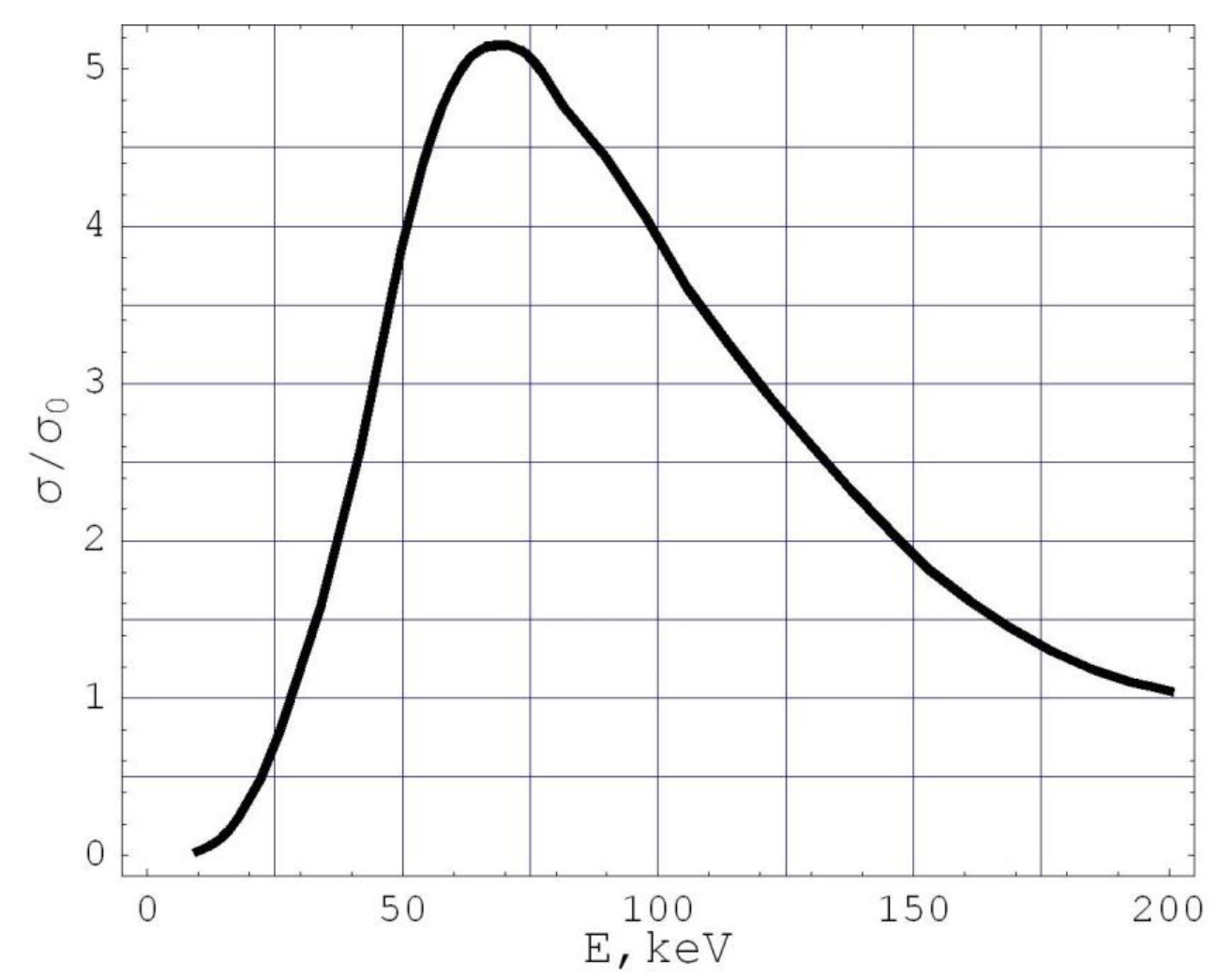
e) [3 points] Determine, analytically and numerically, the average reaction rate at the temperature , assuming that the effective velocity distribution is Maxwellian with the reduced mass . The dependence of is graphically represented in the Fig.3 below. [3 т.]
f) [3 points] The matter heated to such a high temperature is in the state of plasma and the atoms are fully ionized. On the average, the total density of nuclei equals the density of electrons to satisfy the neutrality charge. To heat up the matter to the optimum temperature it is necessary to put in per unit of time a certain amount of energy, which should not exceed the amount released in fusion reactions. The energy of helium nucleus can totally be used for power production while only of the neutron energy can be utilized. The rate of loss of thermal energy is given by , where is the energy density and is the time of plasma retention. Assuming that the particle concentrations are , obtain, analytically and numerically, the inequality that guarantees the positive production of energy in a controlled nuclear fusion and relates the plasma concentration and retention time . [3 т.]
g) [2.5 points] The plasma with temperature has a quite high pressure for a simple wall to sustain. A magnetic field, generated by a superconducting electromagnets of Tokamaks, is used to confine such matter. Magnetic field is used to compensate the thermal pressure. In the presence of magnetic field, the additional pressure due to magnetic field is , where , is the magnetic constant and is the magnetic field. Magnetic field is completely screened inside the plasma, so the additional pressure is absent there. Using dimensional analysis, find and and determine, analytically and numerically, the magnetic field needed to confine the plasma with . [2,5 т.]
Numerical values:
Mass of deuterium ,
Mass of tritium ,
Mass of helium ,
Mass of neutron ,
Speed of light ,
Elementary charge ,
Boltzmann constant ,
Electric constant ,
Magnetic constant
Note:
The Maxwell distribution of the particle velocities with mass and temperature T has the following density function:
Отговори
a) J
b) eV
c) En = 2.375·10⁻¹² J = 1.482·10⁷ eV; EHe = 5.984·10⁻¹³ J = 3.735·10⁶ eV
The printed formulas En = mHe/(mHe + mn) and EHe = mn/(mHe + mn) omit the factor E0; the numbers correspond to the mass fractions times E0.
d) K
e) m³/s
f)
g) 1.178 T
α = −1, β = 2; the official solution prints the unit as „Ts“.
Решение
a) [1 point] In accordance with the Einstein formula the energy released in a single reaction is written as follows
b) [0.5 points] The same energy is written in electron-volts as follows
c) [1 point] If one can neglect the initial energies of reacting particles, the momentum and energy conservation laws immediately produce
d) [1 point] To overcome the Coulomb barrier nuclei should possess an appropriate thermal kinetic energy
Thus
e) [3 points] The reaction rate is given by an average over the Maxwellian distribution as follows
with the Maxwellian distribution function
Introducing the dimensionless value and substituting the latter expression into the previous one can obtain
The integrand function is drawn with the aid of the cross section figure as follows
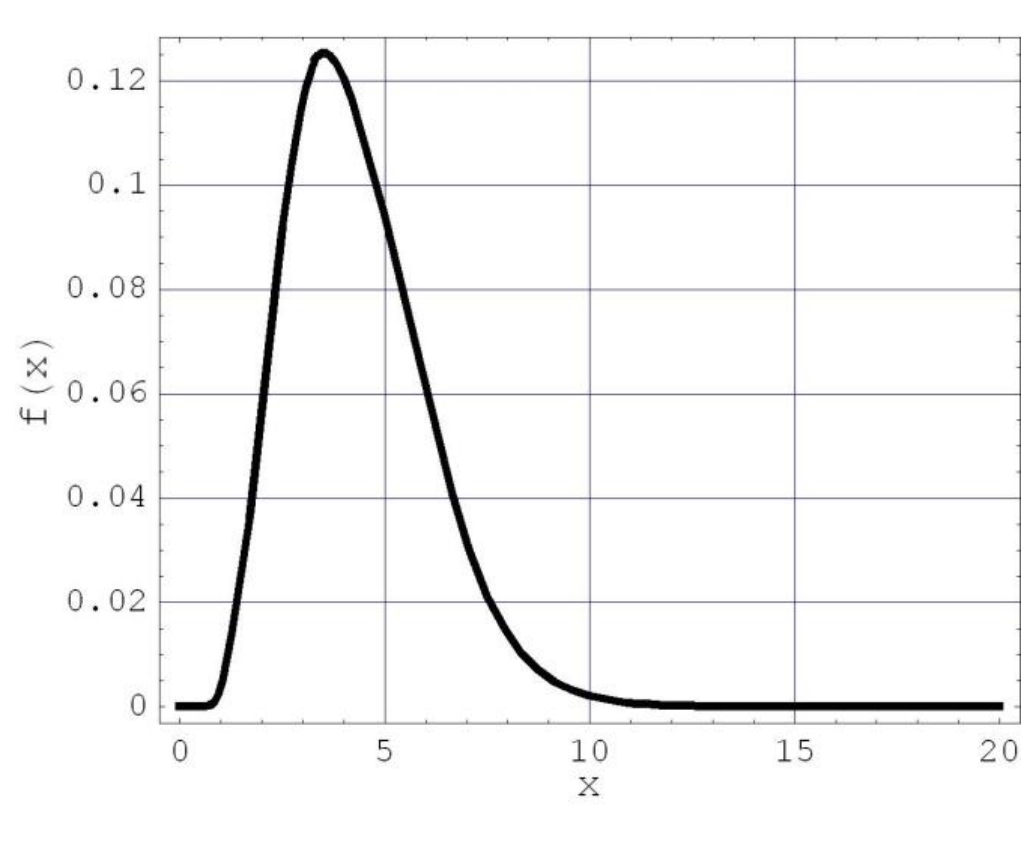
Estimating the area under the line gives
f) [3 points] Plasma consists of electrons and ions and loses its thermal energy at time . The effective power of losses in the unit of volume is given by the expression
This power should be less than that produced in fusion reactions (see e)
Thus,
This is the so-called Lawson’s criterion.
g) [2.5 points] Dimensional analysis immediately produces and . The thermal pressure of the plasma medium
should be compensated by the magnetic pressure from outside
Thus,
Оригинал в Архива: IZhO-2007-Theory_eng_sf.doc · официални решения: IZhO-2007-Theory_eng_sol_sf.doc