IZhO 2010, Теория, английски — Задача 1
VI International Zhautykov Olympiad. Theoretical Competition · 13 януари 2010 г. · 10 т.
Please read this first:
THEORETICAL COMPETITION
January 13, 2010
The time available for the theoretical competition is 4 hours. There are three questions.
Use only the pen provided.
You can use your own calculator for numerical calculations. If you don’t have one, please ask for it from Olympiad organizers.
You are provided with Writing sheet and additional paper. You can use the additional paper for drafts of your solutions but these papers will not be checked. Your final solutions which will be evaluated should be on the Writing sheets. Please use as little text as possible. You should mostly use equations, numbers, figures and plots.
Use only the front side of Writing sheets**.** Write only inside the bordered area.
Begin each question on a separate sheet.
Fill the boxes at the top of each sheet of paper with your country (Country), your student code (Student Code), the question number (Question Number), the progressive number of each sheet (Page Number), and the total number of Writing sheets used (Total Number of Pages). If you use some blank Writing sheets for notes that you do not wish to be evaluated, put a large X across the entire sheet and do not include it in your numbering.
At the end of the exam, arrange all sheets for each problem in the following order:
- Used Writing sheets in order;
- The sheets you do not wish to be evaluated
- Unused sheets and the printed question.
Place the papers inside the envelope and leave everything on your desk. You are not allowed to take any paper out of the room.
Условие
This problem consists of three unrelated parts.
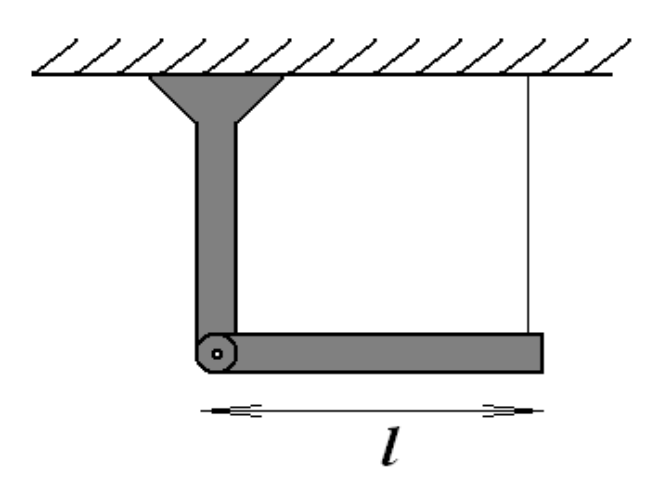
1А One end of a homogeneous rigid rod with mass and length is suspended on the vertical support by an ideal joint, and the other end hangs on a thread such that the rod is in horizontal position. At a certain time point the thread is cut. Find the dependence of reaction force of the joint on the angle of the rod deviation from the horizontal position. [3 т.]
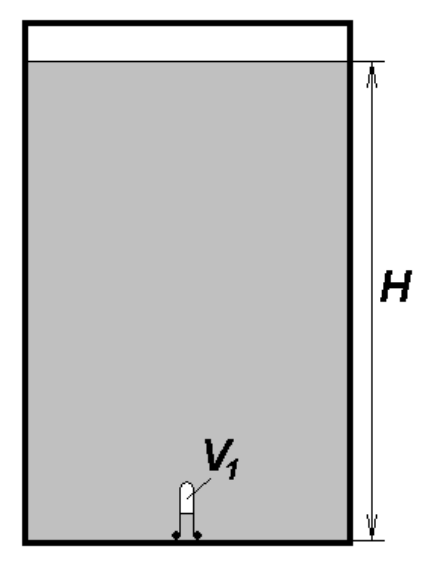
1В Liquid is poured in a closed cylindrical vessel with thick walls. The height of the liquid level is H. The mass density of the liquid decreases linearly with the height from to small value which can be assumed to be equal to zero. Thin layer of vapor is saturated over the liquid surface but its pressure can be neglected with respect to the hydrostatic pressure of the liquid. Inverted test-tube of the volume is placed at the bottom of the vessel. The mass of the test-tube is concentrated at its neck, and its length is small compared to . The gas of volume with negligible mass is placed inside the test-tube. The temperature of the system is kept constant. Can the test-tube stay motionless in the liquid at a certain height from the bottom? If it is possible, what conditions are to be satisfied? What is the height of the test-tube position over the bottom in this case? Is this state stable? The volume of walls of the test-tube is small compared to . [4 т.]
1C Rectangular light source of size is fixed on the ceiling of the room of height .
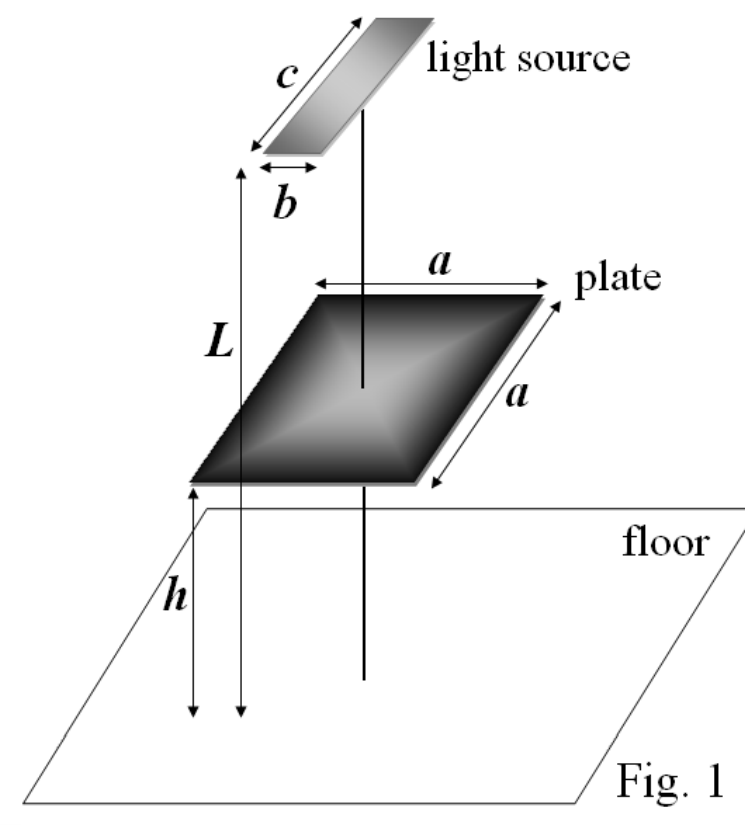
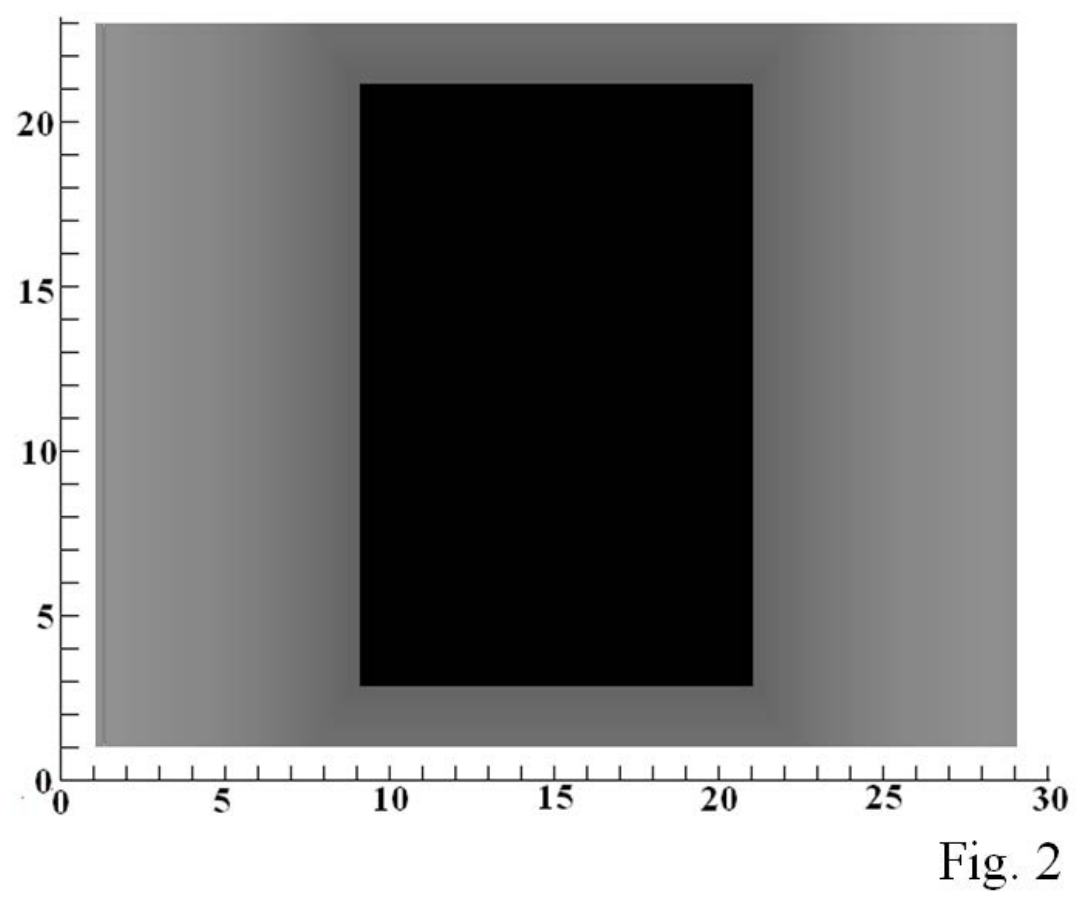
Opaque square plate with side is placed horizontally under the lamp at a height above the floor (Fig. 1). Fig. 2 schematically shows the shape of the shadow casted by the plate on the room floor. The shadow consists of a dark rectangle surrounded by a lighter rectangle, and when approaching the edges of the outer rectangle the shade turns lighter. The value of the scale division in Fig. 2 is . Find the sizes of the light source and , and the height of the plate position. Specify the exact orientation of the light source with respect to the plate shadow. [3 т.]
Отговори
- 1А
- 1В Equilibrium is possible when ; with there are two points, (A, unstable) and (B); with only B exists; .
- 1C h = 1,5 м; b = 8,0 см; c = 2,0 см; the long side of the source is placed horizontally (with respect to Fig. 2).
Решение
Theoretical Question 1
1A
Potential energy of the rigid rod transforms to the kinetic energy of its rotation , where is its inertia moment with respect to the vertical support, is the angular velocity. Making balance of these energies, one can find angular velocity of the center of mass around the axis of the support, and after that one can get instantaneous angular velocity of rotation of the center of mass around the axis of the support, and with the help of the obtained expression we find normal acceleration
We find the tangent acceleration from the dynamics equation , where is momentum of the gravity force with respect to the axis of rotation, is angular acceleration of the center of mass related to tangent acceleration :
Center of mass acceleration а is found from the equation
where Р is gravity force, N is reaction force of the support. Decomposing this equation into vertical and horizontal components, and accounting for
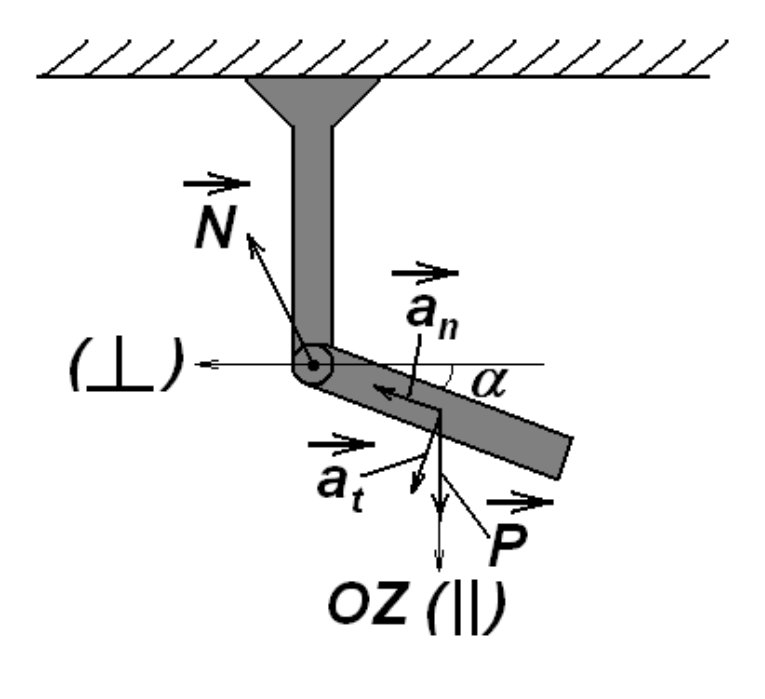
we find
Marking scheme
| No. | Items | Points |
|---|---|---|
| 1 | Writing down balance equation for the kinetic and potential energies and determination of the angular velocity of rotation of the center of mass | 0.5 |
| 2 | Determination of the normal acceleration | 0.5 |
| 3 | Determination of the tangent acceleration from the equation of dynamics of rotation | 0.75 |
| 4 | Determination of the component of the reaction force of the support from the 2nd Newton law | 1.25 |
1В
First of all let us find dependencies of the liquid density and pressure upon the height measured from the vessel bottom:
One can see that pressure goes to zero at the top level of the vessel. It means that in this region volume of the gas will exceed the volume of the test-tube, so the gas bulbs will come out. Until the gas doesn’t come out from the test-tube, its isothermal expansion takes place, so
From (2) and (3) one can obtain:
Formula (4) is valid for , i.e. for
One can write down the average density of the gas in the test-tube taking into account the mass of its walls from (4)-(5):
where .
Various kinds of dependencies of upon are plotted on Fig.1-3. Curve 1 corresponds to the liquid, while curve 2 corresponds to the average density of the gas in the test-tube taking into account the mass of its walls.
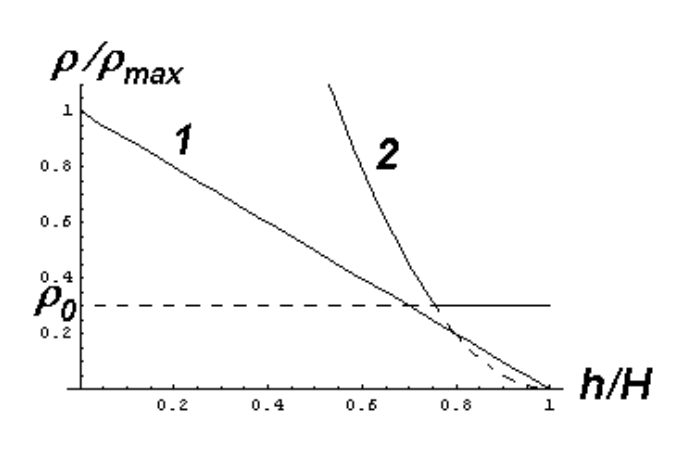
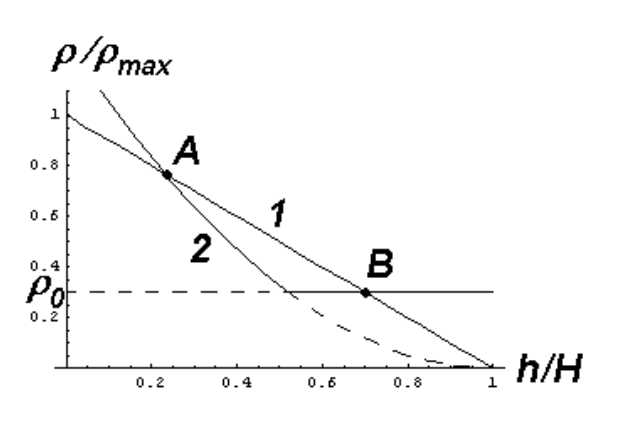
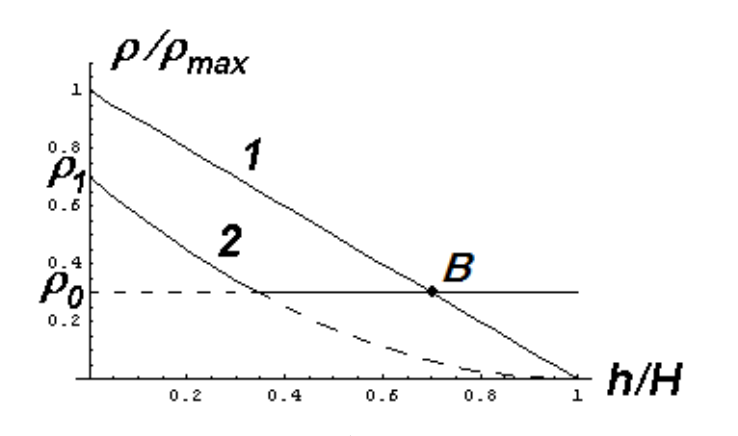
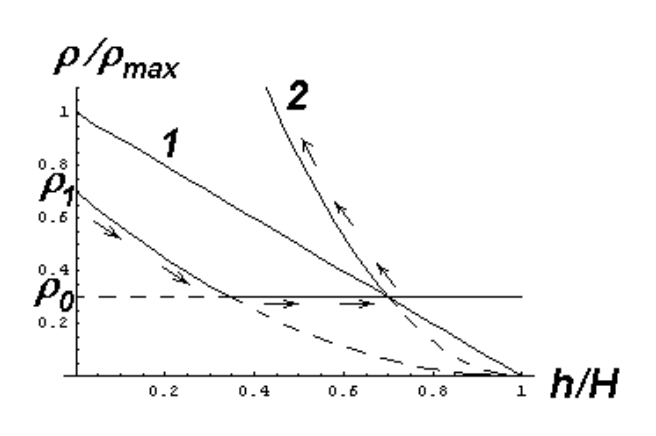
Curves 1 and 2 don’t intersect (Fig.1), if the condition is fulfilled for , i.e.
In this case the test-tube will always sink.
If the conditions
are fulfilled in the same time, curves intersect in two points A and B (Fig.2):
(point А);
(point B).
Point A is unstable because the test-tube will sink due to the shift down, and it will rise due to the shift up. Analysis of stability of the point B will be presented below.
If conditions
are fulfilled, only the intersection point B exists (Fig.3). But one should take into account that at the horizontal part of curve 2 motion to the right along this curve results to the gas flow out of the test-tube. Consequently, motion to the left along the curve will be quite different. It will take place along the parabola corresponding to (6) (upper line of the formula), but with the new (larger) value of corresponding to the amount of gas remained in the test-tube.
Grading scheme
- Pressure dependency upon the height — 0.5
- Dependency of the average gas density in the test-tube upon the height:
- a) taking into account the gas flow from the test-tube (complete answer) — 1.0
- b) without taking into account the gas flow from the test-tube (incomplete answer) — 0.5
- Comparison of dependencies of liquid and gas densities upon the height:
- a) for three cases (complete answer) — 1.25
- b) for two cases (incomplete answer) — 0.75
- c) for one case (incomplete answer) — 0.5
- Determination of the height corresponding to the intersection points:
- a) two points (complete answer) — 0.5
- b) one point (incomplete answer) — 0.25
- Study of stability for point A — 0.25
- Study of stability for point B — 0.5
Totally (maximum) — 4.0
1C
The form of shape described in the problem is explained by the appearance of the full shade (dark rectangle) and the semi-shadow (lighter outer rectangle). Fig. 1 illustrates the course of outer rays forming a shadow and the semi-shadow ( and ) in cross section perpendicular to one sides of the source. Denote the full width of the shadow - ,, the width of the semi-shadow - . These values can be expressed through the geometric dimensions of the source and the plate.
From the similarity of the triangles and it follows
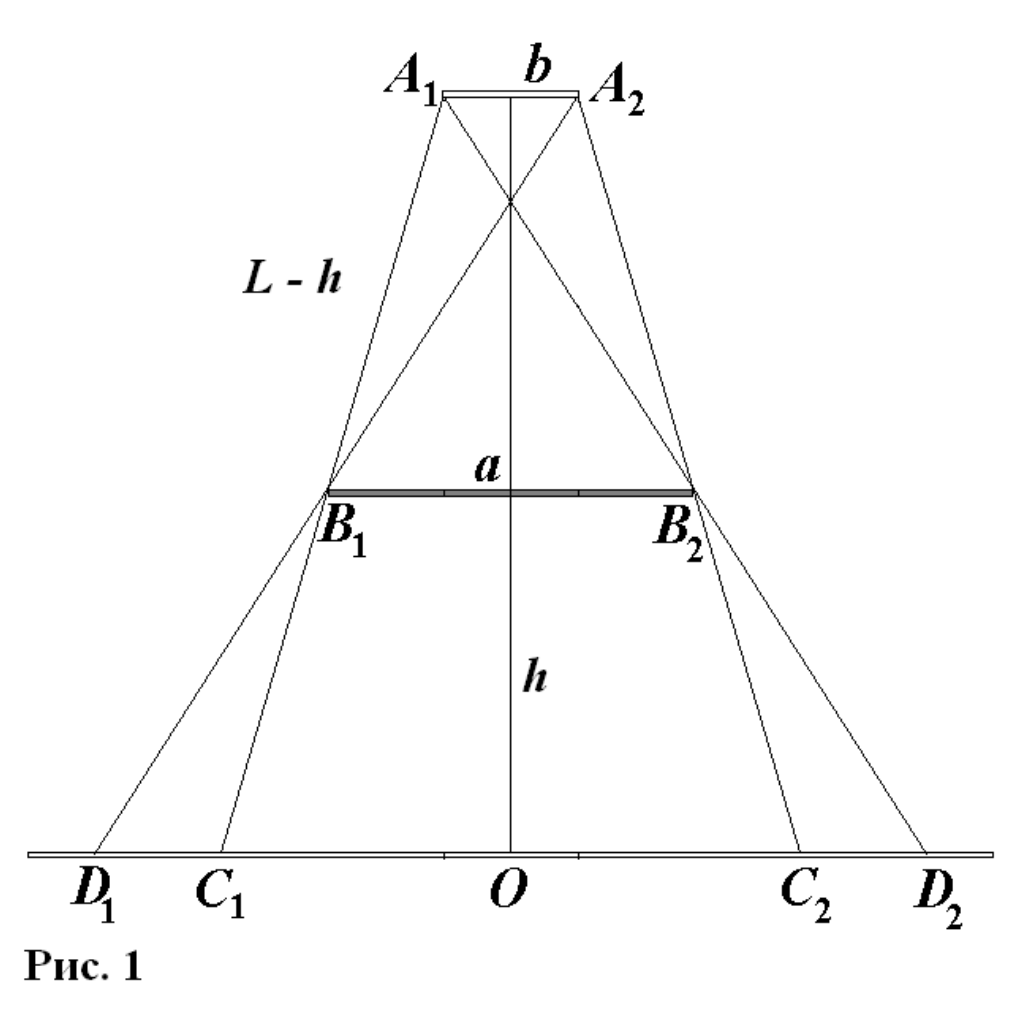
From the similarity of the triangles and it follows
From the drawing of shadows, we define the required sizes
Using formula (1) we find
Hence, we find . From formula (2) we find one of the transverse source size . Similar calculations for the perpendicular cross section gives the following results:
Then, it follows that .
The results indicate that the long side of the source is placed horizontally (if you use fig.2 from the conditions of the problem).
Marking scheme.
| No. | Solution item number | Points |
|---|---|---|
| 1 | Plotting of the ray tracing to explain the emergence of the shadow and semi-shadow | 0,5 |
| 2 | Geometric relationships between size of the source, location and size of the plate and size of the shadow and the semi-shadow (1)-(2) | 2х0,25 |
| 3 | Calculation of height of the plate above the floor (with a numerical value) | 0,5 |
| 4 | Calculation of the dimensions of the source (with numerical values) | 2х0,5 |
| 5 | Position of the source with respect to the shadow | 0,5 |
Оригинал в Архива: IZhO-2010-Theory_eng.pdf · официални решения: IZhO-2010-Theory_eng_sol.pdf