IZhO 2011, Теория — Задача 1
VII International Zhautykov Olympiad/Theoretical Competition · 16 януари 2011 г. · 10 т.
Please read this first:
The time available for the theoretical competition is 4 hours. There are three questions.
Use only the pen provided.
You can use your own calculator for numerical calculations. If you don’t have one, please ask for it from Olympiad organizers.
You are provided with Writing sheet and additional paper. You can use the additional paper for drafts of your solutions but these papers will not be checked. Your final solutions which will be evaluated should be on the Writing sheets. Please use as little text as possible. You should mostly use equations, numbers, figures and plots.
Use only the front side of Writing sheets. Write only inside the boxed area.
Begin each question on a separate sheet of paper.
Fill the boxes at the top of each sheet of paper with your country (Country), your student code (Student Code), the question number (Question Number), the progressive number of each sheet (Page Number), and the total number of Writing sheets used (Total Number of Pages). If you use some blank Writing sheets for notes that you do not wish to be evaluated, put a large X across the entire sheet and do not include it in your numbering.
At the end of the exam, arrange all sheets for each problem in the following order:
- Used Writing sheets in order;
- The sheets you do not wish to be evaluated
- Unused sheets and the printed question.
Place the papers inside the envelope and leave everything on your desk. You are not allowed to take any paper out of the room.
Условие
This problem consists of three independent parts.
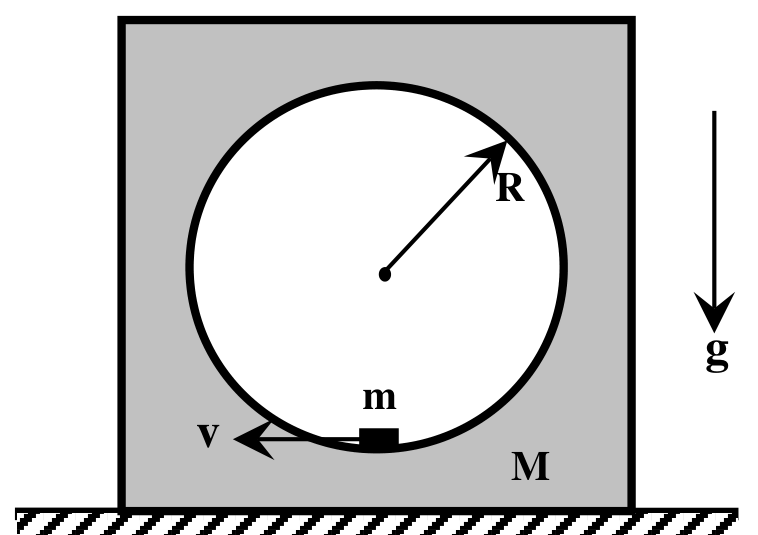
1A The body is a cube in the center of which a spherical cavity of radius is carved out. Inside the spherical cavity at its bottom there is a motionless puck whose geometric sizes are negligible. Find the minimal horizontal velocity (at all possible cube-to-puck mass ratios) which has to be imposed on the puck so as the cubic body should jump up from the table surface in the motion process followed. Friction in the system is completely absent. At which value of the cube-to-puck mass ratio that minimal velocity is achieved? [3,5 т.]
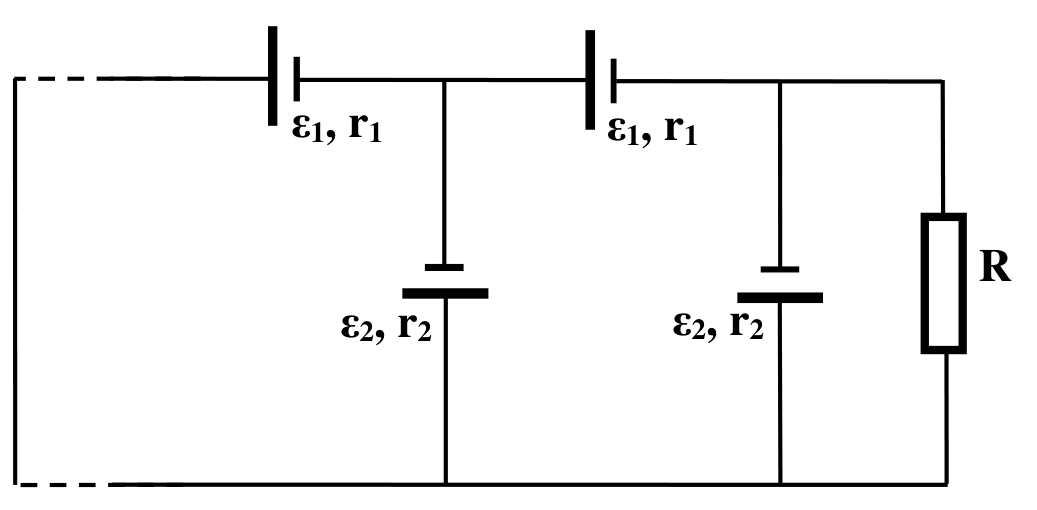
1B The resistance is connected to an infinite number of current sources obtained by repetition as shown in the figure on the right. Find the electric current flowing through the resistance . The emfs’ and internal resistances of the sources are known to be , , and , . [4 т.]
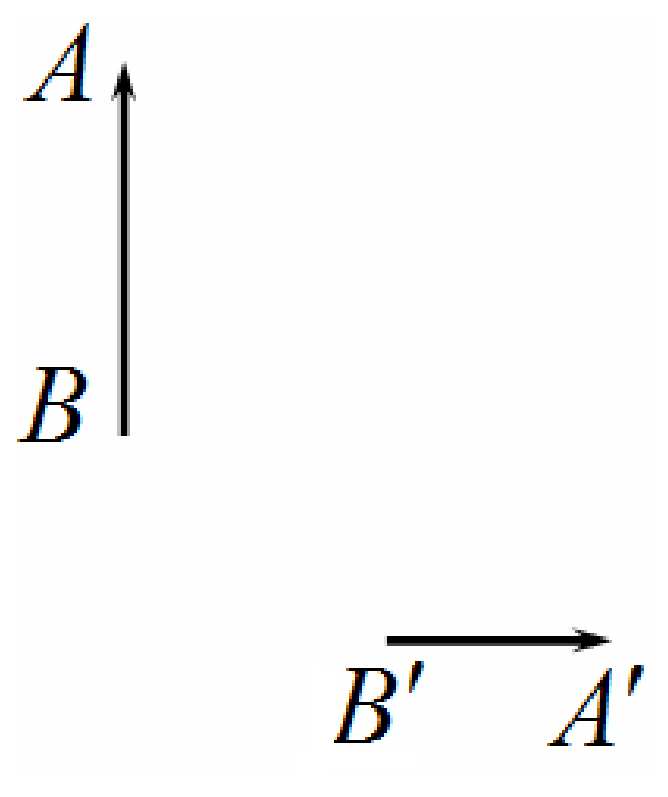
1C In Figure on the right b, you can see the object AB and its image A’B’ in a thin lens. By drawing method, please find:
a) the optical center of the lens (0.5 points);
б) the lens plane (1 point);
в) the main focuses of the lens (0.5 points).
Is the lens concave (diverging) or convex (collecting)? Please write down the answer. (0.5 points). [2,5 т.]
Отговори
- 1A
- 1B 1 A
- 1C The lens is concave (diverging).
Решение
1A (3.5 points)
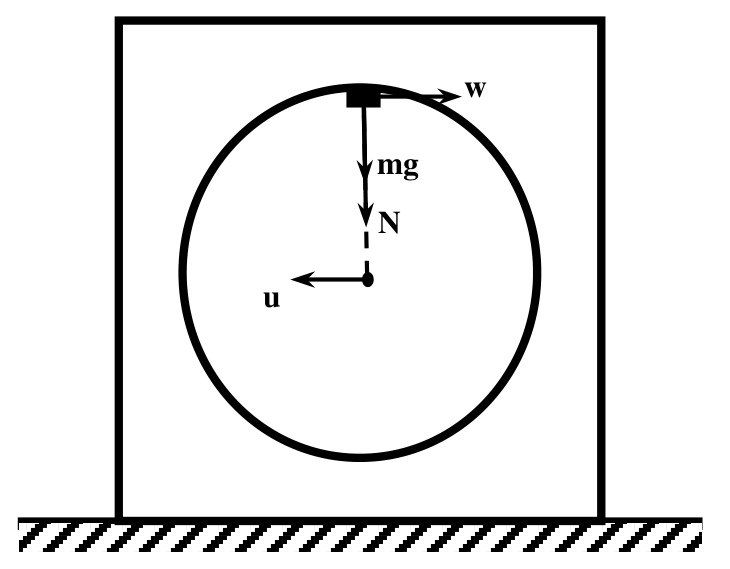
It is elementary to show that the jump of the cube appears at the puck position depicted in the picture on the left hand side. Let be the cube velocity of mass at this time moment and let be the horizontal relative velocity of the puck of mass with respect to the cube. Since the friction in the system is totally absent, the horizontal projection of the total momentum of the system is conserved,
as well as with the total mechanical energy,
In the instant frame of reference associated with the cube, the puck moves with the velocity along the circle of radius and its equation of motion projected on the radial direction is given by
It is rather obvious that the condition of the cube’s jump from the plane of the table is found, according to Newton's third law, as
Solving the set of equations (1)-(4), the puck velocity is obtained as
The minimal velocity of the puck is derived from relation (5) by differentiating over ,
and it is achieved at the mass ratio
Marking scheme
| № | Content | points |
|---|---|---|
| 1 | Formula (1) | 0.5 |
| 2 | Formula (2) | 0.5 |
| 3 | Formula (3) | 0.5 |
| 4 | Formula (4) | 0.5 |
| 5 | Formula (5) | 0.5 |
| 6 | Formula (6) | 0.5 |
| 7 | Formula (7) | 0.5 |
1B (4 points)
We can replace the infinite circuit of current sources by an effective current source with an emf and an internal resistance . Thus, we obtain the circuit shown in the figure on the left hand side. Then, we disconnect the resistance , add another two current sources and connect back the resistance . Hence, we obtain the circuit shown in the figure on the right hand side. Since the number of cells with the sources is infinite, then both circuits should be equivalent at any value of .
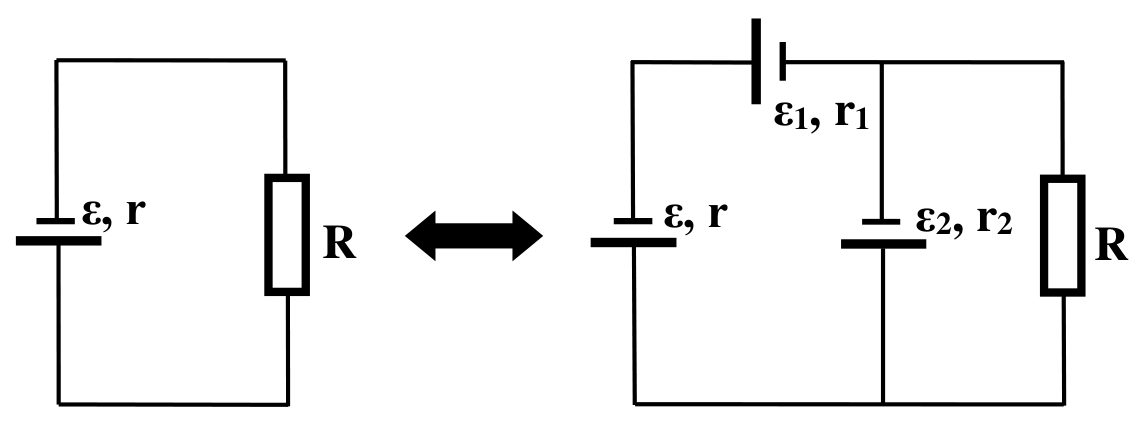
It can be shown from the direct current laws that the following two statements are valid:
- Let us take two current sources with and , connected in series. Then, they can be replaced by a single source with and .
- Let us take two current sources with and , connected in parallel. Then, they can be replaced by a single source with and .
Now, applying 1 and 2 to the circuit shown on the right hand side, we should obtain the circuit shown on the left hand side, thus the following relations must be satisfied:
Solution is given by
Therefore, the current flowing through the resistance is found as
Marking scheme
| № | Content | Points |
|---|---|---|
| 1 | Equivalent circuit | 1,0 |
| 2 | Rule 1 | 0.5 |
| 3 | Rule 2 | 0.5 |
| 4 | Formula (1) | 0.5 |
| 5 | Formula (2) | 0.5 |
| 6 | Formula (3) | 0.25 |
| 7 | Formula (4) | 0.25 |
| 8 | Formula (5) | 0.5 |
1C (2.5 points)
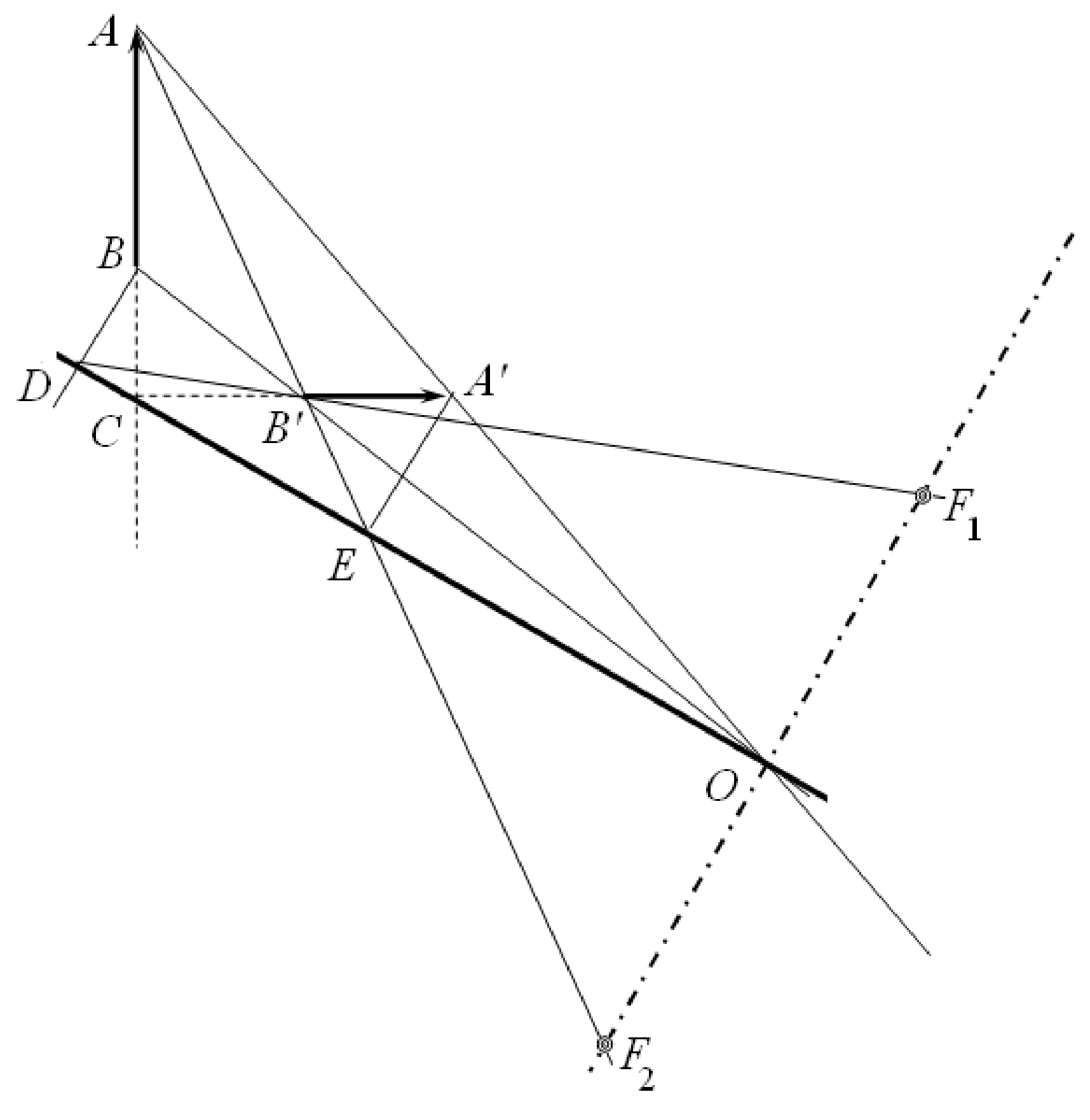
All the rays eradiated from the point A have to pass through the point A' after refraction in the lens; all the rays eradiated from the point B have to pass through the point B' after refraction in the lens. Rays passing through the optical center of the lens do not change direction. Therefore, the point of intersection of lines AA' and BB' is the optical center O of the lens. If a ray passes through both the points A and B, then it should necessarily pass through the points A' and B'. Consequently, the point of the intersection of lines AB and A'B' lies in the plane of the lens. Thus, the plane of the lens passes through the points O and C. The main optical axis of the lens passes through its optical center and is perpendicular to the plane of the lens, Further constructions are traditional: we draw ray BD through the point B which is parallel to the main optical axis, and after refraction in the lens the ray (or its extension) should pass through B'. From its continuation to the intersection with the main optical axis, we find one of the main focuses . Similarly, we find the second main focus . The drawing above shows that the lens is concave (diverging).
Оригинал в Архива: IZhO-2011-Theory_eng.pdf · официални решения: IZhO-2011-Theory_eng_sol.pdf