IZhO 2011, Теория — Задача 2. Electrical conductivity of metals
VII International Zhautykov Olympiad/Theoretical Competition · 16 януари 2011 г. · 10 т.
Please read this first:
The time available for the theoretical competition is 4 hours. There are three questions.
Use only the pen provided.
You can use your own calculator for numerical calculations. If you don’t have one, please ask for it from Olympiad organizers.
You are provided with Writing sheet and additional paper. You can use the additional paper for drafts of your solutions but these papers will not be checked. Your final solutions which will be evaluated should be on the Writing sheets. Please use as little text as possible. You should mostly use equations, numbers, figures and plots.
Use only the front side of Writing sheets. Write only inside the boxed area.
Begin each question on a separate sheet of paper.
Fill the boxes at the top of each sheet of paper with your country (Country), your student code (Student Code), the question number (Question Number), the progressive number of each sheet (Page Number), and the total number of Writing sheets used (Total Number of Pages). If you use some blank Writing sheets for notes that you do not wish to be evaluated, put a large X across the entire sheet and do not include it in your numbering.
At the end of the exam, arrange all sheets for each problem in the following order:
- Used Writing sheets in order;
- The sheets you do not wish to be evaluated
- Unused sheets and the printed question.
Place the papers inside the envelope and leave everything on your desk. You are not allowed to take any paper out of the room.
Условие
Ohm's law
Conductors are materials, usually metals, in which an ordered motion of free charges called an electric current is possible in the presence of an external electric field. The law relating the electric current strength flowing through the conductor with a voltage applied to its ends was experimentally discovered by Georg Ohm (1787-1854) and has the following form:
where is called the resistance of the conductor.
Consider a small element of the metallic material with the length and the cross section , whose ends are subject to the voltage . Let be the specific electrical conductivity of the substance which is the quantity inverse to the specific electrical resistivity . The resistance of the conductor and the electric current strength flowing through it are written as
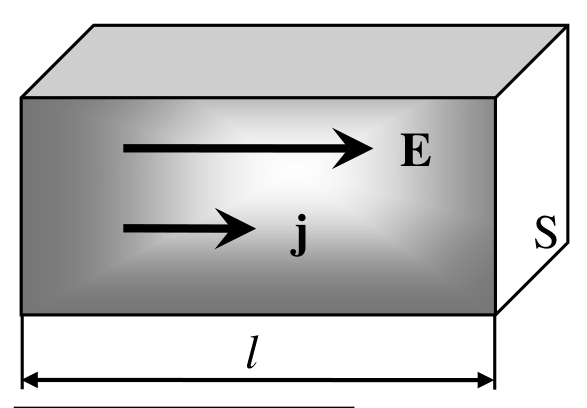
where the current density is introduced, representing the amount of the electric charge that passes through the unit of the cross section in the unit of time. The current density depends on the electron number density and electron average ordered velocity.
Taking into account that stands for the electric field strength, the local (differential) form of Ohm’s law is obtained from Eqs. (1) and (2) as
Accounting for the same direction of the electric field strength and the current density vectors, relation (3) can be rewritten in vector form
1. Starting from the Joule-Lenz law, discovered first by James Joule and later by Heinrich Lenz, determine the volume density of the thermal power released in the conductor, i.e. the amount of heat generated by the electric current in the unit volume 1 m in the unit of time 1 s. Express your answer in terms of and . [1 т.]
The Drude model
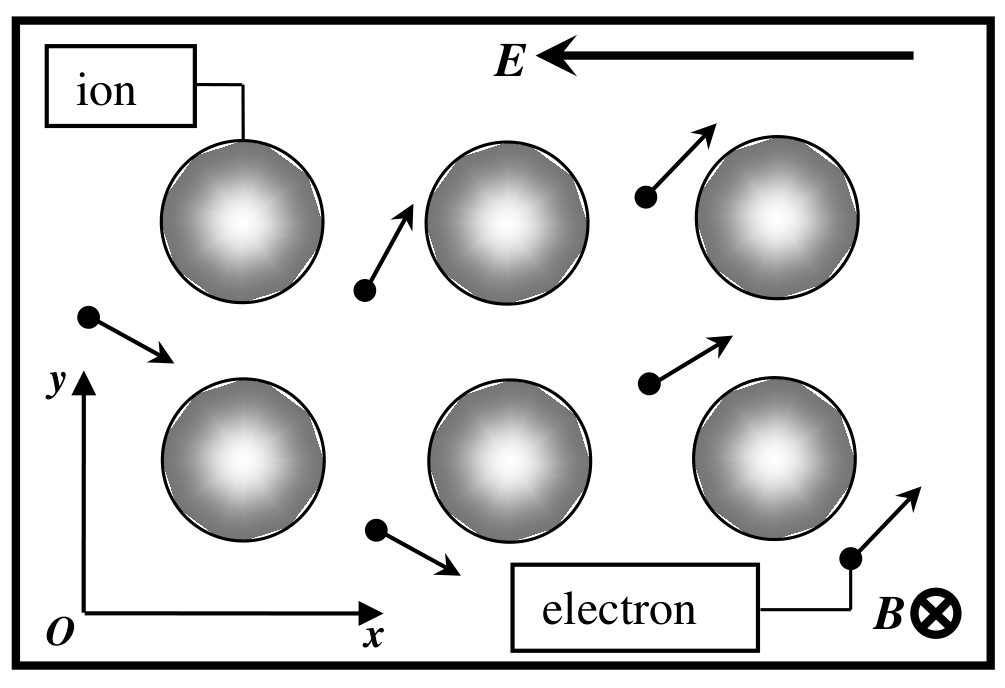
After the discovery of the electron in 1900 by Joseph John Thompson, German physicist Paul Drude proposed the so-called classical theory of electrical conductivity of metals. According to this theory, the electrons with the number density , the mass and the electric charge can move freely in the ionic crystal lattice of metal, occasionally colliding with ions located at the sites and thereby transferring their kinetic energy to ions.
Real motion of an electron is very complicated because of the chaotic thermal motion. Under the influence of the external field, all electrons acquire the same acceleration and thus gain some extra velocity. This results in an ordered motion of electrons causing an electrical current to appear. We are only interested in that ordered motion of electrons which is superimposed on their random thermal walks.
Since the real picture of the electrical conductivity is very complicated, we adopt the following simplified model. Assume that an electron with an initial zero velocity accelerates over time interval and then collides with an ion at the site, thereby transferring all the acquired kinetic energy. Then it again starts to accelerate and over time interval collides with another ion and so on. Keeping this in mind find answers to the following: In those processes the electrons do not interact with each other.
2. Determine the vector of average ordered velocity of electrons . Express your answer in terms of , , , and . [1 т.]
3. The current density in the sample is determined by the average velocity component parallel to the external electric field strength . Show that Ohm’s law holds in this simplified model and determine the specific conductivity of the metal. Express your answer in terms of , , , and . [1 т.]
4. Determine the amount of the kinetic energy transferred by electrons to the crystal lattice in the unit volume 1 m and in the unit of time 1 s. Express your answer in terms of , , , , and . [1 т.]
Magnetoresistance
One of the important galvanomagnetic phenomenon is the change in the conductivity of a conductor that is subject to an external transverse magnetic field. This phenomenon is called a magnetoresistance effect. Due to experiments, the relative deviation of the specific conductivity at not very strong magnetic field with the induction is given by the formula
where and are some constants.
Making use of the Drude model described above, solve the following problems. Carefully examine figure 2 presented above, since it represents the system of coordinates in use and displays directions of all vectors.
5. Find the dependences on time of the projections and of the electron velocity between two consecutive collisions. Express your answer in terms of , , , , and . [1 т.]
6. The current density in the sample is determined by the average velocity component parallel to the external electric field strength . Assuming that the magnetic field induction is small enough, find the constants and in formula (5). Express your answer in terms of , , and . [2 т.]
The Hall effect
In 1879, Edwin Hall discovered the phenomenon of appearance of the transverse potential difference, later called the Hall voltage, by placing the current-carrying conductor in a constant transverse magnetic field.
In the simplest consideration, the Hall effect is described as follows. Suppose that an electric current flows through a metal bar due to the applied external electric field of the strength and is placed in a weak transverse magnetic field of induction . The magnetic field deflects electrons from their straight-line motion to one of the bar faces. Thus, the Lorentz force, in contrast to the magnetoresistance effect, causes the accumulation of the negative charge near one of the bar faces and the positive charge near the opposite face. The accumulation of charge persists until the transverse electric field , generated by the accumulated charges themselves (directed along the axis as shown in the figure above), does totally compensate for the transverse displacement of electrons over the time interval .
Making use of the Drude model, described above, solve the following problems. Carefully examine figure 2 presented above, since it represents the system of coordinates in use and displays directions of all vectors.
7. Look carefully at the second figure above. Near which of the faces, the top or the bottom, is the negative charge accumulated? [0,5 т.]
8. Find the dependences on time of the projections and of the electron velocity between two consecutive collisions. Express your answer in terms of , , , , , and . [1,5 т.]
9. Find the Hall electric field strength . Express your answer in terms of , , , , and , and then in terms of , , , and . [1 т.]
In solving these problems you can use the following approximate formulae valid for small values of :
Отговори
- 1.
- 2.
- 3.
- 4.
- 5.
- 6.
- 7. Near the bottom face.
- 8.
- 9.
Решение
Ohm's law
1. [1 point]
In accordance with the Joule-Lentz law, the heat power released in the conductor is found as
which means that the specific heat power is written as
With the aid of
one gets
The Drude model
2. [1 point]
The second law of Newton for the electron motion in a constant electric field is read as
It follows from Eq.(5) that for the time interval the electron passes the distance
which means that the module of the average velocity of the electron is
or, in the vector form,
3. [1 point]
The current density depends on the electron number density, its electric charge, and its average velocity as follows:
which is Ohm’s law with the specific conductivity found as
4. [1 point]
Each electron transfers its kinetic energy at the end of the acceleration, i.e. at the moment of collision with an ion,
By definition there are electrons in the cubic meter of the conductor, and each of them transfers its kinetic energy (11) for the time interval . Thus, the total specific energy transferred by electrons to the crystal lattice in the unit of volume and in the unit of time,
This expression coincides with Eq.(4), thus proving the validity of the Joule-Lenz law in the Drude model.
Magnetoresistance
5. [1 point]
In the presence of magnetic field the equation of motion for the electron is written as
The projections on the coordinate axes are found as
Eq.(16) shows that the electron trajectory lies in XY plane. Substituting , into Eqs. (14)-(15), we obtain
Solutions to Eqs. (17) and (18) are derived as harmonic oscillations of the form
or, in terms of the previous variables,
where .
From initial conditions and , we determine the constants and . Substitution into Eqs. (21) and (22) yields
6. [2 points]
At small magnitude of the magnetic field induction, Eq. (23) takes the form
The displacement of the electron along the OX axis over the time interval equals
and the average speed is found as
Thus, we are able to determine the relative deviation of the specific conductivity as
and, therefore,
The Hall effect
7. [0.5 points]
The Lorentz force acting on the electrons is directed downward, therefore the negative charge is accumulated near the bottom face.
8. [1.5 points]
Since the electrons are accumulated near the bottom face of the bar, the Hall electric field is oppositely directed with respect to the OY axis. Hence, the electron equation of motion (13) is rewritten as
Again, the electron trajectory lies in the XY plane. Making substitution , in Eqs. (30) and (31), one gets
Solutions to Eqs. (33) and (34) are again derived as harmonic oscillations of the form
or, in terms of the previous variables,
From initial conditions and , we obtain the following final solution
9. [1 point]
At small magnitudes of the magnetic field induction, the condition for zero final displacement along the OY axis at the time moment
or
Marking scheme
| Content | points | |
|---|---|---|
| 1 | The Joule-Lenz law (1) | 0.25 |
| 2 | The specific heat power (2) | 0.25 |
| 3 | Formulae (3) | 0.25 |
| 4 | Final result (4) | 0.25 |
| 5 | Equation of motion (5) | 0.25 |
| 6 | Path (6) | 0.25 |
| 7 | Average speed (7) | 0.25 |
| 8 | Vector of the average velocity (8) | 0.25 |
| 9 | Current density (9) | 0.5 |
| 10 | Specific conductivity (10) | 0.5 |
| 11 | Kinetic energy of electrons (11) | 0.5 |
| 12 | Total heat transferred (12) | 0.5 |
| 13 | Equation of motion (13) | 0,25 |
| 14 | Equations of motion (14)-(16) | 0,25 |
| 15 | Velocity (23) | 0,25 |
| 16 | Velocity (24) | 0,25 |
| 17 | Expansion of the velocity (25) | 0,25 |
| 18 | Displacement (26) | 0,25 |
| 19 | Average speed (27) | 0.5 |
| 20 | Final result (29) | 2*0.5 |
| 21 | The correct face stated | 0.5 |
| 22 | Equations of motion (30)-(32) | 0.5 |
| 23 | Velocity (39) | 0.5 |
| 24 | Velocity (40) | 0.5 |
| 25 | The Hall electric field strength (41) | 0.5 |
| 26 | The Hall electric field strength (42) | 0.5 |
Оригинал в Архива: IZhO-2011-Theory_eng.pdf · официални решения: IZhO-2011-Theory_eng_sol.pdf