IZhO 2011, Теория — Задача 3. Thermodynamics of simple quantum ideal gas
VII International Zhautykov Olympiad/Theoretical Competition · 16 януари 2011 г. · 10 т.
Please read this first:
The time available for the theoretical competition is 4 hours. There are three questions.
Use only the pen provided.
You can use your own calculator for numerical calculations. If you don’t have one, please ask for it from Olympiad organizers.
You are provided with Writing sheet and additional paper. You can use the additional paper for drafts of your solutions but these papers will not be checked. Your final solutions which will be evaluated should be on the Writing sheets. Please use as little text as possible. You should mostly use equations, numbers, figures and plots.
Use only the front side of Writing sheets. Write only inside the boxed area.
Begin each question on a separate sheet of paper.
Fill the boxes at the top of each sheet of paper with your country (Country), your student code (Student Code), the question number (Question Number), the progressive number of each sheet (Page Number), and the total number of Writing sheets used (Total Number of Pages). If you use some blank Writing sheets for notes that you do not wish to be evaluated, put a large X across the entire sheet and do not include it in your numbering.
At the end of the exam, arrange all sheets for each problem in the following order:
- Used Writing sheets in order;
- The sheets you do not wish to be evaluated
- Unused sheets and the printed question.
Place the papers inside the envelope and leave everything on your desk. You are not allowed to take any paper out of the room.
Условие
In classical physics, the energy of the system varies continuously. In the physics of the microworld, most physical parameters are quantized, i.e., they can take a discrete set of values. Quantization of energy can result in actually observed macroscopic effects. In this problem, you are to consider the simplest model of a quantum ideal gas.
Model
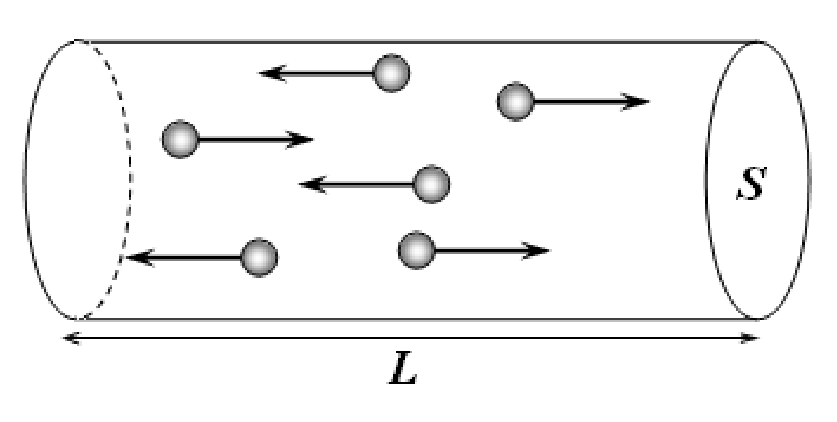
Let a gas consist of N identical atoms of mass m, which are placed in a long cylindrical vessel of length L and cross-section S. Atoms can only move along the axis of the vessel. The kinetic energy of atoms is quantized, i.e. it can take a discrete set of values determined by
where and is a known constant value. Assume that the kinetic energy of an atom is expressed by the formula of classical physics.
The vessel is brought into contact with the thermostat so that the gas temperature in the vessel is . The value of kinetic energy of a single atom is changed due to contact with the thermostat. Assume that the atom number density is such low that collisions between atoms are rare and can be neglected.
At thermodynamic equilibrium the number of atoms, which occupy the level with the energy , is determined by the Boltzmann distribution function of the form
where denotes the Boltzmann constant, is a normalization factor that you have to determine by yourself.
Subproblems:
1 Find the number of atoms that occupy the energy level . Express your answer in terms of , , , and . [1 т.]
2 Find the expression for the internal energy of the gas. Express your answer in terms of , , , and . Obtain approximate formulae for the internal energy of the gas in two limiting cases: (high temperature limit or classical limit) and (low temperature limit). [3 т.]
3 Calculate the molar heat capacity of gas at constant volume. Express your answer in terms of , , , and . Obtain approximate formulae for the molar heat capacity at constant volume both in the classical limit and the limit of low temperatures. Draw a schematic plot of the molar heat capacity dependence against the gas temperature. [3 т.]
4 Find the pressure exerted by the gas on the vessel walls. Express your answer in terms of , , , and . Obtain approximate formulae for the pressure both in the classical limit and the limit of low temperatures. Draw a schematic plot of the pressure dependence against the gas temperature. [3 т.]
In solving these problems you can use the following formulae:
Отговори
- 1
- 2
- 3
- 4
Решение
1 [1 point] The constant is found from the condition that the total number of particles is equal to :
Substituting the expression for the Boltzmann distribution function and obtaining summation, we get
2 [3 points] The internal energy of the gas is a sum of the kinetic energies of all atoms:
In the classical limit , the argument of the exponent is small, it is thus justifiable to use the approximate formula . In this case, we obtain
At low temperatures, the exponent itself is small, , hence
3 [3 points] The molar heat capacity at fixed volume is found as
In the most general case we derive
In order to approximate expressions in two limiting cases it is easier to use the expansions deduced in Subproblem 2. In the high temperature limit, we get
i.e. the molar heat capacity is a constant. Here is the Avogadro constant, stands for the universal gas constant.
At law temperatures,
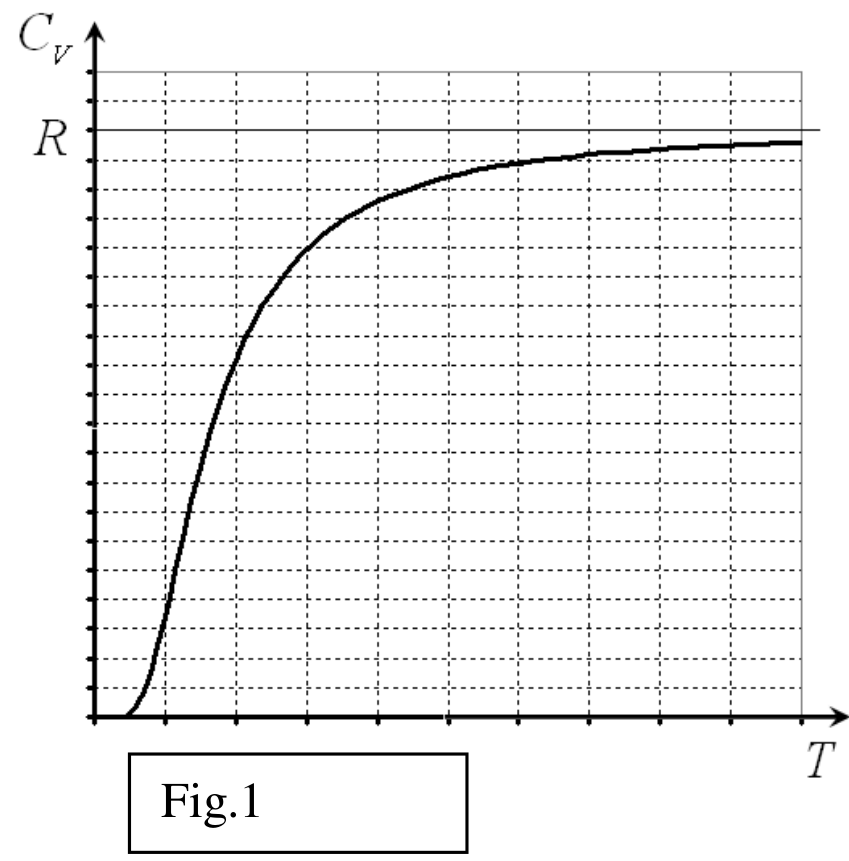
It is seen that the molar heat capacity goes to zero as the temperature vanishes. The schematic plot is drawn in figure 1.
4 [3 points] Calculation of the gas pressure can be conducted in different ways. For example, the average force exerted on the wall by a single atom is equal to the ratio of the moment transferred to the time interval between two consecutive collisions,
To determine the pressure it is necessary to summarize those forces
Substituting the formula for the internal gas energy (3), we obtain
In the two limiting cases the above obtained expressions for the internal energy should be used.
At
i.e. the pressure is proportional to the absolute temperature.
At low temperatures, we have
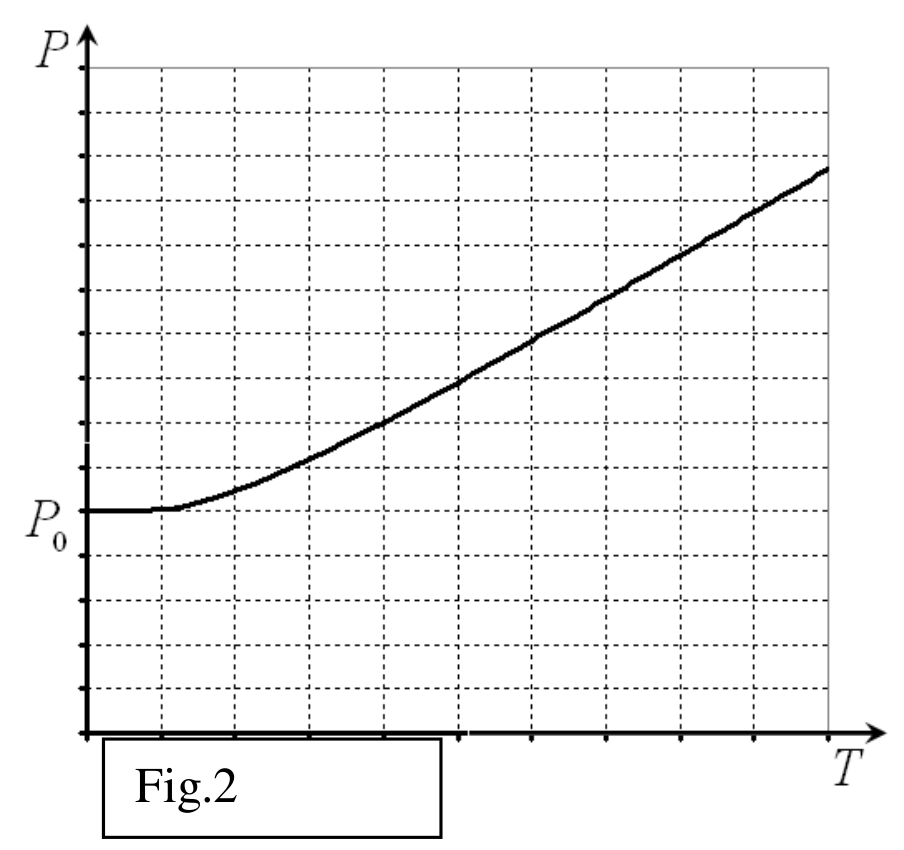
At temperatures going to zero, the pressure tends to a constant value
The schematic plot of the pressure against the temperature is shown in figure 2.
Marking scheme
| № | Contents | points | |
|---|---|---|---|
| 1 | Normalizing condition (1) | 0,5 | 1 |
| 2 | Calculation of the number of particles (2) | 0,5 | |
| 3 | General expression for the internal energy U | 0,5 | 3 |
| 4 | Calculation of the internal energy U (3) | 1,0 | |
| 5 | Calculation of the classical limit of U (4) | 0,5 | |
| 6 | Calculation of the low temperature limit of U (5) | 1,0 | |
| 7 | General expression for the molar heat capacity C_V (6) | 0,5 | 3 |
| 8 | Calculation of the molar heat capacity C_V (7) | 1,0 | |
| 9 | Calculation of the classical limit of C_V (8) | 0,5 | |
| 10 | Calculation of the low temperature limit of C_V (9) | 0,5 | |
| 11 | Schematic plot for C_V | 0,5 | |
| 12 | General expression for average force (10) | 0,5 | |
| 12 | General expression for P (11) | 0,5 | 3 |
| 13 | Calculation of the pressure P (12) | 0,5 | |
| 14 | Calculation of the classical limit of P (13) | 0,5 | |
| 15 | Calculation of the low temperature limit of P (14) | 0,5 | |
| 16 | Schematic plot P | 0,5 |
Оригинал в Архива: IZhO-2011-Theory_eng.pdf · официални решения: IZhO-2011-Theory_eng_sol.pdf