IZhO 2012, Теория — Задача 1
VIII International Zhautykov Olympiad/Theoretical Competition — THEORETICAL COMPETITION, January 17, 2012 · 17 януари 2012 г. · 10 т.
Внимание: Бележка към темата
The graph of the diode characteristic handed out on a separate sheet for Problem 1.B is not in the archive.
Please read this first:
The time available for the theoretical competition is 4 hours. There are three questions.
Use only the pen provided.
You can use your own calculator for numerical calculations. If you don’t have one, please ask for it from Olympiad organizers.
You are provided with Writing sheet and additional paper. You can use the additional paper for drafts of your solutions but these papers will not be checked. Your final solutions which will be evaluated should be on the Writing sheets. Please use as little text as possible. You should mostly use equations, numbers, figures and plots.
Use only the front side of Writing sheets**.** Write only inside the boxed area.
Begin each question on a separate sheet of paper.
Fill the boxes at the top of each sheet of paper with your country (Country), your student code (Student Code), the question number (Question Number), the progressive number of each sheet (Page Number), and the total number of Writing sheets used (Total Number of Pages). If you use some blank Writing sheets for notes that you do not wish to be evaluated, put a large X across the entire sheet and do not include it in your numbering.
At the end of the exam, arrange all sheets for each problem in the following order:
- Used Writing sheets in order;
- The sheets you do not wish to be evaluated
- Unused sheets and the printed question.
Place the papers inside the envelope and leave everything on your desk. You are not allowed to take any paper out of the room.
Условие
This problem consists of three independent parts.
1.A 2012
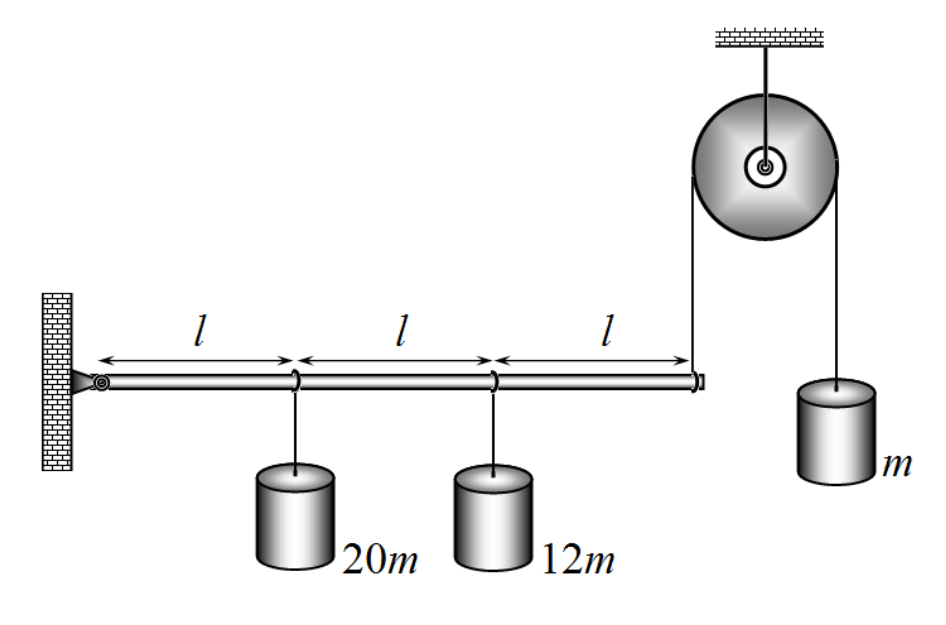
One end of a rigid weightless rod is fixed by a pivot. The weight of mass is suspended to the other end of the rod with a thread which is thrown over the weightless block. Two more weights of masses and respectively are hung by threads to the rod at the points that divide it into three equal parts (see the figure on the right). Assume all of the threads inextensible and weightless. Initially, the rod is held in a horizontal position and then it is released. Find the accelerations of all of the weights immediately after the rod has been released. The acceleration of gravity is . [4 т.]
1.B Diodes ...
On a separate sheet of paper you are provided with the graph of the current-voltage characteristics of a diode (representing a current through a diode against its voltage drop, ). Five identical diodes are connected in a circuit as shown in the figure on the right. Plot a graph of the current in the circuit against the voltage of the source, when the latter varies from 0 to 3V.
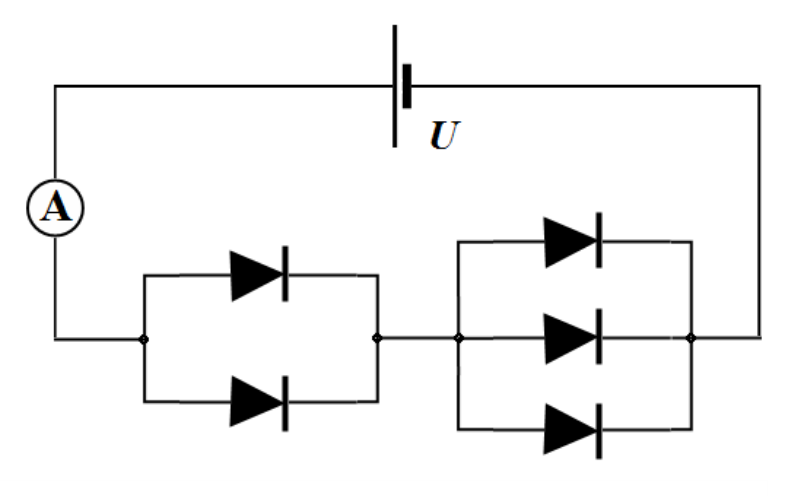
Use a separate sheet of paper provided to plot the corresponding graph. Do not forget to return it! [2,5 т.]
1.C Flat lens
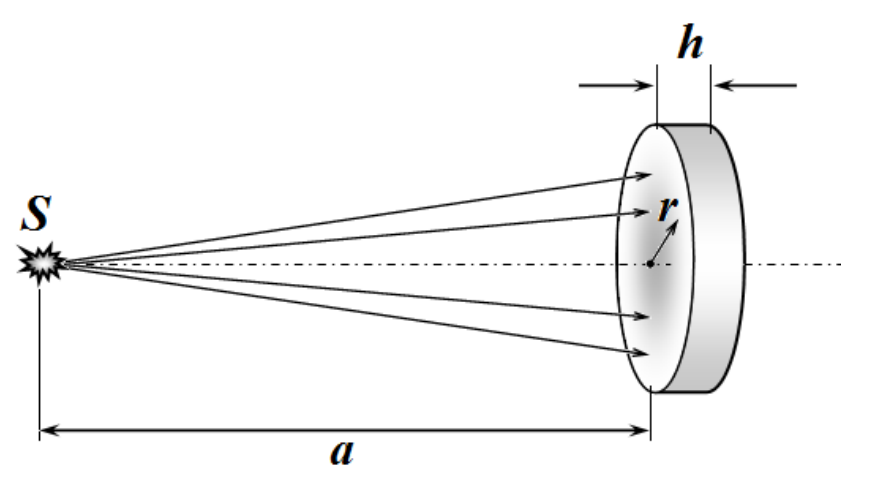
A round transparent plane-parallel disk of the thickness is made of the material with the refractive index which depends on the distance to the disk center according to the law
where , are known positive constants. The plate is surrounded by the air whose refractive index is . A point-like light source is placed on the axis of the disk at the distance () from its center. Show that the plate acts as some kind of a lens that forms a point-like image of the source. Determine the distance between the disk and the image of the source. What is the focal length of the lens? [3,5 т.]
Отговори
1.A
Accelerations of the weights 20m, 12m and m respectively; the thread of the 12m weight becomes slack.
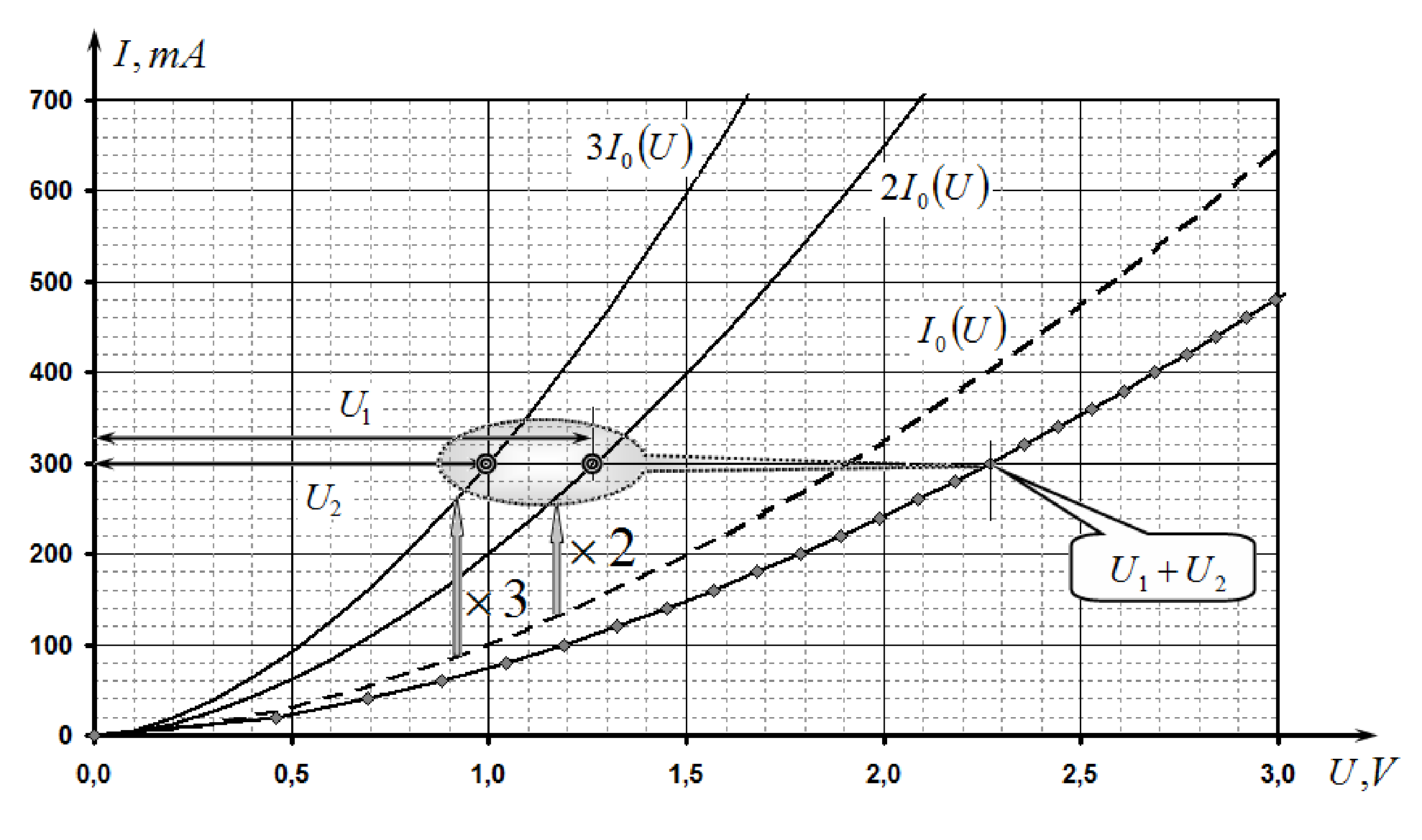
1.B Graphical answer: U(I) = U0(I/2) + U0(I/3), the horizontal sum of the graphs 2I0(U) and 3I0(U) (see the official solution graph).
1.C
Решение
Problem 1.A 2012
The forces acting on the system are shown in the figure on the right. Since the rod is rigid and weightless, the threads are inextensible and weightless, the accelerations of the weights are in a ratio 1:2:3. The net torque acting on a weightless rod should be equal to zero. These two conditions together with the equations of motion for all the weights are formally written as a set of equations
from which we find
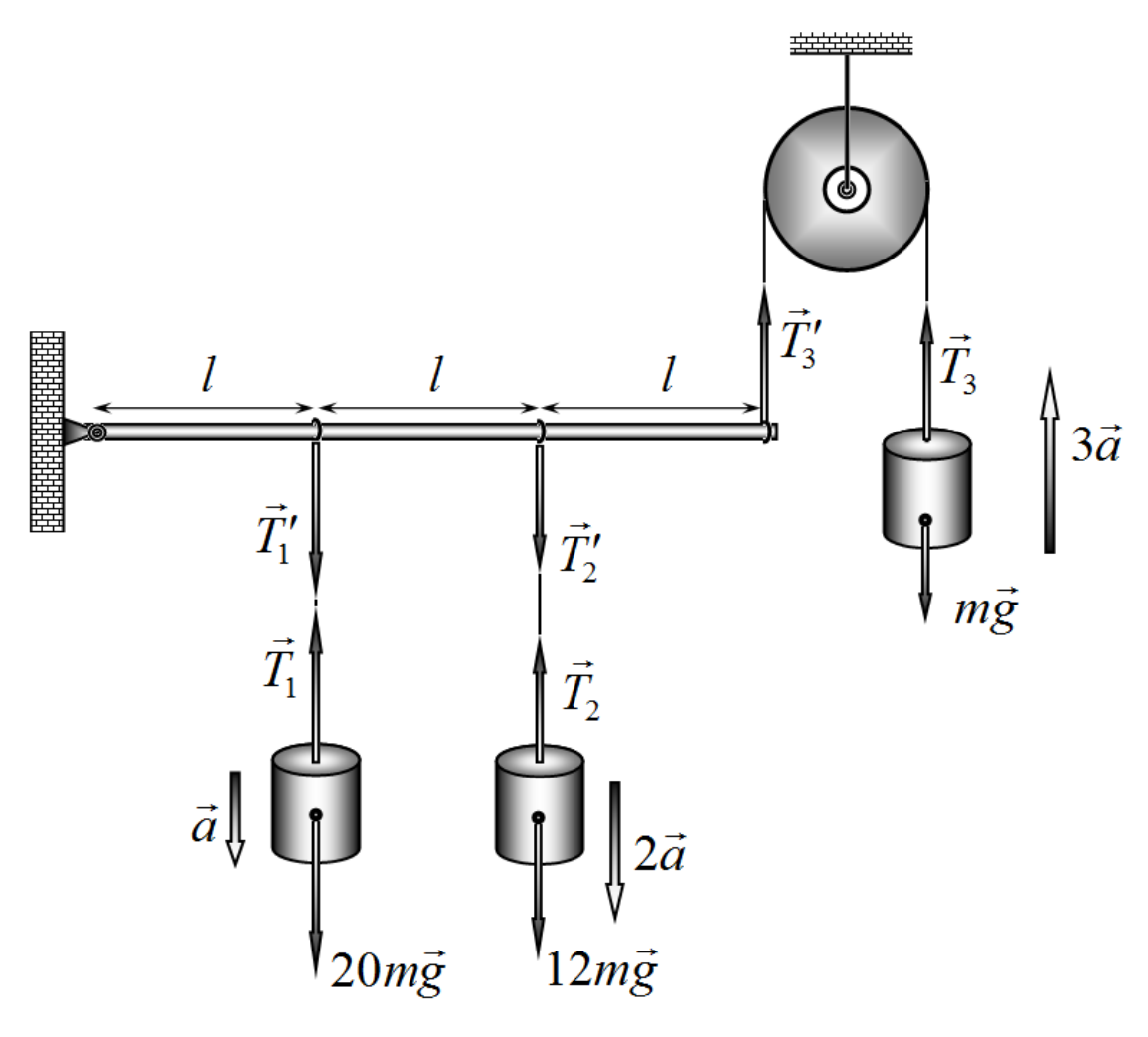
However, it is seen that the acceleration of the weight with mass appears to be and larger than the acceleration of gravity. This means that the second thread will not be tight, thus the acceleration of the weight with mass is equal to . One can also show that the formal solution to the set of equations (1) yields , that, of course, cannot happen with a thread. Therefore, the thread to which the second weight with mass is suspended exerts no force on the rod. This means that the set of equations (1) incorrectly describes the system under consideration. To calculate the accelerations of the rod and the weights, the weight with mass should be excluded from the analysis.
Correct values for the accelerations of the first and the third weights are obtained from the following set of equations
Finally, one gets
Grading scheme for Problem 1.A
| № | Points | |
|---|---|---|
| 1 | Figure with all the forces | 0,4 |
| 2 | The set of equations (1) | 0,8 |
| 3 | The solution of (1) to get the acceleration (2) | 0,4 |
| 4 | Exclusion of the weight with mass from consideration | 0,3 |
| 5 | Prove the correctness of the exclusion (the acceleration of the weight with mass is larger than or the tension of the thread is negative) | 0,7 |
| 6 | Acceleration of the weight is equal to | 0,4 |
| 7 | The set of equations (3) | 0,6 |
| 8 | The solution to (3) for accelerations (4) | 0,4 |
| Total | 4,0 |
Problem 1.B Diodes
We denote the voltage drop on the pair of parallel-connected diodes by and on the three of parallel-connected diodes by . The total current in the circuit can be found in two ways:
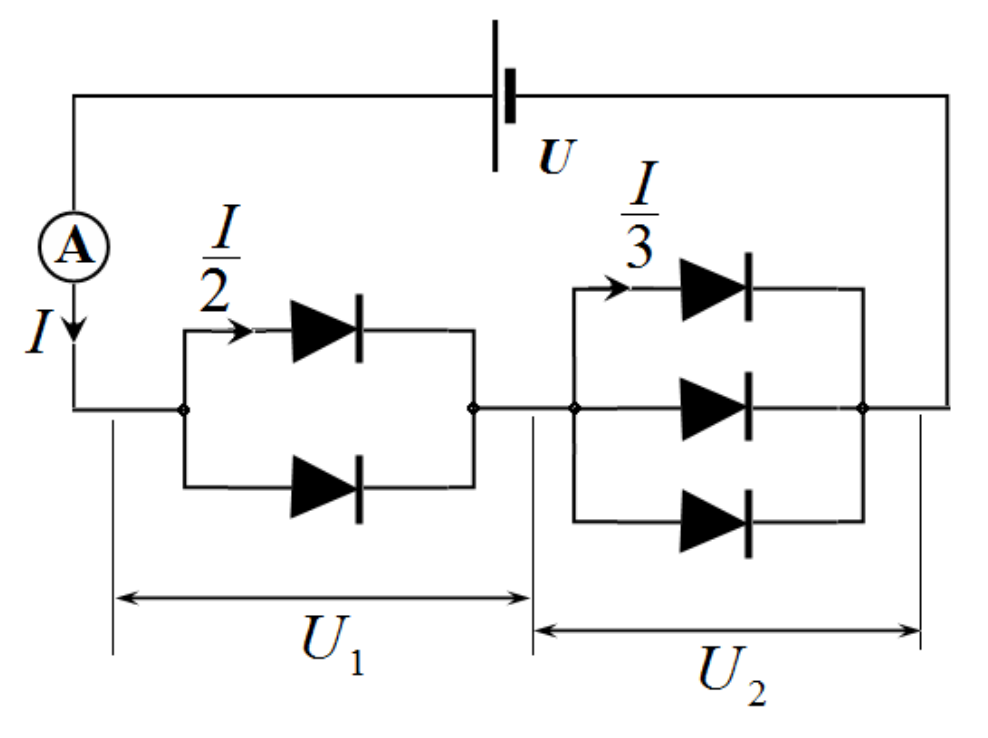
A double value of the current through one diode of the pair:
A triple value of the current through one diode of the triplet:
We construct the graphs of and . It is enough to multiply points on the graph of the by appropriate factors, i.e. for several values of the voltage one should read the currents, multiply them by factors 2 and 3 respectively, and plot the appropriate point on the graphs. When connected in series the total voltage is the sum of the voltages written as follows
Graphically, this condition corresponds to a “horizontal summation” of graphs and : for a given value of the current the voltages and are read, and their sum is then taken to be plotted in the final graph.
Note that the formal solution of the problem can be written as (for the inverse functions):
where is the function inverse to the graphically given function .
Grading scheme of Problem 1B
| № | Contents of number scores | Points |
|---|---|---|
| 1 | In a parallel connection electric currents are summed | 0,3 |
| 2 | Plotting functions and | 0,6 |
| 3 | If a series connection the voltages are summed | 0,3 |
| 4 | “Horizontal” summation | 0,7 |
| 5 | Calculations are made for: | |
| 3 points; | 0,3 | |
| 6 points. | 0,6 | |
| 6 | Alternatives (realized ideas): | |
| To approximate the dependence; | 0,4 | |
| To solve the equations explicitly; | 0,4 | |
| Total | 2,5 |
Problem 1.C. Flat lens
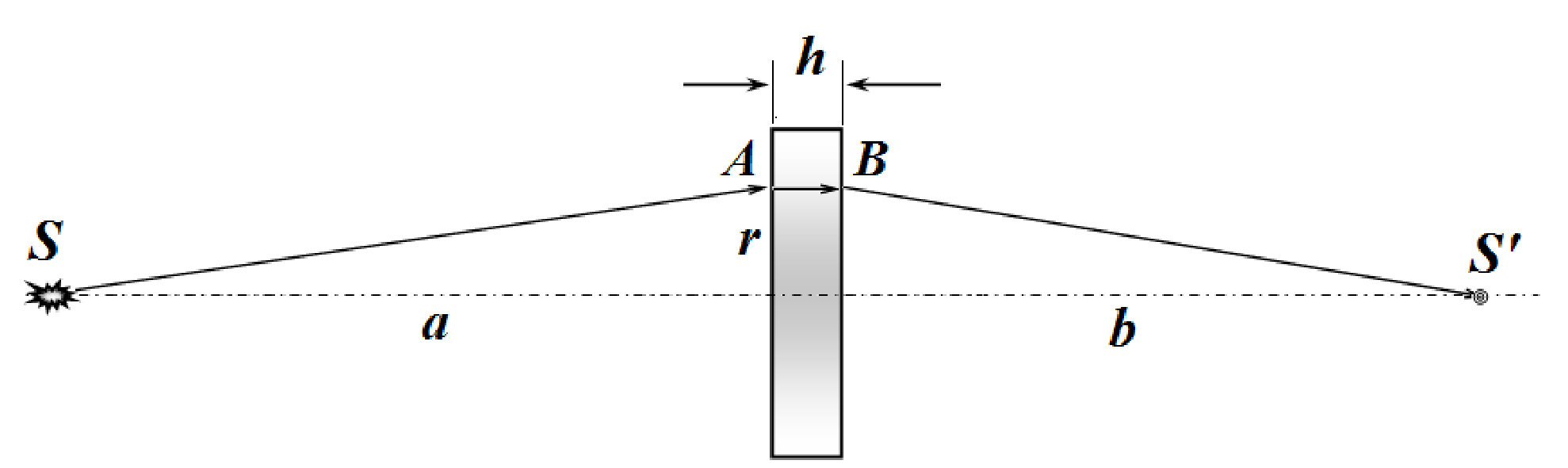
Plate will form an image if the optical path length for any ray of light, emitted by the source and refracted in the plate, will be the same for all rays (tautochronism condition for a lens system).
Consider a ray incident on the plate at a distance from its axis. We assume that , i.e. we make use of the paraxial approximation. The distance is found using the Pythagorean theorem and making use of the approximation , we get:
Similarly, the distance is expressed as
Thus, the optical path length is equal to
This value does not depend on (i.e., the same for all rays) if the following condition is satisfied
which can be rewritten as
This expression is identical in form to a thin lens formula
with the focal length .
Comparing (5) and (6), we find the focal length of the plate
From formula (5) one also finds the distance from the plate to the image:
The alternative is a geometrical optics approximation.
This problem, in principle, can be solved in the framework of geometrical optics. The main stages of this very complex solution are:
- Use the law of refraction of Snellius;
- Choose an arbitrary ray and determine the angle of incidence on the plate;
- Determine an angle of the ray after the refraction at the front plane of plate;
- Obtain a differential equation for the ray path inside the plate;
- Solve this equation in the quadratic approximation;
- Determine the angle at the front plane of the plate (should be negative);
- Determine the angle after the refraction at the rear plane;
- Determine the distance to the intersection point with the axis of the plate;
- Proove that the distance is the same for any ray;
- Get the lens formula;
- Write the formula for the focal length.
Grading scheme of Problem 1C
| № | Points | |
|---|---|---|
| 1 | Formulation of basic idea: the constancy of the propagation time for all paths | 1,5 |
| 2 | Using the quadratic approximation (for small angles) | 0,5 |
| 3 | Calculation of distances and | |
| - The exact formula; | 0,2 | |
| - And its expansion; | 0,4 | |
| 4 | The optical path length (3) | 0,2 |
| 5 | A formula of a thin lens (4) | 0,3 |
| 6 | Focal length of lens (7) | 0,2 |
| 7 | Distance to the image (8) | 0,2 |
| Total | 3,5 |
Grading for geometrical optics approximation (alternative solution)
| № | Points | |
|---|---|---|
| 1 | The refraction law | 0,4 |
| 2 | Two small-angle approximation (but quadratic) | 0,4 |
| 3 | The starting angle at the plate | 0,2 |
| 4 | The differential equation for the ray trajectory in the plate | 0,7 |
| 5 | The solution in a quadratic approximation | 0,6 |
| 5 | The value of the angle near the rear plane | 0,2 |
| 6 | The value of the angle after refraction at the rear plane | 0,2 |
| 7 | The point of intersection with the optical axis | 0,2 |
| 8 | Invariance of distance b for all refracted rays | 0,2 |
| 9 | Formula analogous to a thin lens | 0,2 |
| 10 | The formula for the focal length | 0,2 |
| Total | 3,5 |
Оригинал в Архива: IZhO 2012 Theory_eng_f.doc · официални решения: IZhO 2012 Theory_eng_sol_final.doc