IZhO 2012, Теория — Задача 2. Adventures of a piston
VIII International Zhautykov Olympiad/Theoretical Competition — THEORETICAL COMPETITION, January 17, 2012 · 17 януари 2012 г. · 10 т.
Внимание: Бележка към темата
The graph of the diode characteristic handed out on a separate sheet for Problem 1.B is not in the archive.
Please read this first:
The time available for the theoretical competition is 4 hours. There are three questions.
Use only the pen provided.
You can use your own calculator for numerical calculations. If you don’t have one, please ask for it from Olympiad organizers.
You are provided with Writing sheet and additional paper. You can use the additional paper for drafts of your solutions but these papers will not be checked. Your final solutions which will be evaluated should be on the Writing sheets. Please use as little text as possible. You should mostly use equations, numbers, figures and plots.
Use only the front side of Writing sheets**.** Write only inside the boxed area.
Begin each question on a separate sheet of paper.
Fill the boxes at the top of each sheet of paper with your country (Country), your student code (Student Code), the question number (Question Number), the progressive number of each sheet (Page Number), and the total number of Writing sheets used (Total Number of Pages). If you use some blank Writing sheets for notes that you do not wish to be evaluated, put a large X across the entire sheet and do not include it in your numbering.
At the end of the exam, arrange all sheets for each problem in the following order:
- Used Writing sheets in order;
- The sheets you do not wish to be evaluated
- Unused sheets and the printed question.
Place the papers inside the envelope and leave everything on your desk. You are not allowed to take any paper out of the room.
Условие
An open cylindrical vessel of the height and cross-sectional area is filled with the air under the normal conditions, i.e. at the atmospheric pressure and the temperature . A thin heavy piston of mass is gently inserted into the vessel. The vessel wall and the piston are made of the material that conducts heat very poorly. Assume that air is an ideal diatomic gas with an average molar mass , the acceleration of gravity is , and the universal gaseous constant is equal to . Heat capacities of the piston and the vessel, as well as the friction between the walls and the piston, are to be completely ignored.
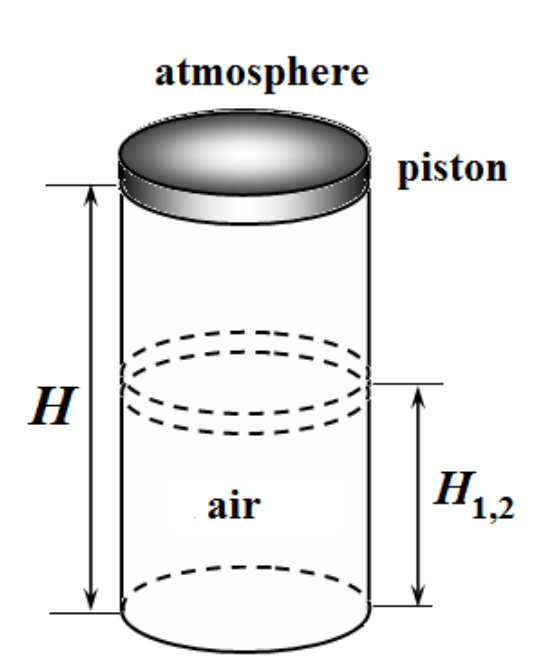
The piston is released. The process of transition to final equilibrium consists of two consecutive stages. During the first stage the piston oscillates such that the corresponding gas processes cannot be considered quasistatic. Because of this, the piston oscillations are damped, that is the mechanical energy is dissipated. Assume that a half of the dissipated energy is transferred to the gas under the piston and the other half is given to the atmosphere. At this stage you can also neglect the thermal conductivities of the vessel and the piston. After the oscillations have vanished, the piston stops at some height .
The second stage appears to be quite slow, that is during some long period of time the piston achieves its final equilibrium position at some height .
2.1 What is the air pressure in the vessel at the end of the first stage? Express your answer in terms of the atmospheric pressure , the adiabatic exponent and the parameter . Calculate the numerical value of . [0,5 т.]
2.2 What is the temperature at the end of the first stage? Express your answer in terms of , and . Calculate the numerical value of . [1,5 т.]
2.3 Find the height . Express your answer in terms of , and . Calculate the numerical value of . [0,5 т.]
2.4 What is the air pressure in the vessel at the end of the second stage? Express your answer in terms of and . Calculate the numerical value of . [0,5 т.]
2.5 What is the temperature at the end of the second stage? [0,5 т.]
2.6 Find the height . Express your answer in terms of and . Calculate the numerical value of . [0,5 т.]
2.7 Find the frequency of small oscillations around the equilibrium position of the piston, assuming that the process is quasistatic and adiabatic. Express your answer in terms of , , and . Calculate numerical value of . [2 т.]
At the end of the second stage, a great number of small holes are made in the bottom of the vessel whose total cross-sectional area is . The size of each hole is much smaller than the mean free flight path of air molecules. After some time the piston starts to move with the constant velocity .
It is known that the average number of molecules hitting the unit of surface area per unit of time is equal to
where is the so-called average thermal velocity of molecules, and stands for the number density.
The average kinetic energy of translational motion of molecules passing through the holes is
where is the Boltzmann constant.
Assuming that the heat flow through the walls of the vessel and the piston is completely negligible, answer the following questions:
2.8 The steady air pressure under the piston has the form , where is a constant that depends on , while is a function of . Find and . Calculate the numerical value of . [1 т.]
2.9 The steady velocity of the piston has the from , where is a constant depending on , , , and , while is a function of . Find and . Calculate the numerical value of . [2 т.]
2.10 The steady temperature of the gas under the piston has the form , where is a constant that depends on , while is a function of . Find and . Calculate the numerical value of . [1 т.]
Отговори
2.1 ≈ Pa
2.2 ≈ K
2.3 ≈ cm
2.4 ≈ Pa
2.5 ≈ K
2.6 ≈ cm
2.7 ≈ rad/s
The official solution prints the value as 13.5 Hz; for the angular frequency ω the unit is s⁻¹ (rad/s).
2.8 ≈ Pa
2.9 ≈ m/s
2.10 ≈ K
Решение
2.1 [0.5 points] From the equilibrium condition of the piston, we find the gas pressure
2.2 and 2.3 [2 points] In the first stage the gas is compressed and heats up to a certain temperature. Because the vessel’s walls and the piston are made of a material that conducts heat poorly, the gas compression can be assumed to be adiabatic, but the process is not quasistatic and one cannot use the adiabatic equation. In the transition from the initial to the final state of the system piston+gas, external forces (gravity and the atmospheric pressure) have done the work
By the assumption in the formulation, only a half of this work is spent to increase the internal energy of the gas
where
Here, is the number of moles.
We write the equation of state of ideal gas for the initial and final states
Solving the set of equations (2)−(6), we obtain
2.4 [0.5 points] Since the piston is still in equilibrium, the pressure equals
2.5 [0.5 points] After a sufficiently long period of time the gas temperature inside the vessel will be equal to the ambient temperature, i.e., becomes equal to
2.6 [0.5 points] The height is found from (9) and (10), as well as from the equation of state
2.7 [2 points] An adiabatic equation of state has the form
we obtain
Let a piston deviate from its equilibrium position at a small height , then, according to (13), the pressure change is equal to
The equation of motion of the piston can be written as
whence we obtain the frequency of small oscillations
2.8 [1 point] When moving with the constant velocity, the piston remains in equilibrium, so the pressure can be written as
that is
2.9 and 2.10 [3 points] Suppose a steady temperature has established in the vessel. The balances both in the number of particles and the energy should be achieved.
The law of conservation of particle number is given by
In the conservation of energy it is necessary to take into account not only the translational kinetic energy but also the rotational energy of each molecule. Therefore, the total energy carried by each molecule is
Then, the energy conservation law can be written as
Solving (18) and (19), we finally obtain
that is
and the temperature is
that is
Grading scheme of Problem 2
| N | Points | ||
|---|---|---|---|
| 2.1 | Formula (1) | 0,25 | 0,5 |
| Numerical value of | 0,25 | ||
| 2.2 | Formula (2) | 0,25 | 1,5 |
| Formula (3) | 0,25 | ||
| Formula (4) | 0,25 | ||
| Formulas (5) and (6) | 0,25 | ||
| Formula (7) | 0,25 | ||
| Numerical value of | 0,25 | ||
| 2.3 | Formula (8) | 0,25 | 0,5 |
| Numerical value of | 0,25 | ||
| 2.4 | Formula (9) | 0,25 | 0,5 |
| Numerical value of | 0,25 | ||
| 2.5 | Formula (10) | 0,25 | 0,5 |
| Numerical value of | 0,25 | ||
| 2.6 | Formula (11) | 0,25 | 0,5 |
| Numerical value of | 0,25 | ||
| 2.7 | Formula (12) | 0,25 | 2,0 |
| Formula (13) | 0,25 | ||
| Formula (14) | 0,5 | ||
| Formula (15) | 0,5 | ||
| Formula (16) | 0,25 | ||
| Numerical value of | 0,25 | ||
| 2.8 | Formula (18) for | 0,25 | 1,0 |
| Formula (18) for | 0,25 | ||
| Formula (17) | 0,25 | ||
| Numerical value of | 0,25 | ||
| 2.9 | Formula (19) | 0,25 | 2,0 |
| Formula (20) | 0,5 | ||
| Formula (21) | 0,25 | ||
| Formula (23) for | 0,25 | ||
| Formula (23) for | 0,25 | ||
| Formula (22) | 0,25 | ||
| Numerical value of | 0,25 | ||
| 2.10 | Formula for (25) for | 0,25 | 1,0 |
| Formula for (25) for | 0,25 | ||
| Formula (24) | 0,25 | ||
| Numerical value of | 0,25 | ||
| Total | 10,0 |
Оригинал в Архива: IZhO 2012 Theory_eng_f.doc · официални решения: IZhO 2012 Theory_eng_sol_final.doc