IZhO 2012, Теория — Задача 3. Nuclear droplet
VIII International Zhautykov Olympiad/Theoretical Competition — THEORETICAL COMPETITION, January 17, 2012 · 17 януари 2012 г. · 10 т.
Внимание: Бележка към темата
The graph of the diode characteristic handed out on a separate sheet for Problem 1.B is not in the archive.
Please read this first:
The time available for the theoretical competition is 4 hours. There are three questions.
Use only the pen provided.
You can use your own calculator for numerical calculations. If you don’t have one, please ask for it from Olympiad organizers.
You are provided with Writing sheet and additional paper. You can use the additional paper for drafts of your solutions but these papers will not be checked. Your final solutions which will be evaluated should be on the Writing sheets. Please use as little text as possible. You should mostly use equations, numbers, figures and plots.
Use only the front side of Writing sheets**.** Write only inside the boxed area.
Begin each question on a separate sheet of paper.
Fill the boxes at the top of each sheet of paper with your country (Country), your student code (Student Code), the question number (Question Number), the progressive number of each sheet (Page Number), and the total number of Writing sheets used (Total Number of Pages). If you use some blank Writing sheets for notes that you do not wish to be evaluated, put a large X across the entire sheet and do not include it in your numbering.
At the end of the exam, arrange all sheets for each problem in the following order:
- Used Writing sheets in order;
- The sheets you do not wish to be evaluated
- Unused sheets and the printed question.
Place the papers inside the envelope and leave everything on your desk. You are not allowed to take any paper out of the room.
Условие
In this problem you have to investigate basic characteristics and stability conditions of atomic nuclei. Let an atomic nucleus contain nucleons ( is the atomic weight of the corresponding element), namely, protons ( is the atomic number in the table of chemical elements) and neutrons. The expression for the total energy of the nucleus can be written as
where denotes the nucleus mass, is the mass of the free proton, is the mass of the free neutron, stands for the speed of light, and is the interaction potential energy of the nucleons in the nucleus.
The interaction potential energy of the nucleons can be described by the following semi-empirical formula proposed by Weizsäcker
where , , , .
Weizsacker semiempirical formula corresponds to one of the simplest model of the atomic nucleus, the so-called spherical liquid droplet model, which relies on the analogy between a nucleus and a droplet of an ordinary liquid. The mass and the charge of a nucleus is assumed to be uniformly distributed inside a sphere of some radius, and the nucleon fluid is characterized by some parameter which is an analogue of the surface tension of the liquid.
The formula for the potential energy takes into account the following contributions:
- surface energy, which takes into account the surface tension of the nuclear matter in the liquid droplet model;
- the energy of the Coulomb repulsion of the protons within the nucleus;
- the exchange interaction energy reflecting the trend towards the stability of nuclei at N=Z;
- direct dependence on the number of nucleons due to nuclear forces.
At the derivation of his semiempirical formula Weizsäcker used an experimentally established fact that the following dependence holds for nucleus radius on the number of nucleons
where is a constant.
Starting from the above statements, find answers to the following questions:
3.1 Find the electrostatic energy of a ball of radius , uniformly charged with the net charge . Express your answer in terms of the charge , the dielectric constant and the radius of the ball. [2 т.]
3.2 Find the formula and the numerical value of the coefficient in formula (3). [1 т.]
3.3 Find the formula and the numerical value of the density of the nuclear matter. [1 т.]
3.4 Find the formula and the numerical value of the surface tension of the nucleon liquid. [1 т.]
Suppose now that the nucleus fisses (is divided) into two fragments with atomic weights and respectively, where . Assume that the electric charge and the number of neutrons are distributed between the fragments similar to the atomic weight.
3.5 Nuclear fission (division into fragments) becomes energetically favorable under the condition . Find an expression for the function and plot its graph schematically. [2 т.]
3.6 Find the limiting value at which the spontaneous fission is still theoretically possible. [0,5 т.]
Under the above condition in 3.5, a nucleus can stay stable for quite a long time. For example, the half-life of Uranium-235 nucleus is equal to 713 million years. Consequently, an instantaneous fission is prevented by an energy barrier, which disappears at some critical value . In fact, a nucleus will only fiss if a significant deviation of its shape from the ball occurs.
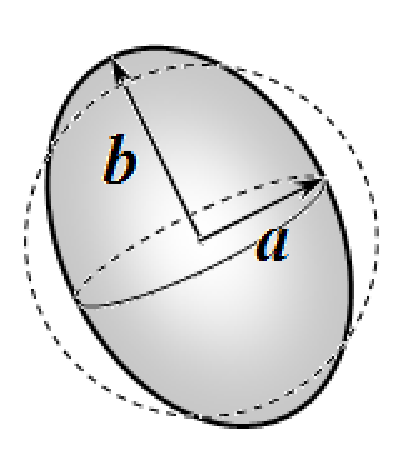
For the sake of simplicity assume that a spherical nucleus undergoes such a deformation that its surface turns into a prolate ellipsoid of rotation, which is described in the Cartesian coordinates by the equation
where is a minor, and is a major semi-axes of the ellipsoid, respectively.
The volume of a prolate ellipsoid is given by
and its surface area can be calculated via the formula
Let a spherical nucleus undergo such a deformation that and , so that , and is the initial radius of the nuclear droplet.
3.7 Find the relation between and . [0,5 т.]
Calculations show that the energy of the electrostatic interaction of protons of the deformed nucleus is equal to .
3.8 Find the expression and calculate the numerical value of . [2 т.]
Known physical constants
| Elementary charge | |
| The dielectric constant | |
| The mass of the nucleon (proton or neutron) |
In solving these problems you can use the following formulae:
Отговори
- 3.1
- 3.2 ≈ m
- 3.3 ≈ kg/m³
- 3.4 ≈ N/m
- 3.5
- 3.6 16
- 3.7
- 3.8 ≈
Решение
3.1 [2 points] Let us calculate the total electrostatic energy of the protons in the nucleus. Within the droplet model the nuclear charge is uniformly distributed inside a ball of radius , so that its volume density is the same everywhere and equals to
Using the Gauss theorem, we find the electric field inside and outside of the ball
Hence we get
Total electrostatic energy is given by the integral
3.2 [1 point] From (5), and one can see that the electrostatic energy corresponds to the third term in the Weizsacker semiempirical formula, so
whence
3.3 [1 point] The density of the nuclear matter is given by
3.4 [1 point] The surface energy depends on the surface tension
We conclude that the surface energy corresponds to the second term of the semi-empirical formula of Weizsäcker
whence
3.5 [2 points] Nuclear fission becomes exoteric only if the potential energy of the nuclei decreases, that is,
which yields
Graph of the function is presented below.
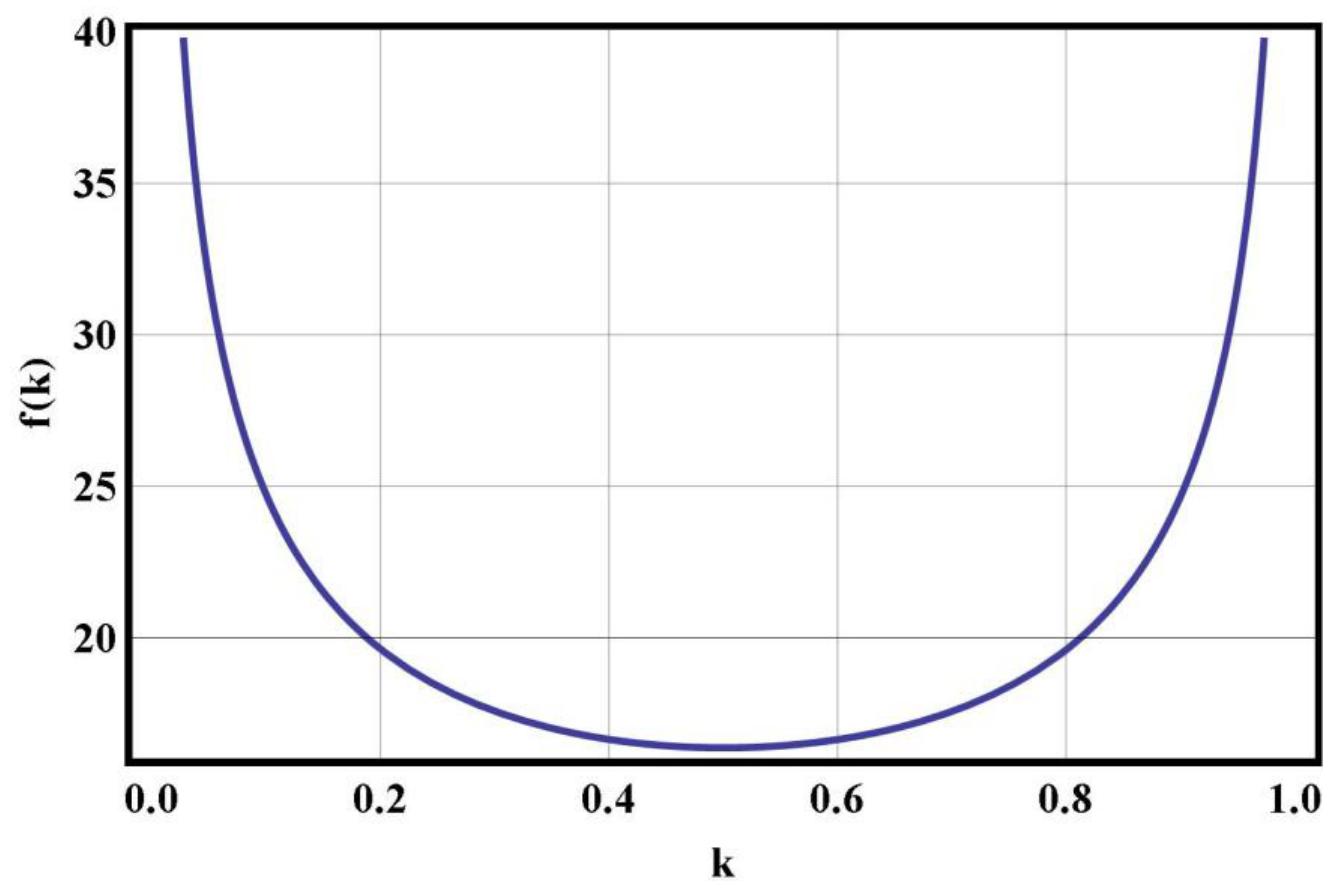
3.6 [0.5 points] The function is symmetric with respect to the point , so the minimum is achieved exactly at this point, which corresponds to
3.7 [0.5 points] Since the nucleus is treated as a liquid, its volume should not change. Using the formula for the volume of an ellipsoid and the fact that we obtain
whence
3.8 [2 points] Using Taylor's series expansion for small deformations of the nucleus and taking into account (16), the surface area of the liquid increases by
and an increase in the surface energy is equal to
The Coulomb interaction energy of the protons is decreased by the value
A nucleus is unstable under the condition
whence
Grading scheme of Problem 3
| N | Points | ||
|---|---|---|---|
| 3.1 | Formula (1) | 0.5 | 2.0 |
| Formula (2) | 0.5 | ||
| Formula (3) | 0.5 | ||
| Formula (5) | 0.5 | ||
| 3.2 | Formula (6) | 0.5 | 1.0 |
| Formula (7) | 0.25 | ||
| Numerical value of | 0.25 | ||
| 3.3 | Formula (8) | 0.75 | 1.0 |
| Numerical value of | 0.25 | ||
| 3.4 | Formula (9) | 0.25 | 1.0 |
| Formula (10) | 0.25 | ||
| Formula (11) | 0.25 | ||
| Numerical value of | 0.25 | ||
| 3.5 | Formula (12) | 0.5 | 2.0 |
| Formula (13) | 0.5 | ||
| Plot: X axis symbol indicated | 0.25 | ||
| Plot: Y axis symbol indicated | 0.25 | ||
| Plot: shown from 0 to 1 | 0.25 | ||
| Plot: appropriate values on plot | 0.25 | ||
| 3.6 | Appropriate value of | 0.25 | 0.5 |
| Appropriate value of | 0.25 | ||
| 3.7 | Formula (15) | 0.25 | 0.5 |
| Formula (16) | 0.25 | ||
| 3.8 | Formula (17) | 0.5 | 2.0 |
| Formula (18) | 0.25 | ||
| Formula (19) | 0.25 | ||
| Formula (20) | 0.5 | ||
| Formula (21) | 0.25 | ||
| Numerical value of | 0.25 | ||
| Total | 10.0 |
Оригинал в Архива: IZhO 2012 Theory_eng_f.doc · официални решения: IZhO 2012 Theory_eng_sol_final.doc