IZhO 2013, Експеримент — Задача 1. Advertising tricks
IX International Zhautykov Olimpiad/Experimental Competition · 16 януари 2013 г. · 15 т.
EXPERIMENTAL COMPETITION — 16 January, 2013
Please read the instructions first:
- The Experimental competition consists of one problem. This part of the competition lasts 3 hours.
- Please only use the pen that is provided to you.
- You can use your own non-programmable calculator for numerical calculations. If you don’t have one, please ask for it from Olympiad organizers.
- You are provided with Writing sheet and additional papers. You can use the additional paper for drafts of your solutions but these papers will not be checked. Your final solutions which will be evaluated should be on the Writing sheets. Please use as little text as possible. You should mostly use equations, numbers, figures and plots.
- Use only the front side of Writing sheets. Write only inside the bordered area.
- Fill the boxes at the top of each sheet of paper with your country (Country), your student code (Student Code), the question number (Question Number), the progressive number of each sheet (Page Number), and the total number of Writing sheets (Total Number of Pages). If you use some blank Writing sheets for notes that you do not wish to be evaluated, put a large X across the entire sheet and do not include it in your numbering.
- At the end of the exam, arrange all sheets for each problem in the following order:
- Used Writing sheets in order;
- The sheets you do not wish to be evaluated
- Unused sheets and the printed question.
Place the papers inside the envelope and leave everything on your desk. You are not allowed to take any paper or equipment out of the room
Условие
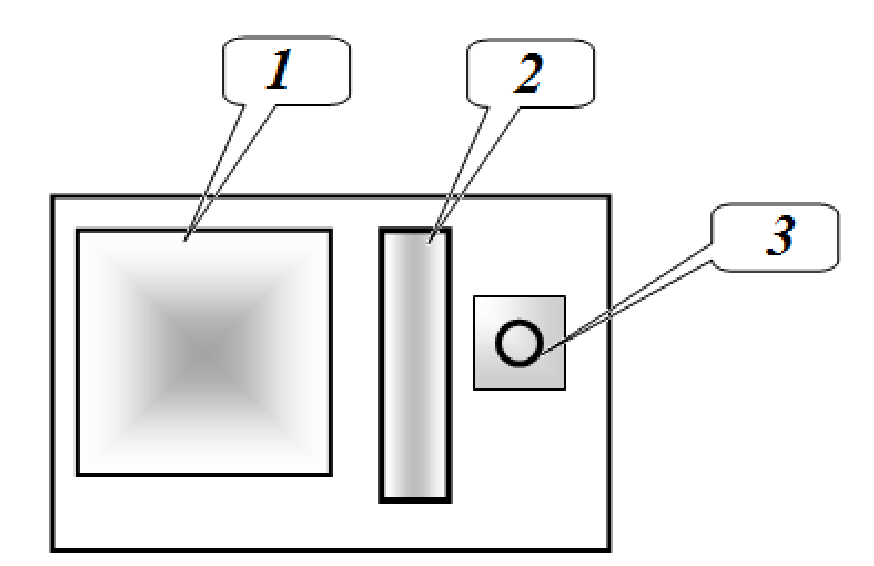
Equipment: Laser, tripod with the clip, collecting lens on a stand, cardboard screen, graph paper, two guide rulers, measuring ruler, plate with three optical elements:
- Fresnel mirror (square piece of foil with applied rings);
- Glossy reflective stripe.
- Plastic refractive element (orange piece of material covering the hole)
Turn on the laser only when you take measurements!
The wavelength of the laser beam is .
Part 1.Lens
In this part of the problem the laser beam deflection angle from the optical axis should be considered small.
Place the lens on the stand between the guide rulers such that it could be moved in parallel to itself. Fix the laser in the tripod clip. Attach the cardboard screen to the laser. Direct the laser beam at the lens center such that the reflected beam is clearly visible on the screen. Ensure that the reflection is approximately backward. When the lens is displaced along the guide rulers the reflected spot moves across the screen. Note that the spot gets diffuse, that is why take measurements of the spot center.
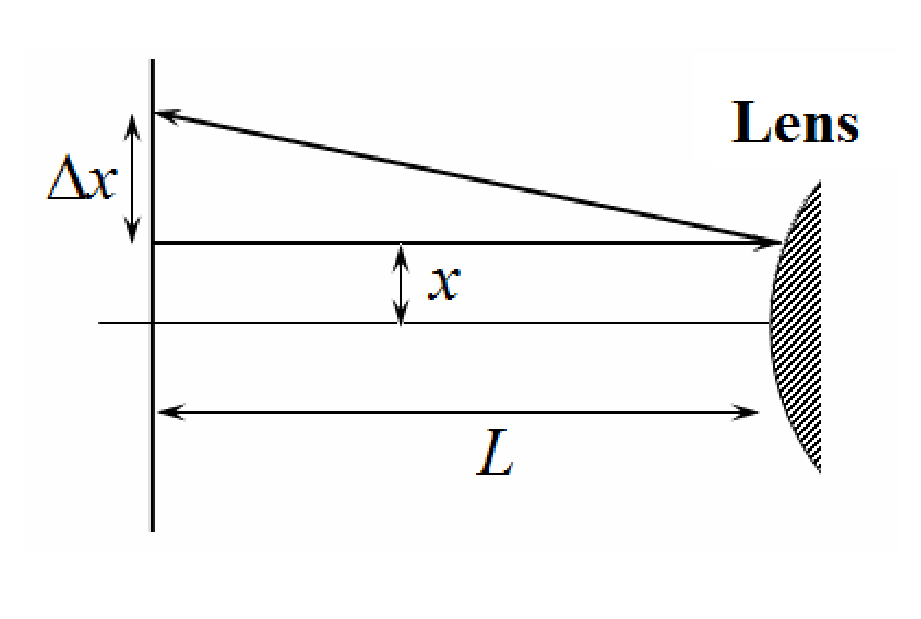
1.1 For both surfaces of the lens, measure the dependence of the displacement of the reflected laser beam on the displacement of the lens. Plot graphs of the corresponding dependences.
1.2 Using the data obtained, determine the radii and of the two surfaces of the lens.
1.3 Place the screen at a certain distance behind the lens. Measure the dependence of the displacement of the refracted laser beam on the lens displacement . Plot the corresponding graph.
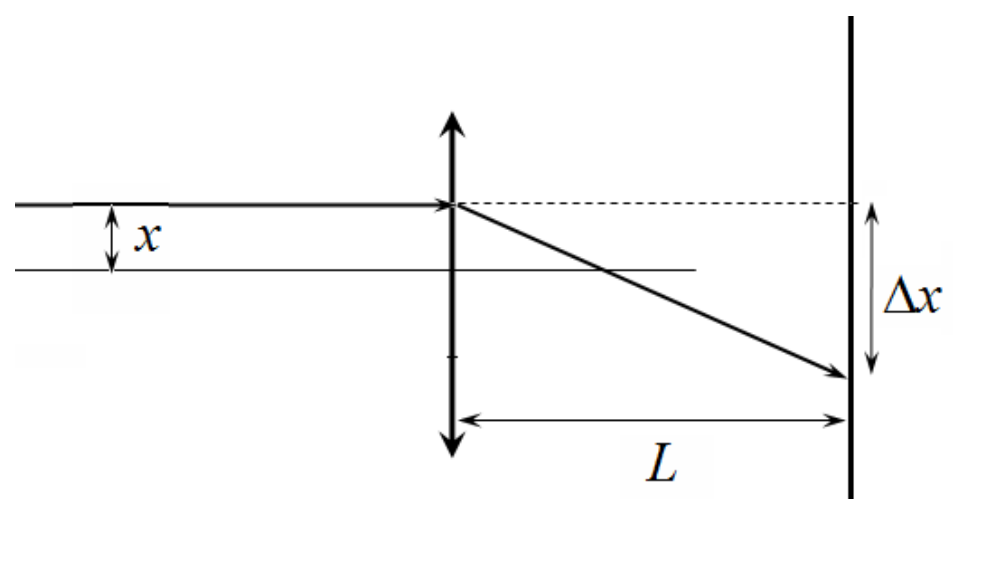
1.4 Using the experimental data obtained, determine the focal length of the lens.
1.5 Calculate the refractive index of the lens material. Evaluate the experimental error of the refractive index.
Hint: You can use the following formula for the focal length of the lens
In the following parts of the problem estimation of errors is not required!
Part 2. Fresnel mirror
Using a piece of plasticine attach the plate with the optical elements to the lens, i.e. use the lens as a stand only.
Place the lens with the plate between the guide rulers such that the laser beam directly hits the Fresnel mirror. Place the laser with the screen at a distance of 15-20 cm from the mirror. Carefully adjust your installation such that the laser beam moves along the mirror diameter when the mirror itself is displaced. You should see the diffuse reflected spot which should move almost horizontally at the level of the incoming laser beam when the mirror is slightly displaced.
The Fresnel mirror is a set of concentric rings whose radii vary with the number , counted from the center, according to the law
In this part of the problem deflection angles cannot be considered small.
2.1 Measure the displacement of the center of the reflected spot as a function of the mirror displacement . Plot the graph of the sine of the reflection angle as a function of the mirror displacement.
2.2 Estimate in formula (1).
Part 3. Glossy reflective stripe
Direct the laser beam onto the glossy reflective stripe 2. You can observe a few reflected beam on the screen.
3.1 Make a guess on the structure of the glossy reflective stripe that could explain the observed pattern of the reflected beams. Calculate the numerical values of the parameters of this structure.
Part 4. Plastic refractive element
Direct the laser beam on the hole with the plastic orange element. This element has a three-dimensional structure. Place the screen behind this element, you should see a number of bright spots in the transmitted light.
4.1 Make a guess on the structure of this element that could explain the observed pattern of the reflected beams.
4.2 Estimate the refractive index of the material from which this optical element is made of.
Решение
РЕШЕНИЕ ЗАДАЧИ ЭКСПЕРИМЕНТАЛЬНОГО ТУРА
Рекламные трюки
Часть 1. Линза
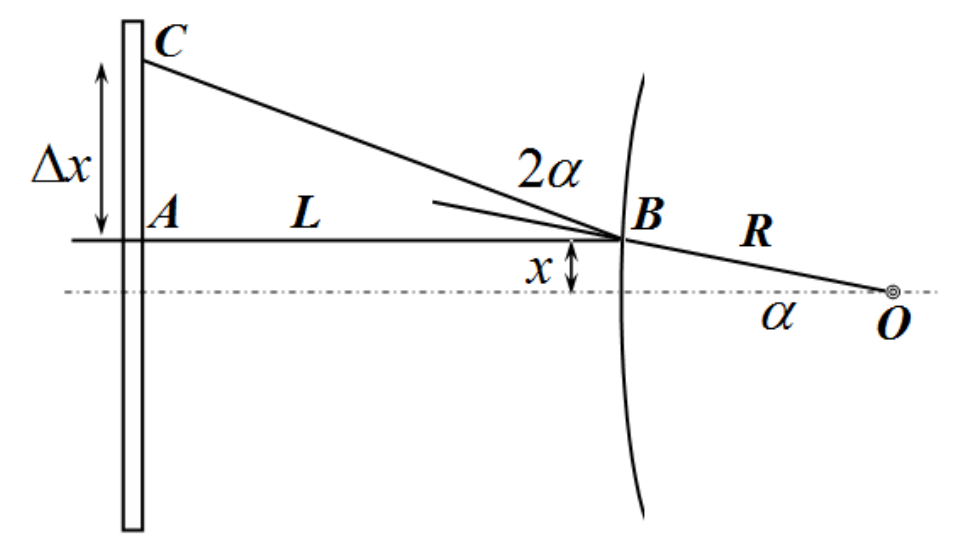
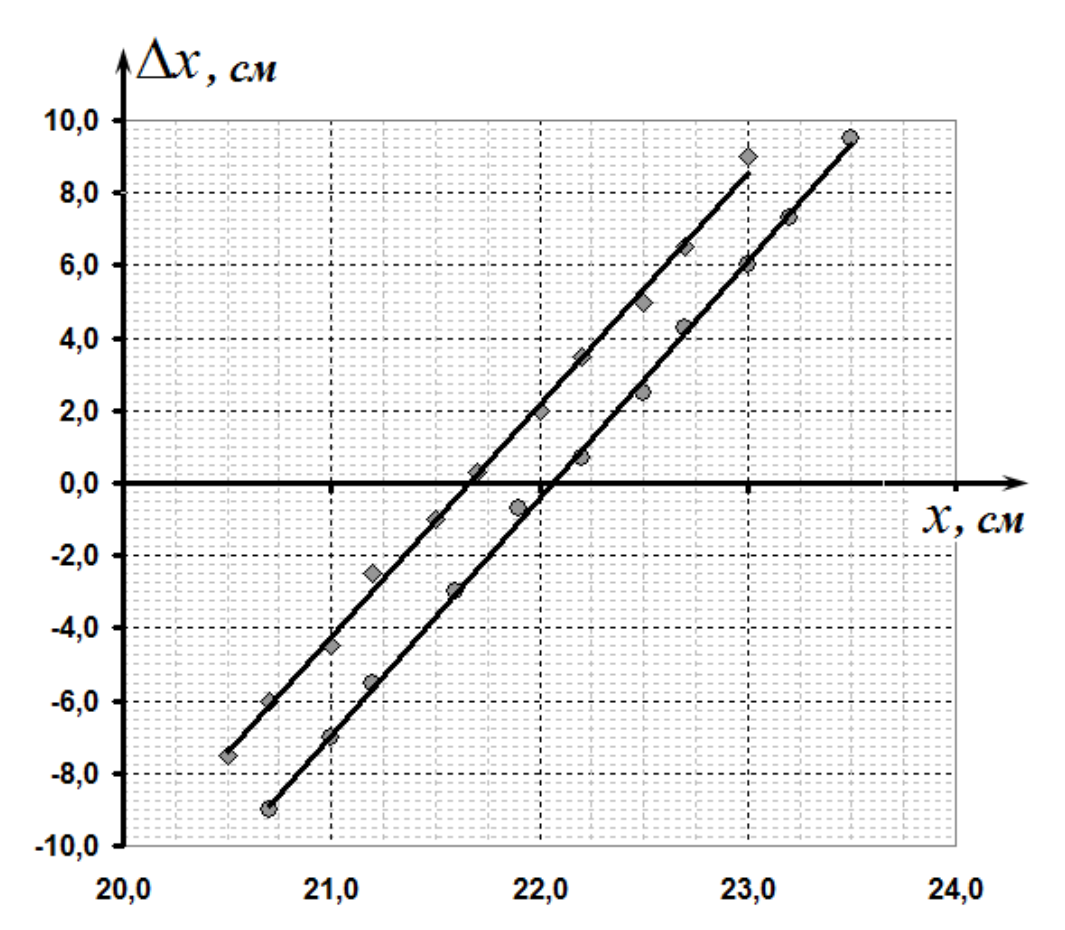
1.1-1.2 На рисунке показан ход луча , отраженного от поверхности линзы. Из рисунка следует, что отраженный луч идет под углом к оси линзы, где
- радиус кривизны поверхности, - центр кривизны. Следовательно, смещение отраженного луча на экране определяется формулой
Таким образом, по коэффициенту наклона графика зависимости смещения луча от смещения линзы можно определить радиус кривизны поверхности. Для определения коэффициента наклона нет необходимости точно определять положение центра поверхности - начало отсчета можно выбирать произвольно.
В Таблице 1 приведены результаты измерений смещения луча для двух поверхностей линзы. Измерения проведены для Рядом показаны графики полученных зависимостей.
Таблица 1
| Сторона 1 | Сторона 2 | ||
|---|---|---|---|
| , см | , см | , см | , см |
| 23,5 | 9,5 | 23,0 | 9,0 |
| 23,2 | 7,3 | 22,7 | 6,5 |
| 23,0 | 6,0 | 22,5 | 5,0 |
| 22,7 | 4,3 | 22,2 | 3,5 |
| 22,5 | 2,5 | 22,0 | 2,0 |
| 22,2 | 0,7 | 21,7 | 0,3 |
| 21,9 | -0,7 | 21,5 | -1,0 |
| 21,6 | -3,0 | 21,2 | -2,5 |
| 21,2 | -5,5 | 21,0 | -4,5 |
| 21,0 | -7,0 | 20,7 | -6,0 |
| 20,7 | -9,0 | 20,5 | -7,5 |
Коэффициенты наклона зависимостей предпочтительнее рассчитывать по методу наименьших квадратов. Радиусы кривизны рассчитываются по формуле, следующей из выражения (2):
Расчеты приводят к следующим значениям:
Для первой стороны ;
Для второй стороны ;
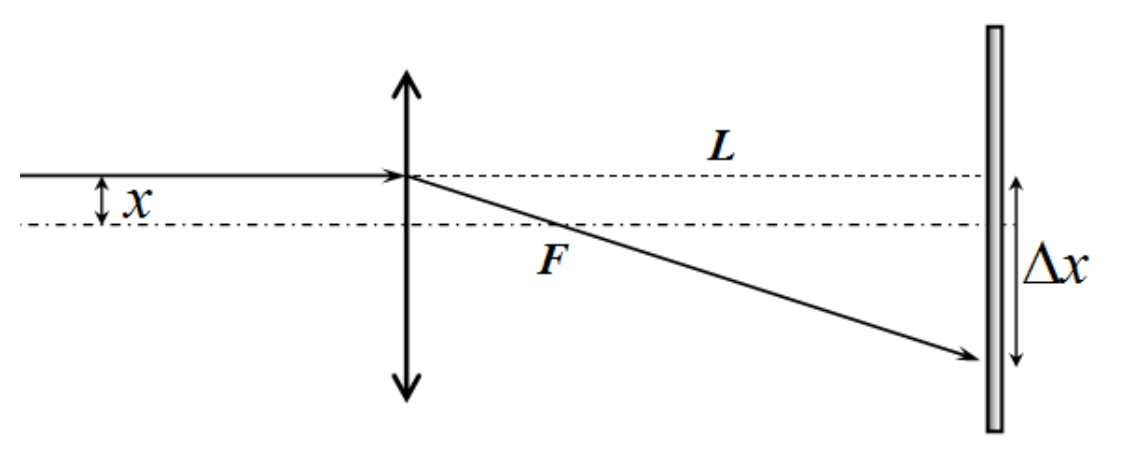
1.3-1.4 На рисунке показан ход луча после преломления в линзе. Из подобия треугольников следует пропорция . Поэтому зависимость смещения луча от смещения линзы имеет вид
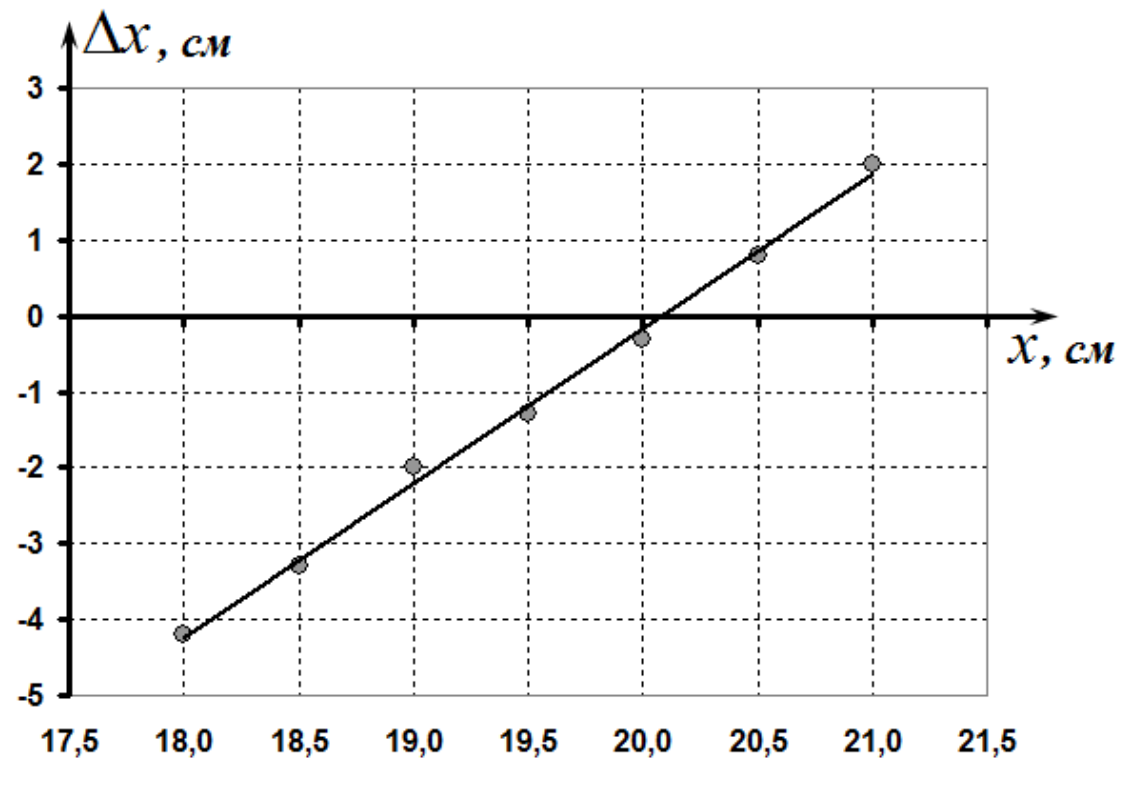
В Таблице 2 приведены результаты измерений, проведенных для . График этой зависимости показан на рисунке.
Таблица 2
| , см | , см |
|---|---|
| 21,0 | 2,0 |
| 20,5 | 0,8 |
| 20,0 | -0,3 |
| 19,5 | -1,3 |
| 19,0 | -2,0 |
| 18,5 | -3,3 |
| 18,0 | -4,2 |
Коэффициент наклона этой зависимости, рассчитанный по МНК равен . Соответственно, фокусное расстояние линзы
1.5 Из формулы для фокусного расстояния следует, что показатель преломления линзы можно рассчитать по формуле
Погрешность определения оказывается равной .
Часть 2. Зеркало Френеля
Зеркало Френеля можно рассматривать как дифракционную решетку с переменным периодом. Если радиусы колец зависят от номера по закону
то при больших расстояния между кольцами находятся по формуле
Эта же величина может рассматриваться как период решетки . Для обработки экспериментальных данных ее необходимо выразить через расстояние до центра зеркала. Из формулы (6) можно выразить
Поэтому период решетки изменятся в зависимости расстояния по закону
Экспериментально эту зависимость можно получить, используя формулу дифракционной решетки
Из этой формулы следует, что синус угла отклонения зависит от смещения зеркала по закону:
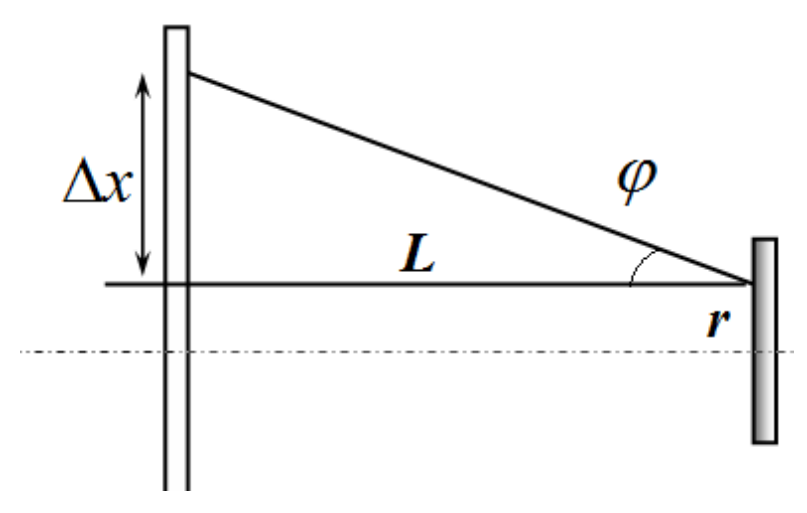
Экспериментально можно измерить зависимость смещение отраженного луча от расстояния от точки падения луча до центра зеркала. Так как углы отклонения в данном случае нельзя считать малыми, то синус угла отклонения следует рассчитать по формуле
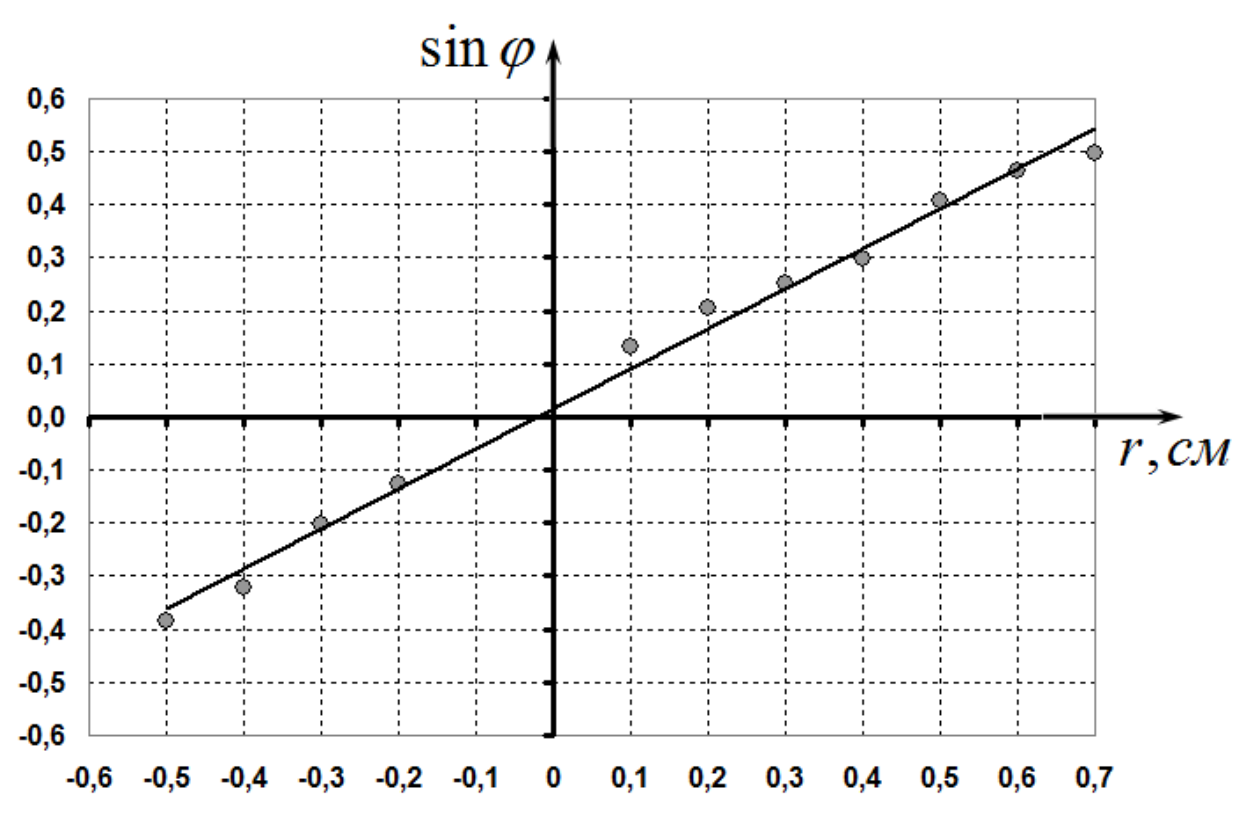
В таблице 3 Приведены результаты измерений зависимости смещения луча от расстояния , там же приведены рассчитанные значения синуса угла отклонения. Рядом приведен график зависимости синуса угла отклонения от расстояния .
Таблица 3
| , см | , см | |
|---|---|---|
| 0,7 | 11,0 | 0,497 |
| 0,6 | 10,0 | 0,463 |
| 0,5 | 8,5 | 0,406 |
| 0,4 | 6,0 | 0,297 |
| 0,3 | 5,0 | 0,253 |
| 0,2 | 4,0 | 0,207 |
| 0,1 | 3,0 | 0,159 |
| -0,2 | -2,5 | -0,127 |
| -0,3 | -4,0 | -0,201 |
| -0,4 | -6,5 | -0,321 |
| -0,5 | -8,0 | -0,385 |
Так как полученная зависимость близка к линейной, то в соответствии с общей формулой (11) искомый показатель равен .
Часть 3. Блестящая полоска
В отраженном свете видны, по крайней мере, пять отраженных лучей: одно центральное и четыре в вершинах квадрата. Такая картина может быть объяснена дифракцией на двумерной решетке. По результатам измерений угол дифракции примерно равен градусам. Следовательно период решетки равен
Часть 4. Пластиковый прозрачный элемент
При прохождении света через пластиковую полоску на экране наблюдается шесть пятен, расположенных в вершинах правильного шестиугольника. Такая картина объясняется преломлением света на гранях правильных треугольных пирамид. Основания пирамид полностью заполняют плоскость, образуя гексагональную структуру.
Если экран расположен на расстоянии , то длина стороны шестиугольника равна . Такое же расстояние и от центра правильного шестиугольника. Эти данные позволяют рассчитать синус угла отклонения лучей
В задаче теоретического тура была получена формула для этого угла
с помощью которой можно вычислить показатель преломления .
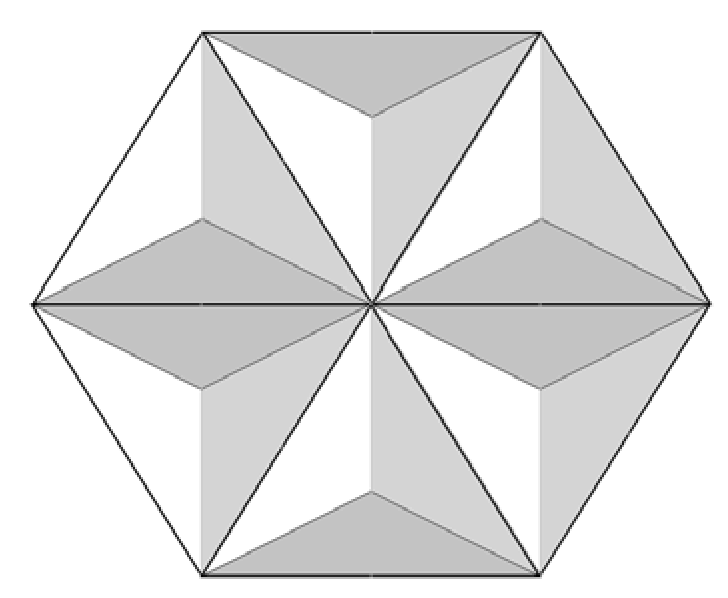
Схема оценивания
| Часть 1. Линза | (6) | |
|---|---|---|
| 1.1 | Измерения: | |
| - указано ; | 0,2 | |
| - 7 и более точек; | 0,7x2 | |
| - (4-6 точек); | (0,3x2) | |
| - (меньше 4 точек); | 0 | |
| Графики зависимостей: | ||
| - оси подписаны и оцифрованы; | 0,1 | |
| - нанесены все экспериментальные точки; | 0,1x2 | |
| - проведены сглаживающие прямые; | 0,1x2 | |
| 1.2 | Расчет радиусов кривизны: | |
| -вид зависимости (2); | 0,1 | |
| - формула (3); | 0,1 | |
| - рассчитаны коэффициенты наклона: | ||
| - по МНК; | 0,3x2 | |
| - (графически); | (0,2x2) | |
| - (по двум точкам); | (0,1x2) | |
| Расчет радиусов кривизны: | ||
| - в диапазоне 6,5 -7,5 см; | 0,2x2 | |
| - (в диапазоне 5-9 см); | (0,1x2) | |
| - (вне диапазона 5-9 см); | (0x2) | |
| 1.3 | Измерения: | |
| - указано ; | 0,2 | |
| - 5 и более точек; | 0,5 | |
| - (3-4 точки); | (0,3) | |
| - (менее 3 точек); | (0) | |
| График зависимости: | ||
| - оси подписаны и оцифрованы; | 0,1 | |
| - нанесены все экспериментальные точки; | 0,1 | |
| - проведены сглаживающие прямые; | 0,1 | |
| 1.4 | Измерение фокусного расстояния: | |
| - формула (4); | 0,2 | |
| рассчитан коэффициент наклона: | ||
| - по МНК; | 0,3 | |
| - (графически); | (0,2) | |
| - (по двум точкам); | (0,1) | |
| Расчет фокусного расстояния: | ||
| - в диапазоне 7 -8 см; | 0,4 | |
| - (в диапазоне 6-9 см); | (0,2) | |
| - (вне диапазона 6-9 см); | (0) | |
| 1.5 | Расчет показателя преломления: | |
| - расчетная формула; | 0,1 | |
| - численное значение в диапазоне 1,45-1,55; | 0,5 | |
| - (в диапазоне 1,35 – 1,65); | (0,2) | |
| - (вне диапазона 1,35 - 1,65); | (0) | |
| - оценка погрешности; | 0,2 |
| Часть 2. Зеркало Френеля. | (4) | |
|---|---|---|
| 2.1 | Измерения: | |
| - указано ; | 0,2 | |
| - 7 и более точек; | 0,8 | |
| - (4-6 точек); | (0,4) | |
| - (меньше 4 точек); | (0) | |
| Формула для синуса угла; | 0,1 | |
| Рассчитаны значения синусов; | 0,2 | |
| Получена примерно линейная зависимость; | 0,5 | |
| График: | ||
| - оси подписаны и оцифрованы; | 0,1 | |
| - нанесены все экспериментальные точки; | 0,1 | |
| - проведена сглаживающая прямая; | 0,1 | |
| Методика определения : | ||
| - идея о дифракционной решетке; | 0,3 | |
| - зависимость периода от расстояния до центра (9); | 0,4 | |
| - зависимость синуса угла отклонения от расстояния до центра (11); | 0,4 | |
| Получено значение : | ||
| - по линейной зависимости синуса угла; | 0,3 | |
| - иным разумным способом; | (0,2) | |
| ; | 0,5 | |
| - в диапазоне 0,3-0,7; | (0,2) | |
| - вне диапазона 0,3 – 0,7; | (0) | |
| Часть 3. Блестящая полоска. | 2 | |
| - получено более 5 пятен на экране; | 0,4 | |
| - (получено 5 пятен на экране); | (0,3) | |
| - (получено 3 пятна на экране); | (0,2) | |
| Структура дифракционная решетка: | ||
| - двумерная; | 0,5 | |
| - (одномерная); | (0,3) | |
| Измерен угол отклонения лучей; | 0,4 | |
| Формула для расчета периода решетки; | 0,2 | |
| Рассчитан период решетки (1 мкм); | ||
| - в диапазоне погрешности менее 10%; | 0,5 | |
| - (в диапазоне 30%); | (0,2) | |
| - (вне диапазона 30%); | (0) | |
| Часть 4. Пластиковый прозрачный элемент. | 3 | |
| - получено 6 пятен на экране; | 0,5 | |
| Структура - призмы; | 0,5 | |
| Заполнение плоскости (гексагональная структура); | 0,5 | |
| Формула для расчета показателя преломления; | 0,5 | |
| Измерен угол отклонения лучей; | 0,5 | |
| Численное значение показателя преломления: | ||
| - численное значение в диапазоне 1,45-1,55; | 0,5 | |
| - (в диапазоне 1,35 – 1,65); | (0,3) | |
| - (вне диапазона 1,35 - 1,65); | (0) |
Теми и трудност
Трудност: неоценена.
Оптика · Лещи и образи · Пречупване · Дифракция и разделителна способност
Предпоставки: Гимназиална подготовка
Оригинал в Архива: IZhO_2013_Exp_eng_fiz.doc · официални решения: IZhO-2013-Exp_rus_sol.pdf