IZhO 2013, Теория, английски — Задача 1
IX International Zhautykov Olympiad/Theoretical Competition · 15 януари 2013 г. · 10 т.
Please read this first:
The time available for the theoretical competition is 4 hours. There are three questions.
Use only the pen provided.
You can use your own calculator for numerical calculations. If you don’t have one, please ask for it from Olympiad organizers.
You are provided with Writing sheet and additional paper. You can use the additional paper for drafts of your solutions but these papers will not be checked. Your final solutions which will be evaluated should be on the Writing sheets. Please use as little text as possible. You should mostly use equations, numbers, figures and plots.
Use only the front side of Writing sheets. Write only inside the boxed area.
Begin each question on a separate sheet of paper.
Fill the boxes at the top of each sheet of paper with your country (Country), your student code (Student Code), the question number (Question Number), the progressive number of each sheet (Page Number), and the total number of Writing sheets used (Total Number of Pages). If you use some blank Writing sheets for notes that you do not wish to be evaluated, put a large X across the entire sheet and do not include it in your numbering.
At the end of the exam, arrange all sheets for each problem in the following order:
- Used Writing sheets in order;
- The sheets you do not wish to be evaluated
- Unused sheets and the printed question.
Place the papers inside the envelope and leave everything on your desk. You are not allowed to take any paper out of the room.
Условие
This problem consists of three independent parts.
1.A Pulley
The rope of length and mass is put on the pulley of radius . The rope begins to slide off the pulley without friction. Consider the time moment when the difference in height between the hanging ends of the rope is equal half of the rope length. For this time moment find the following:
- acceleration of the rope;
- the tension of the rope at the top of the pulley;
- the point of the rope at which the tension is maximum (it is enough to find the angle between the radius to that point and the vertical). [5 т.]
1.B Assistant Vapor
In the physical laboratory the thermometer reading was 20 ºC, and the barometer reading was 1 atm. The laboratory assistant Vapor pulled out a sturdy vessel of the closet, poured some water into it and sealed it with the lid. Then assistant Vapor slowly heated the vessel to the temperature 200 ºC. At this temperature, the pressure in the vessel turned out to be 2,88 atm. Find the temperature at which all the water evaporated. Justify your answer. [2 т.]
1.C Pyramid
A regular triangular pyramid is made of a transparent material with the refraction index . All angles at the top of the pyramid are right. The base of the pyramid forms a right triangle whose sides’ lengths are equal . The pyramid can be thought of as "a corner cut off from the cube." The pyramid is homogeneously illuminated such that the light falls along its height, perpendicular to the base plane.
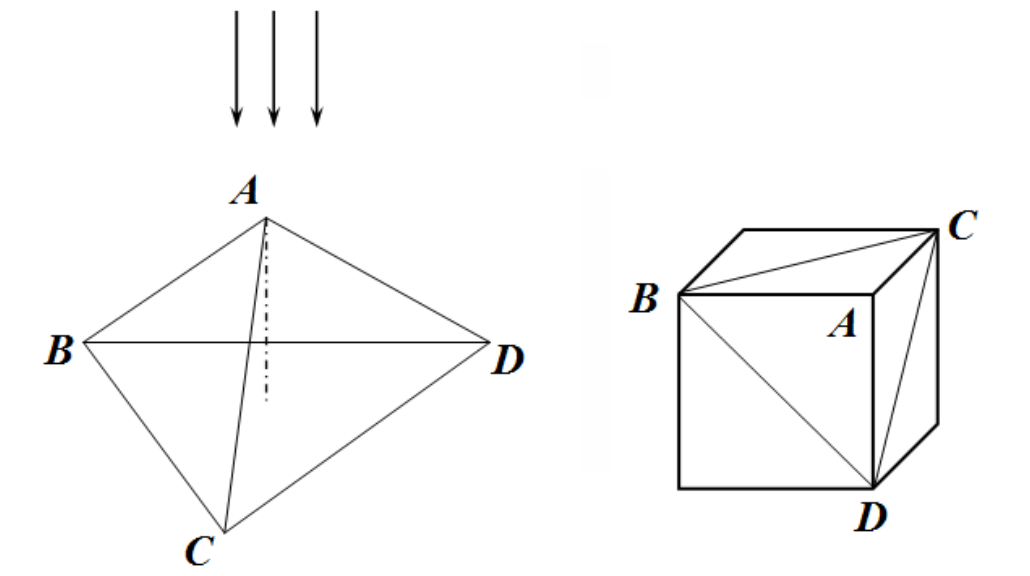
- Draw an area at the base of the pyramid illuminated by the light refracted in the plane .
- A screen is placed in parallel to the pyramid base at a distance of from it. Draw areas illuminated by the light refracted by the pyramid. Specify the position and sizes of these areas. [3 т.]
Отговори
1.A a = g/2; T = mg[3/8 + (R/L)(1 − π/2)]; α = 30°
1.B 373 K
T = 373 K = 100 °C.
1.C Three small triangular regions at the tops of an equilateral triangle: displaced by r = L·tgγ = 8,6 cm (γ = 41°), side l = r√3 = 14,9 cm; on the base the point F lies at |DF| = 0,91 mm.
Решение
Problem 1.A
Let and be the lengths of the hanging ends of the rope (). Then and , from which .
1. Consider the rope after a very short time interval from the moment when the height difference of the rope ends is to the moment when one end of the rope is displaced by the small interval . Since there is no friction in the system, any increase in the kinetic energy of the rope should be equal to decrease in the potential energy. It could be easily noticed that the displacement of the rope along itself is equivalent to lowering of a small piece of the rope by the height h:
Hence,
2. Using similar approach as in section 1, an equation for the conservation of energy is written for the right hand part of the rope (from the top point) considered for a small time interval . Let be the length of that part, is its mass, is the tension at the top point, is the difference in heights between the top point and the lowest points of the rope. Then:
3. The second law of Newton for the small piece of the rope is written in projection to the tangent line:
If that small piece is chosen at the point with the maximum tension, then , from which the following can be obtained:
Grading scheme for Problem 1.A
| № | Description | Points |
|---|---|---|
| 1. | Correct value of the acceleration | 1 |
| 2. | There is a correct reasoning, some justification for the final answer | 1 |
| 3. | Correct method to find is presented | 1 |
| 4. | Exact answer for | 0,5 |
| 5. | Reasonable method to solve for α is presented | 1 |
| 6. | Final answer for α | 0,5 |
| Total | 5,0 |
Problem 1.B Assistant Vapor
Air, closed in the vessel at the temperature of 200ºC,exerts the following pressure:
At the same temperature, the vapor pressure is . Then, the vapor pressure at any temperature T when all water is vaporized is found as:
Let P(T) be the temperature dependence of the saturated vapor pressure. Then, all water is evaporated at the temperature, which is derived from the following equation:
Solution of this equation could be obtained even without further knowledge of the function . It is well known, that at . Thus, this checks the solution.
Marking scheme for Problem 1B:
| № | Description | Points |
|---|---|---|
| 1. | Correct value for air pressure at | 0,5 |
| 2. | Vapor pressure was found for any temperature | 0,5 |
| 3. | Condition for was written | 0,5 |
| 4. | Correct final answer | 0,5 |
| Total | 2.0 |
Problem 1.C Pyramid
- Consider a beam, which falls down on one of the sides at the point, close to the top of the pyramid. The angle of incidence of the beam on the facet is equal to the angle between the lateral facet and the base of the pyramid . It is easy to prove geometrically that , thus .
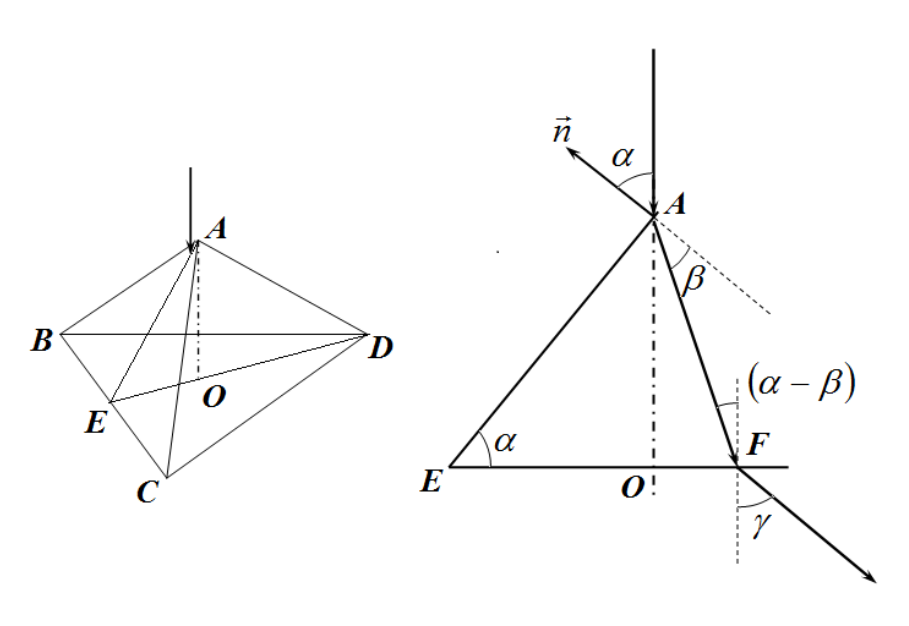
According to the refraction law the angle can be written as follows:
Thus, .
Let us find the point F, where that beam falls on the base of the pyramid. The height of the lateral facet is , pyramid’s height .
Then, . Finally, the point sought is located at the distance . The same point is located at a distance from the middle point of base’s side Thus, the beam refracted by the facet illuminates a triangle at the base of the pyramid. Symmetrical triangles are illuminated by the other two facets (see figure 2).
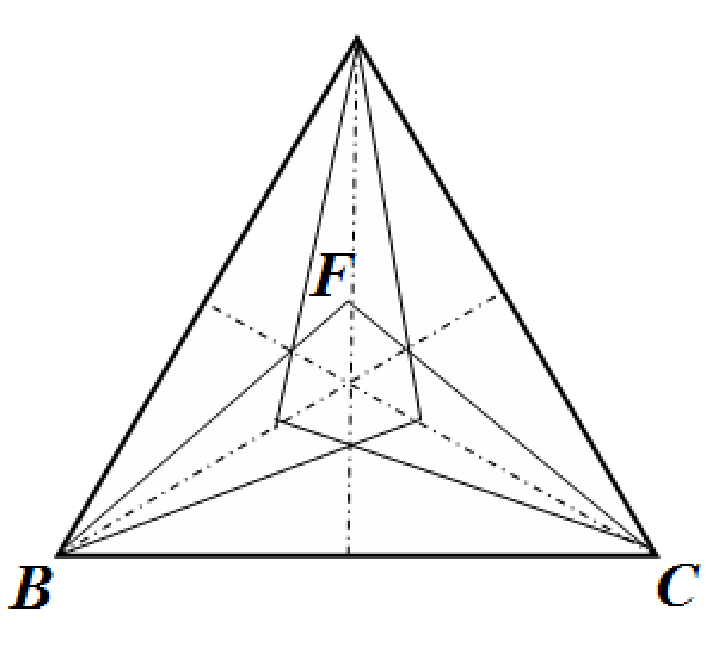
- Let us find an angle , of the beam after its refraction on the base of the pyramid. It follows from Figure 1 and the refraction law that:
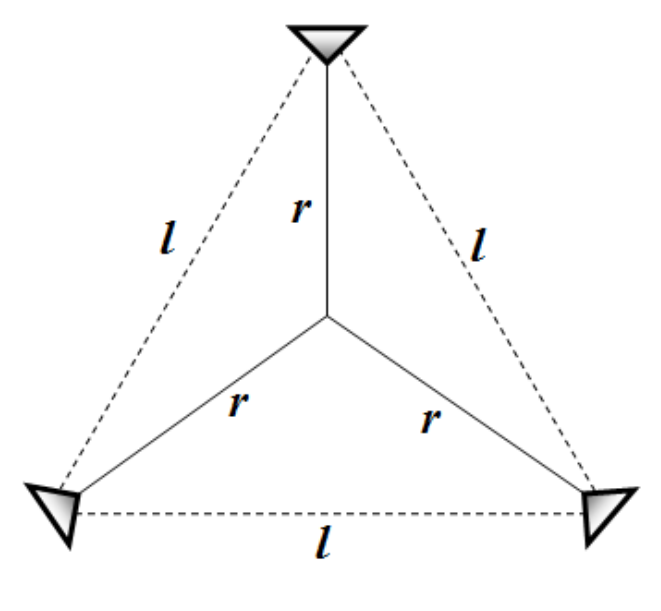
Numerical value of this angle is . As the beams, refracted by one facet are parallel to each other, they illuminate similar regions on the screen as they do at the base of the pyramid. The only difference is that those triangular regions are displaced at the distance . Thus, three small triangular regions are seen on the screen, which are located at the tops of the triangle of the side .
Marking scheme for Problem 1C:
| № | Description | Points |
|---|---|---|
| 1 | Light refraction law | 0.2 |
| 2 | Incidence angle on the facet of the pyramid | 0.4 |
| 3 | Location of point F | 1.0 |
| 4 | Illuminated regions at the base of the pyramid | 0.4 |
| 5 | Outlet angle at the base | 0.4 |
| 6 | Illuminated regions at the screen | 0.6 |
| Total | 3.0 |
Оригинал в Архива: IZhO_2013_Theory_eng_fiz.doc · официални решения: IZhO_2013_Theory_eng_sol_fiz.doc