IZhO 2014, Експеримент — Задача 1. Magnetic interactions
X International Zhautykov Olimpiad/ Experimental Competition · 15 т.
Please read the instructions first:
EXPERIMENTAL COMPETITION
15 January, 2014
The Experimental competition consists of one problem. This part of the competition lasts 3 hours.
Please only use the pen that is provided to you.
You can use your own non-programmable calculator for numerical calculations. If you don’t have one, please ask for it from Olympiad organizers.
You are provided with Writing sheet and additional papers. You can use the additional paper for drafts of your solutions but these papers will not be checked. Your final solutions which will be evaluated should be on the Writing sheets. Please use as little text as possible. You should mostly use equations, numbers, figures and plots.
Use only the front side of Writing sheets. Write only inside the bordered area.
Fill the boxes at the top of each sheet of paper with your country (Country), your student code (Student Code), the question number (Question Number), the progressive number of each sheet (Page Number), and the total number of Writing sheets (Total Number of Pages). If you use some blank Writing sheets for notes that you do not wish to be evaluated, put a large X across the entire sheet and do not include it in your numbering.
At the end of the exam, arrange all sheets for each problem in the following order:
- Used Writing sheets in order;
- The sheets you do not wish to be evaluated
- Unused sheets and the printed question.
Place the papers inside the envelope and leave everything on your desk. You are not allowed to take any paper or equipment out of the room
Условие
Instruments and equipment: tripod, pendulum with a bead magnet, clay, ruler, magnetic beads, stopwatch, power supply (battery of the voltage 4.5V) , 6 Ohm rheostat, coil, multimeter, switch, connecting wires, nails, piece of chocolate.
The pendulum consists of two wooden chopsticks stuck into the eraser. There are two pieces of clay fixed at the free ends of both chopsticks, the lower piece of clay contains a metal magnetized bead inside. Pendulum axis is simply a steel needle piercing the eraser.
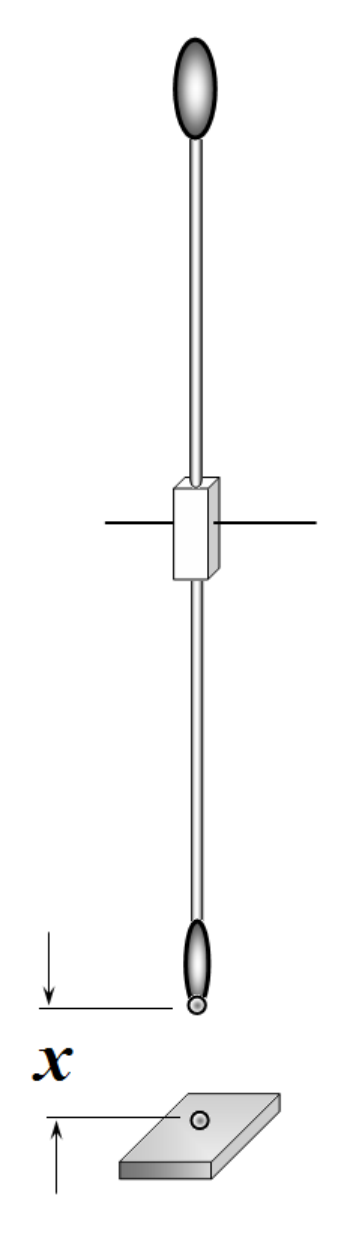
Another magnetized bead is mounted on another piece of clay provided.
Attention! Do not change the orientation of magnetized beads during the experiment!
Part 1. Interaction with the magnetic field of a coil
Put the pendulum axis on the rack of the tripod. Make sure that the pendulum can make free oscillations without touching the tripod with the wooden chopsticks or the eraser. By changing the clay masses at the ends of the chopsticks make the oscillation period larger than 2 seconds. In the equilibrium position both chopsticks should be vertical.
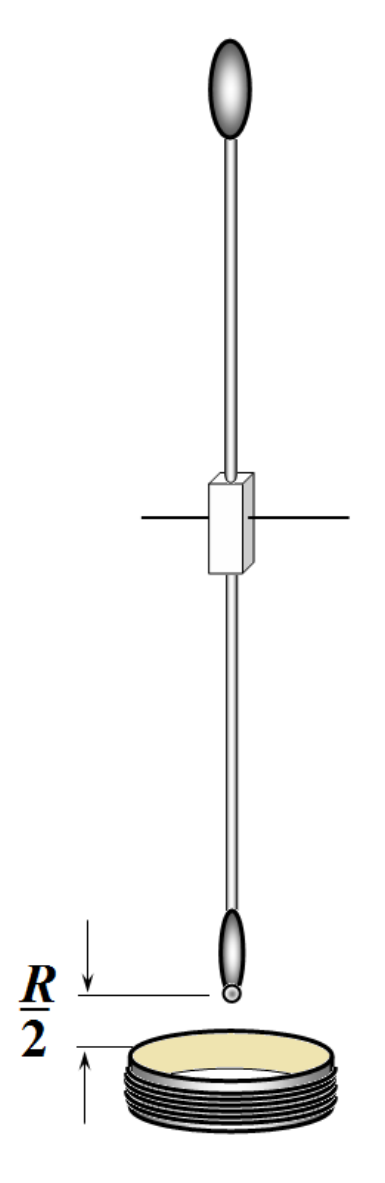
1.1. Measure the oscillation period of the pendulum. Evaluate the corresponding experimental error. [0,5 т.]
Attention! In the subsequent parts error estimation is not required!
Place the coil under the pendulum so that the distance from the center of the coil to the magnetized bead in the pendulum to be approximately equal to half the radius of the coil.
Connect the coil to the power supply so that you could change and measure the strength of the current flowing through it.
Attention! Be sure to use the key, switch it on while doing measurements only, otherwise the battery will quickly discharge!
1.2. Draw schematically an electric circuit that you have used for making measurements. [0,5 т.]
1.3. Measure the dependence of the oscillation period of the pendulum on the current in the coil. Plot the corresponding graph. [2 т.]
1.4. Based on the experimental data obtained prove that the force, acting on the magnetic bead, is proportional to the current in the coil. Justify your conclusion graphically. [1 т.]
Part 2. Pointlike interactions
Place the magnetized bead fixed on a piece of clay right under the pendulum. The beads should attract each other!
It can be assumed that the interaction force is central, i.e. it is directed along the line connecting the centers of the two beads. The magnitude of that force depends on the distance between the centers of the beads according to the law
2.1. Put down the equation of motion of the pendulum in this case. Obtain the formula for the period of small oscillations. [1 т.]
2.2. Measure the dependence of the period of small oscillations on the distance between the centers of the beads. Plot the corresponding graph. [4 т.]
2.3. Using the experimental data obtained, evaluate the exponent in formula (1). Justify formula (1) graphically. [4 т.]
Part 3. Magnetic piece of chocolate
Let us reduce the damping by changing the design of the pendulum. Stick the upper chopstick into the eraser to make an angle of approximately . Stick two nails into the eraser to play the role of two legs on which the oscillations are performed. Attach two beads to the bottom of the pendulum. Make sure that the pendulum is steadily balanced on its legs while performing oscillations. To adjust the pendulum you can mount the ruler in the rack as a support.
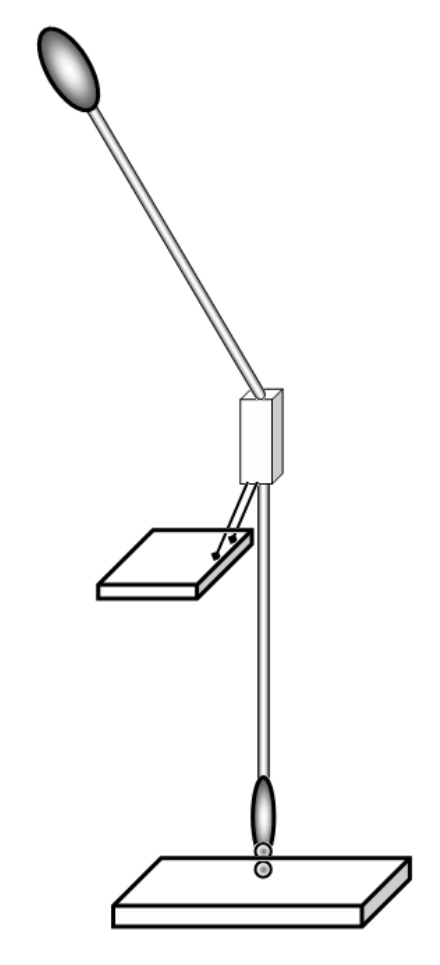
Place a piece of chocolate under the pendulum, but do not take off its wrap! The lower end of the pendulum should move along the piece of chocolates at a distance of 1-2 mm.
It turns out that a piece of chocolate can affect the pendulum motion.
3.1. Establish experimentally which physical characteristics of the pendulum are affected by the piece of chocolate. [0,5 т.]
3.2. Take necessary measurements to confirm your assumption. Justify your answer graphically. [1,5 т.]
Отговори
2.3. 4
Official solution: γ = 4 from the slope of ln ξ against ln r; the grading scheme gives partial credit for a slope in the range from 2 to 6.
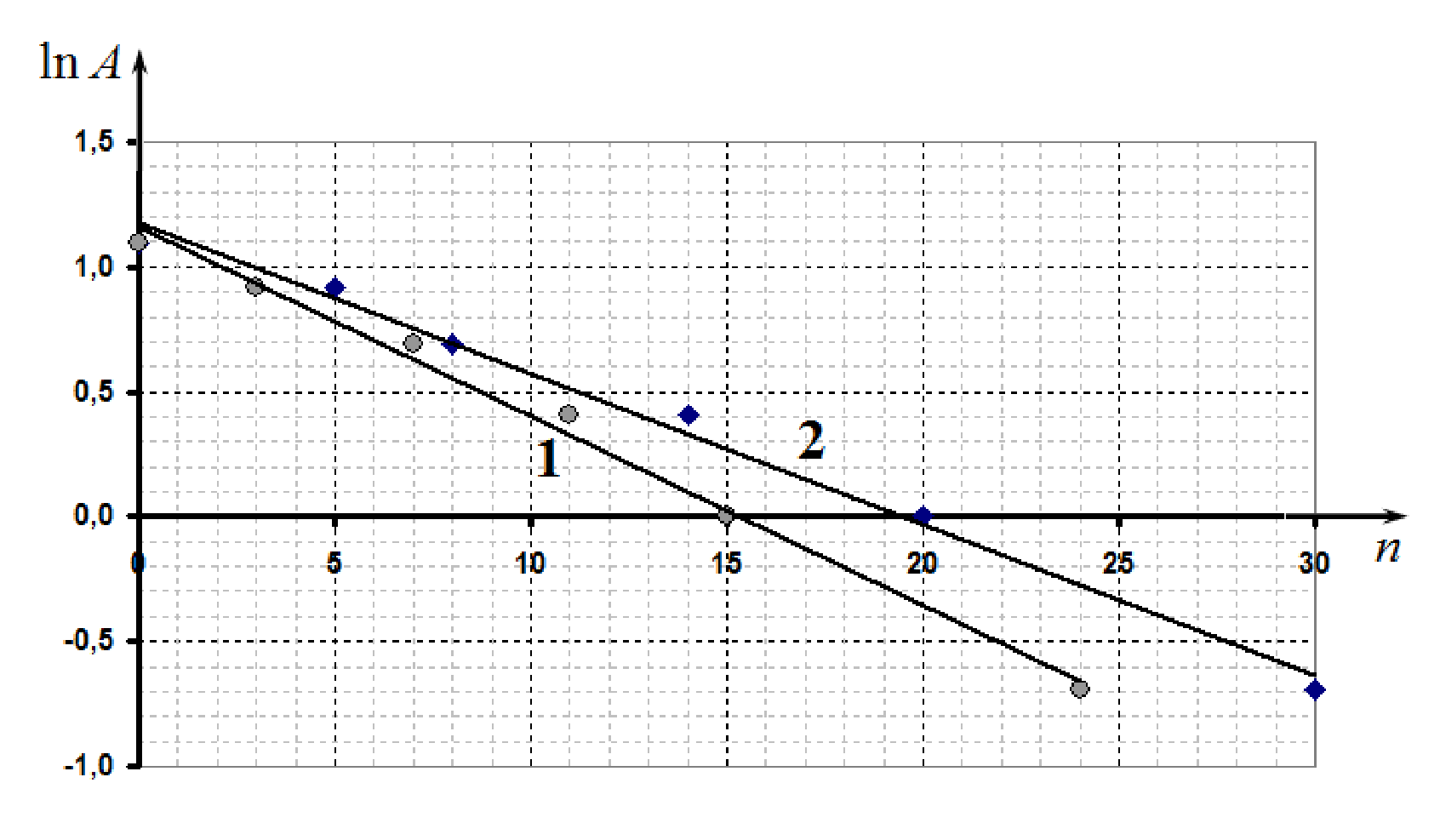
3.1. Chocolate does not affect the period of oscillation, but significantly increases the damping of oscillations (eddy currents in the foil).
Решение
SOLUTION FOR THE EXPERIMENTAL COMPETITION
Magnetic interactions
Part 1. Interaction with the magnetic field of a coil
1.1. To measure the oscillation period it is necessary to measure the time of at least 10 oscillations several times. The following values for 10 oscillations are obtained:
Evaluation of the period from this data gives rise to
Experimental error is evaluated by the formula
and, therefore , the accuracy of the period is equal to .
Finally, one can write
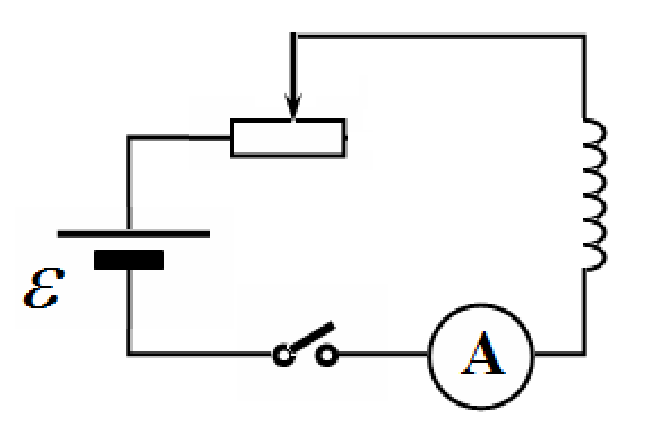
1.2. The following circuit can be used for measurements (it is also acceptable for the rheostat to be used as a potentiometer).
1.3. Table 1 shows the dependence of the oscillation period of the pendulum against the current in the coil and below the corresponding graph is drawn.
Table 1
| 0,00 | 2,655 | 0,142 | 0,000 |
| 0,80 | 2,062 | 0,235 | 0,093 |
| 0,37 | 2,350 | 0,181 | 0,039 |
| -0,37 | 3,083 | 0,105 | -0,037 |
| -0,72 | 3,724 | 0,072 | -0,070 |
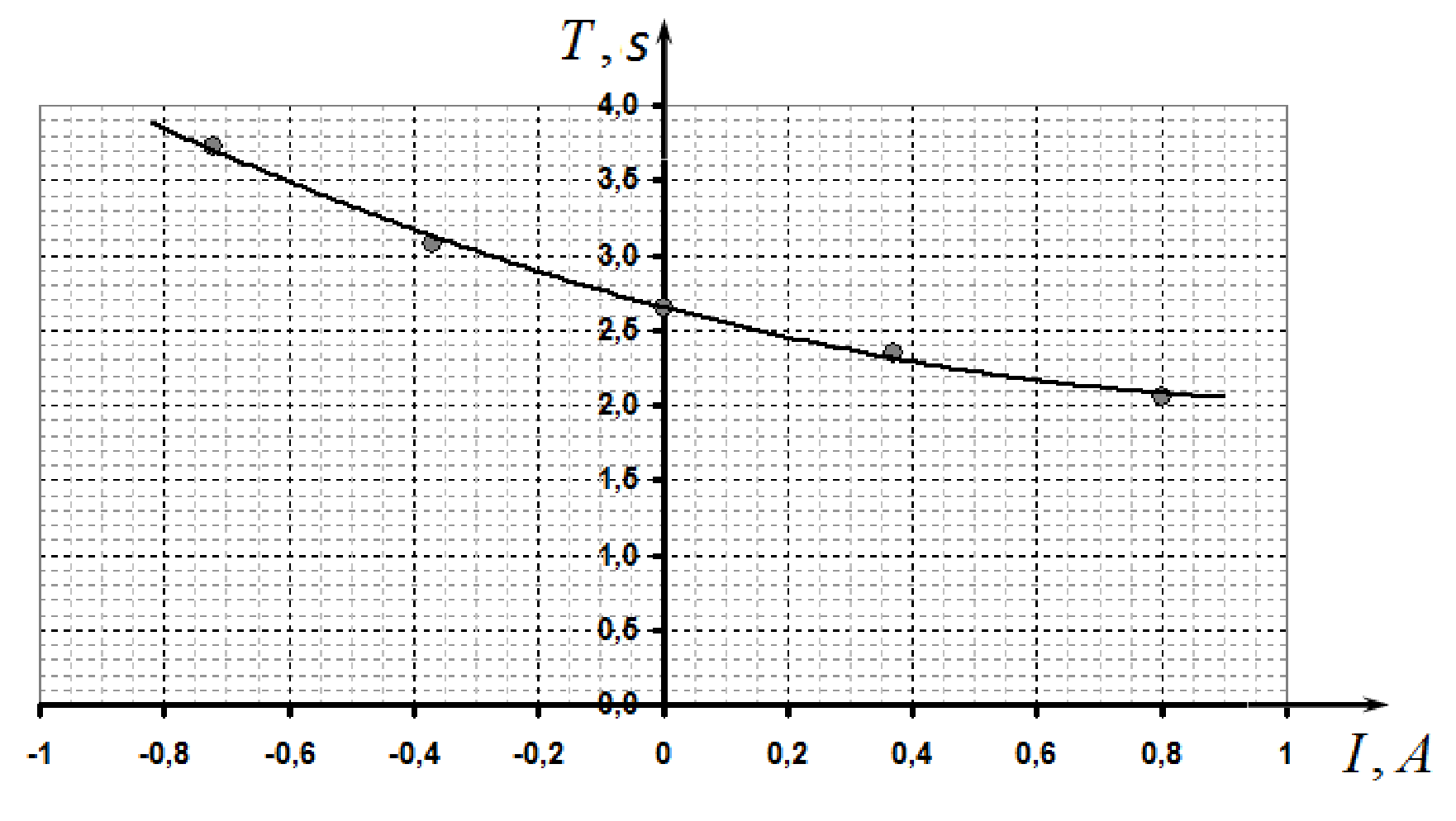
1.4. To describe the motion of the pendulum the following equation should be used
where stands for the angle of deflection of the pendulum from the vertical, denotes the moment of inertia of the pendulum about the axis of rotation, is the pendulum mass, designates the distance from the axis of rotation to the center of the pendulum mass, refers to the moment of the force acting on a magnetized bead caused by the magnetic field of the coil. Equation (2) implies that the square of the oscillation frequency depends linearly on the current strength as:
It is clearly seen that the square of the oscillation frequency against the coil current is conveniently represented as
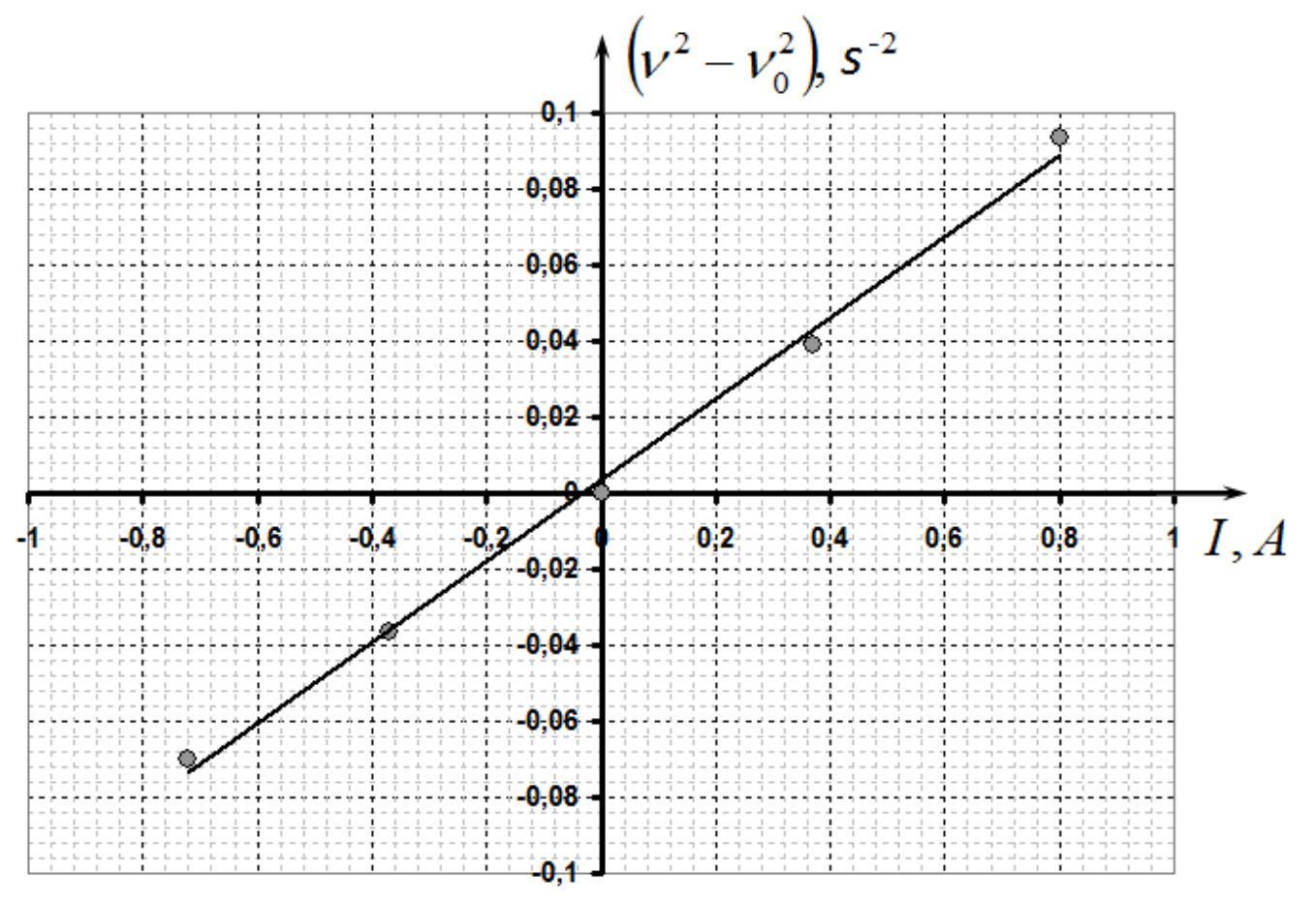
where stands for the square of the oscillation frequency in the absence of the current in the coil.
Thus, the linear dependence of the value against the current strength proves the assertion of direct proportionality between the strength of the magnetic interaction and the current in the coil. The figure shows the corresponding graph which confirms the linearity assumption.
Part 2 . Pointlike interaction
2.1.
To write the equation of motion it is necessary to correctly calculate the torque of the interaction forces between magnetized beads. Since the force is central, the shoulder is a segment , and its length is
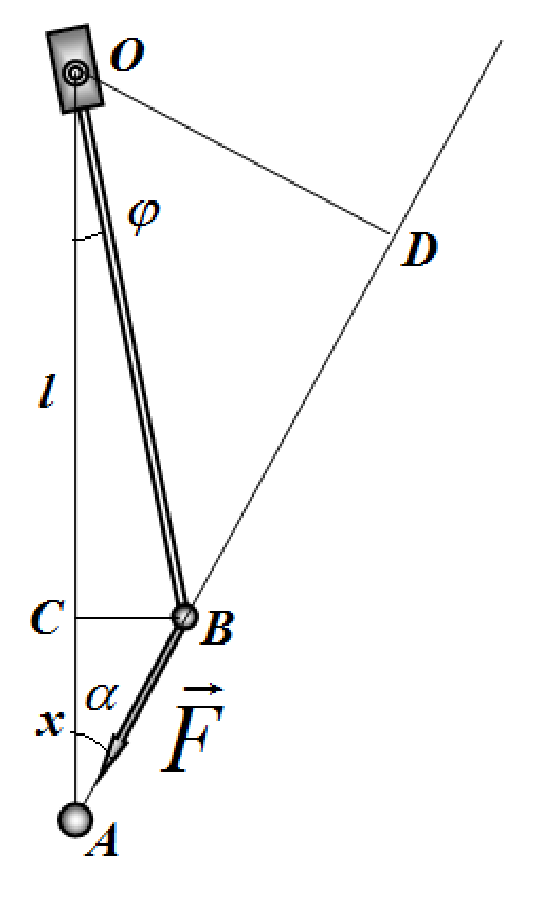
where is the distance from the rotation axis to the bead in the pendulum, stands for the distance between the beads in the equilibrium position. Hereinafter angles are assumed small. The angle should be expressed through the angle of the pendulum deflection. For this purpose the following ratio can be used
which gives rise to
Thus, the motion of the pendulum is described by the equation
This equation implies that the formula for the oscillation period is given by
2.2. Measurement results of the time of 10 oscillations at different distances between the centers of the beads are given in Table 2 and are drawn in the graph below.
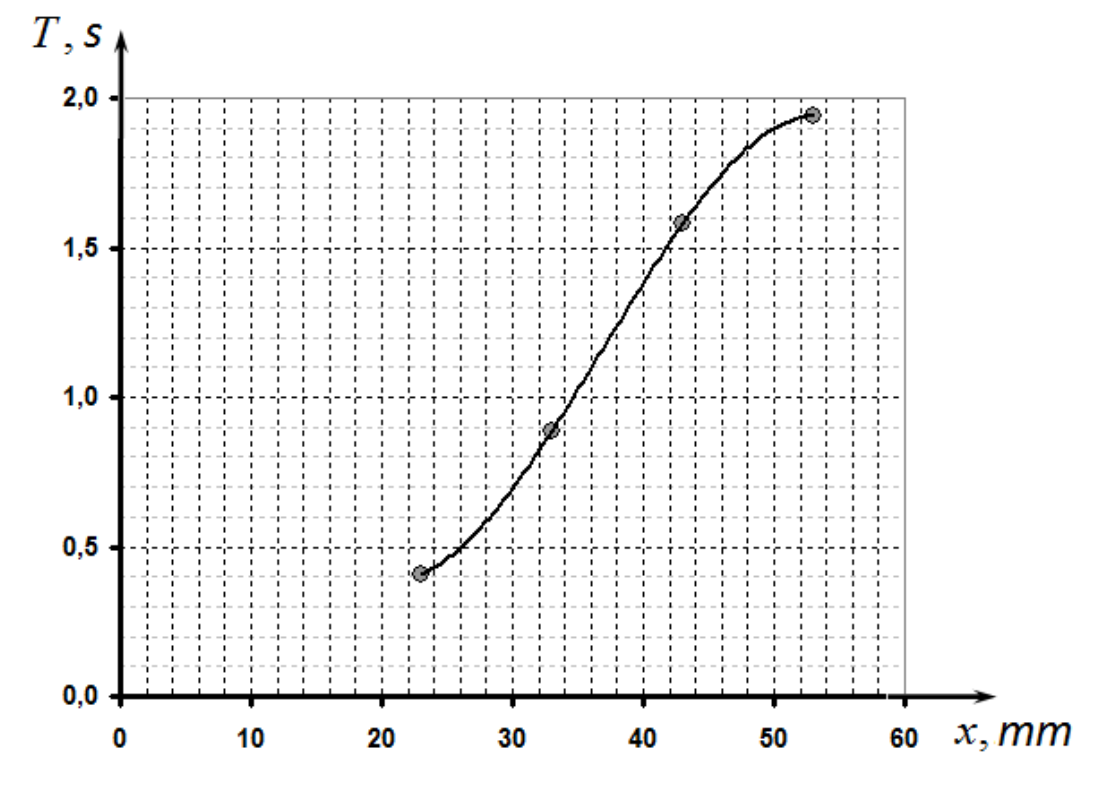
Table 2.
| , mm | ,s | ,s | ,s | , s |
|---|---|---|---|---|
| 23 | 4,27 | 4,09 | 3,90 | 0,409 |
| 33 | 8,72 | 9,03 | 8,83 | 0,886 |
| 43 | 15,96 | 15,73 | 15,68 | 1,579 |
| 53 | 19,20 | 19,64 | 19,36 | 1,940 |
2.3. To determine the exponent it is necessary to express the strength of interaction in terms of measurable characteristics. It follows from the formula for the oscillation period that the change of the squared frequency is found as
This means that the value
is proportional to the strength of the magnetic interaction . To determine the exponent it is necessary to plot the dependence of on the distance in a logarithmic scale. The slope coefficient in this graph provides the desired exponent.
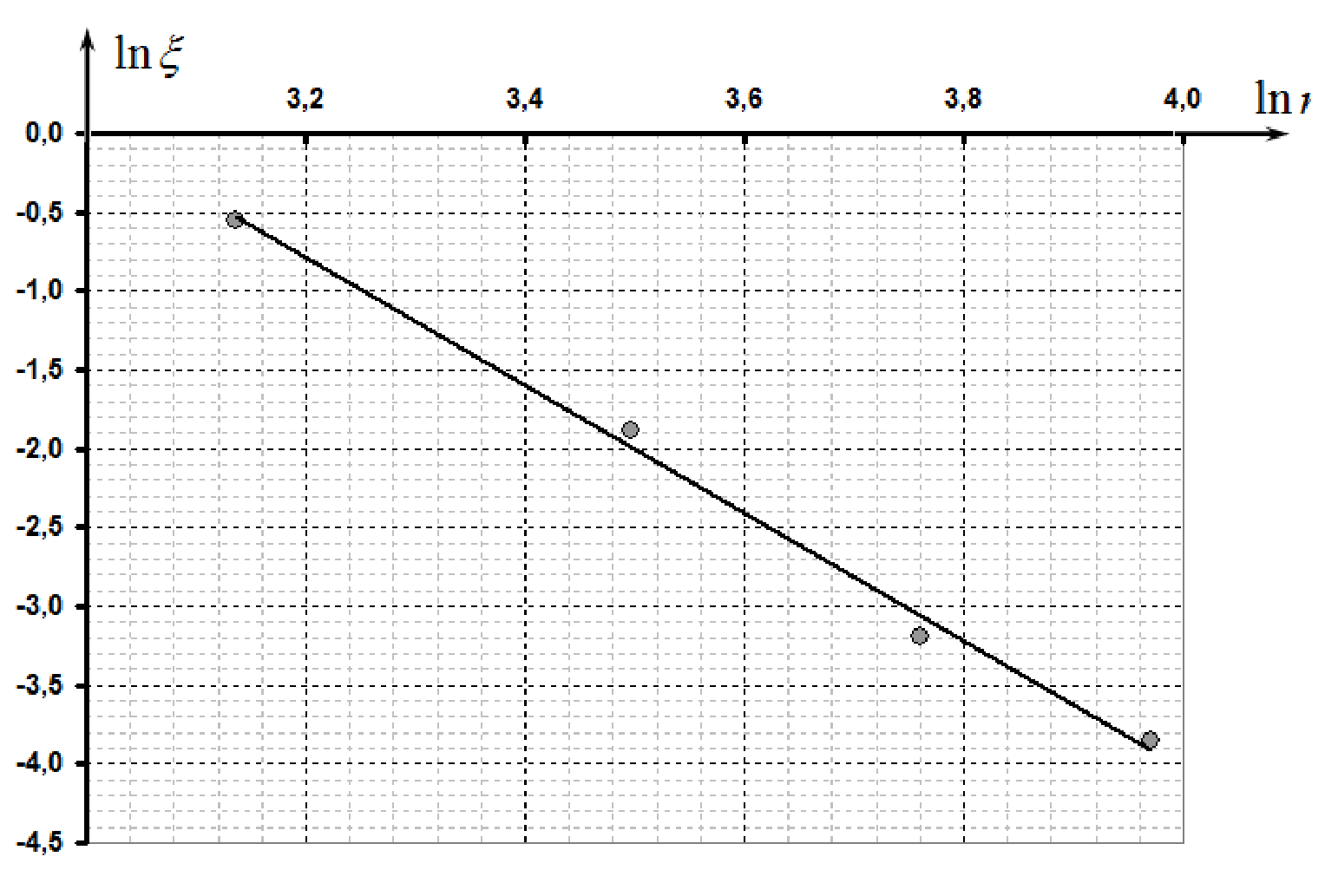
The figure shows the corresponding graph. It follows from this graph that the exponent is equal to .
Part 3 . Magnetic chocolate
3.1 Chocolate does not affect the period of oscillation, but significantly increases the damping of oscillations. This occurs due to the occurrence of eddy currents in the foil.
3.2 In order to prove this, one can measure the dependence of the oscillation amplitude on the time ( or, equivalently, on the number of oscillations in semi-logarithmic scale.
The graph below shows the corresponding data with (1) and without (2) chocolate. The graphs show an increase in the damping of oscillations in the presence of chocolate.
Grading scheme
| № | Part of the problem | Total for the part | Points |
|---|---|---|---|
| 1.1 | Measurement of the period: | 0,5 | |
| - Period is larger than 2 seconds; | 0,1 | ||
| - Not less than 3 measurements; | 0,1 | ||
| - Each measurement includes at least 10 periods; | 0,1 | ||
| - The average value is found; | 0,1 | ||
| - Random error is evaluated; | 0,1 | ||
| 1.2 | 0,5 | ||
| Circuit diagram (all elements connected in series): | |||
| - Source; | 0,1 | ||
| - Coil; | 0,1 | ||
| - Rheostat (two possible ways); | 0,1 | ||
| - Key; | 0,1 | ||
| - Ammeter; | 0,1 | ||
| 1.3 | 2,0 | ||
| Measurements (counted only if the period is measured in the range 1-5 s) | |||
| - Measured at 7 (5, 3, less) values of the current; | 1 (0,5; 0,3; 0) | ||
| - Current flows in two directions; | 0,4 | ||
| - Change in the period is not less than 50% (20% less); | 0,2 (0,1;0) | ||
| - Measured not less than 5 oscillations; | 0,1 | ||
| Plotting: | |||
| - Axis signed and digitized; | 0,1 | ||
| - All the points of the table are plotted; | 0,1 | ||
| - A smooth line is drawn; | 0,1 | ||
| 1.4 | 1,0 | ||
| Linearization: | |||
| - Dependence of the squared frequency on the current is linear; | 0,4 | ||
| - all the points are included in evaluation; | 0,2 | ||
| Plotting: | |||
| - Axis signed and digitized; | 0,1 | ||
| - All the points of the table are plotted; | 0,1 | ||
| - A smooth straight line is drawn; | 0,1 | ||
| Conclusions on the validity | 0,1 | ||
| 2.1 | 1,0 | ||
| The equation of motion: | |||
| - General view (the dynamics of rotational motion); | 0,3 | ||
| - Torque of the gravity force; | 0,2 | ||
| - Torque of the magnetic interaction force; | 0,3 | ||
| Formula for the period of oscillation | 0,2 | ||
| 2.2 | Measurements of the oscillation period (counted only if the period is the range of 0.3-5 s) | 4,0 | |
| - Measurements for 7 (5.3 less) distances; | 2,5 (1,5; 1,0; 0) | ||
| - Change in the period is not less than 4 times (2 times, or less); | 1,2 (0,5;0) | ||
| Plotting: | |||
| - Axis signed and digitized; | 0,1 | ||
| - All the points of the table are plotted; | 0,1 | ||
| - A smooth line is drawn; | 0,1 | ||
| 2.3 | Determination of the exponent | 4,0 | |
| The correct linearization is found; | 2,0 | ||
| The parameters of the linearized dependence are determined; | 0,5 | ||
| Plotting: | |||
| - Axis signed and digitized; | 0,1 | ||
| - All the points of the table are plotted; | 0,1 | ||
| - A smooth straight line is drawn; | 0,1 | ||
| The slope lies in the range from 2 to 6; | (0,6) | ||
| The exponent is found to be equal to 4; | 1,2 | ||
| 3.1 | 0,5 | ||
| Period is constant; | 0,2 | ||
| Damping is increased; | 0,2 | ||
| The reason is the eddy currents in the chocolate bar. | 0,1 | ||
| 3.2 | 1,5 | ||
| The dependence of the amplitude on the number of oscillations (it is equivalent to measure the number of oscillations for amplitude decrease in the specified limits) | 1,2 | ||
| Plotting: | |||
| - Axis signed and digitized; | 0,1 | ||
| - All the points of the table are plotted; | 0,1 | ||
| - A smooth line is drawn; | 0,1 | ||
| TOTAL | 15 |
Оригинал в Архива: IZhO-2014-Exp_eng.pdf · официални решения: IZhO-2014-Exp_eng_sol.pdf