IZhO 2014, Теория — Задача 1
X International Zhautykov Olympiad/Theoretical Competition — THEORETICAL COMPETITION, January 14, 2014 · 14 януари 2014 г. · 10 т.
Please read this first:
The time available for the theoretical competition is 4 hours. There are three questions.
Use only the pen provided.
You can use your own calculator for numerical calculations. If you don’t have one, please ask for it from Olympiad organizers.
You are provided with Writing sheet and additional paper. You can use the additional paper for drafts of your solutions but these papers will not be checked. Your final solutions which will be evaluated should be on the Writing sheets. Please use as little text as possible. You should mostly use equations, numbers, figures and plots.
Use only the front side of Writing sheets. Write only inside the boxed area.
Begin each question on a separate sheet of paper.
Fill the boxes at the top of each sheet of paper with your country (Country), your student code (Student Code), the question number (Question Number), the progressive number of each sheet (Page Number), and the total number of Writing sheets used (Total Number of Pages). If you use some blank Writing sheets for notes that you do not wish to be evaluated, put a large X across the entire sheet and do not include it in your numbering.
At the end of the exam, arrange all sheets for each problem in the following order:
- Used Writing sheets in order;
- The sheets you do not wish to be evaluated
- Unused sheets and the printed question.
Place the papers inside the envelope and leave everything on your desk. You are not allowed to take any paper out of the room.
Условие
This problem consists of three independent parts.
1A Steam engine consists of a vertical cylindrical vessel, in which a piston can move without friction. There is some water in the vessel with an electrical heater located inside. Steam engine cycle consists of four stages, as shown in the figure on the right:
- A load is placed on the piston, the heater is switched on making the water boiling and the vapor lifts up the piston with the load.
- Once the piston has risen to some height, the load is quickly removed and the heater is immediately switched off.
- The vapor under the piston cools down and condenses, the piston moves down slowly .
- Once the piston has come down to some other height, the load is again put on the piston.
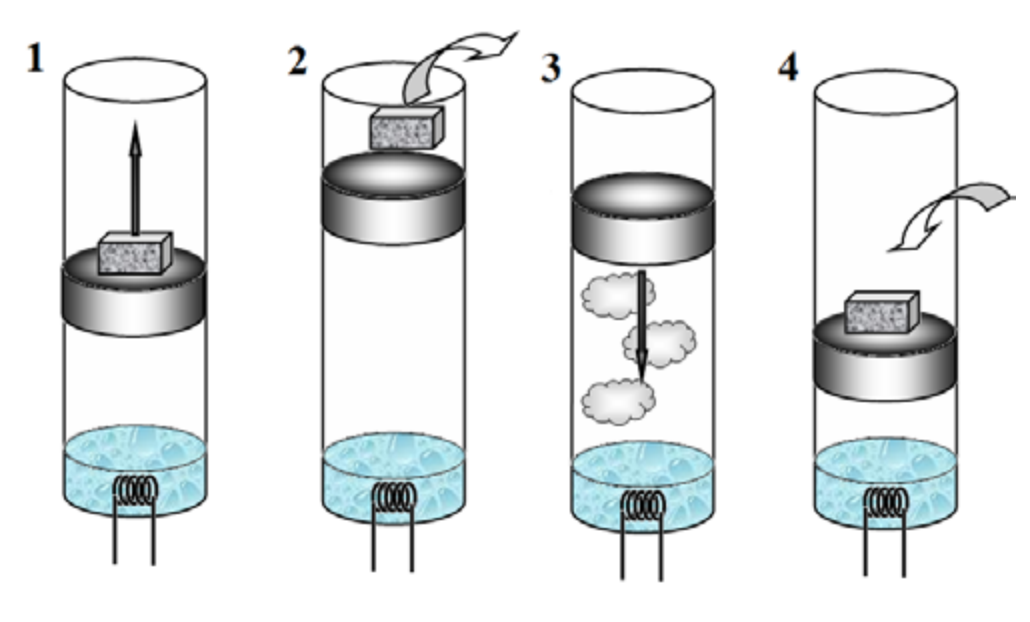
Draw a diagram schematically showing the cycle of the steam engine and find its efficiency.
The atmospheric pressure is , the piston mass is , the piston area is , the load mass is , and the free fall acceleration is . Assume that there is nothing under the piston except for the water vapor, and the dependence of the pressure of the saturated water vapor in the temperature range under consideration is approximated by the formula , where , , is the temperature in degrees Celsius. [3 т.]
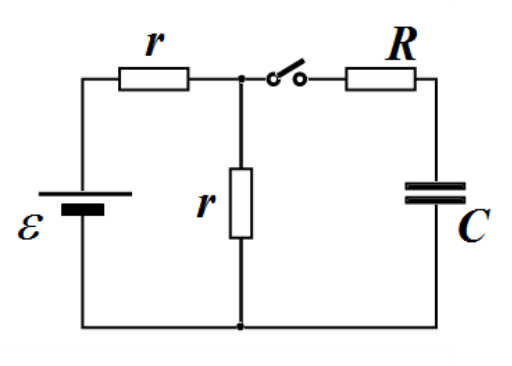
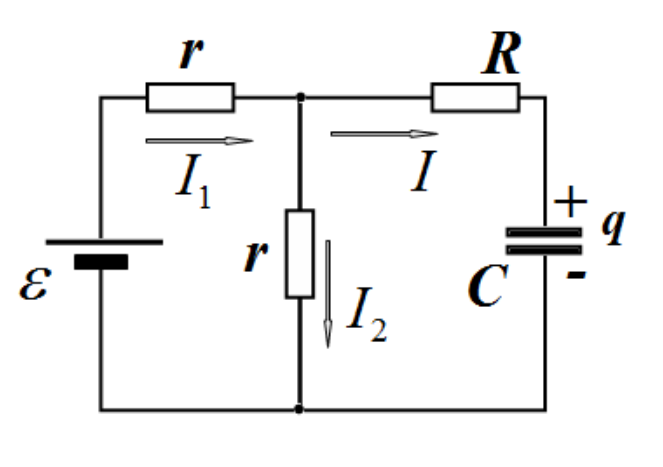
1B In the circuit shown in the figure on the right, all the electrical components are ideal and their parameters are assumed to be given. Before switching on the key, the capacitor has been discharged. Find an amount of heat releasing in the resistor after the key has been switched on. [5 т.]
1C Thin lens gives an image of the object, located perpendicular to its optical axis. The image size is 1 cm. If the distance from the object to the lens is increased by 5 cm, the image size remains 1 cm. Find the image size if the distance from the object to the lens is increased by another 5 cm. [2 т.]
Отговори
1A 1.1 %
Carnot cycle: η = (T1 − T2)/T1 = 4,2/379 = 1,1 %.
1B
The first official solution gives RCε²/(4(2R+r)); the end of the second solution prints RCε²/(4(R+2r)), which contradicts its own preceding line (R + r/2 in the denominator) — a misprint in the source.
1C
Решение
Problem 1A (3 points)
In the first stage boiling occurs at a constant pressure, hence at a constant temperature. Likewise, in the third stage condensation takes place at a constant pressure and temperature. The second and the fourth stages can be considered as adiabatic. Schematic (P,V) diagram of the steam engine cycle is shown in the figure on the right. Since this cycle is composed of two isotherms and two adiabats, it is, thus, simply the Carnot cycle. Therefore, its efficiency is found as
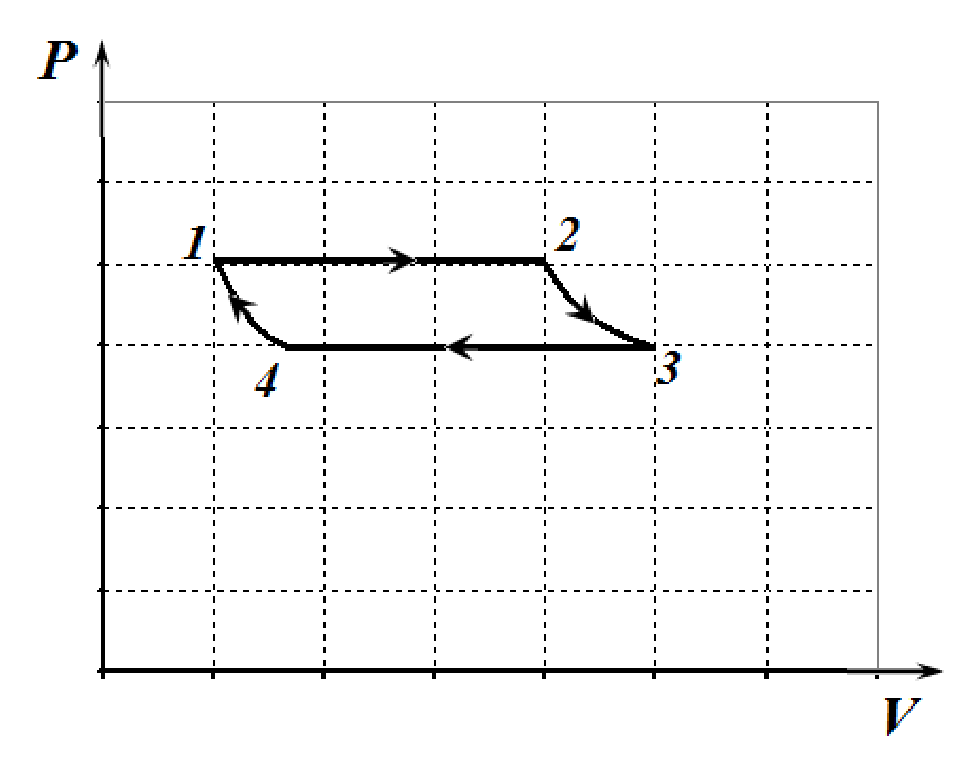
where is the boiling temperature in the first stage of the cycle, and is the condensation temperature in the third stage of the cycle.
The corresponding temperatures are found from the approximate formula for the saturated vapor pressure provided at the formulation of the problem.
The first stage of the cycle happens at constant pressure
The vapor temperature is the temperature of the water boiling point and is equal to
The temperature difference in formula (1) is conveniently evaluated as
Thus, the efficiency of the steam engine is .
Grading scheme
| № | Content | Points |
|---|---|---|
| 1. | 1 and 3 stages are isobars and isotherms | 0,25 |
| 2. | 2 and 4 stages are adiabats | 0,25 |
| 3. | The cycle is identified as a Carnot cycle | 1,0 |
| 4. | Correct cycle diagram | 0,75 |
| 5. | Formula (1) for the efficiency of the Carnot cycle | 0,25 |
| 6. | Formulas (2) and (4) | 0,25 |
| 7. | Correct numerical value for the efficiency | 0,25 |
| Total | 3.0 |
Problem 1B (5 points)
The first solution.
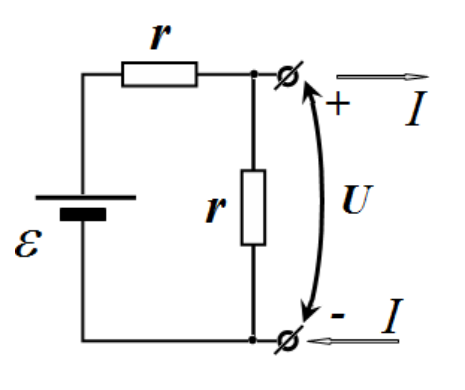
Consider the left part of the circuit. Its load characteristic (dependence of U against I)) is the straight line corresponding to an equivalent source with the parameters , .
For the equivalent circuit
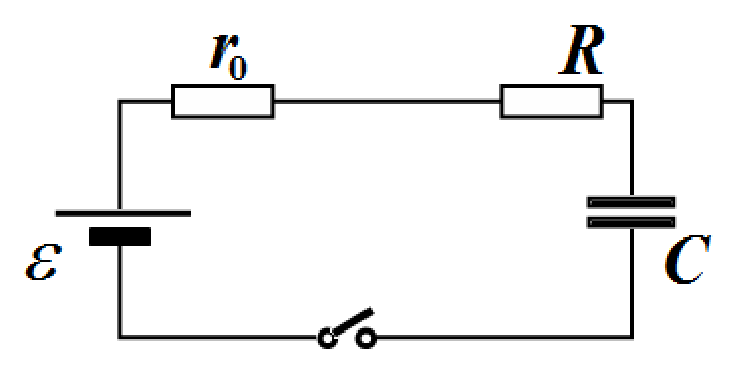
the total released heat is found as . In the resistor R the released heat is obtained from the simple proportion as
The second solution.
The Kirchhoff set of equations has the following form
Eliminating и , we obtain the relation
and multiplying it by I we get
Hence
and, thus,
On substituting and , we finally obtain
Grading scheme
I. Direct solution
| № | Content | Points |
|---|---|---|
| 1. | There is a correct set of equations allowing to obtain the answer – 1.0; if there is an error in the set or it is not complete – 0. | 1.0 |
| 2. | Correct expression for the current in the resistor R or/and for the charge of the capacitor | 1.0 |
| 3. | Correct expression for the derivative of the square of the current in R, or correct dependence I(t) For manipulating errors – 1.0 points of 2.0 Propagation error is not accepted | 3.0 |
| 4. | Correct formula for | 1.0 |
| Total | 5.0 |
II. Solution with the equivalent source
Propagation errors are not accepted
| № | Content | Points |
|---|---|---|
| 1. | Idea: to change the left part of the circuit by an equivalent source and to apply the energy conservation law | 1.0 |
| 2. | The parameters of the equivalent source | |
| 2.1 Two of the following statement are present: 1. No-load voltage 2. Short circuit current 3. Internal resistance is the parallel connection of two resistors r or the dependence U(I) is obtained | 1.0 | |
| 2.2 It is found that: , (по 0.5 for each) (Justification of the equivalent circuit is not required) | 1.0 | |
| 3. | Total released heat in the equivalent circuit | 1.0 |
| 4. | Correct answer | 1.0 |
| Total | 5.0 |
Problem 1C (2 points)
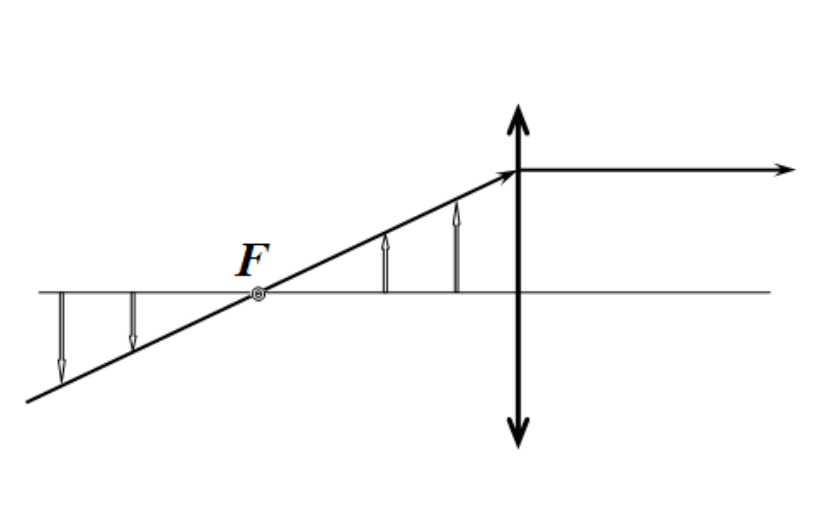
It is known that the beam, passing through the focal point of the lens, goes parallel to the optical axis of the lens after refraction. Therefore, all the objects, shown in the figure, give the images of the same size, i.e. the lens magnification is inversely proportional to the distance from the object to the focal point.
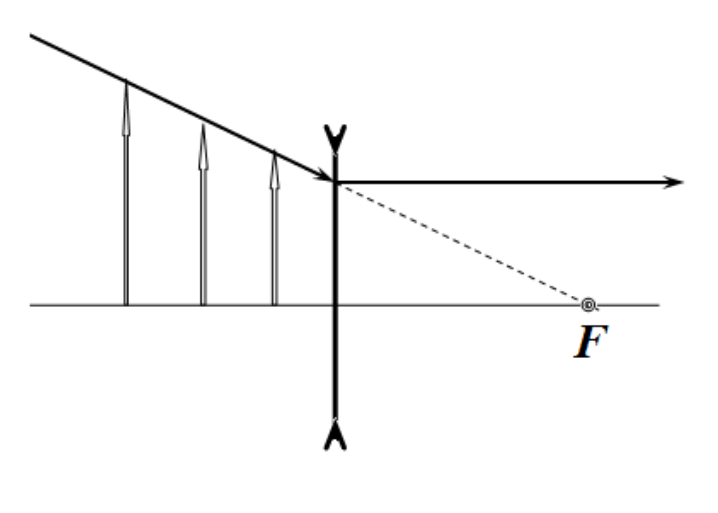
It is clearly seen from figure 2 that in the case of the diverging lens it is impossible to get the same image size at different positions of the object, so the lens is necessarily converging.
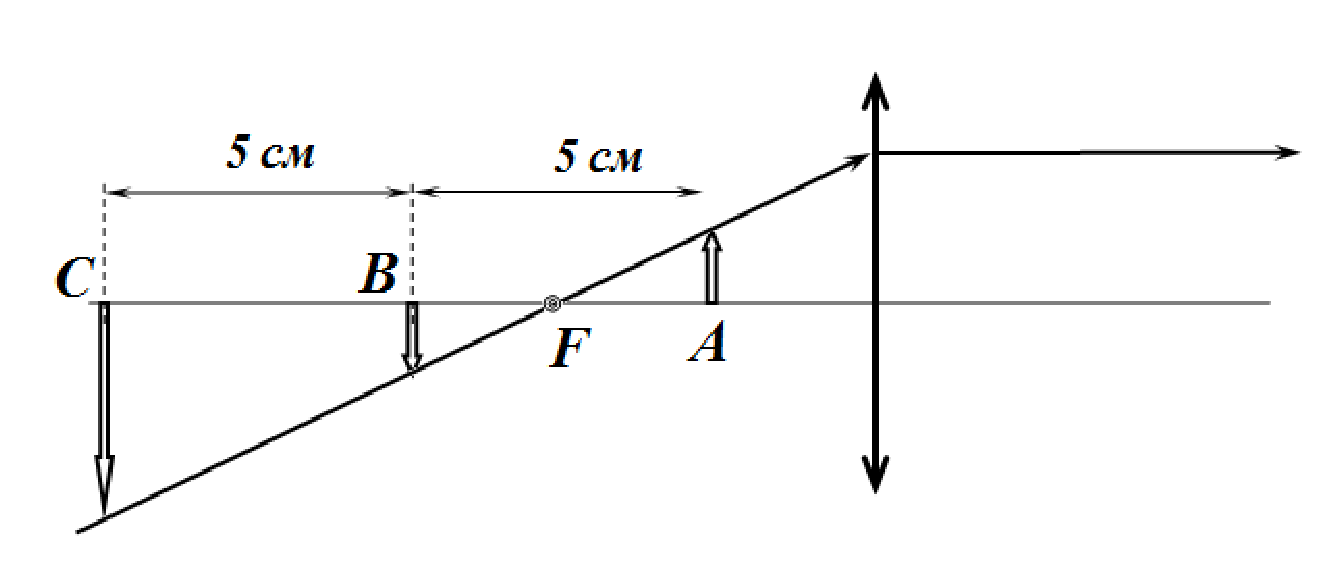
Positions A and B of the object, which are arranged symmetrically with respect to the focal point of the lens, result in the same image sizes (see figure 3). If the object is moved away by another 5 cm, then it will be located in the position C, in which the image of the same size would have been obtained by a three times larger object, so the image of the object is to be three times smaller. Answer: 1/3 cm.
Grading scheme
| № | Content | Points |
|---|---|---|
| 1. | Correct answer | 1.0 |
| 2. | Correct justification of the correct answer | 1.0 |
| 3. | There is an error in the application of the lens formulas | -0.5 |
| Total | 2.0 |
Оригинал в Архива: IZhO-2014-Theory_eng.pdf · официални решения: IZhO-2014-Theory_eng_sol.pdf