IZhO 2014, Теория — Задача 2. Jet propulsion
X International Zhautykov Olympiad/Theoretical Competition — THEORETICAL COMPETITION, January 14, 2014 · 14 януари 2014 г. · 10 т.
Please read this first:
The time available for the theoretical competition is 4 hours. There are three questions.
Use only the pen provided.
You can use your own calculator for numerical calculations. If you don’t have one, please ask for it from Olympiad organizers.
You are provided with Writing sheet and additional paper. You can use the additional paper for drafts of your solutions but these papers will not be checked. Your final solutions which will be evaluated should be on the Writing sheets. Please use as little text as possible. You should mostly use equations, numbers, figures and plots.
Use only the front side of Writing sheets. Write only inside the boxed area.
Begin each question on a separate sheet of paper.
Fill the boxes at the top of each sheet of paper with your country (Country), your student code (Student Code), the question number (Question Number), the progressive number of each sheet (Page Number), and the total number of Writing sheets used (Total Number of Pages). If you use some blank Writing sheets for notes that you do not wish to be evaluated, put a large X across the entire sheet and do not include it in your numbering.
At the end of the exam, arrange all sheets for each problem in the following order:
- Used Writing sheets in order;
- The sheets you do not wish to be evaluated
- Unused sheets and the printed question.
Place the papers inside the envelope and leave everything on your desk. You are not allowed to take any paper out of the room.
Условие
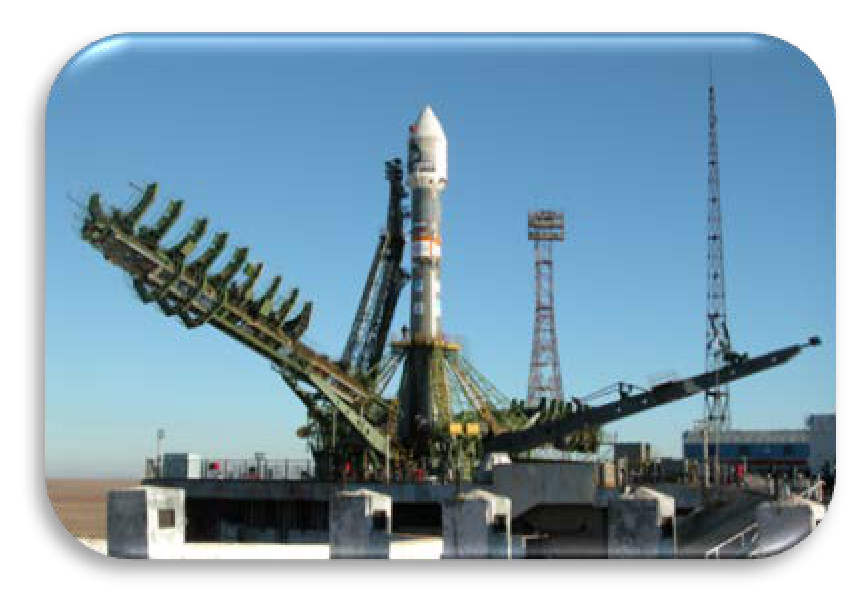
In a rocket engine thrust is created by the release of products of fuel combustion in the direction opposite to its motion. It is, of course, natural that the mass of the rocket decreases in the acceleration process. This idea was first proposed by the great Russian scientist K. Tsiolkovsky to implement the motion of objects in a vacuum, for example, in outer space. Nowadays space flights have become habitual. It is widely known that the space launching site, Baikonur, is situated on the territory of Kazakhstan. The first satellite and the first cosmonaut, Yu. Gagarin, were sent into space from Baikonur which is now a complex of high-tech facilities intended to launch manned spacecraft into space, in particular, to the International Space Station.
Classical rocket
Let a rocket have an initial mass and let a fuel velocity relative to the rocket be constant and equal . Assume that at the initial time moment the rocket is at rest in the laboratory frame of reference and no external force is present.
1. [0.5 points] Find the rocket velocity as a function of its mass . This formula is called after K. Tsiolkovsky. Express your answer in terms of .
2. [0.5 points] An object of mass is required to be accelerated to the orbital velocity. Evaluate the initial rocket mass , if the free fall acceleration is and the radius of the Earth is and .
Let a rocket move in the gravitational field of the Earth. The free fall acceleration is assumed to be constant, whereas the fuel consumption may depend on time.
3. [0.75 points] Write down the equation of motion of a rocket in Earth's gravitational field. This equation is called after I. Meshcherskij. Express your answer in terms of .
Assume in the following that the fuel exhaust velocity is directed parallel to the free fall acceleration , and the initial velocity of the rocket is zero.
4. [0.75 points] Find how the fuel consumption should depend on time in order for the rocket to hung motionless at some height. Express your answer in terms of .
Assume now that the fuel consumption is also constant over time such that .
5. [2.0 points] In this case the rocket velocity dependence on time can be represented as
where are some constants.
Find and express them in terms of .
6. [1.0 points] Suppose that the initial mass of the rocket is equal , and the final mass is to be . Find the maximum height that the rocket can reach and determine the corresponding optimum fuel consumption . Express your answer in terms of .
Relativistic rocket
In the previous part of the problem it has been assumed that the rocket moves with a nonrelativistic velocity. To implement interstellar travels it is necessary to accelerate the rocket to the speed close to that of light and, then, relativity effects cannot be ignored at the calculations.
To establish the characteristic features of the rocket motion in a relativistic case, we introduce the concept of the proper frame of reference. The proper frame of reference is an inertial frame of reference which moves with the speed of the rocket itself relative to the laboratory reference frame, i.e. it is the reference frame in which the rocket is at rest at any given time.
7. [2.5 points] Find the relation between the rocket acceleration in the proper reference frame and its acceleration in the laboratory frame of reference when the velocity of the rocket is , and stands for the speed of light. Express your answer in terms of .
8. [1.5 points] Let the rocket be at rest at the initial time moment. Then, using the results of the previous question it can be shown that at any time moment the rocket mass in the proper reference frame is related to its speed in the laboratory reference frame as
Find and express it in terms of .
9. [0.25 points] An object of mass is required to be accelerated to half the speed of light where the speed of light is . Evaluate the initial rocket mass together with the fuel and write it down as a power of 10, if the fuel exhaust velocity is .
10. [0.25 points] It can be shown that from the practical point of view the best rocket is the one that exploits photons rather than hot gases produced at the fuel combustion. An object of mass is required to be accelerated to half the speed of light . Evaluate the initial rocket mass together with the fuel .
Отговори
1.
2. 4870 kg
The statement prints the unit of g as „m/c²“ (m/s² meant).
3.
4.
5.
6.
7.
8.
9.
10. 1730 kg
Решение
- Consider the rocket motion in the proper reference frame, i.e. the inertial reference frame which moves with the speed of the rocket itself relative to the laboratory reference frame. In the proper reference frame the rocket is always at rest at any given time. Let a rocket have mass at the rime moment and throw away some fuel of mass with the velocity . As a result the rocket velocity changes by and the conservation of the momentum can be written as
In classical mechanics, the change in the rocket velocity in the laboratory reference frame must coincide with the change in rocket velocity in the proper reference frame by virtue of the Galilean transformations. Therefore, solving equation (1) with the initial condition at , we obtain the formula named after K. Tsiolkovsky
- It is known that the orbital velocity at the Earth's surface is
then from equation (2) the initial mass of the rocket is found as
- If an external force is exerted on the rocket, then, in the proper reference frame the total momentum of the system does change, and equation (1) can be rewritten as
or, using the notation , we obtain
By virtue of the relativity principle, this equation does not change its form in any inertial frame of reference and it is called after I. Meshcherskij.
On substituting , we finally obtain
- Since the rocket should hung motionlessly at some height, we assume that . Substituting in equation (7) and differentiating it over time, we get
Using the initial condition , we finally find
- Substituting and into equation (7), one gets
- The rockets achieves its maximum velocity if the fuel burns out almost instantaneously, and, at the same time, the work done by the gravity force, turns out minimal. Thus, the optimal fuel consumption is
Since the gravity force does not have time to affect the rocket velocity, it turns possible to use the Tsiolkovsky formula (2)
Hence, the maximum height of the rocket is
- Suppose that a particle moves with the velocity in the reference frame which, in turn, moves with the velocity in the laboratory reference frame. Then, the particle velocity in the laboratory reference frame is given by the relativistic formula
Hence, we find the relationship between the velocity changes in corresponding reference frames as
In accordance with the Lorentz transformations
the time differences in two frames are related as
Dividing equation (17) and (19 ) and assuming , we finally obtain
- In the proper reference frame the rocket motion is classical, and its acceleration is given by
Now we make use the transformation of acceleration (20) and time (19) for to obtain
Hence, we find that
- Evaluation gives rise
- Evaluation gives rise
Grading scheme
| № | Content | Points | |
|---|---|---|---|
| 1 | Formula (1) | 0.25 | 0.5 |
| Formula (2) | 0.25 | ||
| 2 | Formula (3) | 0.25 | 0.5 |
| Correct numerical value in (4) | 0.25 | ||
| 3 | Formula (5) | 0.25 | 0.75 |
| Formula (6) | 0.25 | ||
| Formula (7) | 0.25 | ||
| 4 | Formula (8) | 0.25 | 0.75 |
| Initial condition | 0.25 | ||
| Formula (9) | 0.25 | ||
| 5 | Equating the coefficients of the polynomial in time to zero | 0.5 | 2.0 |
| Formula (10) | 0.5 | ||
| Formula (11) | 0.5 | ||
| Formula (12) | 0.5 | ||
| 6 | Formula (13) | 0.5 | 1.0 |
| Formula (14) | 0.25 | ||
| Formula (15) | 0.25 | ||
| 7 | Formula (16) | 0.25 | 2.5 |
| Formula (17) | 0.5 | ||
| Formula (18) | 0.25 | ||
| Formula (19) | 0.5 | ||
| Formula (20) | 0.5 | ||
| 8 | Application of formula (19) to get equation (22) | 0.5 | 1.5 |
| Formula (21) | 0.25 | ||
| Formula (22) | 0.25 | ||
| Formula (23) | 0.5 | ||
| 9 | Correct numerical value in (25) | 0.25 | 0.25 |
| 10 | Correct numerical value in (26) | 0.25 | 0.25 |
| Total | 10,0 |
Оригинал в Архива: IZhO-2014-Theory_eng.pdf · официални решения: IZhO-2014-Theory_eng_sol.pdf